
TL;DR:
- Pre-qualification offers first-time buyers a quick, informal estimate of borrowing capacity based on self-reported financial information.
- It is distinct from pre-approval, which requires verified documents and provides a formal commitment, enhancing credibility in competitive markets.
Stepping into the property market for the first time can feel like you’ve been handed a map written in a foreign language. One of the most common sources of confusion is the difference between mortgage pre-qualification and pre-approval, and many first home buyers mix up these two entirely different processes, sometimes with costly consequences. Understanding pre-qualification, what it is, what it tells you, and where it fits in your journey, is the first smart move you can make before you even start browsing property listings. This article walks you through everything you need to know, from the basics right through to making a confident offer on your first home.
Table of Contents
- What is pre-qualification?
- How does pre-qualification compare to pre-approval?
- What information do you need to get pre-qualified?
- The benefits and limitations of pre-qualification
- How to move from pre-qualification to home ownership
- The truth about pre-qualification: what most Kiwis miss
- Start your home loan journey with expert support
- Frequently asked questions
Key Takeaways
| Point | Details |
|---|---|
| Early estimate only | Pre-qualification gives you a fast, informal idea of how much you could borrow. |
| Not a guarantee | Pre-qualification isn’t a loan approval—you need pre-approval to make serious offers. |
| Know your numbers | Accuracy with your income, debts, and savings is essential for a reliable estimate. |
| Next step matters | Moving from pre-qualification to pre-approval strengthens your position as a buyer. |
| Expert help available | Mortgage advisers can clarify your options and support you across the whole process. |
What is pre-qualification?
Pre-qualification is your financial starting point. Think of it as a compass that points you in the right direction before you commit to the full journey. It is a fast, informal estimate provided by a lender or mortgage adviser, based on general financial information you share with them. There is no credit check, no deep document scrutiny, and no obligation on either side.
As a first home buyer in New Zealand, pre-qualification gives you a realistic sense of your borrowing power before you start attending open homes or saving for a specific price range. It is not a binding commitment from a lender, but it is a genuinely useful tool for gauging your financial readiness. A borrowing power estimate like this is less detailed than a formal pre-approval, but it serves a distinct and valuable purpose at the very start of your property journey.
Here is what the pre-qualification process typically involves:
- Sharing your gross income, including salary, wages, or self-employment income
- Disclosing existing debts such as student loans, car loans, or credit card balances
- Providing an overview of your savings and KiwiSaver balance
- Outlining your regular living expenses and financial commitments
- Receiving an informal estimate of how much you may be able to borrow
Pre-qualification is not a promise. It is a personalised financial snapshot that helps you understand where you stand before you take the next step toward pre-approval in New Zealand.
The beauty of this step is its simplicity. You are not signing anything, and you are not locked in. You are simply having an honest conversation about your finances so you can move forward with clarity and confidence.
How does pre-qualification compare to pre-approval?
Now that you know what pre-qualification is, it is helpful to understand how it differs from pre-approval, a distinction that trips up many buyers. Both are important, but they serve completely different purposes and carry very different levels of weight with sellers and real estate agents.
Pre-qualification uses self-reported financial numbers to generate a quick estimate, whereas pre-approval requires verified documents and a formal assessment by the lender. If pre-qualification is the starting line, pre-approval is the green light that tells sellers you are a serious and credible buyer.
| Feature | Pre-qualification | Pre-approval |
|---|---|---|
| Speed | Usually same day | Several days to weeks |
| Documents required | Minimal, self-reported | Full financial verification |
| Credit check | Typically not required | Usually required |
| Strength with sellers | Informal estimate | Formal lender commitment |
| Cost | Usually free | May involve fees |
| Accuracy | Estimate only | Verified and reliable |
Here is how the two processes sit in your overall journey:
- Pre-qualification gives you an informal borrowing estimate based on your self-reported finances.
- Pre-approval involves a lender thoroughly checking your income, credit history, and financial commitments.
- Property search becomes focused and realistic once you hold pre-approval.
- Making an offer is far more confident and competitive when you have been pre-approved.
- Settlement is the final milestone where your home officially becomes yours.
Understanding the loan pre-approval advantages at each stage helps you avoid making offers you cannot back up or falling in love with homes that sit outside your true financial reach.
Pro Tip: Do not mistake a pre-qualification for a pre-approval when speaking to real estate agents. Agents take pre-approval far more seriously because it demonstrates a lender has genuinely assessed your ability to repay. If you want to know why get pre-approved, the short answer is that it dramatically improves your credibility in a competitive market.
What information do you need to get pre-qualified?
Armed with the difference between the two, you can now prepare to get pre-qualified by knowing what financial information lenders want to see. The good news is that the bar is relatively low at this stage. Pre-qualification relies on the numbers you provide, such as your income and existing debt, to estimate how much you could borrow. This means accuracy from your side is everything.

If you inflate your income or underestimate your debts, the estimate you receive will be misleading. This can set you up for disappointment later when the lender runs a formal assessment and the numbers do not match. Honest, accurate inputs are the foundation of a useful pre-qualification.
Here is the information you will typically need to provide:
- Employment income: Your annual salary or wages before tax, including bonuses or allowances if applicable
- Additional income sources: Rental income, freelance earnings, or government support payments
- Existing debts: Outstanding balances on student loans, hire purchase agreements, credit cards, or personal loans
- Monthly expenses: Regular commitments such as insurance, subscriptions, childcare costs, and living expenses
- Savings and KiwiSaver: Your current savings balance and how much is in your KiwiSaver account earmarked for a first home withdrawal
- Deposit estimate: How much you have available or expect to have available for a deposit
Some lenders or mortgage advisers may also ask about your employment type, whether you are salaried, a contractor, or self-employed, as this affects how your income is assessed. Understanding what is covered under mortgage documents explained can help you feel better prepared even at this early stage.
Pro Tip: Before your pre-qualification conversation, gather your last two payslips and three months of bank statements. This removes any guesswork from your numbers and ensures the estimate you receive is as close to reality as possible. Being well-prepared here also sets a great foundation for providing financial documents at the pre-approval stage. Reviewing whether your bank statements are ready for lender scrutiny is a smart move early in the process.
The benefits and limitations of pre-qualification
Now that you have collected the needed information, here is what you gain, and where you need to exercise caution, by getting pre-qualified. Pre-qualification is a no or low commitment analysis that helps buyers understand their likely borrowing capacity early and quickly. That is genuinely valuable for first home buyers who are still figuring out which suburbs or property types to focus on.
The real benefits include:
- Clarity on your price range: You stop wasting time viewing homes you cannot afford and start focusing on realistic targets.
- Reduced stress: Knowing your rough borrowing limit removes a significant layer of uncertainty from the property search process.
- Faster progression: You are better prepared to move toward pre-approval because you have already thought through your finances.
- Useful for early conversations: When talking to real estate agents or attending open homes, having even an informal estimate shows you are a serious buyer.
- No impact on your credit score: Because pre-qualification typically does not involve a credit check, you can explore your options without any negative effects on your credit profile.
| Benefit | What it means for you |
|---|---|
| Price range clarity | Focus your property search with confidence |
| No credit impact | Explore freely without affecting your credit score |
| Quick turnaround | Receive an estimate often within the same day |
| Low barrier to entry | No complex paperwork required at this stage |
| Foundation for pre-approval | Sets you up for the next, more formal step |
Where caution is needed:
Pre-qualification has real limitations that you should keep clearly in mind. The estimate is only as accurate as the information you provide. If your expenses are higher than you estimated, or your credit history has issues you were not aware of, the pre-qualification figure may be considerably higher than what a lender will actually offer you.
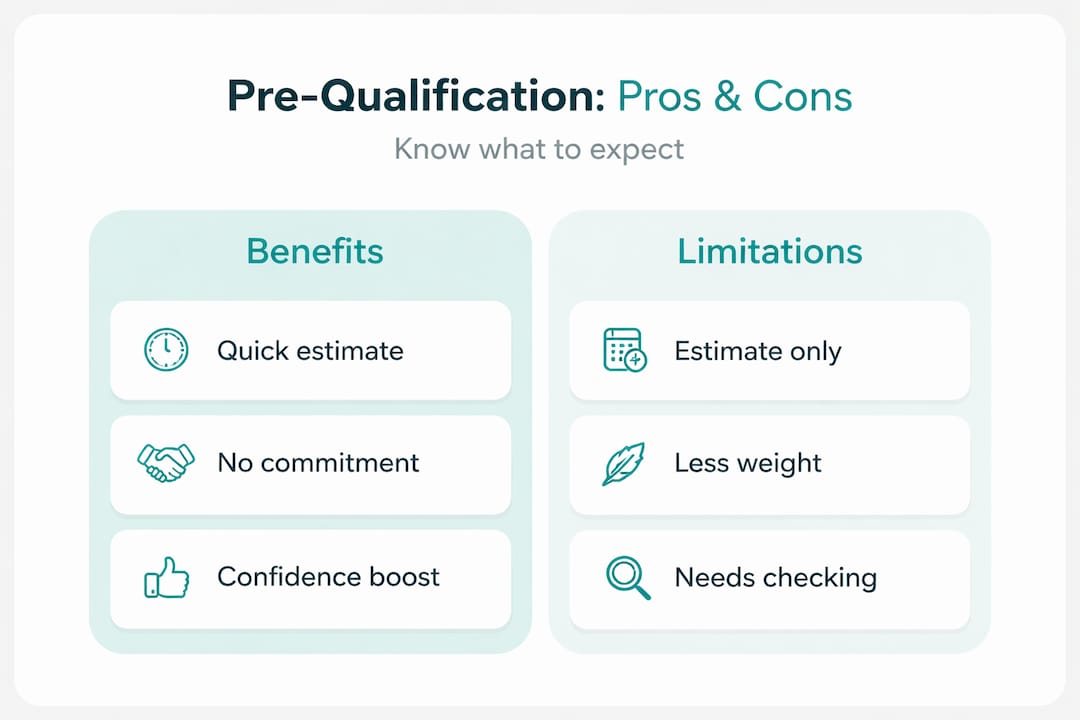
Sellers and real estate agents also know that pre-qualification carries less weight than pre-approval. In a competitive market, relying solely on pre-qualification can leave you underprepared. Discovering the full pre-approval benefits and making that progression is essential if you are serious about securing a property.
Pro Tip: Use pre-qualification as a foundation, not a finish line. Treat the estimate as a helpful guide that informs your next steps, not as a confirmed budget for bidding at auction.
How to move from pre-qualification to home ownership
Once you are pre-qualified, what comes next? Here are the sensible steps to maximise your chances of turning that initial estimate into the keys to your first home. Pre-qualification is a quick, early step before a formal mortgage application and approval process, so treating it as such is critical.
-
Review your pre-qualification estimate carefully. Look at the figures and assess whether there are any gaps in your finances, such as a deposit shortfall or high existing debts, that need to be addressed before progressing.
-
Address any financial weaknesses. If your debt-to-income ratio is too high, work on reducing credit card balances or paying down personal loans before applying for pre-approval. Small improvements here can make a meaningful difference to your final borrowing limit.
-
Gather full documentation for pre-approval. This includes payslips, bank statements, proof of KiwiSaver, identification, and a record of your regular expenses. The mortgage application process is far smoother when you arrive prepared.
-
Work with a mortgage adviser to explore your options. A qualified mortgage adviser can compare loan products from multiple lenders and identify the most suitable option for your specific situation. This step alone can save you thousands of dollars over the life of your loan.
-
Obtain formal pre-approval and begin your property search. With pre-approval in hand, you can make offers with genuine confidence. Sellers take you seriously, and your negotiating position is considerably stronger.
-
Make an offer and proceed to settlement. Once you find the right property and your offer is accepted, your mortgage adviser and solicitor will guide you through the final stages.
Pro Tip: Engaging a mortgage adviser at the pre-qualification stage, rather than waiting until pre-approval, means you receive expert guidance from the very beginning. This is especially valuable for first home buyers who may be unfamiliar with New Zealand lending criteria, KiwiSaver first home withdrawals, or the First Home Loan scheme.
The truth about pre-qualification: what most Kiwis miss
Here is something that does not get said often enough. Pre-qualification is one of the most misused tools in the home buying process. Many first home buyers treat it as a finish line when it is really just the starting gun. That misunderstanding creates a false sense of security that can genuinely derail your chances of buying a home.
We have seen buyers who felt confident because they were pre-qualified, only to discover at the formal pre-approval stage that their borrowing capacity was significantly lower than expected. This happens because pre-qualification does not account for credit history issues, lender-specific criteria, or the fine print of how your income is assessed. Over-reliance on an informal estimate can set you up for real disappointment.
What experienced buyers understand is that pre-qualification is a conversation starter, not a commitment. Its real value lies in helping you spot potential issues early, before they become deal-breakers during a formal application. If your pre-qualification reveals a tight borrowing range, that is not bad news. It is an early warning that gives you time to improve your financial position.
We also see too many buyers dismiss professional advice at this stage because they feel the numbers are “just an estimate anyway.” That reasoning misses the point entirely. Understanding why lenders reject applications before you reach that stage is exactly the kind of insight a mortgage adviser brings to the table. Getting that expert perspective early can help you avoid the most common and costly first home buyer mistakes.
The bottom line is this: use pre-qualification wisely. Treat it as diagnostic information, seek professional advice on what the numbers mean, and move with purpose toward pre-approval. That is how confident, successful first home buyers approach the process.
Start your home loan journey with expert support
Taking the first step toward your first home is exciting, but it can also feel overwhelming without the right support beside you. Understanding pre-qualification is a great start, but the real momentum builds when you have a knowledgeable mortgage adviser guiding you from estimate through to settlement.

At Mortgage Managers, we act as personal shoppers for your home loan, searching across multiple lenders to find the right fit for your financial situation. Based in Hobsonville and servicing buyers across Auckland, the North Shore, West Auckland, and remotely throughout New Zealand, we specialise in helping first home buyers move confidently from their very first question to the day they get the keys. Whether you are just beginning to explore your options or you are ready to take the formal steps, we are here to help. Apply for a mortgage today and let us help you make your first home a reality.
Frequently asked questions
Does pre-qualification guarantee a home loan in New Zealand?
No, pre-qualification provides an estimate, not a guarantee. You will still need to complete a full pre-approval process with verified documents before a lender formally commits to lending you money.
Is pre-qualification mandatory to buy a house?
Pre-qualification is not a mandatory requirement, but it helps you understand your borrowing power before you begin searching. Getting a borrowing estimate early means you can focus your property search on realistic price ranges from the start.
How long does pre-qualification usually take?
Pre-qualification is a fast, information-based process that can often be completed within a day when you have your basic financial details ready to share.
What are the risks of relying only on pre-qualification?
You may overestimate your true borrowing ability because pre-qualification is less detailed than a formal assessment. Always progress to pre-approval before making offers on properties to avoid financial surprises.
Can you get pre-qualified with more than one lender?
Yes, you can seek estimates from multiple lenders because pre-qualification is a low-commitment analysis that typically does not involve a credit check and therefore does not negatively affect your credit score.