
TL;DR:
- Easy mortgage approval depends on meeting lender criteria such as credit score, debt-to-income ratio, and documentation. Preparing thoroughly and obtaining pre-approval significantly improves your chances of securing a home loan quickly, especially with flexible or specialist products for lower credit scores. Working with an adviser streamlines the process, helping you find the right lender and avoid delays or rejections.
Easy mortgage approval is defined as meeting a lender’s core criteria — credit score, debt-to-income ratio, and documentation — well enough to receive a formal home loan offer without significant delays or rejections. For New Zealand first home buyers and those with lower credit scores, this is entirely achievable with the right preparation. Mortgage pre-approval, the industry’s standard first step, gives you a verified borrowing limit before you start house hunting. This guide walks you through every factor that matters, from credit thresholds to the documents lenders scrutinise most closely, so you can approach your mortgage pre-approval application with genuine confidence.
What credit scores qualify for easy mortgage approval?
Your credit score is the single number lenders use first to assess risk. Most mortgage types require a minimum score of 620, though some specialist lenders accept scores as low as 550. That lower threshold matters for New Zealand buyers who have had financial setbacks, because it means a rejection from one lender does not close every door.
Your debt-to-income (DTI) ratio is the second critical metric. Lenders require a DTI below 50%, with 36% or less recommended for the best interest rates and loan conditions. A lower DTI signals to lenders that you have room in your budget to service a mortgage comfortably, which directly reduces their perceived risk.
Government-backed loans consistently offer the most flexible criteria. In the New Zealand context, Kāinga Ora’s First Home Loan scheme operates similarly to government-backed products overseas, accepting lower deposits and working with buyers who have modest credit histories. First home buyer credit score guidance from Australian advisers mirrors this approach, confirming that preparation and product selection matter as much as the raw score.
Before you apply, verify your credit report through Centrix, Equifax New Zealand, or Illion. Errors on credit files are more common than most people expect, and a single incorrect default can drop your score enough to shift you into a higher-risk category.
- Credit score of 620 or above: qualifies for most standard lender products
- Credit score of 550–619: eligible with specialist lenders and some non-bank options
- DTI of 36% or below: positions you for the most competitive rates
- DTI of 37–50%: still approvable but expect tighter conditions
- Government-backed schemes: Kāinga Ora First Home Loan accepts lower deposits and more flexible credit profiles
Pro Tip: Check your credit report at least three months before applying. That window gives you time to dispute errors and see corrections reflected before a lender pulls your file.
Which documents make mortgage approval simpler and faster?
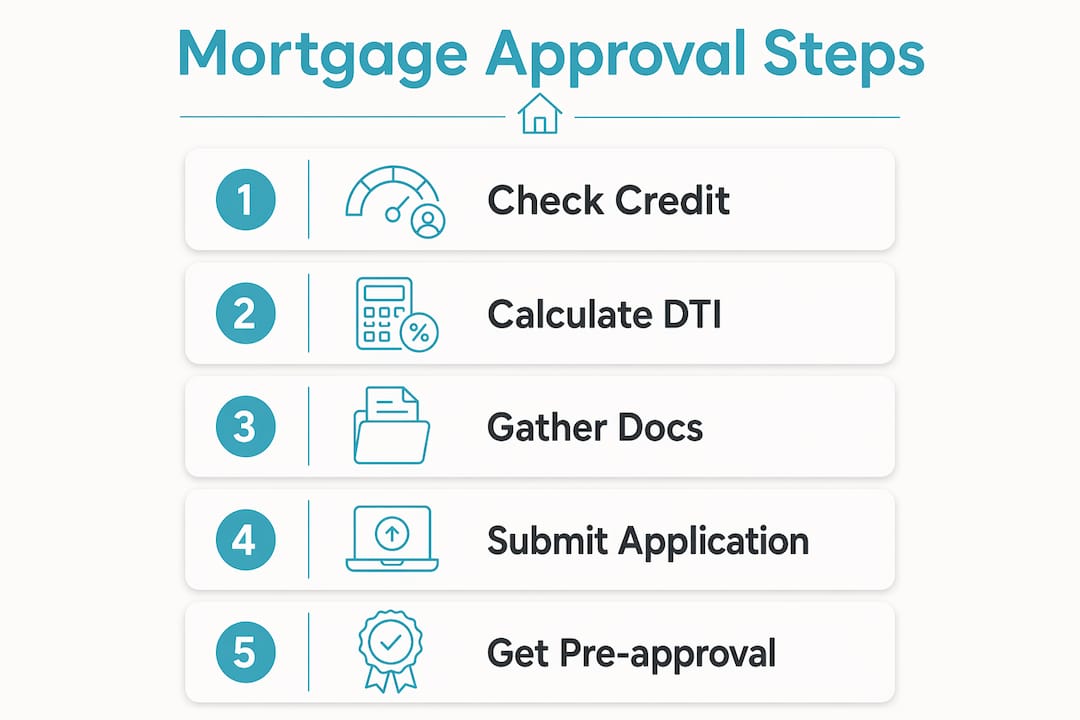
Thorough documentation is the single most controllable factor in your approval timeline. Missing information and documentation are the main causes of delays in the mortgage process. Lenders cannot assess what they cannot verify, so gaps in your paperwork translate directly into waiting time.
Here is the order in which to gather and organise your documents:
- Payslips and proof of income. Collect your two most recent payslips. If you are self-employed, prepare two years of financial statements and tax returns. Pay stubs and bank statements are only valid for 30–60 days, so time your application to avoid needing to refresh them mid-process.
- Bank statements. Provide the last three months of statements for every account you hold. Every page of bank statements must be included, even blank backs. A missing page can stall your application just as effectively as a missing document entirely.
- Tax returns. Supply the last two years of tax returns. These remain valid for 12 months, so they are the most stable document in your file.
- Identification. A current New Zealand passport or driver’s licence satisfies most lenders. Some require two forms of photo ID.
- Evidence of deposit. Show where your deposit funds originate. If any portion is a gift from family, a signed gift letter is required. Large non-payroll deposits without a clear source raise compliance flags and can delay settlement.
- Existing liability statements. Include statements for any personal loans, car finance, student loans, or credit cards. Lenders calculate your DTI from these figures, so accuracy here protects you from surprises.
Resolving credit report errors before you apply is equally important. Preparing finances thoroughly before application dramatically reduces delays and increases the chance of approval. Dispute any incorrect defaults or outdated listings with Centrix or Equifax New Zealand directly, and allow four to six weeks for corrections to process.
Pro Tip: Create a single digital folder labelled with the application date and store every document there. When a lender requests a specific page, you can respond within minutes rather than days.

How to get mortgage pre-approval easily and why it matters
Mortgage pre-approval is a formal underwriting review where a lender verifies your income, assets, and credit before you make an offer on a property. Pre-qualification, by contrast, is an informal self-reported estimate with no verification. Pre-approval carries significantly more weight with sellers and lenders, particularly in competitive New Zealand markets where multiple offers on a single property are common.
Pre-approval typically takes 1–3 business days, though some online lenders and automated underwriting platforms can return a conditional decision within hours. Pre-approval letters remain valid for 60–90 days. If your property search runs longer than that, you will need to refresh your documents and reapply.
Think of pre-approval as your financial snapshot. It sets your home-buying budget and signals seriousness to vendors, but it is not a guarantee of final approval. Changes to your income, new debts, or a property that does not meet the lender’s valuation criteria can all affect the final outcome.
| Feature | Pre-qualification | Pre-approval |
|---|---|---|
| Verification required | No | Yes (income, assets, credit) |
| Credit check | Soft or none | Hard check |
| Weight with sellers | Low | High |
| Typical turnaround | Minutes | 1–3 business days |
| Validity period | Not applicable | 60–90 days |
Working with a mortgage broker pre-approval process adds another layer of advantage. A broker submits your application to multiple lenders simultaneously, and multiple credit inquiries within a 45-day window count as a single inquiry for mortgage scoring purposes. The score impact is minor and temporary, typically 2–5 points, recovering within 12 months. That means you can shop lenders without compounding damage to your credit file.
Which mortgage types help buyers with low credit or small deposits?
Specialist mortgage products exist specifically for buyers who do not fit the standard bank profile. Knowing which products to target is the fastest path to easy mortgage loan approval when your credit score or deposit is below the conventional threshold.
- Kāinga Ora First Home Loan: Backed by the New Zealand government, this product allows eligible buyers to purchase with a deposit as low as 5%. Income and house price caps apply, but the credit criteria are more flexible than most bank products.
- Kāinga Ora First Home Grant: A cash contribution toward your deposit, available to KiwiSaver members who have contributed for at least three years. This does not require a separate application in most cases and can be combined with the First Home Loan.
- Non-bank lenders: Institutions such as Resimac, Pepper Money, and Liberty Financial operate in New Zealand and accept credit scores that major trading banks decline. Their rates are typically higher, but they provide a pathway to ownership that can be refinanced once your credit profile improves.
- Low-deposit loans with lender’s mortgage insurance (LMI): Some lenders accept deposits of 10% with LMI added to the loan. This increases your total borrowing cost but removes the barrier of saving a full 20% deposit.
- Specialist mortgage brokers: A mortgage adviser who knows lender criteria can match your profile to the right product from the outset, avoiding declined applications that further damage your credit score.
The best approach for buyers with low credit is to avoid applying broadly and hoping for approval. Each declined application leaves a mark on your credit file. A mortgage adviser reviews your profile first, identifies the most suitable lenders, and submits a single well-prepared application. That targeted approach is the most reliable path to quick mortgage approval for buyers outside the standard profile.
For first home buyers wanting a broader view of preparation strategies, boosting home loan approval is covered in detail with seven specific steps that apply directly to the New Zealand market.
Key takeaways
Easy mortgage approval in New Zealand requires a credit score of at least 550, a DTI below 50%, complete and current documentation, and the right loan product matched to your financial profile.
| Point | Details |
|---|---|
| Credit score threshold | Most lenders require 620 minimum; specialist lenders accept from 550. |
| DTI ratio target | Keep your debt-to-income ratio at 36% or below for the best loan conditions. |
| Document currency | Pay stubs and bank statements expire after 30–60 days; refresh them if your search runs long. |
| Pre-approval advantage | Formal pre-approval carries far more weight with sellers than informal pre-qualification. |
| Specialist products | Kāinga Ora First Home Loan and non-bank lenders offer pathways for low-deposit and low-credit buyers. |
What I have learned from helping New Zealand buyers through this process
Working with first home buyers across Auckland and beyond, I see the same pattern repeatedly. Buyers spend months saving their deposit and then underestimate how much the documentation stage matters. A missing bank statement page or an unexplained cash deposit can add weeks to an approval timeline, and in a competitive market, weeks cost you properties.
The other thing I have noticed is that buyers with lower credit scores often assume they have no options. That is rarely true. The New Zealand lending market has expanded significantly, and non-bank lenders now offer genuine pathways that did not exist five years ago. The key is knowing which lender suits your profile before you apply, not after a rejection.
My honest advice: treat your mortgage application like a job interview. You prepare, you present your best case, and you go to the right employer for the role you are applying for. A mortgage adviser acts as your financial GPS through that process, reading the lender landscape so you do not have to. The buyers who work with an adviser from the start consistently reach approval faster and with less stress than those who go it alone.
— Stuart
How Mortgagemanagers can help you get approved
Mortgagemanagers is a locally owned Auckland advisory firm that works with first home buyers and applicants across all credit profiles throughout New Zealand. Whether you are preparing your first mortgage pre-approval application or working through a more complex financial situation, the team brings direct access to a wide lender panel, including specialist and non-bank options that most buyers never find on their own.

As your personal shoppers for a home loan, Mortgagemanagers reviews your full financial picture, matches you to the right product, and manages the application from pre-approval through to settlement. There are no guessing games about which lender will accept your profile. If you are ready to take the next step, the Mortgagemanagers team is ready to guide you through it.
FAQ
What is mortgage pre-approval in New Zealand?
Mortgage pre-approval is a formal lender assessment of your income, credit, and assets that produces a verified borrowing limit. It differs from pre-qualification because it involves actual document checks and a credit inquiry, giving it real weight with vendors.
How long does mortgage pre-approval take?
Pre-approval typically takes 1–3 business days, though some online lenders return conditional decisions within hours. Pre-approval letters are valid for 60–90 days before documents need refreshing.
Can I get mortgage approval with a low credit score in New Zealand?
Yes. Specialist lenders accept scores as low as 550, and government-backed products like the Kāinga Ora First Home Loan offer flexible criteria for buyers with modest credit histories.
Does applying with multiple lenders hurt my credit score?
Multiple mortgage inquiries within 45 days count as a single inquiry for scoring purposes. The impact is minor, typically 2–5 points, and recovers within 12 months.
What is the best way to get mortgage pre-approval quickly?
Prepare all documents before you apply, including complete bank statements, payslips, tax returns, and deposit evidence. Thorough financial preparation is the single most reliable way to reduce delays and reach approval faster. Working with a pre-approval explained adviser can also clarify exactly what each lender needs before you submit.