
A down payment home calculator gives you an instant estimate of the deposit and upfront costs you need to buy a home in New Zealand. Plug in your target property price and your preferred deposit percentage, and the tool does the maths for you. No guesswork, no spreadsheet headaches.
Here is what a good mortgage down payment tool typically asks for and returns:
- Property purchase price — the starting point for every calculation
- Deposit percentage — usually 5% or 20% depending on your loan type; some banks may accept 10% deposits but only for a limited share of lending under Reserve Bank LVR policy
- Loan-to-Value Ratio (LVR) — the portion of the property value you are borrowing
- Estimated deposit amount — the actual dollar figure you need to save
- Upfront cost estimates — legal fees, valuation costs, and Lender’s Mortgage Insurance (LMI) where applicable
Use the mortgage calculator on the Mortgagemanagers website to run your own numbers and see a clear picture of what you need before you start house hunting.
How to calculate your down payment and upfront costs for a New Zealand home
The core formula is simple: multiply the property price by your deposit percentage. A $700,000 home at 20% requires a $140,000 deposit. At 5%, that same home needs $35,000. Most buyers need 20% to access standard lending, while those eligible for a Kāinga Ora First Home Loan can buy with a 5% deposit.
Beyond the deposit itself, your upfront budget needs to cover several additional costs:
- Legal fees — a conveyancing solicitor typically charges for title searches, contract review, and settlement
- Property valuation — most lenders require an independent valuation before approving your loan
- LMI premium — if your deposit is below 20%, you may pay a Lender’s Mortgage Insurance premium (the Kāinga Ora First Home Loan charges 1.2% of the loan amount)
- Building inspection — strongly recommended before signing any sale and purchase agreement
Property price movements directly affect how much you need to save. When prices rise, a fixed percentage deposit grows in dollar terms, which is why tracking the market while you save genuinely matters. Lenders also look beyond your savings balance. They assess your income stability, existing debts, and spending patterns to confirm your deposit is genuinely serviceable alongside your repayments.
LVR restrictions set by the Reserve Bank shape what deposit percentage is realistic for you. Under current policy, owner-occupier high-LVR lending is capped at 25% of a bank’s total new lending, meaning most buyers still need 20% to access standard lending without restrictions.

What loan options are available and how do deposit requirements differ?
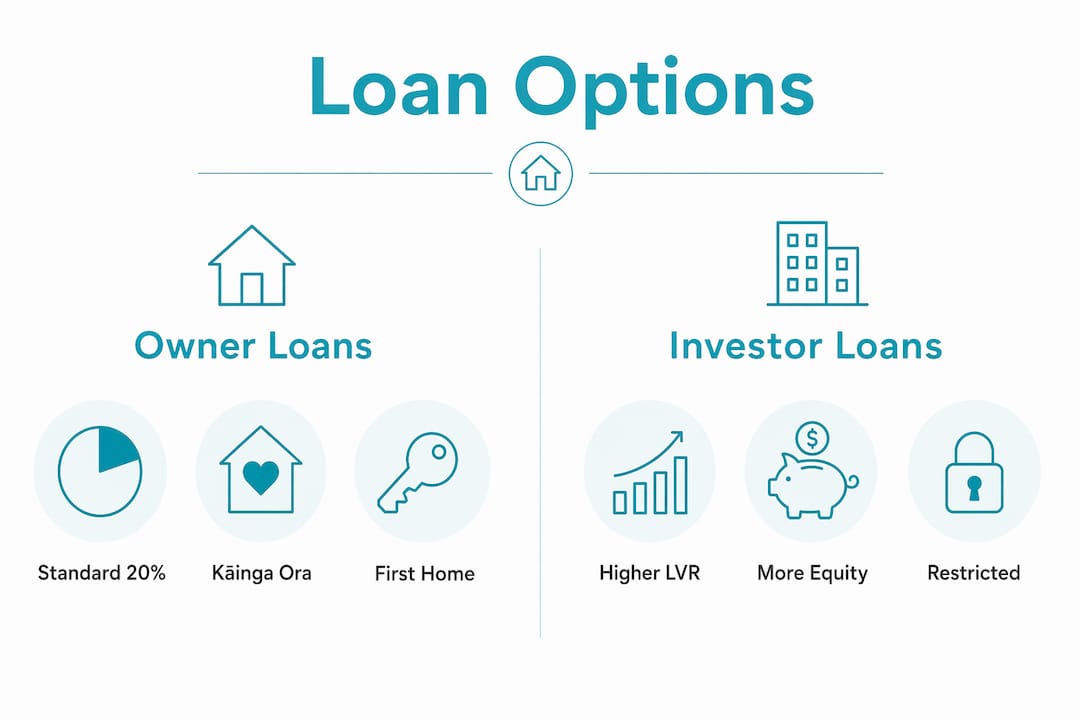
New Zealand offers several home loan pathways, each with its own deposit threshold. Understanding which one fits your situation is the first real step in your home purchase planning.

| Loan type | Minimum deposit | LVR cap | Notes |
|---|---|---|---|
| Standard owner-occupier | 20% | — | Mainstream bank lending; no LMI required |
| Kāinga Ora First Home Loan | 5% | 95% LVR | Government-underwritten; 1.2% LMI premium applies |
| Investor loan | 30% | — | Stricter RBNZ rules cap high-LVR investor lending at 10% of new lending |
| Low-deposit owner-occupier | 10–20% | — | Possible but limited; higher interest margins apply |
The Kāinga Ora First Home Loan is the standout option for buyers who cannot yet reach 20%. It is government-underwritten, which means participating banks can accept a 5% deposit they would otherwise decline. Income eligibility caps sit at $95,000 for an individual buyer and $150,000 combined for multiple buyers. The home must be your primary residence.
Investor loans sit at the other end of the spectrum. The Reserve Bank requires investors to hold a higher equity share, and banks limit the proportion of new lending toward high-LVR investor loans. If you are buying an investment property as your first purchase, that 30% threshold applies to you from day one.
Pro Tip: Most mortgage advisers in New Zealand are paid by lender commission and must disclose how they are paid upfront, including any clawback fees. Ask your adviser directly before you engage them, so there are no surprises if you switch lenders within the clawback period.
How to gather your deposit and manage upfront costs as a New Zealand buyer
Saving a deposit while covering rent and living costs is genuinely hard. The good news is that New Zealand buyers have access to several funding sources beyond a standard savings account.
KiwiSaver first-home withdrawal is the most widely used. If you have been contributing to KiwiSaver for at least three years, you can withdraw all your savings except $1,000 toward your first home deposit. That includes employer contributions and tax credits. For many buyers, this forms the bulk of their 5% deposit. See the full process outlined in the KiwiSaver withdrawal steps guide from Mortgagemanagers.
Other funding sources worth considering:
- Family gifts — lenders accept gifted funds, though they may require a statutory declaration confirming it is not a loan
- Personal savings — a consistent savings history over three to six months strengthens your application considerably
- KiwiSaver employer contributions — these count toward your withdrawal total and are often underestimated
One thing to understand clearly: zero-deposit loans are not realistically available in New Zealand. Under the Credit Contracts and Consumer Finance Act (CCCFA), banks scrutinise your living expenses and financial behaviour closely, not just your savings balance. A pattern of consistent saving and controlled spending carries real weight in a lender’s assessment.
Pro Tip: Speak with a mortgage adviser before you start saving, not after. An adviser can tell you exactly which loan type you qualify for, which deposit target to aim at, and whether your KiwiSaver balance is sufficient. Getting this clarity early means you save toward the right number from the start.
Government grants and subsidies for down payments in New Zealand
The government support landscape for first-home buyers has changed. The First Home Grant, which previously offered eligible buyers up to $5,000 for an existing home or up to $10,000 for a new build, closed to new applications in 2024. If you were counting on it, you will need to adjust your deposit plan accordingly.
What remains available is meaningful. The Kāinga Ora First Home Loan continues to operate and is the primary government-backed tool for low-deposit buyers. Kāinga Ora underwrites the loan, allowing participating banks to lend at 95% LVR to eligible first-home buyers. You can explore eligibility and the application process through the Kāinga Ora First Home Loan page on the Mortgagemanagers website.
KiwiSaver first-home withdrawals also remain fully available. Previous homeowners who are in a similar financial position to a first-home buyer may still qualify for a withdrawal, subject to a financial assessment by Kāinga Ora. This is a lesser-known pathway that catches many people off guard. If you previously owned a home but no longer do, it is worth checking your eligibility before assuming you are excluded.
How interest rates shape your upfront and ongoing costs
Interest rates do not change your deposit percentage, but they affect how much house you can afford at a given deposit level, which indirectly shapes how much you need to save. When rates are higher, your borrowing capacity falls. A buyer who qualifies for a $600,000 loan at a lower rate might only qualify for $520,000 at a higher one, meaning the same deposit percentage buys a less expensive property.
Rates also influence the total cost of your loan from settlement day. A higher interest rate means more of each repayment goes toward interest in the early years, which slows equity building. For buyers using a low-deposit loan, this matters because you start with less equity and pay LMI on top. The combination of a higher rate and an LMI premium can add meaningfully to your total cost over the first few years.
Fixing versus floating your rate is a decision that affects your cash flow from day one. Fixed rates give you certainty over your repayments for the fixed term, which helps with budgeting. Floating rates move with the market and can fall, but they can also rise. Many New Zealand buyers split their loan, fixing a portion and leaving the rest floating, to balance certainty with flexibility. A mortgage adviser can model both scenarios against your specific deposit and loan amount so you can see the real cost difference before you commit. Check current home loan interest rates to see where the market sits right now.
Ready to move from estimates to a real plan? The team at Mortgagemanagers works with first-home buyers and experienced purchasers across Auckland, the North Shore, West Auckland, and remotely throughout New Zealand. As your personal shoppers for a home loan, they compare options across multiple lenders to find the loan that fits your deposit, your income, and your goals.

Key takeaways
Knowing your deposit target before you start saving is the single most important step for any New Zealand home buyer in 2026.
| Point | Details |
|---|---|
| Standard deposit is 20% | Reserve Bank LVR policy caps high-LVR owner-occupier lending at 25% of new bank lending. |
| First Home Loan needs only 5% | Kāinga Ora underwrites the loan; a 1.2% LMI premium applies to the loan amount. |
| KiwiSaver withdrawal helps | Members with three or more years of contributions can withdraw all savings except $1,000 for a first home. |
| First Home Grant has closed | The grant closed in 2024; KiwiSaver withdrawal and the First Home Loan are the remaining government tools. |
| Interest rates affect borrowing power | Higher rates reduce how much you can borrow, which changes the property price your deposit percentage covers. |