
For most New Zealand borrowers in 2025, the most practical route to a competitive home loan is working with a qualified mortgage adviser who can shop across multiple lenders on your behalf, confirm which special rates you actually qualify for, and manage the paperwork from start to settlement. Two immediate next steps: gather your last three payslips, two forms of ID, and your most recent bank statements. Then book a free adviser call or run a quick repayment estimate online to anchor your expectations before any lender conversation.
If your finances are straightforward and you have a long-standing relationship with your bank, direct negotiation can work. But for most buyers, and especially first home buyers, self-employed borrowers, or anyone with a smaller deposit, an adviser’s access to a wider lender panel almost always produces a better outcome than walking into a single branch.
Pro Tip: Before your first adviser meeting, write down your gross annual income, your total savings, and your estimated purchase price. Those three numbers let an adviser pre-qualify you against multiple lenders in minutes.
Key takeaways
For most New Zealand borrowers in 2025, a licensed mortgage adviser gives you the broadest lender access, the clearest rate comparison, and the strongest application support available in the current market.
| Point | Details |
|---|---|
| Use a broker for market access | Brokers access 10 to 20 or more lenders, including non-bank options not available direct to the public. |
| Compare total cost, not just rate | Add fees and weigh features like offset accounts before deciding; a lower rate with higher fees can cost more overall. |
| Fixed vs floating is a risk call | In 2025, one-year fixed rates may offer better value than two-year terms; splitting your loan across terms is a common risk-management approach. |
| Budget for upfront costs | Valuation, legal, and inspection fees typically add several thousand NZ dollars before settlement. |
| Mortgagemanagers shops the market for you | Based in Hobsonville with remote NZ-wide coverage, Mortgagemanagers matches your profile to the right lender and manages the process end to end. |
Table of Contents
- How do you choose a home loan provider in New Zealand?
- What should you actually compare: rates, fees, and features?
- What are current New Zealand mortgage rates in 2026?
- How much will your repayments be? A worked example
- Why use a mortgage broker in New Zealand?
- What does the typical home loan process cost and how long does it take?
- How Mortgagemanagers works with you
- Your next steps: a practical action list for the next 72 hours
- Why I recommend a broker in this market
- Mortgagemanagers: your practical next step
- Sources
How do you choose a home loan provider in New Zealand?
The checklist below cuts through the noise. Use it to compare providers quickly and to know what to ask before you sign anything.
Eligibility and deposit
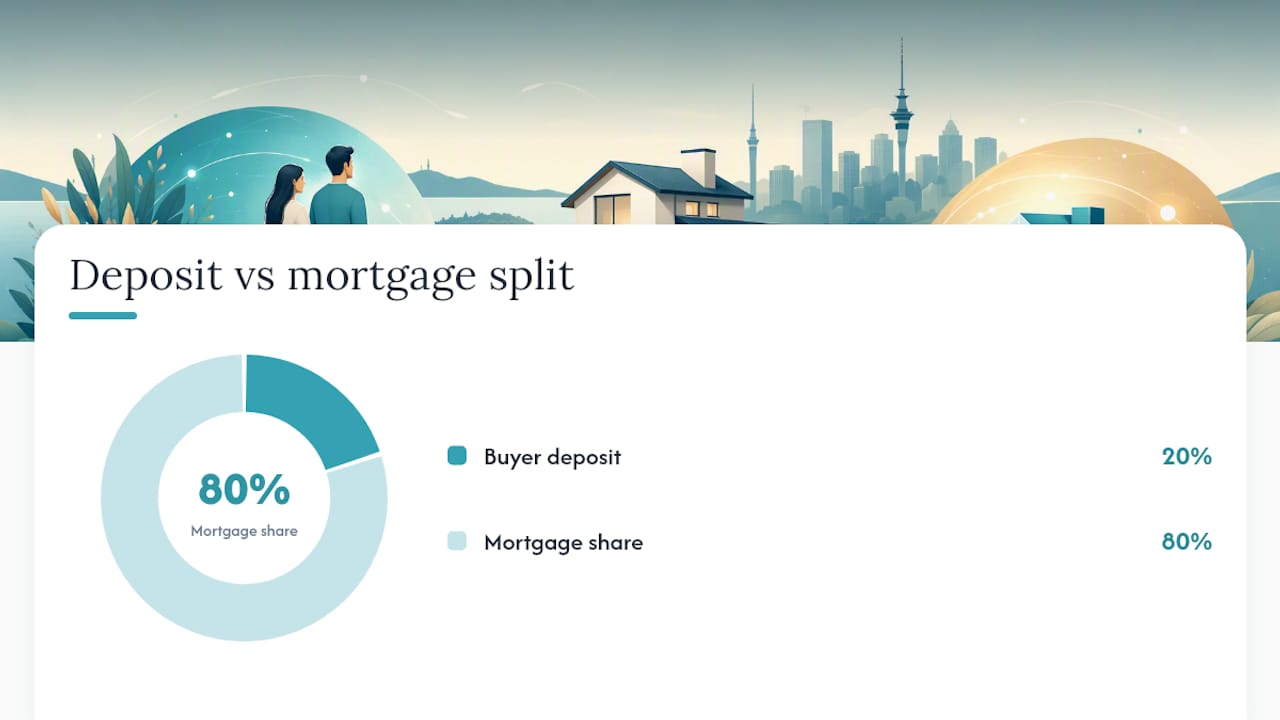
- Confirm your loan-to-value ratio (LVR). Most lenders require at least a 20% deposit for standard pricing; below that, you may face a low-equity premium or restricted product access.
- Check income documentation requirements early. Salaried applicants need payslips; self-employed borrowers typically need two years of financial statements.
- Review your credit file via Centrix or Equifax NZ before applying. A clean file gives you negotiating room; blemishes narrow your lender options.
Fees to confirm upfront
- Application or establishment fee (some lenders waive this; others charge up to several hundred dollars).
- Valuation fee, which is usually paid by the borrower and ranges from roughly NZ$500 to NZ$900 depending on property type and location.
- Ongoing or annual account fees, which vary by lender and product.
- Early repayment charges (break fees) on fixed-rate loans, which can be substantial if you sell or refinance before the fixed term ends.
Product features worth comparing
- Offset accounts and redraw facilities, which can reduce the interest you pay over the life of the loan.
- Repayment frequency options (weekly, fortnightly, or monthly) and whether extra repayments are allowed without penalty on fixed terms.
- Repayment holidays and portability if you plan to move or upgrade within your fixed term.
Total cost, not just the headline rate
A lower advertised rate with higher fees and fewer features can cost more over a typical three-to-five-year holding period than a slightly higher rate with a full-featured product. Always ask for a total cost comparison, not just the rate.
Questions to ask before you commit
Ask your lender or adviser: What conditions apply to this special rate? Is there a minimum equity requirement or a salary direct-credit condition? What is the break fee formula? Does the broker’s lender panel include non-bank lenders? How is the broker’s commission structured, and does it vary by lender?
Pro Tip: In 2025, with rate movements tied to global funding costs, consider splitting your loan across a short fixed term and a floating portion rather than fixing everything at once. That way, you retain some flexibility without betting entirely on one direction. For a deeper look at how rate changes affect your choices, see impact of interest rates on NZ home buyers.
What should you actually compare: rates, fees, and features?
The word “rate” covers several different things, and conflating them is one of the most common and costly mistakes borrowers make.
Advertised standard rates vs conditional special rates
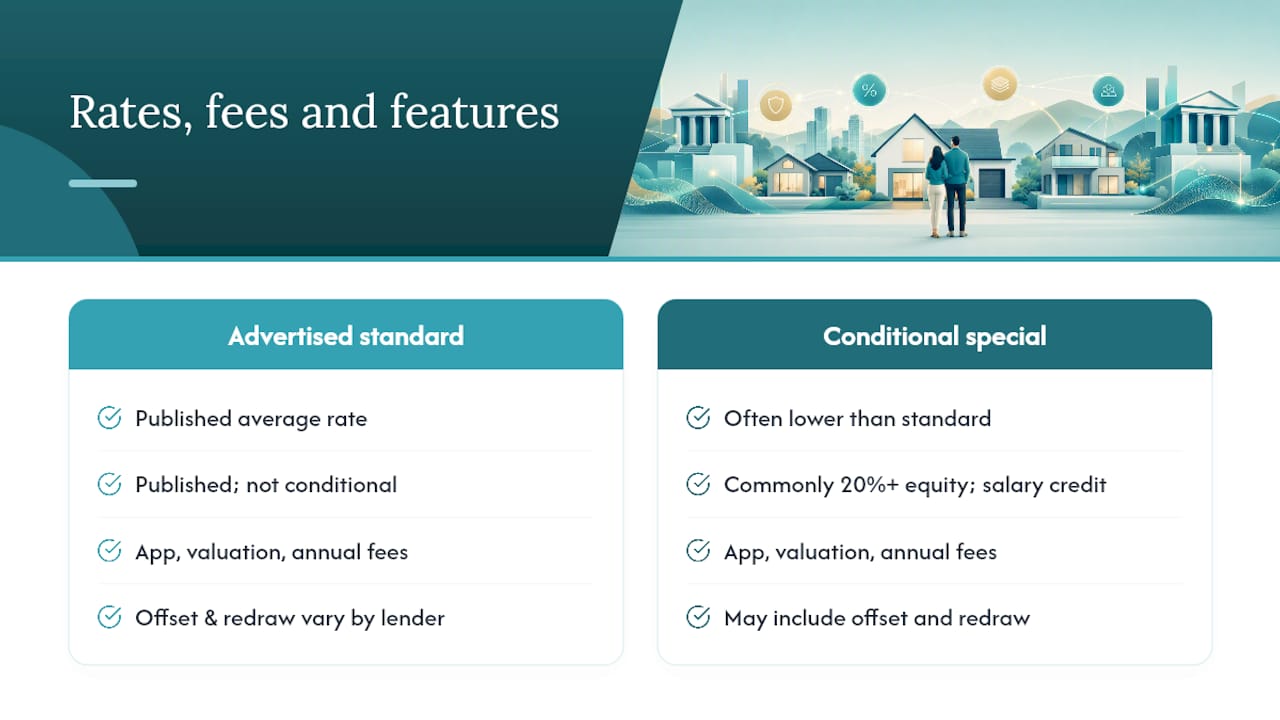
The RBNZ B20 series publishes average advertised standard rates, not the conditional specials that lenders quietly offer to eligible customers. Special rates often require a minimum equity position (commonly 20% or more) and a salary credited directly to the lender’s account. Confirm the precise conditions in writing before assuming you qualify, because a headline special rate that you do not meet the criteria for is simply not your rate.
Fees that belong in your comparison
For an apples-to-apples comparison, add the application fee, valuation fee, and any annual fee to the interest cost over your expected holding period. A lender offering a rate 0.20% lower but charging NZ$800 in upfront fees may cost you more over two years than a lender with a slightly higher rate and no establishment fee.
Features that change your real cost
An offset account, where your savings balance reduces the principal on which interest is calculated, can save thousands over a 25-year term on a large loan. Redraw facilities give you access to extra repayments you have made, which is useful for cash-flow management. Not every lender offers both; some non-bank lenders offer neither. Know which features matter for your situation before you let a rate alone drive the decision.
A quick worked example
Suppose you are comparing two lenders on a NZ$500,000 loan over 25 years. Lender A offers a two-year fixed rate 0.50% lower than Lender B, but charges NZ$700 in upfront fees and has no offset facility. Lender B has the higher rate but includes an offset account. If you keep NZ$20,000 in savings, the offset on Lender B’s product reduces your effective interest cost meaningfully, potentially closing or reversing the gap. The right choice depends on your savings behaviour, not just the rate comparison.
Market commentary in mid-2026 has also noted that one-year fixed rates may currently offer better value than two-year terms for some borrowers, given how short-dated rates are priced relative to longer terms. That nuance is worth exploring with an adviser before you lock in. For a full breakdown of loan product types, see different home loans in New Zealand.
What are current New Zealand mortgage rates in 2026?
The RBNZ B20 series is the authoritative benchmark for advertised standard mortgage rates in New Zealand. According to the B20 data, the average floating rate for new customers was around the market average in mid-2026, while the average two-year fixed rate stayed near typical benchmark levels over the same period. These are standard advertised figures and exclude conditional discounts, so treat them as a market reference point rather than the rate you will automatically receive.
| Term | Average advertised rate (June 2026) | Notes |
|---|---|---|
| Floating | 6.15% | Standard rate; conditional specials lower |
| 2-year fixed | 5.69% | Standard rate; special rates subject to eligibility |
Source: RBNZ B20 series
Rate snapshot: The average two-year fixed rate of 5.69% (June 2026) represents the market benchmark. Eligible borrowers with 20%+ equity and salary direct-credit arrangements can often access special rates below this figure.
The gap between standard and special rates matters. A borrower who qualifies for a conditional special may pay noticeably less than the B20 average, while a borrower who does not meet the conditions will pay the standard rate or higher. The RBNZ housing statistics publish monthly series that let you track how rates have moved over time, which is useful context when deciding whether to fix now or wait.
Rate volatility is real in the current environment. In August 2026, New Zealand’s largest bank lifted fixed rates by up to 0.26% in response to higher wholesale funding costs tied to international events. That kind of move can happen quickly, which is why locking in a pre-approval and understanding your rate options before you need to act is worth the effort. For current rate commentary specific to the New Zealand market, see what are mortgage rates in New Zealand.
How much will your repayments be? A worked example
Knowing your likely repayment before you talk to a lender gives you a realistic budget and stops you from overcommitting. Here is a simple framework using a NZ$500,000 principal and interest loan.
- At 5.69% over 25 years: Monthly repayments sit at a typical level for this loan size and term. Over the full term, total interest paid is substantial, which is why even a small rate reduction or an offset account makes a meaningful difference.
- At 6.15% over 25 years: Monthly repayments rise moderately compared to lower rates; the difference compounds significantly over a 25-year term.
- At 5.69% over 20 years: Shortening the term to 20 years pushes monthly repayments higher, but total interest paid over the life of the loan drops considerably compared to a longer term.
- Interest-only at 5.69% for two years: Monthly payments drop noticeably, which improves short-term cash flow but means the principal balance does not reduce during that period. Total interest paid over the life of the loan is higher as a result.
When you use an online repayment calculator, enter the loan amount, the interest rate, the loan term in years, and the repayment frequency. Weekly or fortnightly repayments reduce total interest compared to monthly, because you make the equivalent of one extra monthly payment per year. Do not forget to account for an offset account balance if you plan to use one, since most calculators allow you to enter an offset amount that reduces the interest calculation.
The interest-only option suits investors managing cash flow in the short term, but for owner-occupiers, principal and interest repayments build equity from day one. That equity becomes your negotiating position at the next repricing or refinance.
Why use a mortgage broker in New Zealand?
A good mortgage broker is not just a form-filler. They are your advocate with lenders, and in a market where rates and conditions shift quickly, that advocacy has real dollar value.
Access to a wider lender panel
Mortgage brokers typically access 10 to 20 or more lenders, including non-bank and specialist lenders that do not deal directly with the public. For borrowers with non-standard incomes, lower deposits, or credit history complications, this access can be the difference between approval and rejection. Many borrowers assume their own bank will give them the best deal. That assumption is often wrong, particularly when a broker can leverage volume relationships to access rates not advertised publicly.
Regulatory protection and trust signals
In New Zealand, mortgage brokers must be registered as financial advisers and listed on the Financial Service Providers Register. Before engaging any broker, search their name on the FSPR to confirm their registration is current. Registered advisers are required to disclose their commission structure in writing, follow conduct rules, and act in your best interest. That regulatory framework gives you meaningful protection that a direct bank relationship does not automatically provide.
Questions to ask your broker
Ask which lenders are on their panel and whether it includes non-bank options. Ask how their commission is structured and whether it varies by lender, since a commission differential could influence which product they recommend. Ask whether they can access bank-only specials and what conditions apply. Ask for written disclosure of all fees and commissions before you proceed.
Red flags to watch for
Refuse to work with any broker who will not show you their lender panel, declines to provide written commission disclosure, or pressures you to sign before you have had time to review the offer. Sorted’s mortgage guide notes that not all lenders work with brokers, so a limited panel is not automatically a red flag, but a broker who is evasive about their panel size should prompt further questions. For more on what brokers can access that banks cannot, see bank alternatives for home loans in New Zealand.
What does the typical home loan process cost and how long does it take?
Getting a home loan in New Zealand follows a predictable sequence, but the timeline varies depending on your lender, your documentation, and whether you are buying at auction or by negotiation.
Typical stages and time ranges
- Pre-approval: Two to five working days with complete documentation; longer if documents are missing or income is complex.
- Full application (post-offer accepted): Three to ten working days for lender credit assessment.
- Valuation: One to five working days; ordered by the lender and paid by you.
- Formal approval: One to three working days after valuation is received.
- Settlement: Coordinated by your solicitor; typically 10 to 30 working days after the sale and purchase agreement goes unconditional.
Upfront costs to budget for
- Valuation fee: roughly NZ$500 to NZ$900 for a standard residential property.
- Legal and conveyancing fees: typically NZ$1,500 to NZ$3,000 depending on complexity.
- Lender application or establishment fee: NZ$0 to several hundred dollars depending on the lender and product.
- Mortgage registration fee: a government charge payable at settlement.
- Lender’s solicitor costs: some lenders pass these on; confirm upfront.
Other costs to factor in
- Building inspection report: NZ$400 to NZ$800 for a standard house.
- LIM (Land Information Memorandum) from the local council: typically NZ$200 to NZ$400.
- Home and contents insurance: required by lenders before settlement; get quotes early.
- Bridging finance costs if you are buying before your existing property settles.
A broker can meaningfully shorten the process by pre-matching your application to the lender most likely to approve it quickly, preparing your documentation checklist before submission, and maintaining direct communication with the lender’s credit team. That operational discipline often shaves days off approval timelines.
How Mortgagemanagers works with you
Mortgagemanagers is a locally owned and operated mortgage advisory business based in Hobsonville, Auckland, with remote capability across New Zealand. The service is built around one core idea: you should not have to navigate lender options alone.
The process starts with an initial assessment of your financial position, including income, deposit, credit history, and borrowing goals. From there, Mortgagemanagers shops the lender market on your behalf, matching your profile to the lenders most likely to approve your application at a competitive rate. Application management, lender communication, and settlement coordination are all handled as part of the service.
Who benefits most from this approach
First home buyers who are unfamiliar with lender criteria and documentation requirements gain the most from having an adviser manage the process. Refinancers who want to check whether their current rate is still competitive benefit from a broker’s real-time market intelligence. Self-employed borrowers and those with complex income structures often find that a broker’s knowledge of which lenders are most flexible on income verification is worth more than any rate difference. Low-deposit borrowers and those with non-standard situations, including credit history complications, benefit from access to specialist and non-bank lenders that Mortgagemanagers can reach directly.
Mortgagemanagers is licensed and operates under New Zealand’s financial adviser conduct rules. You can verify registration on the Financial Service Providers Register. For a first meeting, bring your last three payslips (or two years of financial statements if self-employed), photo ID, your most recent bank statements, and a clear sense of your purchase price range and deposit amount. To learn more about what to expect from the adviser relationship, see the role of a mortgage adviser in New Zealand.
Your next steps: a practical action list for the next 72 hours
The recommendation is clear: for most New Zealand borrowers in 2025, engaging a licensed mortgage adviser is the most reliable route to a competitive loan and a smooth approval process.
Here is what to do now:
- Gather your documents. Collect your last three payslips, two forms of photo ID, three months of bank statements, and your KiwiSaver balance statement if you are a first home buyer.
- Run a repayment estimate. Use the worked example above or an online calculator to get a realistic monthly figure at the current RBNZ B20 benchmark rates (floating 6.15%, two-year fixed 5.69% as at June 2026).
- Book a pre-approval conversation. Contact a licensed adviser and ask them to run a preliminary lender match based on your income and deposit. This costs you nothing and gives you a realistic picture before you start making offers.
- Request the lender list. Ask your adviser which lenders are on their panel and whether non-bank options are included. A panel of 10 or more lenders gives you meaningful market coverage.
- Check the RBNZ B20 snapshot. When you receive a rate offer, compare it against the RBNZ B20 benchmark to understand whether you are above, at, or below the market average. A rate below the B20 standard average for your term is a positive signal.
Why I recommend a broker in this market
The conventional wisdom is that if you have a good relationship with your bank, you should start there. I think that advice is outdated for most borrowers right now.
The New Zealand mortgage market in 2025 is not static. Wholesale funding costs are moving in response to international events, and as we saw in August 2026, a major bank can lift fixed rates by up to 0.26% in a single announcement. In that environment, the borrower who has already spoken to multiple lenders through a broker is in a far stronger position than the one who is starting from scratch with a single institution.
There is also a regulatory dimension that borrowers underestimate. A licensed adviser operating under New Zealand’s financial adviser conduct rules is required to act in your interest and to disclose their commission in writing. That obligation does not exist when you walk into a bank branch. The bank’s mortgage specialist is employed by the bank, not by you. That distinction matters when rates are tight and conditions are competitive.
The repricing data published by the RBNZ housing statistics series shows that a significant portion of fixed-rate loans reprice within any given 12-month window. If you are among those borrowers, the decision you make at repricing time, whether to fix, float, or split, is worth getting right. An adviser who tracks lender movements daily is better placed to help you make that call than a branch manager whose job is to retain you on the bank’s own products.
Mortgagemanagers: your practical next step
Choosing between lenders, rates, and loan structures is genuinely complex, and the stakes are high. Mortgagemanagers gives you a licensed adviser who shops the full market for you, not just one bank’s product shelf.

As mortgage advisers who act as your personal shoppers for a home loan, Mortgagemanagers works across a panel of lenders including non-bank and specialist options, handles your documentation from first meeting to settlement, and provides written disclosure of all commissions so you know exactly how the service works. Based in Hobsonville and serving clients remotely across New Zealand, the team is well placed to help whether you are buying your first home in Auckland or refinancing from anywhere in the country.
To get started, visit Mortgagemanagers and book your first conversation. Bring your income documents and deposit figure, and the team will give you a clear picture of your options within the first session.
This article provides general information only and is not a substitute for personalised financial advice. Confirm current rates and eligibility criteria with a licensed adviser or directly with lenders before making any borrowing decision.
Sources
Use these sources to verify rates, check broker registration, and deepen your understanding of the New Zealand mortgage market.
- New residential mortgage standard interest rates (B20) – Reserve Bank of New Zealand – Te Pūtea Matua
- Why a one-year home loan fix may be better than two right now
- Mortgage Broker vs Bank NZ — Which Is Better for Your Home Loan? | MoneyBalance
- Mortgages and home loans – Consumer Protection (New Zealand)
- Shopping for a mortgage — Sorted