
TL;DR:
- A conditional offer in New Zealand property transactions protects buyers by making obligations dependent on specific conditions being fulfilled. It offers a crucial due diligence period to confirm finance, conduct property inspections, and review council records before committing fully. Proper management of these conditions is essential to safeguard deposits and ensure a smooth purchase process.
A conditional offer in New Zealand property transactions is a purchase agreement where your obligations as a buyer only activate once specific conditions are fulfilled. These conditions, written into the Sale and Purchase Agreement, give you a protected window to confirm finance, inspect the property, and check council records before you are fully committed. Understanding conditional offers is one of the most useful things you can do before you start making offers on homes. Get this right, and you buy with confidence. Get it wrong, and you risk losing your deposit or buying a property with serious problems you never knew about.
What is the explanation of conditional offers in NZ?
A conditional offer means the purchase is subject to one or more conditions in the Sale and Purchase Agreement, and you are not fully committed until those conditions are either satisfied or waived. Once all conditions are met, the agreement becomes unconditional and both parties are legally bound to complete the sale on the agreed settlement date. Think of it as a trial period with legal structure. You are serious about buying, but you have built in the right to walk away if something critical does not stack up.

The industry term for this type of agreement is a “conditional contract.” The phrase “conditional offer” is how most buyers and agents refer to it in everyday conversation, and both terms describe the same thing. Knowing the formal term helps when you are reading legal documents or speaking with your lawyer.
Conditions are not just formalities. They are targeted buyer protections that give you time to conduct key checks before committing your money and your future to a property. Each condition you include should address a specific risk you want to manage.
What conditions are typically included in a NZ offer?
Most New Zealand conditional offers include three to four standard conditions. Each one protects you from a different type of risk.
-
Finance condition: This is the most common condition, and it is often misunderstood. Pre-approval from your bank is not enough to satisfy a finance condition. Conditional finance approval is property-specific and tied to the exact contract clauses, including the purchase price, the property address, and the settlement date. Your lender needs to assess the actual property before confirming approval. Think of it like a job offer that is contingent on a background check. Pre-approval says you are a good candidate; conditional approval says you got the role.
-
Building report condition: A registered building inspector examines the property for structural issues, moisture problems, and deferred maintenance. This condition gives you the right to cancel the contract if the report reveals defects you consider unacceptable. In New Zealand, where leaky building issues have affected thousands of homes, this condition is not optional for most buyers.
-
LIM report condition: A Land Information Memorandum (LIM) is a council document that summarises everything the local council knows about the property. It covers consents, zoning, drainage, and any outstanding notices. A LIM can reveal unpermitted work or flood risk that is not visible during an inspection.
-
Sale of own property condition: If you need to sell your current home before you can buy, this condition protects you. Sale-of-property conditions typically span 4–6 weeks. They give you time to complete your own sale, but they can make your offer less attractive to sellers because the property is effectively off the market during that period.
Pro Tip: Tailor your conditions to the specific risks of the property you are buying. A brand-new build may not need a building report condition, but a 1970s weatherboard home almost certainly does.
Conditional vs unconditional offers: what are the key differences?
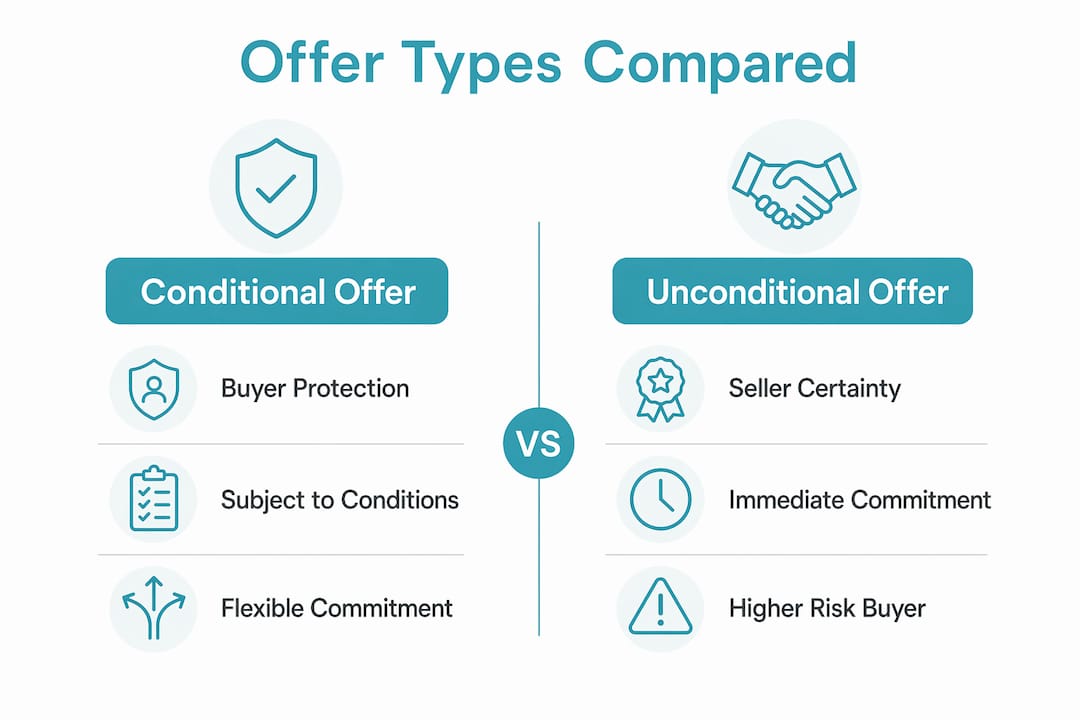
The difference between a conditional and unconditional offer comes down to commitment and risk. An unconditional offer means you are legally bound to complete the purchase the moment the seller accepts. There are no conditions, no exit clauses, and no refund on your deposit if you change your mind or discover a problem.
| Feature | Conditional Offer | Unconditional Offer |
|---|---|---|
| Buyer commitment | Activates only when conditions are met | Immediate and binding upon acceptance |
| Deposit risk | Deposit returned if conditions fail | Deposit at risk if buyer cannot complete |
| Due diligence window | Yes, built into the agreement | No, buyer must complete checks beforehand |
| Seller preference | Lower, due to uncertainty | Higher, provides certainty |
| Buyer protection | Strong | Minimal |
Sellers prefer unconditional offers because they provide certainty and a clean path to settlement. Buyers benefit from conditional offers because of the due diligence window they allow. That trade-off is a real negotiation point, especially in competitive Auckland markets where multiple buyers may be making offers at the same time.
Going unconditional is not always reckless. If you have already completed a building inspection, received a LIM report, and have unconditional loan approval confirmed by your lender, removing conditions may be a reasonable step. The danger is going unconditional before those checks are done, which sacrifices your due diligence protections entirely.
Conditional contracts add flexibility by making the agreement binding only when specified conditions occur. If conditions fail, both parties are released from their obligations, protecting them from financial or legal harm. That protection is worth a great deal, particularly for first-time buyers who may not have the financial buffer to absorb a costly mistake.
Pro Tip: Never waive a condition just to make your offer look more attractive unless you have genuinely completed the checks that condition was designed to cover.
What is the conditional offer process and timeline in NZ?
The conditional offer process follows a clear sequence, and missing any step can cost you your protections or your deposit.
-
Make the offer. Your lawyer or real estate agent prepares the Sale and Purchase Agreement with your chosen conditions and deadlines written in. Each condition has its own deadline, typically 10–15 working days for finance, building, and LIM conditions.
-
Conduct your checks. During the conditional period, you organise your building inspector, request the LIM from the council, and work with your mortgage adviser to secure conditional finance approval from your lender. These tasks run in parallel, so your team needs to be coordinated.
-
Communicate outcomes through your lawyer. When a condition is satisfied, your lawyer formally notifies the seller’s lawyer. If a condition cannot be met, you must actively notify the vendor through your solicitor. Failing to notify the vendor properly when finance falls through can result in some contracts assuming deemed approval, which means you lose your right to cancel.
-
Go unconditional or cancel. Once all conditions are satisfied, the agreement becomes unconditional. The standard deposit in New Zealand is commonly 10%, paid at this point and held in the real estate agent’s trust account until settlement. If you cancel within the conditions, your deposit is returned.
-
Settlement. On the agreed settlement date, your lawyer transfers the funds, and you receive the keys.
Pro Tip: Book your building inspector and request your LIM report on the same day your offer is accepted. Both can take longer than expected, and running out of time is one of the most common mistakes first-time buyers make.
How to navigate conditional offers as a first-time NZ buyer
Managing a conditional offer successfully is a team effort. You are the buyer, but you are not doing this alone.
-
Engage a mortgage adviser early. Mortgage approval tips consistently point to early engagement with a mortgage adviser as one of the most effective steps a first-time buyer can take. Your adviser helps you move from pre-approval to conditional finance approval quickly, which is critical for meeting your finance condition deadline.
-
Work with a property lawyer from day one. Your lawyer reviews the Sale and Purchase Agreement before you sign, not after. They identify unusual clauses, advise on condition wording, and handle all formal communications with the seller’s lawyer during the conditional period.
-
Understand the difference between pre-approval and conditional approval. Pre-approval assesses your financial capability broadly. Conditional approval ties finance specifically to the property and the conditions set by your lender. You need conditional approval to satisfy the finance condition in your contract.
-
Watch for deemed approval clauses. Some contracts include a clause that deems your finance condition satisfied if you do not formally notify the vendor by the deadline. Buyers can lose protection if they misunderstand contract timelines or fail to notify vendors via solicitors when a finance condition is not met. Your lawyer should flag this risk before you sign.
-
Balance protection with competitiveness. In a busy market, a long list of conditions can make your offer less attractive. Work with your adviser and lawyer to include only the conditions that address genuine risks for the specific property you are buying.
Managing conditional offer deadlines requires coordinated effort between your mortgage adviser, lawyer, building inspector, and the seller. Missing or mishandling steps can result in losing your condition protections and putting your deposit at risk. You can read more about the risks buyers face when conditions are not managed carefully.
Pro Tip: Ask your mortgage adviser to give you a written timeline of what needs to happen and by when. Having that roadmap in hand makes the conditional period far less stressful.
Key takeaways
A conditional offer is your most important legal protection as a New Zealand home buyer, and it only works when every condition is properly managed before the deadline.
| Point | Details |
|---|---|
| Definition of conditional offer | A purchase agreement that only becomes binding when specified conditions are satisfied or waived. |
| Finance condition requires more than pre-approval | You need conditional approval tied to the specific property, not just a general pre-approval from your bank. |
| Unconditional offers carry real risk | Going unconditional without completing checks puts your deposit and your finances at serious risk. |
| Deadlines are legally critical | Missing a condition deadline or failing to notify the vendor can result in losing your right to cancel. |
| Team coordination is non-negotiable | Your mortgage adviser, lawyer, and building inspector must all work in sync to meet condition timelines. |
Stuart’s take: why conditional offers are worth protecting
I have worked with a lot of first-time buyers who feel pressure to go unconditional because they think it will make their offer more competitive. Sometimes that pressure comes from agents, sometimes from the fear of missing out on a property they love. My honest view is that removing conditions before you have done the work is one of the riskiest things you can do in a property purchase.
The conditional period is not a formality. It is the window where you find out whether the property you are excited about is actually the property you think it is. I have seen buyers discover significant structural issues during a building inspection that would have cost tens of thousands of dollars to fix. Without that condition, they would have been legally bound to complete the purchase.
The buyers who navigate conditional offers best are the ones who treat the process like a project. They have their mortgage adviser, lawyer, and building inspector lined up before they make an offer. They know their deadlines. They communicate clearly and promptly. When you have that team around you, the conditional period feels manageable rather than overwhelming.
My advice is simple. Use your conditions. Complete your checks. And if you are ever unsure whether to waive a condition, talk to your lawyer and your mortgage adviser before you do anything. The protection those conditions provide is worth far more than the competitive edge you might gain by removing them prematurely.
— Stuart
How Mortgagemanagers supports your conditional offer journey
Securing a conditional offer is only half the challenge. Getting your finance condition satisfied on time is where many buyers feel the pressure most.

Mortgagemanagers is a locally owned mortgage advisory business based in Hobsonville, Auckland, serving buyers across West Auckland, the North Shore, and throughout New Zealand. As your personal shoppers for a home loan, the team at Mortgagemanagers works across multiple lenders to find the right finance for your situation and helps you move from pre-approval to conditional finance approval as quickly as possible. That speed matters when your contract deadline is counting down. Whether you are buying your first home or your fifth, expert mortgage advice early in the process gives you the best chance of meeting every condition on time and with confidence.
FAQ
What is a conditional offer in new zealand property?
A conditional offer is a Sale and Purchase Agreement where the buyer’s obligations only become binding once specific conditions, such as finance approval or a satisfactory building report, are met or waived.
How long does the conditional period last in NZ?
Finance, building, and LIM conditions typically allow 10–15 working days. A sale-of-own-property condition usually spans 4–6 weeks to allow the buyer time to sell their existing home.
What happens if a condition is not met?
If a condition is not satisfied by the deadline, the buyer can cancel the agreement and have their deposit returned, provided they have formally notified the vendor through their solicitor in time.
Is pre-approval enough to satisfy a finance condition?
No. Pre-approval assesses your financial capability broadly, but a finance condition requires conditional approval tied specifically to the property and the exact contract terms set by your lender.
Should first-time buyers always use conditional offers?
For most first-time buyers, a conditional offer is the wisest approach. It provides a protected window to confirm finance, inspect the property, and review council records before you are legally and financially committed.