
Securing your first home in Auckland can feel intimidating, especially if bad credit or a low deposit stand in your way. For many first-time buyers with modest incomes, the dream of homeownership may seem out of reach, but there are practical pathways forward. This guide provides clear steps to assess your financial situation, explore first home loan options like Kāinga Ora’s 5% deposit scheme, and prepare everything needed to confidently apply for a mortgage.
Table of Contents
- Step 1: Assess Your Financial Readiness
- Step 2: Research Available First Home Loan Options
- Step 3: Gather and Organise Required Documentation
- Step 4: Apply for Loan Pre-Approval
- Step 5: Search for Suitable Properties
- Step 6: Finalise Your Home Purchase
Quick Summary
| Key Point | Explanation |
|---|---|
| 1. Assess Your Financial Readiness | Review your financial situation, savings, debts, and credit score to determine your home buying capability and strategy. |
| 2. Research Loan Options | Investigate various first home loan programmes available, understanding deposits and eligibility to find the best fit for you. |
| 3. Organise Required Documentation | Prepare and arrange essential financial documents systematically to streamline your mortgage application process. |
| 4. Obtain Loan Pre-Approval | Apply for pre-approval to understand your borrowing capacity and showcase your commitment to sellers in your home search. |
| 5. Finalise Your Home Purchase | Complete legal processes, inspect the property, and confirm settlement details to successfully transfer ownership of your new home. |
Step 1: Assess Your Financial Readiness
Assessing your financial readiness is crucial when dreaming of purchasing your first home. This step involves a comprehensive review of your current financial situation to determine your home buying potential and prepare a solid strategy for mortgage approval.
Begin by gathering key financial documents and conducting a thorough personal financial audit. This means collecting recent payslips, tax returns, bank statements, and a detailed breakdown of your monthly income and expenses. Comprehensive financial checklists can help guide this process systematically.
Key areas to evaluate include:
- Your current savings and deposit amount
- Monthly income stability
- Existing debt levels
- Credit score and credit history
- Ongoing living expenses
- Potential mortgage repayment capacity
Understanding your borrowing power requires a realistic assessment of what banks and lenders will consider. Most financial institutions want to see:
- Stable employment history (typically 6-12 months in current role)
- Consistent income that can support mortgage repayments
- A deposit of at least 10-20% of the property’s value
- A good credit rating demonstrating financial responsibility
Your financial readiness determines not just if you can buy a home, but how comfortably you can manage the ongoing financial commitment.
Pro tip: Consider requesting a copy of your credit report and addressing any potential issues before applying for a home loan to improve your approval chances.
Step 2: Research Available First Home Loan Options
Researching first home loan options is a critical step in your home buying journey, helping you understand the financial pathways available to turn your homeownership dreams into reality. This stage involves exploring various loan types, eligibility criteria, and potential government support designed specifically for first-time buyers.
New Zealand offers several unique loan options for first home buyers. First home loan programmes provide innovative solutions to help you enter the property market with reduced barriers. The Kāinga Ora First Home Loan stands out as a game-changer, allowing eligible buyers to purchase a home with as little as a 5% deposit – a significant advantage for those struggling to save a traditional 20% down payment.
Key loan options to investigate include:
- Kāinga Ora First Home Loan
- KiwiSaver first home withdrawal
- Welcome Home Loan
- Low deposit home loans from participating banks
- First Home Grant programme
- Kāinga Whenua Loan (specifically for Māori home buyers)
Important considerations for each loan option:
To help you compare major first home loan options, here’s a quick reference guide:
| Loan Option | Minimum Deposit Required | Key Eligibility Focus | Property Value Limitations |
|---|---|---|---|
| Kāinga Ora First Home Loan | 5% of property price | Income, NZ residency | Applies in certain regions |
| KiwiSaver Withdrawal | Follows provider rules | Membership duration | Provider and government set |
| Welcome Home Loan | 10% of property price | Income, first home status | Varies by region |
| Low Deposit Bank Loan | Bank-specific | Credit score, employment | Bank criteria apply |
| First Home Grant | 5-10% of property price | Income and house price cap | Government region limits |
| Kāinga Whenua Loan | 0-20% (land ownership) | Māori land only | Land must be multiple-owned |
- Income eligibility requirements
- Deposit amount
- Property value restrictions
- Lending criteria
- Application process complexity
Understanding the nuanced differences between loan programmes can save you thousands and open doors to homeownership you might have thought were closed.
Pro tip: Consult with a mortgage adviser who specialises in first home buyer programmes to navigate the complex landscape of loan options and find the best fit for your unique financial situation.
Step 3: Gather and Organise Required Documentation
Gathering and organising your documentation is a critical step in the home buying process that can significantly streamline your mortgage application. This stage involves collecting and systematically arranging all the financial and personal documents that lenders will require to assess your home loan eligibility.

First home buyer documentation is comprehensive and requires careful attention to detail. You’ll need to compile a range of financial records that demonstrate your fiscal stability and readiness for homeownership. Think of this process as building a financial portfolio that tells your unique story to potential lenders.
Essential documents to collect include:
- Proof of income (recent payslips, tax returns)
- Bank statements for the past 3-6 months
- Identification documents (passport, driver’s licence)
- Proof of savings and deposit
- KiwiSaver withdrawal confirmation
- Employment verification letter
- Credit history report
Important document organisation steps:
Here’s a summary of essential documentation versus its purpose in the loan process:
| Document Type | Purpose in Application | Notes on Preparation |
|---|---|---|
| Recent payslips, tax returns | Verifies stable income | Ensure latest documents supplied |
| Bank statements (3-6 months) | Assesses spending and savings | Highlight deposit transactions |
| ID (passport, driver’s licence) | Confirms legal identity | Prefer valid, original versions |
| KiwiSaver withdrawal letter | Proof of funds source | Obtain from KiwiSaver provider |
| Employment verification letter | Confirms current job status | Must be from employer directly |
| Credit report | Evaluates creditworthiness | Check for errors before applying |
- Create a dedicated folder (physical or digital)
- Make copies of all original documents
- Arrange documents in a logical order
- Keep digital backups
- Ensure all documents are current and valid
Meticulous documentation preparation can be the difference between a smooth approval process and frustrating delays.
Pro tip: Create a digital and physical checklist to track each document, ensuring nothing is overlooked during your home buying journey.
Step 4: Apply for Loan Pre-Approval
Applying for loan pre-approval is a pivotal moment in your home buying journey, providing you with a clear understanding of your borrowing capacity and demonstrating your serious intent to potential sellers. This crucial step transforms your home buying aspirations from a dream into a tangible, actionable plan.
First home loan pre-approval requires careful preparation and a strategic approach. Lenders will conduct a comprehensive assessment of your financial health, examining your income, expenses, credit history, and overall financial stability to determine how much they’re willing to lend you.
Key steps in the pre-approval process:
- Compile all necessary financial documentation
- Check and improve your credit score
- Calculate your debt-to-income ratio
- Determine your borrowing capacity
- Choose the right lender or mortgage broker
- Complete the pre-approval application
Important pre-approval considerations:
- Pre-approval is not a final loan guarantee
- Typically valid for 60-90 days
- Requires updated financial information
- Can be conditional on further checks
- Helps set a realistic property budget
A strong pre-approval application is your passport to serious home buying, signalling to sellers that you’re a committed and credible buyer.
Pro tip: Get pre-approved before house hunting to understand your exact budget and strengthen your negotiating position with sellers.
Step 5: Search for Suitable Properties
Searching for suitable properties is an exciting journey that requires strategic planning, patience, and a clear understanding of your needs and financial boundaries. This step transforms your home buying dream from a pre-approval into a tangible search for your perfect home.
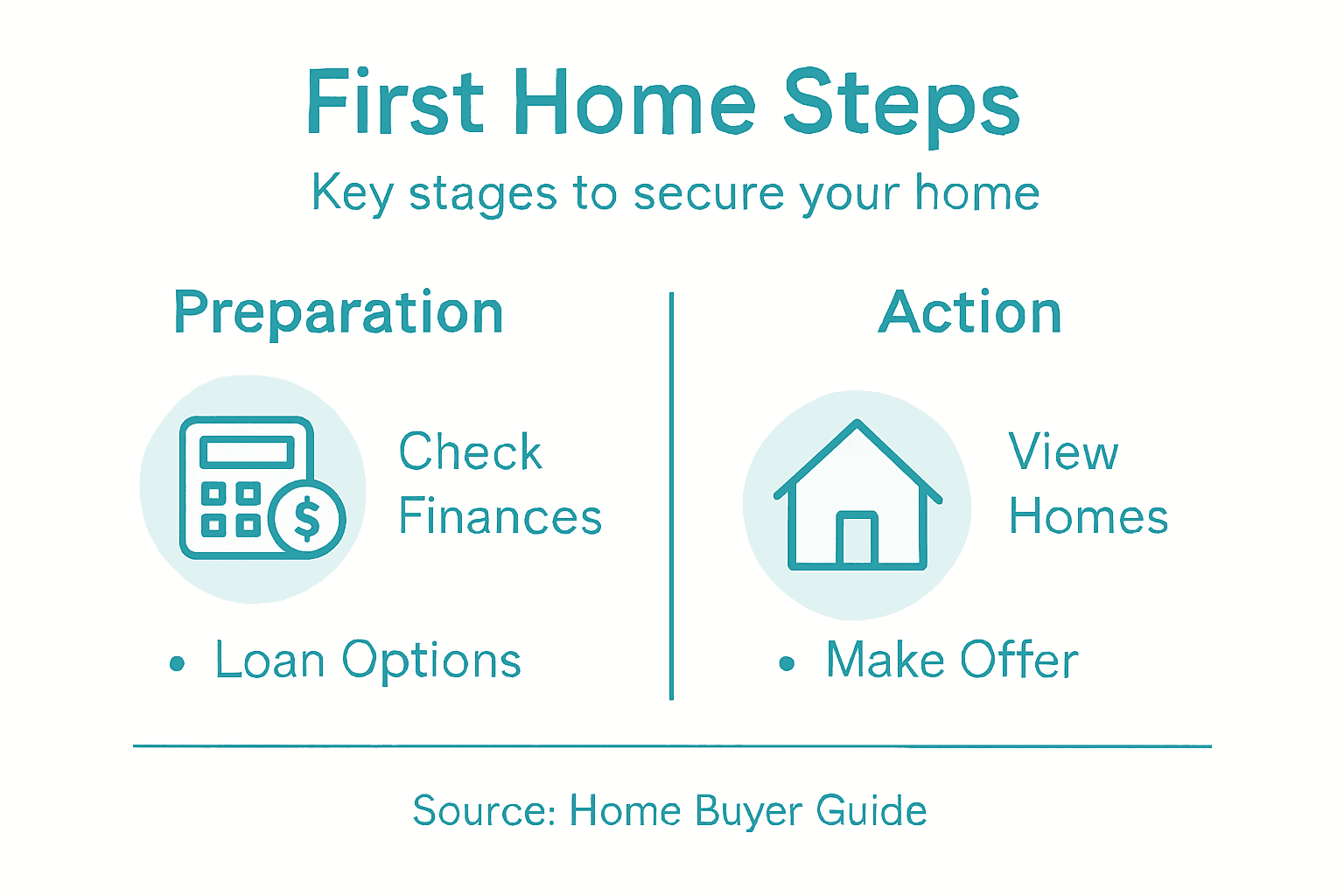
Property searching strategies involve more than just browsing online listings. You’ll need to develop a systematic approach that balances your financial pre-approval, personal requirements, and long-term lifestyle goals.
Crucial property search criteria to consider:
- Affordability within pre-approved loan amount
- Desired location and neighbourhood characteristics
- Property type (apartment, standalone house, townhouse)
- Number of bedrooms and bathrooms
- Potential for future value appreciation
- Proximity to work, schools, and amenities
Detailed search strategy steps:
- Set clear property search parameters
- Use multiple property listing platforms
- Attend open homes and inspections
- Research neighbourhood demographics
- Consider future development potential
- Evaluate property condition and maintenance needs
A well-planned property search is not about finding a perfect home, but finding the right home for your current and future needs.
Pro tip: Create a property viewing checklist with your must-have and nice-to-have features to stay focused and objective during home inspections.
Step 6: Finalise Your Home Purchase
Finalising your home purchase marks the culmination of your home buying journey, transforming your dream into a tangible reality. This critical stage involves navigating complex legal and financial processes that will ultimately transfer property ownership and ensure a smooth transition into your new home.
Home ownership settlement process requires meticulous attention to detail and careful coordination between multiple parties. You’ll need to work closely with your legal representative, mortgage broker, and the property vendor to complete all necessary documentation and meet settlement requirements.
Key tasks to complete before settlement:
- Confirm full mortgage loan approval
- Conduct final property inspection
- Arrange home and contents insurance
- Organise property transfer documentation
- Complete settlement statement review
- Prepare funds for final payment
- Arrange key handover
Settlement day preparation steps:
- Verify all financial arrangements
- Check property condition matches contract
- Confirm bank transfer details
- Obtain settlement statement
- Attend settlement meeting
- Collect property keys
Settlement is not just a transaction, but the moment your property dream becomes a legal reality.
Pro tip: Request a comprehensive settlement checklist from your legal adviser and systematically work through each requirement to avoid last-minute complications.
Navigate Your First Home Buying Journey with Expert Mortgage Advice
Buying your first home can feel overwhelming when faced with questions about financial readiness, loan options, and documentation preparation. This guide highlights key challenges like understanding deposits, securing loan pre-approval, and finding the perfect property. At Mortgage Managers, we specialise in helping first home buyers in Auckland and across New Zealand to bridge these gaps with personalised mortgage solutions.

Take control of your future by partnering with our local experts who can simplify complex loan options such as the Kāinga Ora First Home Loan and KiwiSaver withdrawals. We support you through every step from assessing your borrowing power to finalising your purchase so you can move into your dream home with confidence. Explore how Mortgage Managers can help you secure your first home today. Let us guide you through the financial maze and make your homeownership goal a reality now.
Frequently Asked Questions
How can I assess my financial readiness for buying my first home?
To assess your financial readiness, gather essential financial documents like payslips, tax returns, and bank statements. Conduct a personal financial audit to understand your savings, debt levels, and credit score. Aim to complete this assessment within a week to ensure you are well-prepared for the next steps.
What loan options should I consider as a first home buyer?
As a first home buyer, explore options like the Kāinga Ora First Home Loan, KiwiSaver withdrawal, or the Welcome Home Loan. Reviewing these choices can help you find financial pathways that align with your situation. Research and compare these options in a few days to grasp the best fit for you.
What documents do I need to gather for my home loan application?
You will need to collect documents such as proof of income, bank statements, identification, and a credit report. Organise these documents systematically to present a clear financial picture to lenders. Aim to complete your documentation preparation within two weeks to speed up the application process.
How do I apply for loan pre-approval?
To apply for loan pre-approval, compile all necessary documentation, check your credit score, and choose the right lender or mortgage broker. Complete the pre-approval application with your financial details and submit it for consideration. Ensure this is done before you start property hunting to clarify your borrowing capacity.
What should I consider when searching for a suitable property?
When searching for a suitable property, consider your budget, desired location, property type, and amenities. Create a checklist of must-have features to help streamline your search and ensure you focus on what’s most important to you. Aim to conduct viewings and research properties over a few weeks to find the best match.
How do I finalise my home purchase?
To finalise your home purchase, confirm your mortgage approval, conduct a final property inspection, and ensure all settlement documentation is prepared. Communicate closely with your legal representative and the vendor to ensure a smooth transition. Prepare to complete these tasks within 30 days of your inspection to facilitate timely ownership transfer.