
With the current environment we are seeing more people in need of second chance home loans, and especially in the largest city Auckland where house prices tend to be higher.
There have been reports that over 30 percent of Auckland first-time buyers face challenges when striving for home ownership.
For many, finding pathways beyond the strict rules of traditional New Zealand banks can feel impossible. This is where second chance home loans create new possibilities by recognising that financial setbacks do not define your future.
In this article we help discover practical solutions designed to help you rebuild and qualify for your own home in Auckland, even if your credit history is less than perfect.
Table of Contents
- Defining Second Chance Home Loans In Nz
- Eligibility And Common Lender Requirements
- Key Features In New Zealand Lending
- Credit Repair Pathways For Home Ownership
- Risks, Fees And Obligations For Buyers
Key Takeaways
| Point | Details |
|---|---|
| Second Chance Home Loans | These loans provide alternative financing for individuals with previous credit issues, enabling homeownership opportunities in New Zealand. |
| Flexible Lending Criteria | Borrowers may benefit from reduced deposit requirements and personalised assessments, focusing on current financial capacity rather than past credit history. |
| Increased Costs and Risks | Higher interest rates and fees are common with second chance loans, necessitating careful financial planning and risk management for borrowers. |
| Credit Repair Importance | Ongoing credit improvement strategies are crucial for potential homeowners to secure favourable lending terms and achieve long-term financial stability. |
Defining second chance home loans in NZ
Second chance home loans provide crucial financial opportunities for Auckland buyers who have experienced prior credit challenges or financial difficulties. These specialised lending products offer alternative pathways to homeownership for individuals traditionally excluded from mainstream mortgage markets.
In New Zealand, second chance home loans represent a targeted financial solution designed to help borrowers with imperfect credit histories access mortgage options. These loans acknowledge that past financial struggles do not necessarily predict future financial responsibility. Typically, such loans feature more flexible lending criteria, including:
- Higher interest rates to offset perceived lending risk
- Smaller initial deposit requirements
- Personalised assessment of individual financial circumstances
- Opportunities for credit-impaired borrowers to re-enter the property market
Historically, New Zealand’s lending landscape has evolved to recognise that rigid credit assessments can unfairly disadvantage potential homeowners. Non-bank lenders and specialised mortgage providers now offer nuanced lending approaches that consider broader financial context beyond traditional credit scoring models.
Here’s how second chance home loans differ from standard mortgages in New Zealand:
| Criteria | Second Chance Home Loans | Standard Mortgages |
|---|---|---|
| Typical Interest Rate | Higher than prime rates | Lower, competitive rates |
| Deposit Requirement | 5–10% often accepted | Usually 20% or more |
| Credit History Assessment | Past issues may be overlooked | Clean credit record required |
| Lender Type | Non-bank and specialist lenders | Mainstream banks |
| Custom Loan Features | Flexible repayments, redraw | Fewer flexible features |
| Risk of Extra Fees | More likely | Less common |
Pro tip: Before applying for a second chance home loan, obtain a comprehensive credit report and work systematically to improve your credit score by addressing any outstanding defaults or payment issues.
Eligibility and common lender requirements
Second chance home loans in New Zealand have specific eligibility criteria that potential borrowers must navigate carefully. First home loan programmes typically require applicants to meet several key financial benchmarks that demonstrate their capacity to manage mortgage repayments.
Lenders assess multiple dimensions of a borrower’s financial profile, including:
- Citizenship status (must be a New Zealand citizen or permanent resident)
- Stable and verifiable income
- Credit history assessment
- Minimum deposit requirements (usually around 5-10%)
- Debt-to-income ratio
- Employment stability
Unlike traditional mortgage products, second chance loans recognise that past financial challenges do not necessarily predict future financial behaviour. Non-bank lenders in New Zealand often provide more flexible assessment criteria, understanding that credit-impaired applicants may still represent responsible borrowing potential.

The key consideration for most lenders is not just historical credit performance, but current financial capacity and future repayment likelihood. This means demonstrating consistent income, managing existing debts responsibly, and showing a commitment to improving financial health.
Pro tip: Before applying for a second chance home loan, obtain a comprehensive credit report, address any outstanding issues, and prepare detailed documentation demonstrating your current financial stability and income consistency.
Key features in New Zealand lending
Second chance home loans in New Zealand offer a diverse range of flexible lending features designed to accommodate borrowers with unique financial circumstances. Home loan options provide multiple strategies for managing mortgage repayments and financial flexibility.
Key features of these specialised lending products typically include:
- Offset accounts that allow borrowers to reduce interest charges
- Ability to make additional repayments without penalty
- Flexible repayment schedules (weekly, fortnightly, monthly)
- Redraw facilities for accessing extra payments
- Loan portability options
- Competitive fixed and variable rate structures
These features are particularly valuable for second chance borrowers, as they provide greater control and adaptability in managing mortgage commitments. Non-bank lenders often design more innovative loan structures that recognise the complex financial journeys of credit-impaired applicants, offering tailored solutions that traditional banks might not consider.
Understanding the nuanced landscape of New Zealand lending requires careful consideration of individual financial circumstances. Borrowers should evaluate loan features not just on interest rates, but on overall flexibility, alignment with personal financial goals, and potential for long-term financial recovery.
Pro tip: Request a comprehensive feature comparison from multiple lenders and carefully assess how each loan’s specific features could support your unique financial rehabilitation strategy.
Credit repair pathways for home ownership
Rebuilding credit is a strategic journey for Auckland buyers seeking second chance home loans, requiring deliberate and systematic financial rehabilitation. Community-supported programmes have demonstrated powerful approaches to transforming financial capability and preparing individuals for successful home ownership.
Effective credit repair strategies typically involve:
- Obtaining a comprehensive credit report
- Identifying and addressing negative credit entries
- Establishing consistent payment histories
- Reducing overall debt levels
- Creating structured budgeting practices
- Developing emergency financial reserves
Many New Zealand financial support initiatives focus on providing targeted education and practical skills development. These programmes help individuals understand credit mechanisms, develop robust financial management techniques, and gradually rebuild their economic credibility through structured, supportive interventions.
The credit repair process is not about quick fixes, but sustainable financial transformation. Potential homeowners must demonstrate consistent financial responsibility, showing lenders they can manage mortgage commitments through methodical improvement of their credit profile and overall financial health.
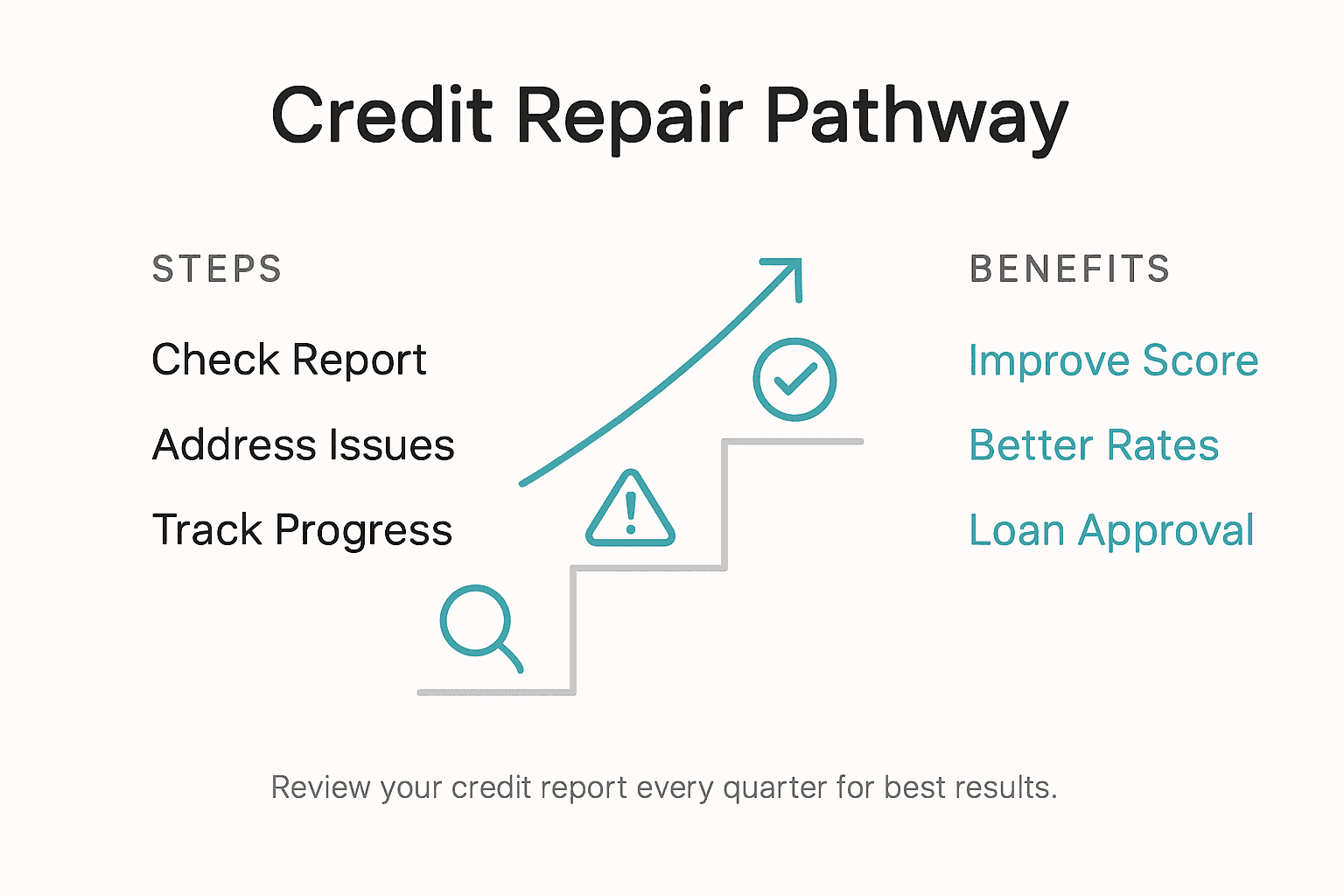
Pro tip: Commit to reviewing your credit report quarterly, addressing any discrepancies immediately and maintaining a disciplined approach to debt management and regular bill payments.
Risks, fees and obligations for buyers
Second chance home loans introduce unique financial responsibilities that require careful navigation and comprehensive understanding. Home buyers must meticulously assess upfront costs and ongoing financial obligations to ensure sustainable homeownership.
Typical fees and financial considerations for Auckland buyers include:
- Legal conveyancing costs ($1,400–$2,000)
- Building inspection expenses
- Council rates ($1,500–$6,000 annually)
- Comprehensive property insurance
- Low equity fees (1–3% of loan value)
- Land Information Memorandum (LIM) report charges
- Potential GST on new property builds
Buyers must also understand the significant risks associated with second chance lending. These include potentially higher interest rates, increased exposure to market fluctuations, and the critical risk of foreclosure if repayment commitments cannot be met. Non-bank lenders often impose more stringent conditions that demand disciplined financial management and consistent income stability.
Below is a summary of key fees and ongoing financial obligations buyers should budget for:
| Cost Type | Typical Amount/Range | When Payable |
|---|---|---|
| Legal Conveyancing | $1,400–$2,000 | Upfront, during settlement |
| Council Rates | $1,500–$6,000 per annum | Annually, ongoing |
| Low Equity Fees | 1–3% of loan value | On loan drawdown |
| LIM Report | $250–$400 (approximate) | Prior to purchase |
| Property Insurance | $800–$2,000 per annum | Annually, ongoing |
| Building Inspection | $400–$800 per property | During due diligence phase |
| GST (New Builds) | 15% (if applicable) | On settlement for new properties |
Navigating these complex financial landscapes requires proactive planning and a thorough understanding of one’s financial capacity. Potential homeowners should seek independent financial and legal advice to fully comprehend their obligations, potential risks, and long-term financial implications before committing to a second chance home loan.
Pro tip: Create a comprehensive financial buffer of at least six months of mortgage repayments to mitigate potential risks and demonstrate financial reliability to lenders.
Find Your Path to Homeownership with Expert Support
Navigating the challenges of second chance home loans in Auckland can feel overwhelming. Whether you are facing higher interest rates, managing low deposit requirements, or rebuilding your credit, the journey to owning a home demands trusted guidance tailored to your unique financial situation. At Mortgage Managers, we understand the importance of personalised mortgage advice that recognises your financial history and future potential.

Take control of your home loan journey today with the support of Auckland mortgage advisers who specialise in helping buyers access flexible and fair lending options. Explore how our team can assist you in understanding loan features, managing risks, and preparing to meet lender requirements. Don’t wait for credit issues to hold you back.
Visit Mortgage Managers now to start your application or learn more about how we can unlock pathways to homeownership for you with second chance home loans.
Frequently Asked Questions
What are second chance home loans?
Second chance home loans are specialised financial products designed to assist buyers who have faced prior credit challenges. They offer alternative pathways to homeownership by providing more flexible lending criteria compared to standard mortgages.
How do second chance home loans differ from standard mortgages?
Second chance home loans typically have higher interest rates, lower deposit requirements (often 5-10%), and include more lenient assessments of credit history. In contrast, standard mortgages usually require a clean credit record and a larger deposit of around 20% or more.
What eligibility criteria do I need to meet for a second chance home loan?
To qualify for a second chance home loan, you typically need to be a citizen or permanent resident, have stable income, a minimum deposit (usually 5-10%), and a manageable debt-to-income ratio. Lenders also consider current financial capacity over past credit issues.
What fees should I expect when applying for a second chance home loan?
Common fees for second chance home loans include legal conveyancing costs, building inspection expenses, council rates, low equity fees, property insurance, and charges for Land Information Memorandum (LIM) reports. It’s important to budget for these upfront and ongoing financial obligations.