
TL;DR:
- Most first home buyers in New Zealand should consider the Kāinga Ora First Home Loan, bank-backed low deposit options, or a mortgage adviser-led search. Combining KiwiSaver, First Home Grant, and a government-backed loan helps reduce upfront costs and speeds up approval. An adviser can streamline the process, optimize lender choices, and ensure proper sequencing of deposit and grant applications.
For most first home buyers in New Zealand, the three strongest paths are: the Kāinga Ora First Home Loan if you meet the income and price-cap criteria; a participating bank’s low-deposit First Home Loan product if you need to buy with just 5% down; or a Mortgagemanagers adviser-led search that matches you to the right lender and manages the application from start to settlement.
Here is the shortlist that suits most buyers:
- Kāinga Ora First Home Loan — Best if your before-tax income is under $95,000 for an individual buyer, $150,000 for an individual buyer with dependants, or $150,000 combined for multiple buyers (as of May 2026), you meet the low deposit requirement, and the property price sits within regional caps. The government underwrites the loan so you avoid the standard 20% deposit requirement.
- Participating bank First Home Loan (ANZ, ASB, Kiwibank, Westpac, BNZ) — Best if you want the backing of a major bank, digital tools, and branch access alongside the Kāinga Ora guarantee.
- Mortgagemanagers adviser service — Best if you want someone to search multiple lenders, handle the paperwork, and negotiate on your behalf. Particularly useful if your situation is non-standard or you simply want faster, managed approval.
- KiwiSaver first home withdrawal + First Home Grant — Not a loan, but a critical deposit source. After a qualifying period of contributions, you can withdraw most of your KiwiSaver balance, and eligible buyers can stack a First Home Grant on top.
Your immediate next step: use the Kāinga Ora First Home Decision Tool to check eligibility in under five minutes, then contact Mortgagemanagers for a free initial consultation and pre-approval support.
Table of Contents
- How do the top first home buyer loans in NZ compare?
- How do you choose the right first home loan?
- What are the NZ government programmes for first home buyers?
- What types of home loans should first home buyers compare?
- What will your repayments look like on a $500k or $700k loan?
- How do you apply for a first home loan, step by step?
- How Mortgagemanagers helps first home buyers get approved
- Key takeaways
- Why an adviser is worth more than most first home buyers expect
- Mortgagemanagers: your first home loan starts here
- Sources and further reading
How do the top first home buyer loans in NZ compare?
The table below uses a representative home loan over 25 years at a typical low deposit percentage as the comparison baseline. Rates shown are indicative ranges only. Eligibility and rates last checked May 2026 — confirm current figures directly with each lender.

| Loan option | Typical rate (indicative) | Min. deposit / max LVR | Key fees | Eligibility summary | Best for | Special features |
|---|---|---|---|---|---|---|
| Mortgagemanagers adviser service | Depends on matched lender | 5% (via Kāinga Ora) | Commission from lender; no upfront adviser fee | NZ buyers; all situations including non-standard | Adviser-led lender matching and managed approval | Searches multiple lenders; handles paperwork |
| Kāinga Ora First Home Loan | Lender’s standard rate | 5% LVR | an Lender’s Mortgage Insurance premium (charged to lender, may be passed on); lender fees apply | Income under applicable income limits; NZ citizen/PR; first home buyer | Low deposit with government underwriting | No standard 20% deposit; no borrower LMI cost in most cases |
| First Home Grant (Kāinga Ora) | N/A (grant, not a loan) | Pairs with low deposit requirement | None | KiwiSaver contributions + income/price caps | Boosting deposit with cash grant | Stacks with First Home Loan and KiwiSaver withdrawal |
| KiwiSaver first home withdrawal | N/A (savings withdrawal) | Requires 3 yrs contributions | None | First home buyer; $1,000 must remain in account | Using existing savings for deposit | Combines with grant and guarantee |
| ANZ First Home Loan (NZ) | Lender’s standard rate | 5% (via Kāinga Ora) | Standard ANZ fees | Kāinga Ora eligibility criteria | Buyers wanting ANZ infrastructure | Branch network; digital banking |
| ASB First Home Loan | Lender’s standard rate | 5% (via Kāinga Ora) | Standard ASB fees | Kāinga Ora eligibility criteria | ASB lending policies and channels | Established first-home product |
| Kiwibank First Home Loan | Lender’s standard rate | 5% (via Kāinga Ora) | Standard Kiwibank fees | Kāinga Ora eligibility criteria | NZ-owned lender preference | Local bank presence |
| Westpac NZ First Home Loan | Lender’s standard rate | 5% (via Kāinga Ora) | Standard Westpac fees | Kāinga Ora eligibility criteria | Large bank network and digital tools | Branch access; digital tools |
| BNZ First Home Loan | Lender’s standard rate | 5% (via Kāinga Ora) | Standard BNZ fees | Kāinga Ora eligibility criteria | BNZ lending approach | Tailored first-home features |
| Loans.com.au Variable Bare Home Loan | Competitive variable rate | Standard deposit requirements | Low/minimal fees | Standard lending criteria | Low headline variable rate | Bare-bones variable product |
| Laboratories Credit Union Simple Home Loan | Standard credit union rate | Standard requirements | Credit union fee structure | Credit union membership | Credit union membership model | Simplified lending terms |
| South West Slopes Bank intro discounted variable | Introductory discounted rate | Standard requirements | Standard fees | Standard lending criteria | Initial variable rate discount | Introductory discount period |
| Pacific Mortgage Group owner occupied variable | Variable rate | Standard requirements | Mortgage group fees | Standard lending criteria | Mortgage group product options | Flexible variable features |
| Border Bank First Home Loan | Regional bank rate | Standard requirements | Regional bank fees | Standard lending criteria; regional focus | Buyers in Border Bank regions | Regional lender responsiveness |
| Gateway Bank Green Plus Home Loan | Competitive rate with green incentive | Standard requirements | Standard fees | Energy-efficient home or improvements | Green home incentives | Rate benefit for eco-friendly homes |
A few quick callouts from this comparison:
- The Kāinga Ora First Home Loan is the only product that formally underwrites a low deposit requirement across multiple participating lenders. The major banks (ANZ, ASB, Kiwibank, Westpac, BNZ) all participate, so your choice of bank does not mean giving up the low-deposit benefit.
- Loans.com.au, Laboratories Credit Union, South West Slopes Bank, Pacific Mortgage Group, Border Bank, and Gateway Bank are worth considering if you fall outside standard eligibility or want a niche product (green incentives, credit union model, introductory discount). An adviser can tell you quickly whether any of these suit your profile.
- Mortgagemanagers sits at the top of this list because it is a different type of solution: rather than being a single product, it searches across lenders to find the right fit for your specific situation.
How do you choose the right first home loan?
The rate headline is rarely the whole story. Here is the framework that actually matters.
Selection criteria to work through
- Deposit and LVR — Do you have 5% or 20%? If you have less than 20%, the Kāinga Ora First Home Loan is likely your most cost-effective path. Check whether you meet the income and price-cap criteria before applying anywhere else.
- Fixed vs variable rate — Fixed rates give you certainty on repayments for a set term (commonly 1–5 years in NZ). Variable rates move with the market. Most first home buyers in NZ fix at least part of their loan for the first 1–2 years.
- Fees — Compare the application fee, ongoing monthly fee, and any early repayment charges on fixed loans. A low rate with a high break fee can cost you more if you need to refinance.
- Features — Offset accounts reduce the interest you pay by offsetting your savings against the loan balance. Redraw lets you access extra repayments you have made. Not all low-deposit products include these; check before you commit.
- Portability — Can you take the loan to a new property if you move? Relevant if you plan to upsize within a few years.
- Lender policy on low-deposit borrowing — Each participating lender applies its own credit criteria on top of the Kāinga Ora rules. One bank may decline where another approves. This is exactly where an adviser adds value.
Questions to ask your lender or broker
- What documents do you need from me, and in what format?
- What triggers a rate loading on my loan (e.g. low deposit, self-employed income)?
- What is the pre-approval validity period, and what can void it?
- Are there any fees I pay if I repay early or switch products?
- How long does your full approval typically take once I have a signed sale and purchase agreement?
Red flags to watch for
- Fees that are not disclosed upfront or buried in fine print
- Unusually slow turnaround on pre-approval (more than five working days is a signal)
- A lender who cannot explain the LMI charge clearly
- Pressure to accept a product before you have compared alternatives
Document checklist for a smooth application
Gather these before you approach any lender or adviser. Having them ready can cut days off your approval time.
- Last three months of payslips (or two years of financials if self-employed)
- Last three months of bank statements (all accounts)
- Photo ID (passport or driver’s licence)
- Proof of deposit (savings history, KiwiSaver balance statement)
- Details of any existing debts (credit cards, personal loans, hire purchase)
- Signed sale and purchase agreement (for full approval)
Pro Tip: Prepare your documents as a single organised PDF folder before your first adviser meeting. Lenders process applications faster when everything arrives in one submission rather than piecemeal over several days.

What are the NZ government programmes for first home buyers?
Understanding the three government-backed tools and how they interact is the single most valuable thing you can do before you apply. Eligibility figures below are as of May 2026.
Eligibility at a glance
| Programme | Who qualifies | Key limit | Deposit impact |
|---|---|---|---|
| Kāinga Ora First Home Loan | NZ citizen/PR; first home buyer; before-tax income under $95,000 for an individual buyer, $150,000 for an individual buyer with dependants, or $150,000 combined for multiple buyers; buying primary residence | Regional house price caps apply | Reduces required deposit to 5% |
| First Home Grant | KiwiSaver contributor for 3+ years; income and price caps (check Kāinga Ora for current figures) | Grant amount varies by years contributed and new/existing build | Cash added directly to deposit |
| KiwiSaver first home withdrawal | First home buyer; 3+ years of contributions; $1,000 must remain | Cannot have previously withdrawn for a home | Converts retirement savings to deposit |
How the Kāinga Ora First Home Loan actually works
Kāinga Ora does not lend to you directly. It underwrites the loan, which means it guarantees the participating lender against a portion of the risk. That guarantee is what allows the lender to accept a low deposit requirement rather than the standard 20%. A Lender’s Mortgage Insurance premium is charged to the lender, not to you as the borrower, though some lenders may pass this cost on through their fee structure. Always ask your lender explicitly whether this is included in your loan costs.
The price caps are the part most buyers underestimate. In high-value markets like Auckland, the cap can exclude a significant portion of available properties. If the home you want is priced above the regional cap, the Kāinga Ora guarantee does not apply and you would need a 20% deposit through a standard loan. Check the current regional caps on the Kāinga Ora website before you start house hunting.
Stacking the programmes together
The real power comes from combining all three. A buyer who has contributed to KiwiSaver for three or more years can withdraw most of their balance, apply for a First Home Grant on top, and use the Kāinga Ora First Home Loan to cover the remaining gap with just 5% total deposit. Coordinating the timing of the KiwiSaver withdrawal, the grant application, and the loan approval is where things get complicated. An adviser’s role is to sequence these so that settlement is not delayed. For a practical guide to managing KiwiSaver for your deposit, Mortgagemanagers has a dedicated resource that walks through the withdrawal process step by step.
Apply to your KiwiSaver scheme provider for the withdrawal, not to Kāinga Ora, unless you are using a complying or exempt employer scheme. Allow at least enough working days before your settlement date for funds to be released.
What types of home loans should first home buyers compare?
Choosing between loan types is not just a rate decision. It shapes your cash flow, your flexibility, and your total cost over the life of the loan.
Fixed, variable, and split rate loans
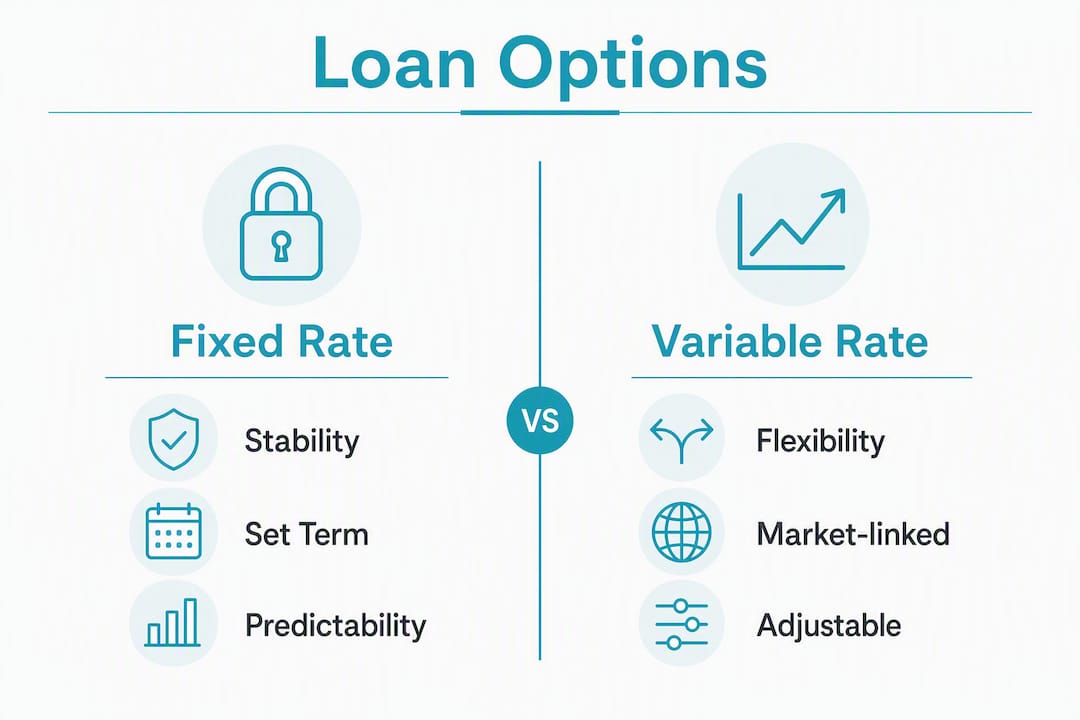
A fixed rate locks your interest rate for a set term, typically one to five years in New Zealand. Your repayments stay the same regardless of what happens to the Official Cash Rate. The trade-off is that breaking a fixed loan early usually incurs a break fee, which can be substantial.
A variable (floating) rate moves with market conditions. You pay more when rates rise and less when they fall. Variable loans typically allow unlimited extra repayments without penalty, which suits buyers who want to pay down their loan faster.
A split loan divides your borrowing between fixed and variable portions. Many first home buyers use this approach to get rate certainty on the bulk of their loan while keeping a smaller variable portion for flexibility and extra repayments. For a deeper look at mortgage features for first-time buyers, including how to structure a split, Mortgagemanagers covers this in detail.
Principal and interest vs interest-only
Principal and interest (P&I) repayments reduce your loan balance with every payment. Interest-only (IO) repayments cover only the interest charge, leaving the principal unchanged. IO is rarely the right choice for first home buyers: you build no equity, your total interest cost over the loan term is higher, and most lenders restrict IO periods to a maximum of five years before reverting to P&I anyway.
Offset and redraw facilities
An offset account is a transaction account linked to your mortgage. The balance in the offset account reduces the loan balance on which interest is calculated. If you have $20,000 in your offset account and a $500,000 loan, you pay interest on $480,000. Redraw lets you access any extra repayments you have made above the minimum. Both features are worth having, but not all low-deposit or government-backed products include them.
Key features comparison
| Feature | Fixed rate | Variable rate | Split loan |
|---|---|---|---|
| Rate certainty | Yes | No | Partial |
| Extra repayments | Limited (break fee risk) | Unlimited | Partial |
| Offset account | Rarely available | Often available | Available on variable portion |
| Redraw | Rarely available | Usually available | Available on variable portion |
| Best for | Budgeting certainty | Flexibility and overpayments | Balance of both |
Pro Tip: If you are buying with a low deposit requirement and using the Kāinga Ora First Home Loan, ask your lender whether the product supports an offset or redraw facility. Some participating lenders offer these features even on low-deposit loans, and using them aggressively in the first few years can meaningfully reduce your total interest cost.
What will your repayments look like on a $500k or $700k loan?
These worked examples use the following assumptions: 25-year loan term, principal and interest repayments, 90% LVR (10% deposit), and a representative indicative rate of 6.5% per annum. Rates in New Zealand change frequently; check current home loan interest rates before making any decisions. These figures are illustrative only and do not constitute financial advice.
Example 1: $500,000 loan
- Monthly repayment (P&I, 6.5%, 25 years): approximately monthly repayment of a few thousand dollars
- Total repaid over 25 years: total repayment amount over the loan term
- Total interest cost: total interest cost over the loan term
- Deposit required at 10% LVR: $55,556 (on a $555,556 purchase price)
- Deposit required at low loan-to-value ratio (LVR) (Kāinga Ora): a reduced deposit amount based on the purchase price
- Salary benchmark: As a rough rule of thumb, lenders typically assess serviceability at roughly 30–35% of gross income. A $3,370 monthly repayment suggests a household income in the range of a household income range generally needed, though lender policies vary.
Example 2: $700,000 loan
- Monthly repayment (P&I, 6.5%, 25 years): approximately a higher monthly repayment amount
- Total repaid over 25 years: total amount repaid over the loan term
- Total interest cost: total interest cost for that repayment scenario
- Deposit required at 10% LVR: $77,778 (on a $777,778 purchase price)
- Deposit required at low loan-to-value ratio (LVR) (Kāinga Ora): deposit required at a low LVR on that purchase price
- Salary benchmark: At 30–35% of gross income, a $4,718 monthly repayment suggests a household income in the range of an estimated household income range.
The low-deposit path does reduce the upfront barrier, but it increases your monthly repayment relative to a larger deposit because you are borrowing more. Buying earlier with 5% means you start building equity sooner, which can offset the higher repayment cost if property values rise. The right answer depends on your income stability, your savings trajectory, and the specific market you are buying in. For strategies to boost your deposit and reduce the total amount you need to borrow, Mortgagemanagers has a practical guide worth reading before you finalise your approach.
How do you apply for a first home loan, step by step?
The process from first enquiry to settlement typically takes 6–12 weeks, though it can move faster with good preparation. Here is the full sequence.
- Check eligibility — Use the Kāinga Ora First Home Decision Tool to confirm whether you qualify for the First Home Loan and/or First Home Grant. Do this before approaching any lender.
- Gather your documents — Payslips, bank statements, ID, KiwiSaver balance statement, and details of any debts. A complete document pack is the single biggest time-saver in the process.
- Get pre-approval — Apply to a participating lender (or through Mortgagemanagers) for pre-approval. This confirms your borrowing capacity and gives you a price range to work with while house hunting. Pre-approvals are typically valid for a few months.
- Make an offer — Once you find a property, make an offer subject to finance and LIM (Land Information Memorandum). Your solicitor should review the sale and purchase agreement before you sign.
- Apply for full approval — Submit the signed sale and purchase agreement to your lender. They will complete a final credit assessment and arrange a valuation.
- KiwiSaver withdrawal and grant application — If you are using KiwiSaver funds, apply to your scheme provider immediately after going unconditional. Allow at least 10–15 working days for funds to be released before your settlement date.
- Solicitor and settlement — Your solicitor handles the title transfer, confirms funds are in place, and completes settlement. You receive the keys.
Typical timeline
| Milestone | Typical duration | Common hold-ups |
|---|---|---|
| Eligibility check and document prep | 1–5 days | Missing payslips or bank statements |
| Pre-approval | 3–7 working days | Incomplete application; credit issues |
| House hunting | 2–4 weeks | Market conditions; price cap constraints |
| Conditional offer to unconditional | 5–15 working days | LIM delays; valuation issues |
| Full approval | 3–5 working days | Valuation below purchase price |
| KiwiSaver withdrawal | 10–15 working days | Late application to scheme provider |
| Settlement | 1–3 working days after unconditional | Solicitor delays; funding shortfalls |
For a detailed walkthrough of the first home loan process in NZ, including what to expect at each stage, Mortgagemanagers has a step-by-step guide that covers the full sequence. The home loan preparation checklist is also worth bookmarking before you start.
How Mortgagemanagers helps first home buyers get approved
Mortgagemanagers is a locally owned mortgage adviser business based in Hobsonville, Auckland, serving buyers across Auckland and remotely throughout New Zealand. For first home buyers, the practical value of working with an adviser comes down to three things: lender matching, paperwork management, and timing coordination.
What Mortgagemanagers does for you
- Lender matching — Mortgagemanagers searches across participating lenders to find the one whose credit policy best fits your situation. This matters because two buyers with identical incomes and deposits can get different outcomes from different lenders, depending on their employment type, spending patterns, and the property they are buying.
- Application management — The adviser handles the paperwork, liaises with the lender, and follows up on outstanding items so you are not chasing documents across multiple parties.
- Scheme coordination — Aligning the Kāinga Ora guarantee, First Home Grant, and KiwiSaver withdrawal so that all three are in place before settlement is genuinely complex. An adviser who has done this many times knows the sequencing and the timing risks.
- Negotiation — Advisers can sometimes negotiate rate or fee concessions that a direct applicant would not know to ask for.
A typical outcome
Consider a buyer with a combined household income of $130,000, $35,000 in KiwiSaver, and $15,000 in savings. On their own, they might approach one or two banks and accept the first approval they receive. Through Mortgagemanagers, the same buyer’s application is assessed against multiple lenders simultaneously. The adviser identifies which participating lender has the most favourable credit policy for their employment type, coordinates the KiwiSaver withdrawal timing, and submits a complete application in one pass. The result is typically a faster approval and a clearer picture of the total cost before the buyer commits.
Mortgagemanagers earns a commission from the lender on successful loan approvals, so there is no upfront cost to you for the adviser service. The role of a mortgage adviser in New Zealand is explained in full on the Mortgagemanagers website for buyers who want to understand how the commission model works before they engage.
Key takeaways
The strongest first home buyer path in New Zealand combines the Kāinga Ora First Home Loan for low-deposit access, KiwiSaver and First Home Grant for deposit top-up, and a Mortgagemanagers adviser to coordinate the application and lender matching.
| Point | Details |
|---|---|
| Kāinga Ora is the low-deposit key | Before-tax income under $95,000 for an individual buyer, $150,000 for an individual buyer with dependants, or $150,000 combined for multiple buyers (as of May 2026) unlocks a low deposit requirement through participating lenders. |
| Stack your deposit sources | KiwiSaver withdrawal (after multiple years of contributions, $1,000 retained) plus First Home Grant can significantly reduce the cash you need upfront. |
| Rate type shapes your risk | Fixed rates give repayment certainty; variable rates offer flexibility and unlimited extra repayments. Most buyers split the difference. |
| Apply KiwiSaver early | Allow at least 10–15 working days before settlement for KiwiSaver funds to be released by your scheme provider. |
| Mortgagemanagers coordinates it all | An adviser-led search across multiple lenders typically produces faster approvals and better lender matching than a direct bank application. |
Why an adviser is worth more than most first home buyers expect
The conventional wisdom is that going directly to your bank is simpler and just as effective as using a broker. After working through the detail of how the Kāinga Ora First Home Loan, First Home Grant, and KiwiSaver withdrawal interact, it is hard to hold that view.
The complexity is not in any single step. It is in the sequencing. A KiwiSaver withdrawal that arrives two days after settlement falls through is not a hypothetical risk. A lender whose credit policy quietly excludes your employment type is not obvious until you are already three weeks into an application. These are the gaps that cost first home buyers time, money, and sometimes the property they wanted.
What I see consistently is that buyers who come to an adviser early, before they have committed to a lender or a property, have a materially smoother experience. They know their actual borrowing capacity, not an estimate. They know which lenders will look favourably on their profile. And they know the exact timing they need to hit for KiwiSaver funds to land before settlement.
The adviser does not cost you anything extra. The lender pays the commission. What you get is someone whose job is to make your application succeed, not to process it.
Mortgagemanagers: your first home loan starts here
Sorting through first home loan options, Kāinga Ora eligibility, KiwiSaver timing, and lender credit policies is a lot to manage on your own. Mortgagemanagers takes that weight off your shoulders. As Auckland-based mortgage advisers who work remotely with buyers across New Zealand, the team searches multiple lenders, handles the paperwork, and coordinates the grant and KiwiSaver timing so your settlement goes smoothly.

There is no upfront fee for the adviser service. Mortgagemanagers earns a commission from the lender when your loan settles, which means the advice is genuinely on your side. Whether you are just starting to think about buying or you are ready to apply, the first step is a free initial consultation.
Talk to a Mortgagemanagers adviser today and find out exactly which lenders and programmes suit your situation.
Sources and further reading
- Kāinga Ora First Home Loan — The primary source for eligibility criteria, income caps, participating lenders, and the low deposit requirement requirement. Start here
- Kāinga Ora First Home Loan brochure (PDF) — A plain-language overview of how the First Home Loan works, with real application examples
- KiwiSaver first home withdrawal — Kāinga Ora’s guide to withdrawal eligibility, the $1,000 retention rule, and how to apply
- Financial help for first home buyers — The NZ Government’s overview of all available assistance, including First Home Grant and Kāinga Whenua Loan
- Kāinga Ora First Home Decision Tool — A quick self-check tool to confirm which Kāinga Ora products you may be eligible for
- MoneyBalance: First Home Loan NZ complete guide — A detailed independent guide covering regional price caps and the practical effects of the Kāinga Ora guarantee
- Mortgagemanagers: first home buyers guide — General guidance and an overview of the Mortgagemanagers adviser service for first home buyers
This article is general information only and does not constitute financial advice. Eligibility criteria, rates, and programme details change regularly. Confirm current figures with Kāinga Ora, your lender, or a qualified mortgage adviser before making any decisions.