
There is one reason that people think of when asked why review your mortgage in 2025 and it’s highlighted by the number of home owners who risk losing out on thousands in potential savings when they overlook regular mortgage reviews.
The evolving lending rules in New Zealand are making long-term strategies more important and especially as we are seeing rising influence from Australian financial markets both in the way that rules here are being developed for the financial sector, but also with so many of the banks and other non-bank lenders being owned and funded from Australia.
Of course you cannot ignore the shifting interest rates that we have seen during 2025, meaning there is more importance on understanding how to optimise your home loan so you can transform your financial future.
This article highlights how smart strategies and expert mortgage advice can help you make informed decisions and secure the best possible deal for your home loan.
Table of Contents
- Mortgage Review Basics For 2025
- Types Of Rate And Term Adjustments
- New Zealand’s Evolving Lending Rules
- How Market Shifts Affect Home Buyers
- Financial Risks And Missed Savings
- Common Pitfalls With Unreviewed Mortgages
Key Takeaways
| Point | Details |
|---|---|
| Mortgage Review Importance | Regularly reviewing your mortgage can save you significant money and ensure it aligns with your evolving financial needs. |
| Rate Adjustment Strategies | Explore various mortgage rate structures like fixed, floating, and split rates to optimise repayments based on your financial goals. |
| Navigating Lending Regulations | Stay informed about New Zealand’s changing lending rules to enhance your chances of mortgage approval and assess your financial profile accordingly. |
| Avoiding Financial Risks | Conduct comprehensive risk assessments and maintain regular mortgage management to prevent costly pitfalls associated with unreviewed home loans. |
Mortgage Review Basics for 2025
Let’s look at why review your mortgage in 2025.
Reviewing your mortgage in 2025 represents a strategic financial checkpoint that could potentially save you thousands in repayments. As interest rates and lending conditions continue to evolve, understanding how to effectively assess your current home loan becomes crucial. The mortgage landscape is dynamic, with key lending features changing rapidly that demand proactive homeowner attention.
A comprehensive mortgage review involves examining multiple critical factors beyond just your current interest rate. These include assessing your loan structure, comparing current market offerings, evaluating your equity position, and understanding how potential refinancing might benefit your specific financial situation. Homeowners should consider their long term financial goals, potential changes in personal income, and the broader economic environment when conducting this evaluation.
Home loan comparison resources from Sorted provide some guidance on navigating these complex considerations.
Key elements to analyse during your 2025 mortgage review include:
- Current interest rate competitiveness
- Loan term and remaining balance
- Potential refinancing opportunities
- Changes in personal financial circumstances
- Alignment with long term property investment strategies
Our Tip: Complete a Financial Strategy Review:
Schedule a comprehensive mortgage review with one of our professional advisers at least twice per year to ensure your home loan remains optimised for your evolving financial needs.
Types of Rate and Term Adjustments
Understanding the nuanced landscape of mortgage rate and term adjustments is crucial for Auckland homeowners navigating the 2025 financial environment. Different mortgage types offer distinct strategies for managing your home loan, each with unique advantages depending on your financial goals and risk tolerance. These adjustments can significantly impact your overall repayment structure and long-term financial planning.
The primary mortgage rate adjustment options typically include fixed, floating, and blended rate structures. Fixed-rate mortgages provide stability with consistent repayments, while floating rates offer flexibility but potentially higher variability. Canstar’s analysis highlights the strategic considerations when determining the optimal rate adjustment approach, emphasising the importance of matching your loan structure to your personal financial circumstances.
Key mortgage rate and term adjustment strategies include:
- Short-term fixed rates (1-2 years)
- Long-term fixed rates (3-5 years)
- Floating rate options
- Split rate mortgages (combination of fixed and floating)
- Revolving credit facilities
- Interest-only periods
Specific considerations for each adjustment type involve:
- Potential interest rate movements
- Personal income stability
- Risk tolerance
- Long-term financial objectives
- Current market lending conditions
Pro Tip: Rate Adjustment Strategy: Consult with a mortgage professional at least annually to review your current loan structure and assess whether your existing mortgage alignment remains optimal for your evolving financial needs.
Here’s a comparison of common mortgage rate structures and their strategic impacts for Auckland homeowners:
| Rate Structure | Key Benefit | Main Limitation | Best Suited For |
|---|---|---|---|
| Fixed Rate | Stable, predictable payments | Limited flexibility | Risk-averse borrowers |
| Floating Rate | Flexible, may drop in cost | Payments can increase | Those expecting falling rates |
| Split Rate | Balance of risk and control | More complex management | Borrowers wanting flexibility |
| Revolving Credit | Easy debt access, flexibility | Higher risk of over-borrowing | Financially disciplined owners |
New Zealand’s Evolving Lending Rules
The New Zealand lending landscape continues to transform dramatically in 2025, with significant regulatory shifts impacting mortgage accessibility and borrower requirements.
You may find that the financial services reforms are redefining responsible lending principles, moving away from prescriptive assessment frameworks towards more flexible yet protective guidelines. These changes represent a nuanced approach to balancing consumer protection with lending innovation and increase the value that a good mortgage adviser gives.

Mortgage seekers in Auckland and across New Zealand must now navigate increasingly complex lending restriction frameworks, which include refined approaches to debt-to-income ratios, loan-to-value assessments, and responsible borrowing criteria. The regulatory environment now emphasises principles-based assessments, giving lenders more discretion while maintaining critical consumer safeguards.
Key developments in New Zealand’s lending regulations include:
- Removal of strict affordability assessment rules
- Enhanced focus on responsible lending principles
- More flexible loan evaluation processes
- Greater emphasis on individual financial circumstances
- Increased lender discretion in risk assessment
Specific regulatory considerations for borrowers involve:
- Understanding updated lending criteria
- Preparing comprehensive financial documentation
- Demonstrating robust financial planning
- Maintaining strong credit histories
- Adapting to more personalised lending assessments
Pro Tip: Regulatory Navigation: Engage a professional mortgage adviser who understands the latest lending rule changes to help you strategically position your loan application for optimal approval prospects.
Summary of key regulatory changes and borrower actions in New Zealand’s 2025 lending environment:
| Regulatory Change | Impact on Borrower | Recommended Action |
|---|---|---|
| Relaxed affordability rules | Easier access but scrutiny | Prepare complete financial records |
| Emphasis on responsible lending | Individual risk evaluated | Demonstrate robust financial plan |
| More lender discretion | Varied application outcomes | Engage a knowledgeable adviser |
How Market Shifts Affect Home Buyers
Housing affordability in Auckland continues to present significant challenges for potential home buyers, with market volatility creating both obstacles and opportunities in 2025. The complex interplay of economic factors—including mortgage rates, disposable income, and property valuations—demands strategic navigation from prospective homeowners. Understanding these dynamic shifts is crucial for making informed purchasing decisions in an unpredictable real estate environment.
The current market landscape reveals profound impacts on buyer behaviour and expectations. Consumer financial stress has fundamentally reshaped home buying strategies, with buyers becoming increasingly sophisticated in their approach to property investment. Consecutive years of economic uncertainty have prompted more cautious and analytical decision-making processes, transforming how Australians and New Zealanders conceptualise home ownership.
Key market dynamics affecting home buyers include:
- Fluctuating mortgage interest rates
- Reduced borrowing capacity
- Increased deposit requirements
- Greater scrutiny of financial histories
- More complex lending assessments
Strategic considerations for navigating market shifts:
- Maintaining flexible financial planning
- Building robust savings buffers
- Improving personal credit profiles
- Understanding regional market variations
- Developing long-term investment perspectives
Pro Tip: Market Adaptation: Regularly reassess your financial strategy and remain adaptable, as market conditions can change rapidly and unexpectedly in the current economic climate.
Financial Risks and Missed Savings
Homeowners in Auckland face increasingly complex financial landscapes that demand proactive mortgage management to mitigate potential risks. Understanding potential financial vulnerabilities becomes critical in navigating the unpredictable economic terrain of 2025, where seemingly minor oversights can result in substantial long-term financial consequences. The interconnected nature of mortgage structures, personal financial health, and broader economic conditions requires strategic, forward-thinking approaches.
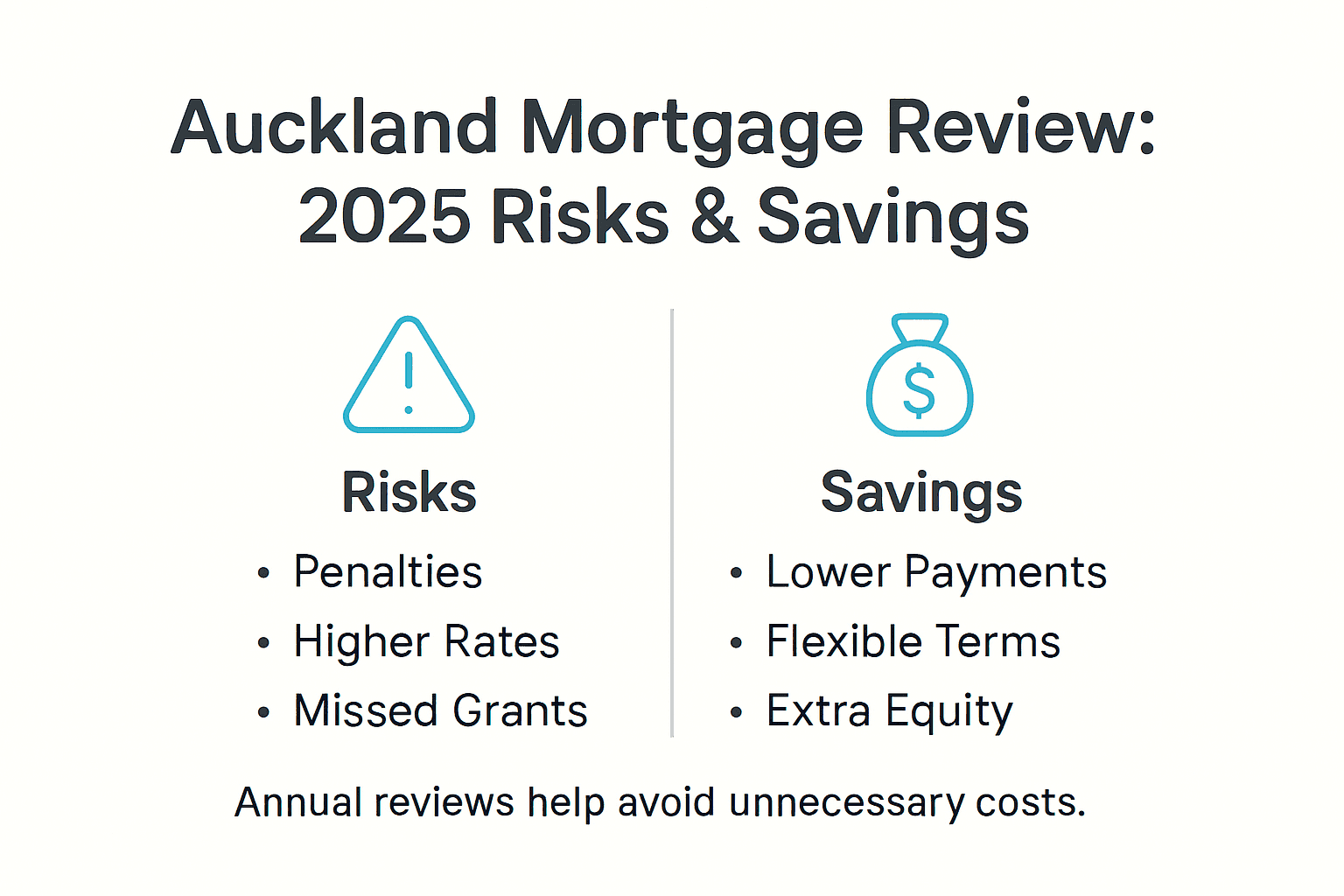
Mortgage-related financial risks manifest through multiple channels, including interest rate fluctuations, unexpected life events, and potential income disruptions. Homeowners who fail to regularly review and adapt their mortgage strategies risk significant financial exposure, potentially losing thousands of dollars through suboptimal loan structures, missed refinancing opportunities, or inadequate financial planning. Comprehensive risk management involves continuous assessment of loan performance, personal financial goals, and emerging market trends.
Key financial risks homeowners must consider include:
- Interest rate volatility
- Potential income reduction scenarios
- Unexpected life event financial impacts
- Inadequate emergency financial buffers
- Suboptimal mortgage structure expenses
Strategic approaches to mitigating financial risks:
- Regular mortgage structure reviews
- Building comprehensive emergency funds
- Maintaining flexible financial planning
- Developing multiple income streams
- Implementing robust personal risk management
Pro Tip: Financial Resilience: Conduct a comprehensive financial risk assessment every six months, treating your mortgage as a dynamic financial instrument that requires consistent monitoring and strategic adjustment.
Common Pitfalls with Unreviewed Mortgages
Homeowners who neglect regular mortgage reviews expose themselves to significant financial risks that can accumulate silently over time. Common lending mistakes can dramatically impact long-term financial health, with unreviewed mortgages potentially costing thousands in unnecessary expenses. The complexity of modern mortgage products demands ongoing attention and strategic reassessment to ensure alignment with changing personal and economic circumstances.
The most critical pitfalls emerge from automated or uninformed financial decision-making. Refinancing through banking apps without professional guidance represents a particularly dangerous approach, as these platforms often lack the nuanced understanding required for optimal mortgage management. Homeowners frequently overlook subtle details that can significantly impact their long-term financial trajectory, such as hidden fees, inflexible terms, or missed opportunities for more competitive rates.
Key pitfalls associated with unreviewed mortgages include:
- Paying unnecessarily high interest rates
- Missing potential refinancing opportunities
- Failing to adjust loan structures with changing life circumstances
- Overlooking penalty clauses in existing agreements
- Accumulating unnecessary additional costs
Strategic considerations for avoiding mortgage pitfalls:
- Regular professional mortgage reviews
- Comprehensive understanding of loan terms
- Proactive financial planning
- Maintaining flexibility in loan structures
- Continuous market rate monitoring
Pro Tip: Financial Vigilance: Schedule a comprehensive mortgage review at least twice annually, treating your home loan as a dynamic financial instrument that requires consistent professional evaluation and strategic adjustment.
Take Control of Your Mortgage in 2025 with Expert Auckland Advisers
Navigating the complex world of mortgage reviews in Auckland can feel overwhelming as lending rules, interest rates and market conditions continue to shift in 2025. If you want to avoid common pitfalls like missed refinancing opportunities or paying unnecessarily high rates it is crucial to have a professional guide who understands the evolving regulatory landscape and personalised mortgage strategies. At Mortgage Managers, we specialise in helping Auckland homeowners optimise their loan structures to align with their financial goals and risk tolerance.

Don’t let outdated mortgage terms or uncertain market shifts hold you back. Connect with our local experts based in Hobsonville who know the intricacies of Auckland’s lending environment. Act now to schedule your tailored mortgage review and secure your financial future. Visit Mortgage Managers today for trusted advice and start your journey towards smarter home loan decisions. Learn more about how we work here and why a professional mortgage review is essential with Mortgage Managers. Take the first step to financial resilience now.
Frequently Asked Questions
Why is it important to review your mortgage in 2025?
Reviewing your mortgage in 2025 is crucial due to evolving interest rates and lending conditions that could significantly affect your repayments. A thorough assessment can help you identify potential savings and ensure your mortgage aligns with your current financial situation and long-term goals.
What factors should I consider when assessing my mortgage?
When reviewing your mortgage, consider factors such as your current interest rate competitiveness, loan term and remaining balance, potential refinancing opportunities, changes in your personal financial circumstances, and how well your mortgage aligns with your long-term property investment strategies.
How can changing lending rules impact my mortgage review?
Changes in lending rules can affect your eligibility for refinancing and the terms available to you. In 2025, the focus has shifted to more flexible lending criteria, which may provide opportunities for better rates or terms if you present a robust financial plan.
What are the risks of not reviewing my mortgage regularly?
Neglecting to review your mortgage can lead to paying unnecessarily high interest rates, missing out on better refinancing options, and failing to adjust your loan structure to fit changing life circumstances, all of which can strain your financial health in the long term.