
Trying to step onto the property ladder in West Auckland can feel overwhelming, especially for first home buyers navigating complex loan rules and deposit hurdles. Changing mortgage policies driven by the Reserve Bank of New Zealand now mean your deposit size and Loan to Value Ratio can make or break your home ownership plans. Understanding LVR restrictions and exemptions helps you approach lenders more confidently, find the right support schemes, and map out a clear path to achieving your home ownership dream.
Table of Contents
- Understanding Lvr And Its Purpose
- Lvr Rules For New Zealand Mortgages
- Lvr Exemptions And Special Cases
- How Lvr Affects Low Deposit Buyers
- Strategies For Overcoming Lvr Challenges
Key Takeaways
| Point | Details |
|---|---|
| Understanding LVR | Loan to Value Ratio (LVR) is crucial for assessing mortgage lending risk and impacts borrowing capacity for first home buyers in New Zealand. |
| LVR Regulations | The Reserve Bank imposes LVR limits to moderate market volatility, with typical thresholds being 80% for residential lending and stricter rules for investors. |
| Exemptions and Support | Certain categories, including first home buyers, may benefit from LVR exemptions and government-backed schemes to ease entry into the property market. |
| Navigating LVR Challenges | First home buyers can improve their chances by enhancing savings, utilising government support programs, and seeking professional financial advice. |
Understanding LVR and Its Purpose
Loan to Value Ratio (LVR) represents a critical metric in New Zealand’s mortgage landscape, directly impacting how first home buyers access property financing. Reserve Bank regulatory guidelines define LVR as the proportion of a loan amount compared to the total property value, serving as a key risk management tool for financial institutions.
At its core, LVR helps lenders and regulators assess mortgage lending risk by establishing clear boundaries for borrowing. When a potential homebuyer seeks a mortgage, the LVR determines their borrowing capacity and associated lending conditions. For instance:
- A 100% LVR means borrowing the entire property value
- A 80% LVR indicates borrowing 80% of the property’s value
- A 60% LVR represents borrowing 60% of the property’s value
The Reserve Bank uses LVR restrictions strategically to moderate potential housing market volatility. By limiting high-risk lending, they aim to protect both financial institutions and borrowers from potential market downturns. These restrictions are particularly significant for first home buyers, who often have smaller deposits and may struggle to meet stringent lending criteria.
Understanding LVR helps prospective homeowners navigate complex borrowing landscapes more effectively. Deposit size becomes crucial, with lower LVRs typically requiring larger upfront investments. Lenders generally prefer lower LVR loans, as they represent reduced financial risk and demonstrate a borrower’s ability to save.
Pro tip: Calculate your potential LVR by dividing your intended loan amount by the property’s valuation, helping you understand your borrowing capacity before approaching lenders.
LVR Rules for New Zealand Mortgages
Reserve Bank regulatory guidelines outline specific LVR rules designed to moderate New Zealand’s mortgage lending landscape. These regulations establish clear parameters for lending institutions, focusing on managing financial risk and protecting both borrowers and banks from potential market instability.
The primary LVR rules in New Zealand typically include:
- A standard 80% LVR threshold for most residential lending
- Stricter requirements for property investors
- Different rules for owner-occupied versus investment properties
- Periodic adjustments based on market conditions
For first home buyers, these rules translate into practical lending constraints. Banks are generally restricted from writing more than a specified percentage of high-risk loans, which means potential homeowners must demonstrate stronger financial positions. Typically, this involves:
- Maintaining a larger deposit
- Showing consistent savings history
- Demonstrating stable income
- Meeting credit worthiness criteria
The New Zealand Law Society’s property law guidelines emphasise that these LVR restrictions are not just financial barriers, but strategic mechanisms to ensure responsible lending practices. By limiting high-risk loans, regulators aim to prevent potential housing market bubbles and protect both individual borrowers and the broader financial system from potential economic shocks.
Lending restrictions can vary significantly between different property types and buyer categories. First home buyers might encounter more flexible rules compared to property investors, reflecting the government’s commitment to supporting initial home ownership while maintaining market stability.
Below is a summary table illustrating how LVR thresholds differ for types of property buyers in New Zealand:
| Buyer Type | Typical Deposit Required | Standard LVR Limit | Flexibility Available |
|---|---|---|---|
| First Home Buyer | 20% of property value | 80% | Moderate (exemptions apply) |
| Property Investor | Over 20% | Often below 70% | Low (stricter rules) |
| Social Housing Buyer | Varies by programme | Up to 90% (with support) | High (special schemes) |
| Māori Authority | Depends on transaction | Flexible (special cases) | High (cultural support) |
Pro tip: Consult a mortgage adviser to understand your specific LVR eligibility, as rules can change frequently and vary between different lenders.
LVR Exemptions and Special Cases
Inland Revenue Department property regulations reveal a nuanced landscape of LVR exemptions designed to support specific housing needs in New Zealand. These special provisions create pathways for buyers who might otherwise struggle with standard lending restrictions, offering targeted relief in critical housing market segments.
Special LVR exemption categories typically include:
- Kāinga Ora housing projects
- New residential property developments
- Social and emergency housing initiatives
- First home buyer government support schemes
- Māori authority property transactions
For first home buyers, these exemptions can be transformative. Some key scenarios where relaxed LVR rules might apply include:
- Purchasing newly constructed homes
- Participating in government-backed housing programmes
- Buying properties in designated development zones
- Qualifying for special first home buyer grants
The New Zealand Law Society emphasises that these exemptions are not blanket permissions, but carefully structured mechanisms to support responsible lending. Each exemption comes with specific eligibility criteria, requiring potential buyers to meet precise financial and personal requirements.
Lending flexibility varies significantly between different exemption categories. Some programmes might allow higher loan-to-value ratios, while others provide alternative assessment methods for borrowers with unique financial circumstances.
Pro tip: Always consult a mortgage specialist to understand the specific exemption criteria applicable to your individual home buying situation.
How LVR Affects Low Deposit Buyers
Low deposit buyer support strategies reveal the significant challenges first home buyers face when navigating LVR restrictions. These regulations create substantial barriers for those with limited savings, effectively constraining their ability to enter the property market.
Key impacts on low deposit buyers include:
- Higher deposit requirements (typically 20%)
- More challenging loan approval processes
- Limited lending options
- Increased financial planning complexity
- Greater need for alternative funding sources
Most low deposit buyers encounter substantial hurdles when attempting to secure mortgage financing. Banks typically require significant upfront capital, which can seem insurmountable for many first-time purchasers. The standard LVR restrictions mean buyers must demonstrate:
- Substantial savings capacity
- Strong credit history
- Stable income evidence
- Comprehensive financial documentation
Government initiatives like KiwiSaver and First Home Grants provide critical support mechanisms. Deposit accumulation becomes a strategic process, with buyers needing comprehensive financial planning to overcome LVR constraints.

Lending restrictions fundamentally reshape how low deposit buyers approach property acquisition. While challenging, understanding these regulations allows strategic navigation of the complex mortgage landscape.
Pro tip: Consistently track your savings and explore government support programmes to incrementally build your deposit and improve your LVR eligibility.
Strategies for Overcoming LVR Challenges
First home buyer support strategies reveal multiple innovative approaches for navigating LVR restrictions in the New Zealand mortgage market. First home buyers can employ strategic techniques to enhance their borrowing potential and overcome traditional lending barriers.
Key strategies for addressing LVR challenges include:
- Maximising KiwiSaver first home withdrawal options
- Exploring government-backed lending programmes
- Building comprehensive savings portfolios
- Investigating alternative financing arrangements
- Improving personal credit profiles
Potential approaches for increasing borrowing capacity involve:
- Utilising Kāinga Ora First Home Loan programme
- Securing family guarantee options
- Demonstrating consistent savings history
- Reducing existing debt commitments
- Seeking professional financial advice
Deposit accumulation becomes a critical focus, with buyers needing structured financial planning to meet lender requirements. Professional guidance can help identify specific pathways through complex lending landscapes, enabling more effective strategy development.
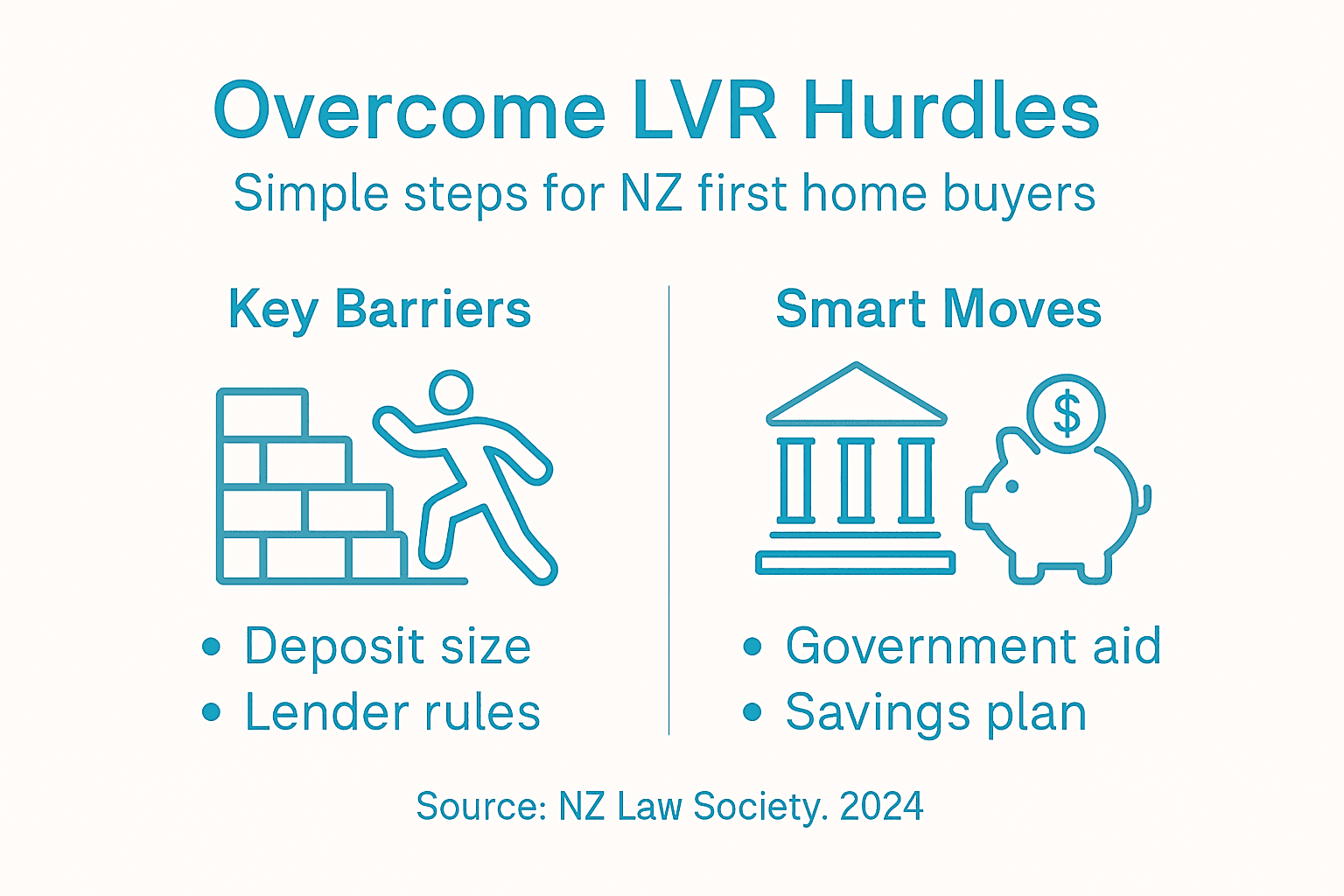
Lending flexibility depends on understanding nuanced financial mechanisms and proactively preparing comprehensive documentation that addresses potential lender concerns.
Here is a quick-reference guide to strategic solutions for improving your LVR eligibility as a first home buyer:
| Strategy | Expected Benefit | Preparation Needed |
|---|---|---|
| KiwiSaver Withdrawal | Boosts deposit amount | Meet scheme criteria |
| Kāinga Ora First Home Loan | Reduces deposit needed | Complete application |
| Family Guarantee | Increases borrowing power | Legal agreement required |
| Debt Reduction | Improves credit profile | Review current debts |
| Structured Savings Plan | Builds deposit over time | Set monthly target |
Pro tip: Create a dedicated savings plan specifically targeting your home deposit, allocating a fixed percentage of your income and tracking progress monthly.
Overcome LVR Challenges With Expert Mortgage Advice
Navigating LVR restrictions can feel overwhelming for first home buyers trying to secure their dream home in New Zealand. The need for a substantial deposit, strict lending rules and varying exemptions often create barriers that can delay or derail your property plans. If you are struggling to understand how to improve your Loan to Value Ratio or want to explore all options including KiwiSaver, government schemes and flexible lending solutions then expert guidance is essential.
Mortgage Managers is a locally owned financial services business dedicated to helping home buyers confidently tackle LVR hurdles. Based in Hobsonville with easy access throughout Auckland and New Zealand we offer personalised mortgage advice designed to find solutions tailored to your unique financial situation. Whether you need help understanding LVR rules, applying for exemptions or building a deposit plan our experienced advisers are here to support you every step of the way.
Explore your mortgage options today and take control of your home buying journey.
[Image:cta_image]
Get the clarity and confidence you need right now to turn your first home dream into reality with trusted mortgage advice from Mortgage Managers. Don’t let loan to value complexities hold you back – connect with us and start your informed path towards home ownership today.
Frequently Asked Questions
What is Loan to Value Ratio (LVR) and why is it important for first home buyers?
LVR is the ratio of the loan amount to the property’s value, serving as a measure of risk for lenders. For first home buyers, understanding LVR is crucial as it determines borrowing capacity and dictates lending conditions.
What are the LVR rules for first home buyers?
First home buyers typically face an 80% LVR threshold, meaning they must provide at least a 20% deposit. There are variations based on individual circumstances that may offer some flexibility, such as government support schemes.
How does having a low deposit affect my LVR and mortgage options?
Low deposit buyers usually encounter higher LVR restrictions, making it harder to secure financing. This means they might need to demonstrate strong savings, stable income, and a good credit history to qualify for loans.
What strategies can first home buyers use to overcome LVR challenges?
First home buyers can enhance their borrowing potential by utilising KiwiSaver withdrawals, exploring government programs like the Kāinga Ora First Home Loan, reducing existing debts, and developing a structured savings plan.