
Searching for your first home in Auckland when credit issues are holding you back can feel overwhelming. Interest rates do not just influence whether you can borrow, they also shape how much you will pay each month and what your options really are. By understanding how the Reserve Bank of New Zealand’s policies ripple through the mortgage market, you can better navigate affordability challenges and make choices that suit your financial circumstances. For buyers facing credit hurdles, knowing how these shifts affect your mortgage can be your strongest asset.
Table of Contents
- Interest Rates And Mortgages Explained
- Types Of NZ Home Loan Rates Available
- How OCR Changes Affect Lending Options
- Impact On Affordability For Credit Issues
- Common Risks And Mistakes To Avoid
Key Takeaways
| Point | Details |
|---|---|
| Understanding Interest Rates is Essential | Mortgage interest rates greatly influence monthly repayments and overall purchasing power in New Zealand. |
| Different Rate Types Offer Various Benefits | Fixed, floating, and hybrid rates provide options for borrowers based on their financial strategies and risk tolerance. |
| OCR Changes Impact Borrowing Costs | Changes in the Official Cash Rate directly affect mortgage rates and lending accessibility, influencing buyer behaviour. |
| Be Aware of Common Pitfalls | Home buyers should avoid financial miscalculations, ensure credit readiness, and conduct thorough property inspections to mitigate risks. |
Interest Rates And Mortgages Explained
Understanding mortgage interest rates is crucial for anyone looking to purchase a home in New Zealand. These rates represent the cost of borrowing money and directly impact your monthly repayments. The Reserve Bank of New Zealand plays a pivotal role in determining these rates through its official cash rate policy.
Mortgage interest rates in New Zealand are influenced by several complex factors. These include:
- Global financial market conditions
- Reserve Bank monetary policies
- Wholesale funding costs for banks
- Domestic economic performance
- Inflation expectations
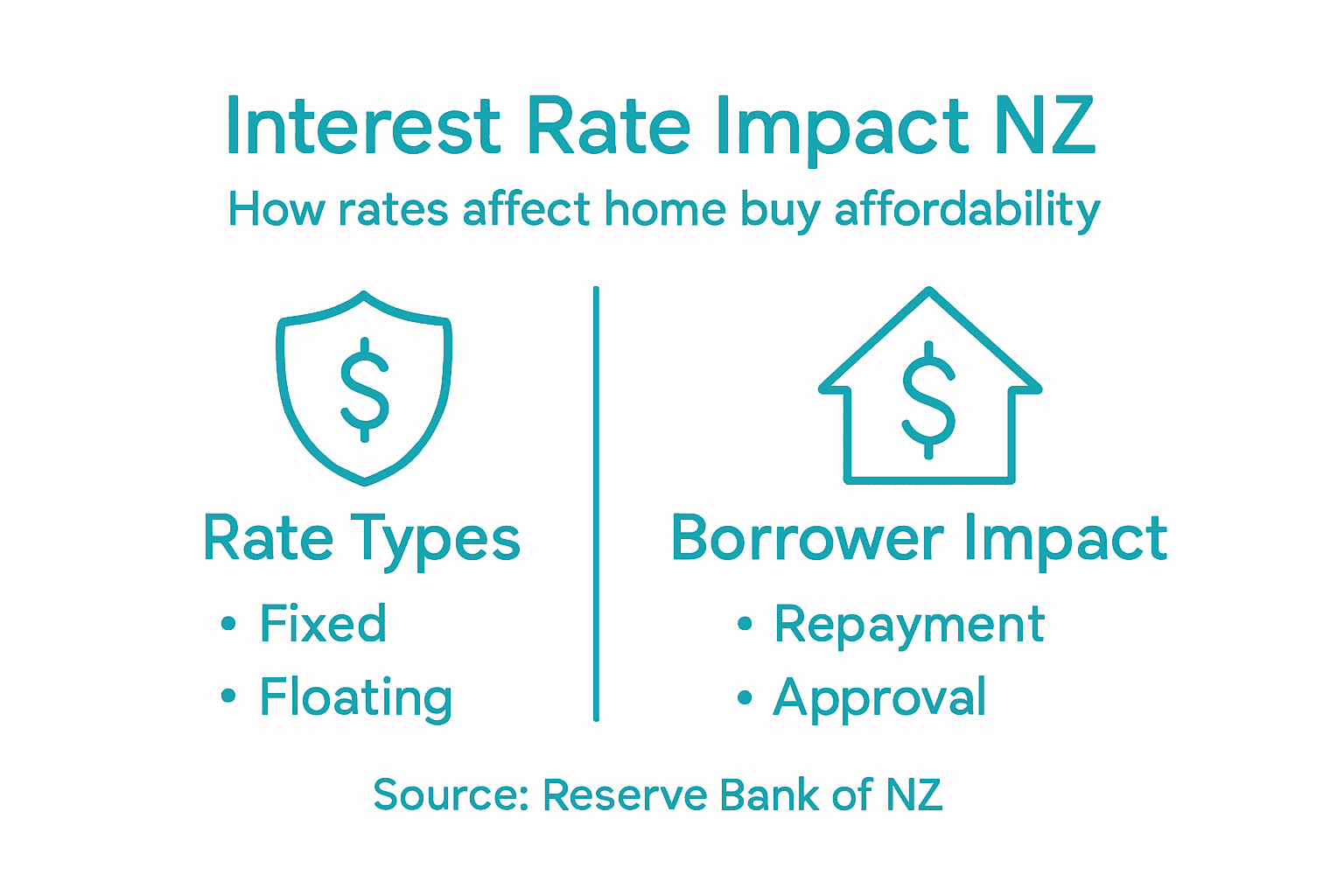
Banks typically offer two primary types of mortgage interest rates: fixed and floating rates. Fixed rates remain constant for a predetermined period, providing predictability in repayments. Floating rates, conversely, fluctuate with market conditions, offering more flexibility but potentially higher uncertainty.

The impact of interest rates extends far beyond simple numbers. A small percentage change can significantly affect your long-term financial planning. For instance, a 0.5% increase in mortgage rates could translate to hundreds of additional dollars in monthly repayments for the average Auckland homebuyer.
Pro tip: Always compare multiple lenders and negotiate interest rates, as even a minor difference can save you thousands over your mortgage’s lifetime.
Types Of NZ Home Loan Rates Available
In New Zealand, home loan interest rates come in several distinct configurations, each designed to meet different financial strategies and risk tolerances. The primary types of home loan rates are carefully structured to provide borrowers with flexible options for managing their mortgage repayments. According to the Reserve Bank’s mortgage rate statistics, these rates are continuously monitored and adjusted based on economic conditions.
The main types of home loan rates in New Zealand include:
-
Fixed Rates: Locked in for specific periods (1-5 years)
- Provide predictable repayments
- Shield borrowers from market fluctuations
- Typically offered in 6-month, 1-year, 2-year, 3-year, and 5-year terms
-
Floating Rates: Variable interest rates that change with market conditions
- More flexible repayment options
- Potential to benefit from rate decreases
- Higher risk of unexpected payment changes
-
Hybrid Rates: Combination of fixed and floating rate elements
- Split loan portions between fixed and floating rates
- Allows partial protection and partial market exposure
- Provides balanced risk management strategy
Each rate type carries unique advantages and potential drawbacks. Fixed rates offer stability and predictability, making them attractive for budget-conscious borrowers who prefer consistent monthly payments. Floating rates, conversely, provide more flexibility but introduce an element of financial uncertainty.
Here’s a breakdown comparing NZ mortgage rate types with their main budgeting impact:
| Rate Type | Budget Certainty | Adjustability | Potential Cost Over Time |
|---|---|---|---|
| Fixed | Very predictable | Cannot adjust | Often higher if rates fall |
| Floating | Unpredictable | Can adjust | May decrease if rates drop |
| Hybrid | Moderately stable | Partially adjustable | Balanced, depending on split |
Pro tip: Consider splitting your mortgage between fixed and floating rates to create a balanced approach that mitigates potential interest rate risks while maintaining some financial flexibility.
How OCR Changes Affect Lending Options
The Official Cash Rate (OCR) serves as a critical economic lever that directly influences lending options across New Zealand’s financial landscape. Reserve Bank’s monetary policy demonstrates how these strategic adjustments ripple through the entire lending ecosystem, ultimately affecting mortgage rates, borrowing costs, and financial decision-making for homebuyers.
Key impacts of OCR changes on lending options include:
-
Mortgage Interest Rates
- Direct correlation with OCR movements
- Lower OCR typically reduces borrowing costs
- Higher OCR increases lending expenses
-
Lending Accessibility
- OCR influences bank’s willingness to lend
- Lower rates encourage more lending
- Higher rates can restrict credit availability
-
Borrower Strategies
- Timing mortgage applications around OCR trends
- Considering fixed vs floating rates
- Evaluating long-term financial implications
When the Reserve Bank reduces the OCR, banks often respond by lowering their lending rates. This creates a more attractive environment for home buyers, potentially making mortgages more affordable and accessible. Conversely, when the OCR increases, lending becomes more expensive, which can slow down property market activity and reduce borrowing appetite.
The following table summarises how changes in the Official Cash Rate (OCR) can affect home buyers:
| OCR Trend | Effect on Mortgage Rates | Typical Lending Climate | Borrower Response |
|---|---|---|---|
| OCR falls | Rates usually decline | Easier access to loans | More buyers enter market |
| OCR rises | Rates typically increase | Tougher lending criteria | Buyers delay borrowing decisions |
Pro tip: Monitor OCR announcements closely and consult with a mortgage adviser to understand how potential rate changes might impact your specific lending options and financial strategy.
Impact On Affordability For Credit Issues
Household debt statistics reveal the complex challenges facing New Zealand home buyers with credit issues. Rising interest rates and stringent lending criteria create significant barriers for individuals with less-than-perfect credit histories, dramatically impacting their mortgage affordability and borrowing options.
Key challenges for borrowers with credit issues include:
-
Credit Score Limitations
- Reduced lending eligibility
- Higher interest rate loading
- Potential requirement for additional security
-
Financial Stress Factors
- Increased weekly mortgage payments
- Limited borrowing capacity
- Higher risk of loan rejection
-
Mitigation Strategies
- Improving credit score before application
- Seeking specialist mortgage advisers
- Exploring alternative lending options
The financial landscape for credit-challenged borrowers is particularly challenging. Adverse credit can significantly increase borrowing costs, with lenders typically charging higher interest rates to compensate for perceived risk. This means individuals with credit issues may face substantially higher monthly repayments compared to borrowers with pristine credit histories.
Pro tip: Obtain a comprehensive credit report and work with a specialist mortgage adviser to develop a strategic plan for improving your credit profile and mortgage eligibility.
Common Risks And Mistakes To Avoid
Consumer research on house hunting reveals critical pitfalls that can derail home buying plans for New Zealand purchasers. Understanding and anticipating these potential risks is crucial for making informed financial decisions and avoiding costly mistakes in the property market.
Common risks home buyers should be aware of include:
-
Financial Miscalculations
- Underestimating total purchase costs
- Failing to budget for additional expenses
- Overlooking maintenance and repair costs
-
Lending and Credit Risks
- Not securing pre-approved finance
- Neglecting credit score preparation
- Applying with insufficient financial documentation
-
Market and Property Risks
- Buying without comprehensive property inspections
- Ignoring potential market volatility
- Overcommitting to properties beyond financial capacity
The Reserve Bank’s housing market analysis highlights the importance of comprehensive risk assessment. Market conditions can shift rapidly, and home buyers who fail to conduct thorough research may find themselves vulnerable to significant financial challenges. This includes understanding potential interest rate fluctuations, supply constraints, and broader economic factors that could impact property values.
Pro tip: Build a support team of professionals including a mortgage adviser, property inspector, and financial planner to comprehensively assess and mitigate potential risks before making a property purchase.
Take Control of Your Mortgage Journey Despite Interest Rate Changes
Navigating the complex world of mortgage interest rates in New Zealand can be overwhelming. With factors like fluctuating OCR levels, fixed or floating rate options, and credit considerations all affecting your borrowing power, you need expert guidance tailored to your unique financial goals and challenges. Mortgage Managers understands these hurdles and specialises in helping home buyers in Auckland and across New Zealand make sense of their lending options while creating the best possible plan to manage repayment risks and affordability.

Don’t let unpredictability in interest rates or credit concerns hold you back. Connect with our local Auckland mortgage advisers at Mortgage Managers for personalised advice that reflects up-to-date market insights and your specific situation. Explore how our team supports smarter borrowing strategies by visiting our homepage or learning about our expert services. Your path to greater financial confidence starts here—act now to secure the best possible mortgage deal before market changes impact your buying power.
Frequently Asked Questions
What are fixed and floating mortgage rates?
Fixed mortgage rates remain constant for a set period, providing predictable repayments, while floating rates fluctuate with market conditions, offering flexibility but more uncertainty.
How do changes in the Official Cash Rate (OCR) affect mortgage rates?
Changes in the OCR directly influence mortgage interest rates; a lower OCR typically leads to reduced borrowing costs, making mortgages more affordable, whereas a higher OCR increases lending expenses.
What impact do interest rates have on my home buying affordability?
Interest rates significantly affect your monthly mortgage repayments, where even a small increase can lead to higher costs, impacting your financial planning and overall affordability when seeking a home loan.
How can I prepare for mortgage application with credit issues?
To improve your chances, work on enhancing your credit score before applying, gather all necessary financial documentation, and consider seeking advice from a specialist mortgage adviser who can guide you through alternative lending options.