
TL;DR:
- A conditional offer in New Zealand property buying is a legal agreement that becomes binding only after specific conditions are met within a set timeframe. It provides crucial protection by allowing buyers to withdraw without penalty if conditions like finance approval or inspections are not fulfilled, as there is no cooling-off period once the deal is unconditional. Once all conditions are satisfied and the offer turns unconditional, the buyer becomes fully committed, risking their deposit if they default.
A conditional offer in New Zealand property buying is a formal agreement to purchase a home, subject to specific conditions that must be satisfied within an agreed timeframe before the sale becomes legally binding. Known formally as a “subject to” clause within a Sale and Purchase Agreement, this type of offer gives you, the buyer, a structured window to complete due diligence before fully committing. Conditional offers are the only effective buyer protection in NZ property purchases, because unlike some other countries, New Zealand residential property law provides no cooling-off period once a deal goes unconditional. Understanding conditional offers is not just useful knowledge. It is your primary safeguard in one of the biggest financial decisions of your life.

What is a conditional offer in NZ property buying?
A conditional offer is defined as a purchase offer that becomes binding only after named conditions are met within a set timeframe. The four most common conditions in NZ Sale and Purchase Agreements are finance approval, a building inspection, a Land Information Memorandum (LIM) report, and the sale of an existing property. Each condition acts as a checkpoint, giving you the legal right to withdraw from the purchase without penalty if that checkpoint cannot be cleared.
The Sale and Purchase Agreement is the legal contract used in all NZ residential property transactions. When you include a condition, you are not reducing your commitment. You are defining the terms under which your commitment becomes absolute. Timeframes typically run between 5 and 15 working days from the agreement date, depending on what each condition requires. A finance condition may need 10 working days, while a building inspection might only need five.
This structure protects you from being legally bound to a purchase before you know the property is sound, the title is clean, and your bank has formally approved your loan.
What conditions are typically included, and why do they matter?
The conditions you include in your offer directly shape how much protection you have during the purchase process. Each one serves a distinct purpose.
- Finance condition: This requires your lender to formally approve the loan for the specific property you are buying. Pre-approval is not unconditional finance; banks must assess the property itself, its valuation, and its title before issuing final approval. Without a finance condition, you are legally committed even if your bank declines the loan.
- Building inspection condition: A registered building inspector examines the property for structural and material defects. Building report conditions cover material defects, not cosmetic issues like scuffed paint or worn carpet. A cracked foundation qualifies; a dated kitchen does not.
- LIM report condition: A LIM report is ordered from the local council and reveals consenting history, drainage information, zoning details, and any legal notices on the property. It can uncover unpermitted additions or flood-risk designations that are not visible during a standard inspection.
- Sale of existing property condition: If you need to sell your current home to fund the purchase, this condition protects you from owning two properties simultaneously. It is common among upgraders and is typically negotiated with a longer timeframe.
Pro Tip: Always include a finance condition even if you hold pre-approval. Lenders assess the property independently, and a low valuation or title issue can cause a previously approved loan to fall over.
How does the conditional period work in NZ?
The conditional period is the window between signing the Sale and Purchase Agreement and either satisfying all conditions or withdrawing from the deal. It is one of the most active and time-sensitive phases of any property purchase.
Here is the typical sequence of steps during a conditional period:
- Sign the agreement. The conditional period clock starts from the agreement date. Both parties are bound by the terms, but the sale is not yet final.
- Apply for formal finance approval. Submit your full loan application to your lender or mortgage adviser immediately. Do not wait. Lenders need time to assess the property valuation, your financials, and the title.
- Commission a building inspection. Book a registered building inspector as soon as possible. Reports typically take two to three working days to complete and review.
- Order the LIM report. Your solicitor usually handles this. LIM reports from Auckland Council can take up to ten working days, so order early.
- Review all reports with your solicitor. Your lawyer checks the title, reviews the LIM, and flags any legal concerns before you confirm the conditions are satisfied.
- Confirm or cancel. Once all conditions are satisfied, you notify the vendor in writing that the offer is unconditional. If a condition cannot be met, you cancel and your deposit is refunded.
If a condition is not met within the deadline, you can cancel the agreement without losing your deposit, provided you acted in good faith. Good faith is a legal obligation here. Buyers must base withdrawal on actual non-fulfilment of a specific condition, not a change of heart or a better property appearing on the market. Using a condition as a convenient exit without genuine grounds can expose you to legal risk.
The moment the offer goes unconditional is critical. Buyers lose deposit protections and become fully legally committed at that point. The deposit, typically 10% of the purchase price, is usually paid at this stage.
Pro Tip: Set a personal deadline two working days before the formal condition deadline. This gives you time to request an extension from the vendor if your bank or inspector needs more time, rather than scrambling at the last moment.
Conditional vs unconditional offers: what NZ buyers need to know
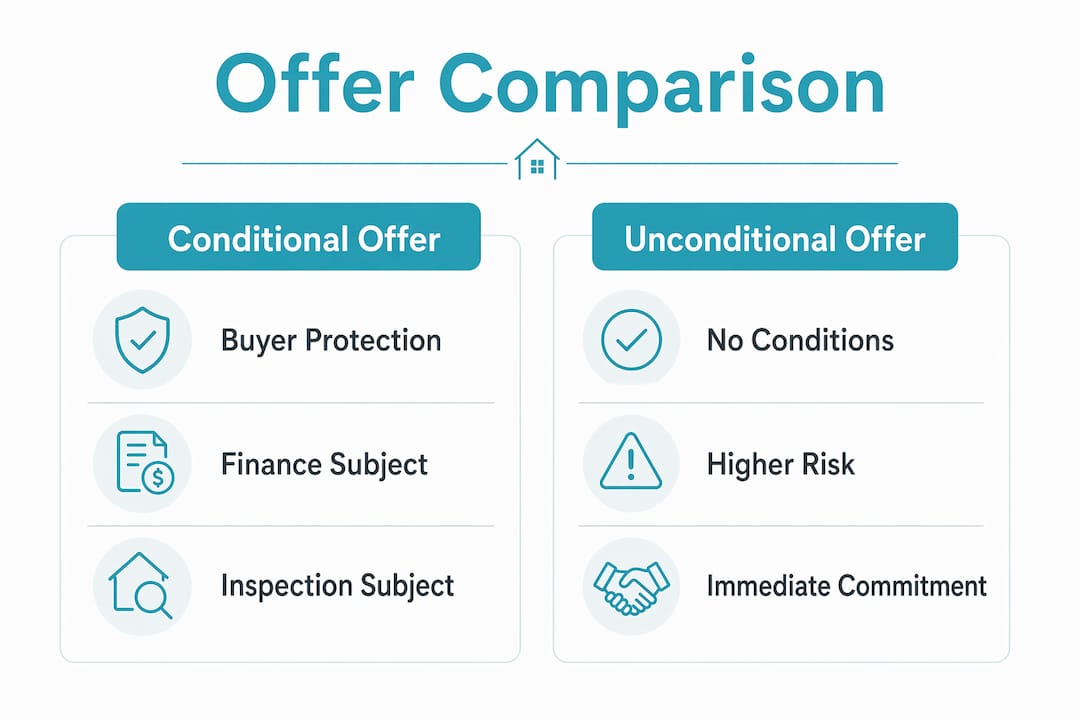
An unconditional offer is a purchase offer with no subject-to clauses. The moment both parties sign, the sale is legally binding and final. Sellers strongly prefer unconditional offers because they remove uncertainty and allow the transaction to proceed immediately.
Unconditional offers carry high risks for buyers if due diligence or finance is not already complete. If you go unconditional and your bank later declines the loan, you are still legally obligated to complete the purchase. Defaulting can result in losing your deposit and facing legal action from the vendor for any losses they suffer on a resale.
No cooling-off period exists in NZ residential property law. Once unconditional, there is no legal mechanism to withdraw without serious financial and legal consequences. This makes the conditional offer not just a preference but a necessity for most buyers.
The table below summarises the key differences:
| Feature | Conditional Offer | Unconditional Offer |
|---|---|---|
| Buyer protection | High. Conditions allow withdrawal without penalty. | None. Legally bound from signing. |
| Seller preference | Lower. Uncertainty during conditional period. | Higher. Immediate certainty for the vendor. |
| Finance risk | Low. Finance condition protects if loan is declined. | High. Buyer must complete regardless of finance. |
| Due diligence | Completed during conditional period. | Must be completed before signing. |
| Deposit at risk | Protected until conditions are satisfied. | At risk immediately upon signing. |
Going unconditional before completing due diligence makes sense in very limited circumstances, such as when you are a cash buyer, have already completed a pre-purchase building inspection, and hold a formal finance approval for that specific property. For the vast majority of buyers, a conditional offer is the right structure. You can explore the full comparison in this NZ buyer’s guide to offers from Mortgagemanagers.
Practical tips for managing conditional offers and home loans
The finance condition is the most critical clause in most conditional offers, and it is also the one most commonly misunderstood. Here is what you need to know to manage it well.
- Work with a mortgage adviser from day one. A mortgage adviser can prepare your full application before you even find a property, so you are ready to submit for formal approval the moment you sign. Mortgagemanagers works with buyers across Auckland and remotely throughout New Zealand to do exactly this.
- Understand the difference between pre-approval and formal approval. Pre-approval does not guarantee final finance; the bank must approve the specific property, its valuation, and the title. Always include a finance condition regardless of your pre-approval status.
- Do not assume your valuation will match the purchase price. If the bank’s registered valuation comes in below the agreed price, your loan amount may be reduced. This can affect your deposit requirements and, in some cases, cause the finance condition to fail.
- Communicate clearly with the vendor’s agent. If you need more time to satisfy a condition, ask for an extension early. Vendors are often willing to extend by a few days if you communicate promptly and professionally.
- If a condition fails, act immediately. Notify your solicitor and the vendor’s agent in writing before the deadline expires. Missing the deadline can mean the condition is deemed waived, leaving you legally bound to the purchase.
The home loan documents checklist from Mortgagemanagers is a practical starting point for gathering everything your lender will need during the conditional period.
Key takeaways
A conditional offer is the single most important legal protection available to NZ home buyers, because no cooling-off period exists once a purchase goes unconditional.
| Point | Details |
|---|---|
| Conditional offer meaning | A purchase offer that becomes binding only after named conditions are satisfied within a set timeframe. |
| Common conditions | Finance, building inspection, LIM report, and sale of existing property are the four standard conditions in NZ. |
| Finance condition is critical | Pre-approval is not final approval; always include a finance condition even if your lender has pre-approved you. |
| Good faith obligation | Cancellation must be based on genuine non-fulfilment of a condition, not a change of mind or better offer elsewhere. |
| Going unconditional | Once unconditional, you are fully legally committed and your deposit is at risk if you default. |
Why conditional offers matter more than most buyers realise
I have worked with hundreds of buyers across Auckland and wider New Zealand, and the single most common mistake I see is underestimating what the conditional period actually protects you from. First-time buyers often treat it as a formality. It is not.
The absence of a cooling-off period in New Zealand is something that genuinely surprises people when they first hear it. In Australia, most states provide buyers with a short cooling-off window after signing. In New Zealand, that protection does not exist. Your conditional clauses are the entire safety net.
What I have also noticed is that lending criteria have tightened considerably over the past few years. Banks are scrutinising property valuations, income documentation, and debt-to-income ratios more carefully than they were in 2021 or 2022. Pre-approvals that felt solid six months ago can fall over when a specific property is assessed. This makes the finance condition more important now, not less.
My honest advice is this: do not shorten your conditional period to make your offer more attractive to a seller unless you have already done the groundwork. A 10-working-day finance condition with a strong offer price is far safer than a five-day condition that leaves your mortgage adviser scrambling. Sellers want certainty, but they also want a deal that actually settles. A well-structured conditional offer with a realistic timeframe signals that you are a serious, prepared buyer.
— Stuart
How Mortgagemanagers can help you through the conditional period
Securing finance approval within a conditional period is one of the most time-sensitive tasks in any property purchase. Having the right support makes the difference between a smooth settlement and a stressful scramble.

Mortgagemanagers is a locally owned and operated mortgage advisory business based in Hobsonville, Auckland. The team works with buyers across West Auckland, the North Shore, and remotely throughout New Zealand to prepare finance applications, liaise with lenders, and guide you through every stage of the conditional period. Whether you are a first-home buyer or an experienced investor, having a dedicated mortgage adviser in your corner means your finance condition is handled with precision and speed. Book a consultation with Mortgagemanagers today and go into your next offer with confidence.
FAQ
What does a conditional offer mean in NZ property?
A conditional offer means you agree to buy a property only if specific conditions, such as finance approval or a building inspection, are satisfied within an agreed timeframe. If any condition is not met, you can withdraw without losing your deposit.
How long does a conditional period last in new zealand?
Conditional periods typically run between 5 and 15 working days from the agreement date, depending on the conditions included and what each one requires to be satisfied.
Can i cancel a conditional offer for any reason?
No. Cancellation must be linked to genuine non-fulfilment of a specific condition within the agreed timeframe. Using a condition as a pretext to exit for unrelated reasons can expose you to legal liability.
Is pre-approval enough to skip a finance condition?
Pre-approval is not final finance approval. Banks must approve the specific property, its valuation, and its title before issuing a formal loan offer. Always include a finance condition regardless of your pre-approval status.
What happens when a conditional offer becomes unconditional?
Once all conditions are satisfied and both parties are notified in writing, the offer becomes unconditional and legally binding. The buyer typically pays the deposit at this point and is fully committed to completing the purchase.