
TL;DR:
- A house loan in New Zealand is a secured loan used to purchase property and is usually repaid over 25 to 30 years through a fixed repayment structure. Starting with interest-heavy payments, extra repayments made early can significantly shorten the loan term and save interest costs, especially with consistent additional payments. Borrowers can choose from fixed, floating, interest-only, revolving credit, or split loans, and working with a mortgage broker helps access more options and negotiate better rates.
A house loan is a secured loan where a lender provides funds to purchase property, and you repay that amount plus interest over a set term. In New Zealand, most borrowers repay over 25–30 years through a structure called a table loan, where your monthly repayment stays fixed but the split between interest and principal shifts over time. Understanding how do house loans work gives you a real advantage before you speak to a lender or sign anything. This guide covers repayment structures, loan types, the application process, and when a mortgage adviser can save you money.
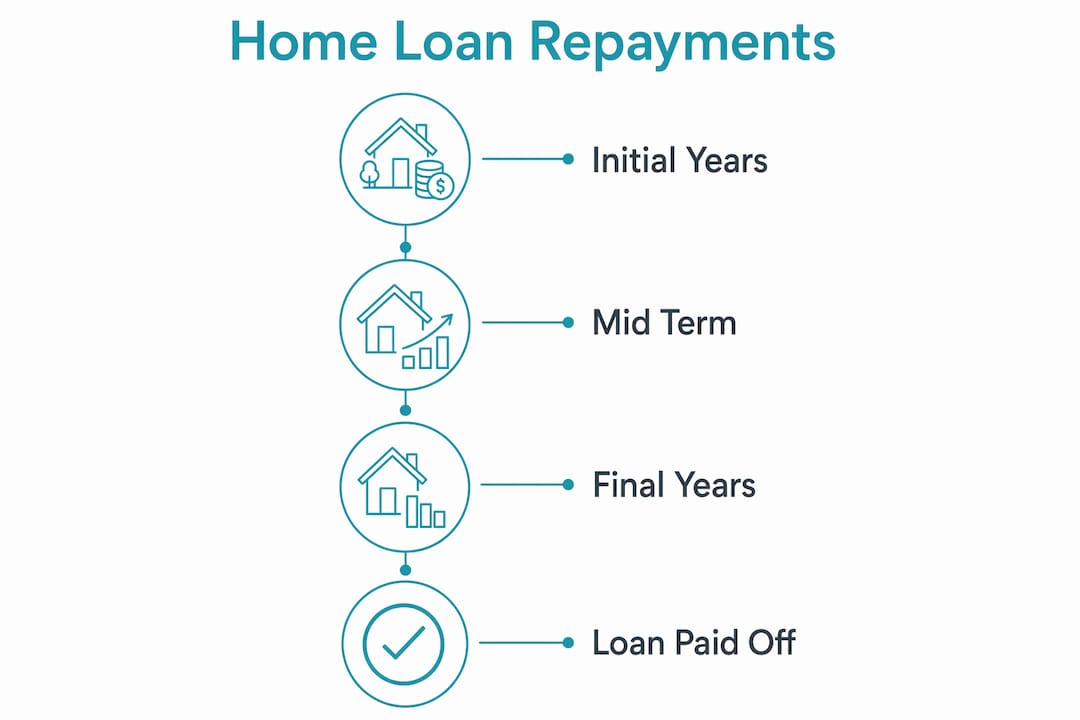
How do house loans work: repayment structures explained
Table loans are the standard mortgage structure in New Zealand, and they work through a process called amortisation. Your repayment amount stays the same every month, but in the early years, most of that payment covers interest rather than reducing your actual debt.

Take a $640,000 loan at 5.66% over 30 years. Your monthly repayment sits at around $3,693. In the first year, the bulk of that goes to interest. By year 25, the balance has flipped and most of each payment reduces the principal. That shift is amortisation in action.
This structure matters because it means your debt reduces slowly at first. Many borrowers are surprised to find that after five years of repayments, their loan balance has barely moved. The good news is that extra repayments made early have an outsized effect.
Extra repayments early in the loan term can cut years off your mortgage and save a significant amount in interest. On a $640,000 loan at 5.66% over 30 years, adding $500 per month to your repayments can shorten the term by more than seven years and save approximately $170,000 in total interest. That is one of the most powerful financial moves available to a homeowner.
Pro Tip: Set up an automatic extra payment of even $100 per fortnight from day one. You will barely notice it in your budget, but the compounding effect over 30 years is substantial.
Repayment structure at a glance
| Loan stage | Interest portion | Principal portion |
|---|---|---|
| Years 1–5 | High (majority of repayment) | Low |
| Years 10–15 | Moderate | Moderate |
| Years 20–25 | Low | High (majority of repayment) |
| Final years | Minimal | Almost all principal |
What types of home loans are available in New Zealand?
New Zealand lenders offer several distinct loan types. Choosing the right one depends on your financial situation, risk tolerance, and how long you plan to hold the property.
- Fixed rate loans. Your interest rate is locked for a set term, typically 6 months up to 5 years. Repayments do not change during that period, which makes budgeting straightforward. Fixed rates suit borrowers who want certainty and protection from rate rises.
- Floating rate loans. Your rate moves with the market, specifically the Reserve Bank of New Zealand’s Official Cash Rate (OCR). Floating rates typically start higher than fixed rates but give you the freedom to make lump sum repayments without penalty.
- Interest-only loans. You pay only the interest for an agreed period, usually 1–5 years. Your principal does not reduce during this time. These suit investors managing cash flow, but the transition to full principal and interest repayments can be a shock if you are not prepared.
- Revolving credit facilities. This works like an overdraft attached to your mortgage. When your salary lands in the account, it immediately reduces your daily balance and cuts the interest charged. You can draw funds back up to your limit as needed. Used well, it can save meaningful interest over the loan term.
- Split loans. Borrowers commonly combine fixed and floating portions. For example, you might fix 70% of your loan for certainty and leave 30% floating so you can make extra repayments freely. This balances stability with flexibility.
Most first home buyers start with a fixed rate loan for the predictability it offers. As your confidence and financial position grow, you can restructure at each fixed term rollover.
How to apply for a mortgage in New Zealand
Applying for a home loan is a process with clear stages. Knowing what to expect at each step reduces stress and improves your chances of approval.
-
Get your finances in order. Lenders look at your credit history, savings behaviour, and income stability. Pay down consumer debt, avoid new credit applications, and keep your bank statements clean for at least three months before applying.
-
Gather your documents. You will typically need payslips or tax returns, bank statements for the past three months, identification, and details of any existing debts or assets. Self-employed borrowers need two years of financial statements.
-
Seek pre-approval. Pre-approval is a conditional commitment from a lender, valid for 60–90 days. It tells you roughly how much you can borrow. Pre-approval is not a guaranteed loan. Treat it as a starting point, not a finish line.
-
Make an offer on a property. Once you find a property, your offer is usually conditional on finance. This gives you time to get the lender’s formal valuation and complete final checks.
-
Unconditional approval and settlement. After your offer is accepted, the lender performs a valuation and verifies all documentation. Once satisfied, they issue unconditional approval. Settlement follows, typically 10–20 working days later.
Lenders do not just check your income. They assess debts, expenses, and stress test your ability to handle higher interest rates, often up to 8%. The Reserve Bank of New Zealand’s debt-to-income rules also cap owner-occupier loans at approximately 6 times gross household income. That cap catches many applicants off guard.
Pro Tip: Do not make any large purchases or change jobs between pre-approval and settlement. Lenders re-verify your financial position before final approval, and any change can derail the process.
Common pitfalls include applying to multiple lenders simultaneously (which leaves multiple credit enquiries on your file), underestimating living expenses in your application, and assuming pre-approval means the loan is confirmed. Timing also matters. Pre-approval expires after 60–90 days, so align your property search accordingly.
Why use a mortgage broker for your home loan?
A mortgage broker acts as your advocate in the lending market, accessing multiple lenders on your behalf rather than just one bank’s product range.
- Broader market access. Brokers access 10–20 or more lenders, including banks, credit unions, and non-bank lenders. A single bank can only offer its own products.
- No direct fees. Brokers are paid by the lender, not by you. You receive professional advice and application management at no direct cost.
- Better rates. Advertised “carded rates” are marketing prices. Brokers negotiate unpublished rates by matching your borrower profile to lenders actively seeking that type of business. This can result in a meaningfully lower rate than walking into a branch.
- Cashback offers. Some lenders offer cashback incentives to attract borrowers. Brokers know which lenders are running these offers and can factor them into your comparison.
- Complex situations. Self-employed borrowers, those with variable income, or buyers with a non-standard credit history often struggle with direct bank applications. Brokers know which lenders suit complex cases and present your application in the most favourable light.
- First home buyer support. Brokers familiar with New Zealand’s government assistance schemes can help eligible buyers access programmes like the First Home Loan or KiwiSaver first home withdrawal.
A direct bank application makes sense if your finances are straightforward, you have an existing relationship with the bank, and you have already done thorough rate comparisons. For most borrowers, though, a broker’s market breadth and negotiation power deliver better outcomes. You can read more about broker advantages for buyers on the Mortgagemanagers website.
Key takeaways
Understanding how house loans work is the foundation of every sound property decision in New Zealand, from choosing the right loan type to timing your application and managing repayments over the long term.
| Point | Details |
|---|---|
| Table loans dominate NZ | Most mortgages use fixed repayments where interest dominates early and principal grows later. |
| Extra repayments pay off | Adding $500 per month on a $640,000 loan can save approximately $170,000 in interest. |
| Pre-approval has limits | Pre-approval lasts 60–90 days and is conditional, not a guaranteed loan offer. |
| Loan types suit different needs | Fixed, floating, revolving credit, and split structures each serve different financial goals. |
| Brokers access more options | Brokers reach 10–20 or more lenders and can negotiate rates not available at the branch. |
What I have learned from years of watching borrowers get this wrong
The most common mistake I see is borrowers treating the mortgage process as a one-time event rather than an ongoing financial relationship. They get the loan, breathe a sigh of relief, and then ignore it for 30 years. That is an expensive habit.
The second mistake is honesty gaps. Borrowers sometimes downplay expenses or debts when speaking to a lender or broker. Lenders stress test at rates up to 8% and scrutinise bank statements carefully. If the numbers do not add up, the application fails at the worst possible moment, after you have already made an offer on a property. Full disclosure upfront protects you.
What actually works is treating your mortgage like a living financial tool. Review it at every fixed rate rollover. Ask whether your current structure still fits your life. Consider whether refinancing makes sense. A small rate improvement on a large loan balance compounds into real money over time.
The borrowers I have seen do best are those who make small extra repayments from day one, stay engaged with their loan structure, and use a broker at each rollover to check whether a better deal exists elsewhere. They do not wait for the bank to offer them a better rate. They ask, or they move.
— Stuart
How Mortgagemanagers can help you find the right home loan
Mortgagemanagers is a locally owned mortgage advisory business based in Hobsonville, Auckland, serving buyers across West Auckland, the North Shore, and remotely throughout New Zealand.

As personal shoppers for your home loan, the Mortgagemanagers team accesses a broad panel of lenders to find rates and structures that match your situation, not just the nearest branch’s standard offer. Whether you are a first home buyer working through KiwiSaver and First Home Loan eligibility, a self-employed borrower with complex income, or a homeowner due for a rate rollover, the team manages the process from application through to settlement. There are no direct fees to you. Get in touch with Auckland mortgage advisers who know the lender market and can put your best case forward.
FAQ
What is a house loan in New Zealand?
A house loan, formally called a mortgage, is a secured loan where a lender provides funds to purchase property and holds that property as security until the loan is repaid in full.
How long does a typical home loan last in New Zealand?
Most New Zealand home loans run for 25–30 years, though borrowers can choose shorter terms or reduce their effective term by making extra repayments.
What is the difference between fixed and floating interest rates?
A fixed rate locks your interest rate for a set term of 6 months up to 5 years, giving repayment certainty. A floating rate moves with the OCR and allows lump sum repayments without penalty.
Is pre-approval the same as loan approval?
Pre-approval is a conditional, in-principle commitment valid for 60–90 days. It is not a guaranteed loan. Final approval requires a property valuation and full documentation verification.
Do mortgage brokers charge fees in New Zealand?
Mortgage brokers in New Zealand are paid by the lender, not the borrower. You receive access to multiple lenders and professional application support at no direct cost to you.