
TL;DR:
- Getting a mortgage in New Zealand requires proof of identity, income, and deposit, with lenders adhering to RBNZ rules on loan-to-value and debt limits. Eligible buyers can access government-backed schemes like the Kāinga Ora First Home Loan with lower deposits and higher LVRs. Preparing accurate documents and understanding the approval timeline help buyers avoid delays and increase their chances of approval.
Getting a mortgage loan means borrowing money secured against a property, and New Zealand lenders require proof of identity, income, deposit, and creditworthiness before approving any application. The Reserve Bank of New Zealand (RBNZ) sets the regulatory framework that governs deposit sizes, loan-to-value ratios (LVR), and debt-to-income (DTI) limits that every lender must follow. Knowing what to prepare before you approach a bank or mortgage adviser puts you firmly in control of the process. Government-backed options like the Kāinga Ora First Home Loan also change the picture for eligible buyers, making a 5% deposit achievable where 20% would otherwise be the standard.
What financial documents do you need for a mortgage application?
A complete mortgage application checklist covers five core document categories, and missing even one can delay your approval by days. Lenders use these documents to verify who you are, how much you earn, how you manage money, and where your deposit comes from. Preparing them before you apply removes the most common source of friction in the process.
Identity documents
You need a current New Zealand passport or driver’s licence. Some lenders accept both together as a stronger proof of identity, particularly for online applications.

Income evidence
Employees need 3 payslips from the last three months, along with a current employment contract if available. Self-employed applicants face a higher bar. Banks require two years of financial statements and tax returns, and they often average the two years of income or use the lower figure to calculate borrowing capacity. That approach can significantly reduce what a self-employed buyer qualifies for, even when their most recent year was strong.
Bank statements and deposit proof
Lenders ask for 3–6 months of bank statements covering all accounts. They are looking for consistent income credits, responsible spending patterns, and no unexplained large withdrawals. Deposit evidence must show the source clearly: savings history, a KiwiSaver balance statement, a signed gifting letter from family, or proceeds from an asset sale all qualify.
Existing debt declarations
You must disclose all current liabilities. That includes credit cards (even unused ones), personal loans, car finance, student loans, and Buy Now Pay Later (BNPL) accounts. Lenders factor every liability into your DTI calculation, so omitting debts is both a compliance issue and a fast track to a declined application.
Pro Tip: Close any credit cards you no longer use before applying. Even a zero-balance card reduces your assessed borrowing capacity because lenders count the full credit limit as a potential liability.
How much deposit do you need and what are the LVR restrictions?
Deposit requirements in New Zealand are set by RBNZ’s LVR rules, and they vary significantly depending on whether you are an owner-occupier, a first-home buyer using a government scheme, or a property investor. Understanding home deposit requirements before you start saving prevents costly surprises later.
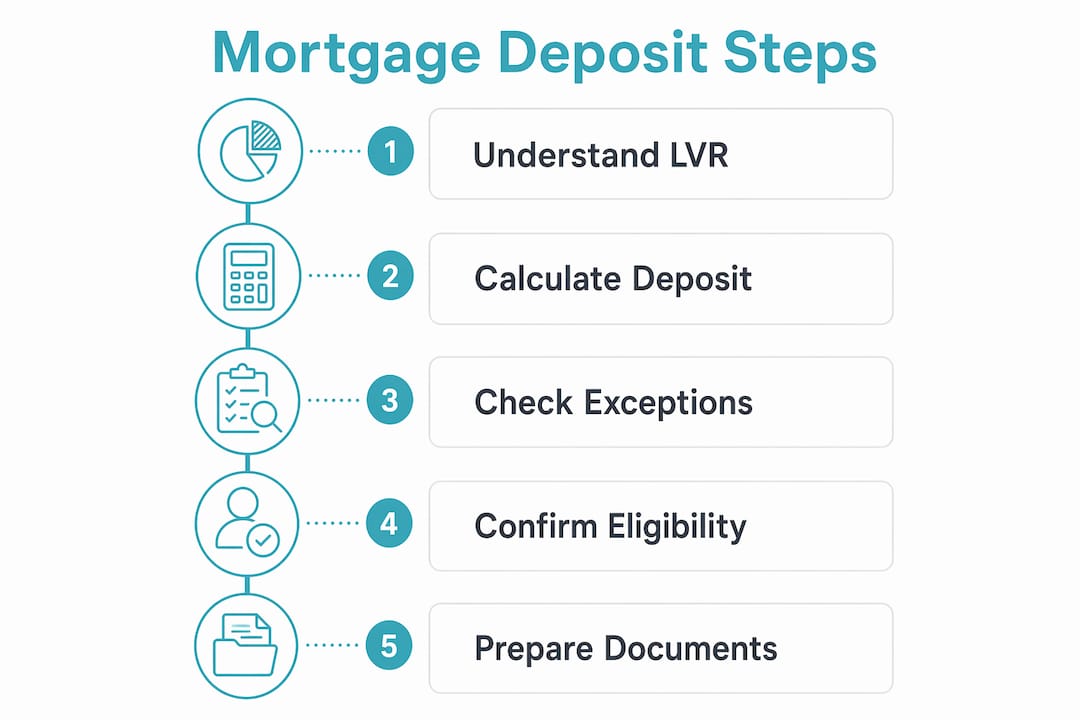
The standard owner-occupier deposit is 20%, meaning you can borrow up to 80% of the property’s value. Investors face a higher threshold, typically 30%, reflecting the greater risk lenders associate with non-owner-occupied lending.
| Buyer type | Minimum deposit | LVR limit | Notes |
|---|---|---|---|
| Owner-occupier | 20% | 80% | Standard rule for most buyers |
| First Home Loan (Kāinga Ora) | 5% | 95% | Income and price caps apply |
| High-LVR owner-occupier | 10–19% | 81–90% | Limited availability, rate premium applies |
| Property investor | 30% | 70% | Higher deposit required by RBNZ |
The Kāinga Ora First Home Loan is the most significant exception to the 20% rule. The government guarantees 15% of the purchase price, which allows eligible buyers to access a 95% LVR loan with just a 5% deposit. No lender mortgage insurance is required, unlike other high-LVR products. Income caps apply: $95,000 for a single buyer and $150,000 for combined household income, with regional house price limits also in effect.
High-LVR lending between 10% and 19% deposit is available but restricted. Banks allocate only a limited share of their lending to this bracket, and borrowers typically pay a higher interest rate to compensate for the increased risk.
Eligible deposit sources include cash savings, KiwiSaver withdrawals after three years of contributions, gifted funds from immediate family, and proceeds from selling other assets. RBNZ’s DTI rules cap owner-occupier borrowing at 6 times gross income, which means a household earning $120,000 combined can borrow a maximum of $720,000 regardless of deposit size.
Pro Tip: Check your KiwiSaver balance early. If you have been contributing for at least three years, you may be able to withdraw most of your balance as part of your deposit, which can make a meaningful difference to your total savings.
What is the mortgage approval process and timeline?
The mortgage approval process follows a clear sequence, and knowing each stage helps you plan your property search with confidence. A full mortgage approval process guide covers every checkpoint from initial enquiry to settlement.
- Pre-approval application. You submit your documents to a lender or mortgage adviser. Pre-approval takes 2–7 business days and is valid for 90 days. It gives you a conditional borrowing limit to use when making offers on properties.
- Property search and offer. You find a property and sign a Sale and Purchase Agreement, typically with a finance condition attached. This condition gives you a safety window of 5–10 working days to secure formal bank approval.
- Formal application submission. Your lender receives the signed agreement and orders a registered valuation of the property. Underwriting checks confirm your financial position has not changed since pre-approval.
- Formal approval. Formal approval takes 5–10 business days after the agreement is signed. The bank confirms the loan amount, interest rate, and conditions.
- Solicitor review. Your solicitor reviews the LIM report, property title, and contract before you waive the finance condition. Never use the vendor’s solicitor. The conflict of interest risk is real and avoidable.
- Settlement. Funds are drawn down on the agreed settlement date, and ownership transfers to you.
Lenders also apply a stress test during underwriting. They assess whether you can still afford repayments if interest rates rise by 2–3% above the current market rate. That test reduces your assessed borrowing capacity more than many buyers expect, particularly when rates are already elevated.
How do credit history and living expenses affect your eligibility?
Your credit history and declared living expenses are two of the most influential factors in a lender’s serviceability assessment. Banks pull your credit report from agencies like Equifax or Centrix and look for patterns that signal financial risk.
The factors lenders scrutinise most closely include:
- Credit defaults or judgements. Any unpaid debt that has been referred to a collection agency or resulted in a court judgement will appear on your report and significantly reduce your approval chances.
- Payment timeliness. Late payments on credit cards, utilities, or loans are recorded and weigh against you, even if the amounts were small.
- Credit card utilisation. Consistently using a high percentage of your credit limit signals financial stress to lenders, even if you pay the balance monthly.
- Employment stability. Lenders prefer at least six months in your current role. Probationary employment is treated cautiously, and contract or casual work requires additional income evidence.
- Existing debt load. Student loans, car finance, and BNPL accounts all reduce your borrowing capacity through their impact on your DTI ratio.
Banks assess living expenses using either your declared actual expenses or a benchmark called the Household Expenditure Measure (HEM). HEM is a minimum living cost estimate based on household size. If your actual expenses are higher than HEM, lenders use the higher figure. Higher declared expenses directly reduce the loan amount you qualify for.
Pro Tip: Review your bank statements for the three months before applying and reduce discretionary spending where you can. Lenders see every transaction, and a pattern of large entertainment or gambling expenses raises flags regardless of your income level.
Key takeaways
Securing a mortgage in New Zealand requires a deposit of at least 5–20%, verified income and identity documents, a clean credit history, and compliance with RBNZ’s DTI and LVR rules.
| Point | Details |
|---|---|
| Minimum deposit varies | Owner-occupiers need 20%; Kāinga Ora First Home Loan buyers may qualify with 5%. |
| Documents are non-negotiable | Identity, 3 payslips or 2 years financials, bank statements, and debt declarations are all required. |
| DTI cap limits borrowing | RBNZ caps owner-occupier borrowing at 6 times gross income, regardless of deposit size. |
| Pre-approval is conditional | Changes to your job or debts after pre-approval can result in formal decline. |
| Credit history matters | Defaults, late payments, and high card utilisation all reduce your approval chances. |
Stuart’s take on getting mortgage-ready in New Zealand
Pre-approval is the step most buyers misunderstand. They treat it as a guarantee, then make financial decisions that quietly undermine it. I have seen buyers take out car finance between pre-approval and formal application, and then watch their loan get declined because the new liability pushed their DTI over the RBNZ limit. Pre-approval is a conditional offer, not a promise. Keep your finances completely stable from the moment you receive it until settlement is done.
The other mistake I see regularly is leaving document preparation too late. Banks do not move faster because you are in a hurry. If your payslips are outdated, your KiwiSaver statement is six months old, or you cannot explain a large deposit in your account, the process stalls. Gather everything before you even start looking at properties.
Self-employed buyers need to be especially prepared. Banks average two years of income or use the lower year. If your business had a rough year in 2024 but a strong 2025, the bank may still lend based on the 2024 figure. A mortgage adviser who understands self-employed lending criteria can identify which lenders take a more favourable view of your income structure.
The finance condition period in your Sale and Purchase Agreement is your safety net. Use every day of it. Get your solicitor to review the title and LIM report before you waive that condition. I have seen buyers skip the solicitor review to save a few hundred dollars and then discover a problem with the title after settlement. That is not a saving. That is a risk with no upside.
— Stuart
How Mortgagemanagers helps you secure the right home loan
Mortgagemanagers is a locally owned Auckland mortgage advisory business based in Hobsonville, with advisers who work with buyers across West Auckland, the North Shore, and remotely throughout New Zealand. Getting the right loan is not just about finding the lowest rate. It is about matching your financial situation to the right lender and the right product.

Mortgagemanagers’ expert mortgage advisers assess your full financial picture, prepare your application documents, and approach multiple lenders on your behalf. They have direct knowledge of Kāinga Ora First Home Loan eligibility criteria and can identify whether you qualify before you apply. For self-employed buyers or those with complex income structures, that expertise saves significant time and reduces the risk of a declined application. Talk to the team at Mortgagemanagers and get clarity on your borrowing position before you start making offers.
FAQ
What documents do I need for a home loan application?
You need proof of identity, three recent payslips or two years of financial statements if self-employed, 3–6 months of bank statements, evidence of your deposit source, and declarations of all existing debts including credit cards and BNPL accounts.
How much deposit do I need for a mortgage in New Zealand?
The standard deposit for owner-occupiers is 20% of the purchase price. Eligible first-home buyers can access the Kāinga Ora First Home Loan with a 5% deposit, subject to income and regional price caps.
How long does mortgage approval take in New Zealand?
Pre-approval takes 2–7 business days and remains valid for 90 days. Formal approval after signing a Sale and Purchase Agreement typically takes a further 5–10 business days, including valuation and underwriting checks.
Can I get a mortgage if I am self-employed?
Yes, but lenders require two years of financial statements and tax returns. Banks typically use the lower of the two years or an average to calculate your income, which can reduce your assessed borrowing capacity compared to a salaried applicant.
What is a DTI ratio and how does it affect my mortgage?
DTI stands for Debt-to-Income ratio. RBNZ caps owner-occupier borrowing at 6 times gross annual income, meaning a household earning $100,000 per year can borrow a maximum of $600,000 regardless of their deposit size.