
TL;DR:
- Your maximum mortgage in New Zealand is limited by the RBNZ’s 6x gross income cap and additional bank stress tests.
- Borrowers can improve approval chances by reducing credit card limits, increasing deposits, and considering new build exemptions.
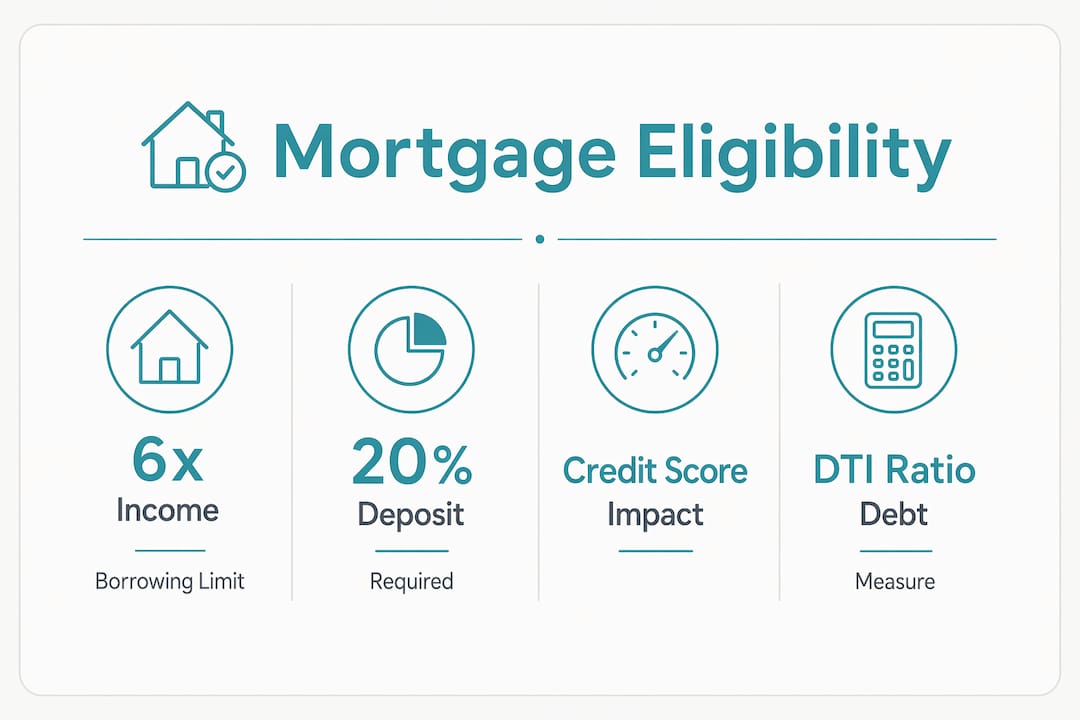
Your maximum mortgage in New Zealand is determined by four factors: your gross income, your debt-to-income (DTI) ratio, your deposit size, and your credit history. The Reserve Bank of New Zealand (RBNZ) sets a hard cap of 6x your gross annual income for owner-occupiers, and banks layer their own serviceability tests on top. Understanding how these rules interact tells you exactly where you stand before you walk into a lender’s office.
What mortgage can I get based on income and DTI ratio?
New Zealand banks apply a DTI cap of 6x gross annual income for owner-occupiers. That means if you earn $100,000 per year, your total debt including your mortgage cannot exceed $600,000. Investors face a stricter 7x cap, but that higher number reflects the additional risk profile lenders assign to investment properties.
Banks do not stop at the DTI calculation. They also run a serviceability stress test, applying a test rate of 7.5%–8.5% to your proposed loan repayments. This test checks whether you could still afford the loan if interest rates rose significantly. Your approval amount is the lower result of these two assessments, not the higher one.
What counts as debt in these calculations surprises many borrowers. Banks include:
- Car loans and personal loans
- Student loans
- Buy-now-pay-later balances
- Credit card limits (not just balances)
That last point catches people off guard. Credit card limits reduce borrowing capacity by roughly $30,000–$40,000 for every $10,000 of limit, because banks assume a 3% monthly repayment on the full limit. A $20,000 credit card limit you never use could cost you $60,000–$80,000 in borrowing power.
Dependants also reduce your capacity. Each child or dependent adult increases the living expense figure banks use in their stress test, which pushes your approval amount down even if your income is strong.

Pro Tip: Cancel or reduce credit card limits you do not actively need before applying for a mortgage. This single step can add tens of thousands of dollars to your borrowing capacity.
What deposit do I need to qualify for a mortgage in New Zealand?
The standard deposit requirement for owner-occupiers is 20% of the property’s purchase price. Borrowing above 80% loan-to-value ratio (LVR) is possible, but it comes with conditions. The RBNZ sets LVR speed limits that restrict how much high-LVR lending banks can do. For owner-occupiers, banks can lend up to 15% of their new residential mortgage book above 80% LVR. For investors, the minimum deposit rises to 35%.
The practical effect of these speed limits is that high-LVR loans are rationed. Banks prioritise strong applications, so a borrower with a 10% deposit needs a very clean credit file and solid income to compete. Lenders also charge a low equity margin, which is an interest rate premium added to loans above 80% LVR. That premium adds to your repayment costs for the life of the loan until you reach 20% equity.
| Borrower type | Minimum deposit | LVR speed limit | Notes |
|---|---|---|---|
| Owner-occupier (standard) | 20% | 15% of new lending above 80% LVR | Low equity margin applies below 20% |
| Owner-occupier (new build) | 10% | Exempt from speed limits | Must have CCC within 12 months |
| Investor | 35% | 5% of new lending above 65% LVR | Stricter criteria apply |
| First Home Loan (Kāinga Ora) | 5% | Exempt | Income and price caps apply |
New builds offer a meaningful exception. A home with a Code of Compliance Certificate issued within the last 12 months, or purchased off-plan directly from a developer, is exempt from LVR speed limits. This exemption allows owner-occupiers to borrow up to 90% LVR without competing for the rationed high-LVR pool. For buyers who can find the right property, this is one of the most underused pathways to homeownership with a smaller deposit.
Pro Tip: If you are close to the 20% deposit threshold, consider whether a new build purchase could get you into the market sooner. The LVR exemption removes the speed limit constraint entirely, giving you a much cleaner path to approval.
Understanding your home deposit requirements before you start house hunting saves you from targeting properties outside your realistic reach.
Can I get a mortgage with bad credit, and what are my options?
Bad credit does not automatically disqualify you from a mortgage, but it does change the terms significantly. Standard banks typically decline applications with defaults, missed payments, or a discharged bankruptcy on record. That does not mean the door is closed. It means you need a different approach.
Non-bank lenders will lend to borrowers with poor credit, but at interest rates 1%–4% above standard bank rates and with deposit requirements of 20%–30%. That rate premium is real money. On a $500,000 loan, an extra 2% in interest adds roughly $10,000 per year to your repayments. The goal for most borrowers in this position is to use a non-bank lender as a short-term solution, rebuild their credit profile, and refinance to a standard bank within two to three years.
Practical steps that improve your approval odds when credit is an issue include:
- Paying off any outstanding defaults or collections before applying
- Checking your credit report through Equifax or Centrix and disputing any errors
- Reducing credit card limits and closing unused accounts
- Saving a larger deposit, since increasing your deposit by 5% can meaningfully shift a lender’s risk assessment in your favour
- Avoiding new credit applications in the six months before your mortgage application
Mortgage advisers play a particularly important role for borrowers with credit challenges. They have access to lenders not listed on public comparison sites, and they know which lenders apply more flexible criteria for specific types of credit issues. A missed payment from three years ago is treated very differently by different lenders. An adviser who negotiates home loans with bad credit knows exactly which lender to approach for your specific situation.
Pro Tip: Get a copy of your credit report before you speak to any lender. Knowing what is on your file lets you address issues proactively rather than being caught off guard during an application.
How does the Kāinga Ora First Home Loan work?
The Kāinga Ora First Home Loan is the most accessible government-backed pathway for first-time buyers in New Zealand. It allows qualifying borrowers to purchase a home with just a 5% deposit, without paying a low equity margin or competing for the rationed high-LVR pool. Kāinga Ora guarantees a portion of the loan to the participating lender, which removes the risk that would normally trigger a rate premium.
Eligibility is straightforward but specific. To qualify, you must:
- Be a first-home buyer or meet the previous homeowner criteria set by Kāinga Ora
- Earn no more than $95,000 gross per year as a single applicant, or $150,000 combined for couples or applicants with dependants
- Purchase a property within the regional price caps, which range from $600,000 to $875,000 depending on location
- Intend to live in the property as your primary residence
- Apply through a participating lender, not directly through Kāinga Ora
The regional price caps are the most common sticking point for Auckland buyers. The cap for Auckland sits at the higher end of the range, but in a market where median house prices remain elevated, some buyers find the cap limits their options to apartments or properties in outer suburbs. That is not necessarily a disadvantage. Apartments in Auckland’s growth corridors have shown strong capital growth, and the First Home Loan makes entry possible at a deposit level that would otherwise take years more to save.
The key distinction between the First Home Loan and a standard low-deposit loan is cost. A standard high-LVR loan carries a low equity margin. The First Home Loan does not. Over a 30-year mortgage, that difference in interest rate compounds into a substantial saving. For eligible buyers, this scheme is the most cost-effective way to enter the market with a small deposit. Exploring low deposit lender options alongside the First Home Loan gives you a complete picture of what is available.
What practical steps can I take to increase my borrowing power?
Knowing your borrowing capacity before you start searching for property is the single most useful thing you can do. A borrowing power calculator that applies both the DTI cap and the serviceability stress test gives you a realistic estimate. Keep in mind that your capacity can vary by $50,000 or more between lenders, because each bank uses slightly different expense benchmarks and debt calculations.
Beyond calculators, the most effective steps to increase what you can borrow are:
- Reduce or cancel credit card limits at least three months before applying
- Pay down personal loans and car finance to lower your total debt obligations
- Avoid taking on any new debt, including buy-now-pay-later accounts, in the lead-up to your application
- Save consistently to demonstrate financial discipline, which lenders view favourably
- Consider whether a gifted deposit from family could help you reach the 20% threshold or qualify for the First Home Loan
Working with a mortgage adviser who understands lender criteria is one of the most reliable ways to maximise your position. Lending criteria differ significantly between banks, and an adviser who knows those differences can match your profile to the lender most likely to approve your application at the best rate.
Key takeaways
Your mortgage eligibility in New Zealand depends on the DTI 6x cap, your deposit size, your credit history, and which lender you approach, making professional advice the most reliable way to maximise your outcome.
| Point | Details |
|---|---|
| DTI cap limits borrowing | Owner-occupiers cannot borrow more than 6x their gross annual income across all debts. |
| Credit card limits cost you | Each $10,000 of credit card limit can reduce borrowing capacity by $30,000–$40,000. |
| 20% deposit avoids premiums | Borrowing below 20% deposit triggers a low equity margin and speed limit competition. |
| New builds offer an LVR exemption | Homes with a CCC within 12 months are exempt from speed limits, enabling 90% LVR lending. |
| First Home Loan cuts the deposit bar | Kāinga Ora’s scheme lets eligible first-time buyers borrow with just 5% deposit at standard rates. |
What I have learned from helping New Zealand borrowers navigate this
After years of working with borrowers across Auckland and beyond, the pattern I see most often is this: people underestimate how much the small details matter. A $15,000 credit card limit that someone opened years ago and barely uses. A car loan with $8,000 remaining. Two dependants. Each of these feels minor in isolation, but together they can reduce borrowing capacity by $150,000 or more. That is the difference between the suburb you want and the one you settle for.
The other thing I see constantly is borrowers going directly to their own bank first. That feels logical. Your bank knows you. But your bank only knows its own criteria, and those criteria may not suit your profile. Borrowing capacity varies significantly between lenders, and the bank you have banked with for 20 years may not be the one that gives you the best outcome.
What I tell every borrower is this: get your information in order early. Know your credit score. Know your debts. Know your deposit. Then speak to someone who can see the full picture across multiple lenders, not just one. The difference between a well-prepared application and a poorly prepared one is not just approval or decline. It is the interest rate you pay for the next 30 years.
— Stuart
How Mortgagemanagers can help you find the right home loan
Mortgagemanagers acts as your personal mortgage adviser, doing the legwork of comparing lenders, understanding their criteria, and matching your profile to the best available option. Whether you are a first-time buyer trying to make sense of the Kāinga Ora scheme, a borrower with a smaller deposit, or someone working through credit challenges, the team at Mortgagemanagers has the lender relationships and expertise to find a path forward.

Based in Hobsonville and servicing Auckland, West Auckland, the North Shore, and borrowers remotely across New Zealand, Mortgagemanagers gives you access to lenders and products that are not publicly listed. Getting in touch early in the process means you apply with confidence, not guesswork. Reach out to the team at Mortgagemanagers to get a clear picture of your borrowing position.
FAQ
What is the maximum mortgage I can get in New Zealand?
The maximum is 6x your gross annual income for owner-occupiers, based on the RBNZ DTI cap. Banks also apply a serviceability stress test, and your approval is the lower result of the two.
Can I get a mortgage with bad credit in New Zealand?
Yes, but typically through non-bank lenders at interest rates 1%–4% above standard rates and with a deposit of 20%–30%. A mortgage adviser can identify lenders with more flexible criteria for your specific credit history.
How much deposit do I need for a mortgage in New Zealand?
Most owner-occupiers need a 20% deposit to avoid low equity margins and LVR speed limit competition. First-time buyers may qualify for the Kāinga Ora First Home Loan with just 5% deposit, subject to income and price caps.
Do credit card limits affect how much I can borrow?
Yes. Banks treat your full credit card limit as debt, not just your balance. Each $10,000 of limit can reduce your borrowing capacity by $30,000–$40,000, so reducing limits before applying is a practical way to increase what you can borrow.
What is the Kāinga Ora First Home Loan income limit?
Single applicants must earn no more than $95,000 gross per year. Couples or applicants with dependants must earn no more than $150,000 combined. Property price caps range from $600,000 to $875,000 depending on the region.