
TL;DR:
- First-home buyers in New Zealand have multiple low-deposit mortgage options, including government-backed schemes, shared ownership, and bank lending with deposits as low as 5 percent. These options often involve additional costs like insurance premiums or higher interest rates, and require thorough planning and documentation. Working with a mortgage adviser can help buyers navigate approval processes, model long-term costs, and choose the best lender for their circumstances.
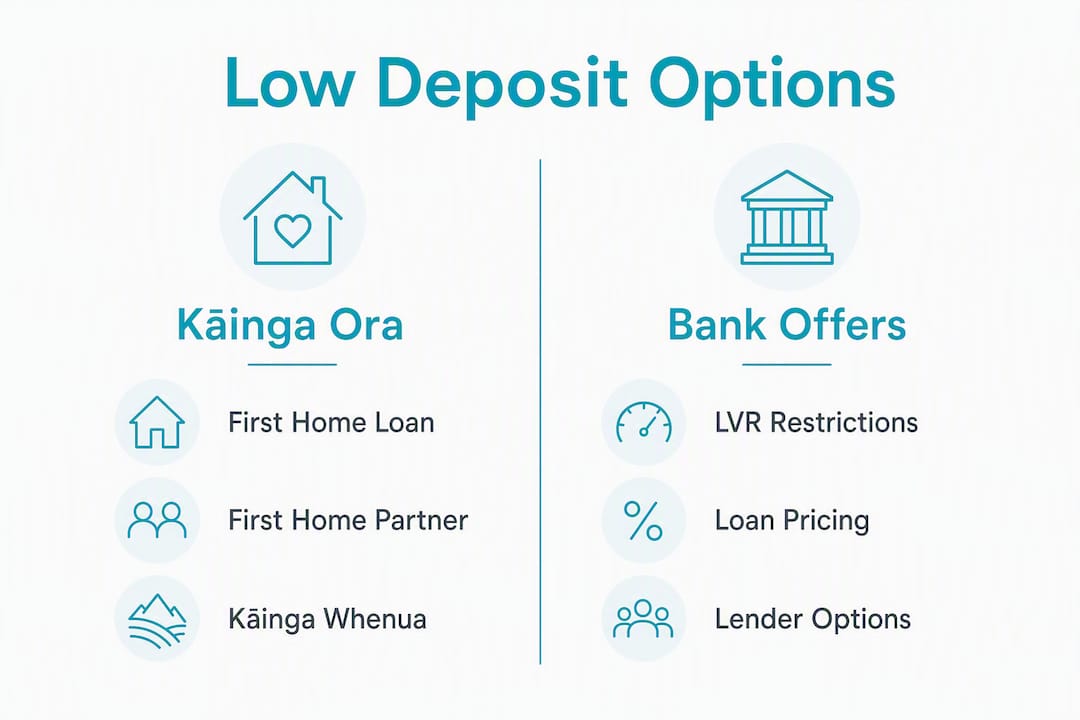
If you’re a first-home buyer in New Zealand, you have more low deposit mortgage options than most people realise. The main pathways are: the Kāinga Ora First Home Loan (5% deposit, government-underwritten), First Home Partner, Kāinga Whenua, mainstream bank lending at 10% or more, and deposit top-ups through KiwiSaver withdrawals or family assistance. None of these are zero-deposit options — mainstream NZ lending requires at least 5%, and most banks set their standard threshold at 20%.
Here’s a quick map of your options:
- Kāinga Ora First Home Loan: 5% deposit, income-capped, underwritten by Kāinga Ora and issued through participating banks
- First Home Partner: shared ownership with Kāinga Ora for buyers who can’t quite reach the deposit or purchase price threshold alone
- Kāinga Whenua: for Māori buyers looking to build or buy on Māori land
- Bank low-LVR lending: typically 10% deposit for existing homes; some lenders go to 5% for new builds
- KiwiSaver first-home withdrawal: can supply part or all of your required deposit
- Family assistance: gifted deposits, parental guarantees, or co-borrowing arrangements
Every low-deposit route carries extra costs. Expect either a Lenders’ Mortgage Insurance (LMI) premium (1.2% of the loan amount on First Home Loans) or a Low Equity Premium (LEP) from your bank, plus potentially higher interest rates. The practical first step: check your Kāinga Ora eligibility, get pre-approval through a participating lender, and talk to a mortgage adviser who can model the long-term cost difference between your options.
Table of Contents
- What are the Kāinga Ora low-deposit schemes?
- What do banks typically offer for low-deposit home loans?
- How can KiwiSaver and family help close your deposit gap?
- What are the real costs and risks of borrowing with a low deposit?
- Who qualifies, and what documents do you need to prepare?
- How Mortgagemanagers helps first-home buyers with low deposits
- Key takeaways
- What most buyers get wrong about low-deposit mortgages
- Mortgagemanagers can help you get there sooner
- Official sources and further reading
What are the Kāinga Ora low-deposit schemes?
Kāinga Ora runs three distinct home ownership products for first-home buyers. Understanding which one fits your situation can save you months of searching.
First Home Loan
The First Home Loan is the most widely used low-deposit pathway in New Zealand. You need just a 5% deposit, and Kāinga Ora underwrites the loan rather than lending to you directly. That distinction matters: you apply through a participating bank, building society, or credit union, and that lender assesses your application against both Kāinga Ora’s eligibility rules and their own lending criteria.

Income caps apply:
| Buyer type | Before-tax income cap |
|---|---|
| Single buyer | $95,000 |
| Single buyer with dependants | $150,000 |
| Multiple buyers (combined) | $150,000 |
Other eligibility requirements include being a New Zealand citizen or permanent resident, intending to live in the property (not rent it out), and meeting the lender’s standard serviceability checks. Property price caps also apply and vary by region, so confirm the current cap for your target area directly with Kāinga Ora or a participating lender.
The cost to note: a one-off LMI premium of 1.2% of the loan amount. On a $600,000 loan, that’s $7,200 — which lenders may allow you to add to the loan balance rather than pay upfront.
Worked example: Purchase price $650,000. Your 5% deposit = $32,500. Loan amount = $617,500. LMI at 1.2% = $7,410, which can be rolled into the loan, bringing your total borrowing to $624,910.
Because Kāinga Ora underwrites rather than lends, the participating lender list matters. Check the official Kāinga Ora website for current participating lenders and confirm with your preferred bank whether they’re actively approving First Home Loans at the time you apply.
First Home Partner
First Home Partner is a shared ownership scheme where Kāinga Ora contributes toward your purchase price in exchange for an ownership share. It suits buyers who meet income requirements but can’t quite reach the deposit or price threshold on their own. You gradually buy out Kāinga Ora’s share over time. Eligibility criteria differ from the First Home Loan, so check the Kāinga Ora website for current thresholds.
Kāinga Whenua
Kāinga Whenua is specifically for Māori buyers who want to build, buy, or relocate a home on Māori land (land held under the Te Ture Whenua Māori Act). Standard bank lending often won’t apply to Māori land titles, making this scheme a critical pathway for eligible buyers. Kāinga Ora underwrites these loans through participating lenders.
What do banks typically offer for low-deposit home loans?
Most New Zealand banks set their standard minimum deposit at 20%. Below that threshold, you’re in low-equity territory, and lenders treat that risk differently.
The most common bank approaches for low-deposit buyers:
- 5% via First Home Loan: — some banks participate in the Kāinga Ora scheme and will lend at 5% deposit for eligible buyers
- New build flexibility: banks often apply more favourable LVR treatment to new builds, meaning a 10% or even lower deposit may be accepted for a recently completed or turnkey property
The Reserve Bank of New Zealand (RBNZ) sets LVR restrictions that limit how much low-deposit lending banks can do in aggregate. The RBNZ increased the owner-occupier high-LVR cap to 25% of new lending (from 20%), which gives banks slightly more room. This doesn’t guarantee you’ll be approved, but it does mean more low-deposit applications can be considered across the system.
Where banks differ most is in how they price low-deposit risk. Low-deposit borrowers typically face LEPs or a rate uplift of around 60–175 basis points depending on their LVR. Some lenders structure this as an ongoing margin added to your rate; others charge a one-off premium. The approach varies by lender, so comparing offers side by side is worth the effort.
Pro Tip: If you’re open to purchasing a new build or turnkey property, ask lenders specifically about their LVR policy for new construction. The deposit requirement can be meaningfully lower than for an existing home, and some lenders will consider 10% or less without requiring the First Home Loan scheme.
How can KiwiSaver and family help close your deposit gap?
A 5% or 10% deposit sounds achievable in theory, but pulling together the actual cash is where many first-home buyers get stuck. These are the most practical ways to close that gap.
KiwiSaver first-home withdrawal
KiwiSaver savings can be withdrawn for a first home purchase, subject to scheme rules. You can generally withdraw all your contributions, your employer’s contributions, and investment returns, leaving only a minimum balance (currently $1,000) in your account. For many buyers, this is the single largest source of deposit funds outside of personal savings. Check your withdrawal eligibility with your KiwiSaver provider and Inland Revenue (IRD) well before you need the funds, as processing takes time.
Family gifted deposits
Parents or family members can gift funds toward your deposit. Lenders accept gifted deposits, but they require a formal gift letter confirming the money is non-repayable. This is not optional paperwork. If the funds are structured as a loan rather than a gift, lenders treat them as debt, which reduces your borrowing capacity and can affect serviceability. A mortgage adviser can help you prepare the gift letter correctly so it doesn’t create problems at approval.
Parental guarantees and co-borrowing
Some buyers use a parent as a guarantor, where the parent’s property or income backs part of the loan. Others add a parent as a co-borrower on the mortgage. Both approaches can unlock lending that wouldn’t otherwise be available, but they carry real implications for the guarantor or co-borrower, including credit exposure and potential impact on their own borrowing capacity.
Co-ownership
Buying with a friend, sibling, or partner is another route. Lenders assess co-ownership applications on the combined income and deposit of all buyers. Shared ownership agreements should be documented carefully, covering what happens if one party wants to sell or can’t meet repayments.
Documentation lenders commonly require for gifted funds or guarantees:
- Signed gift letter on letterhead (if from a family trust or company) confirming funds are non-repayable
- Bank statements showing the source of gifted funds (typically 3 months)
- Guarantor’s proof of income and property ownership documents
- Co-borrower’s full financial disclosure (income, liabilities, assets)
- KiwiSaver withdrawal confirmation letter from your provider
What are the real costs and risks of borrowing with a low deposit?
Getting into a home sooner is genuinely valuable. But low-deposit borrowing costs more, and understanding exactly how much more helps you make a clear-eyed decision.
LMI and LEPs: The First Home Loan charges an LMI premium on the loan amount. For a $600,000 loan, that’s $7,200 added to your debt from day one. Outside the First Home Loan, banks typically apply LEPs or rate uplifts. Low-deposit borrowers often face an additional 60–175 basis points on their interest rate, depending on their LVR.
To put that in perspective: on a $600,000 loan over 25 years, an extra 100 basis points (1%) in interest adds tens of thousands of dollars to your total repayments. The exact figure depends on your rate, term, and repayment structure, which is why modelling your specific scenario with a mortgage adviser before you commit is so important.
Key risks to weigh:
- Negative equity: if property values fall after you buy with a 5% deposit, you can quickly owe more than the property is worth, making it difficult to sell or refinance
- Higher ongoing repayments: LEPs or rate uplifts mean your monthly payments are higher than a 20% deposit borrower’s, reducing your financial buffer
- Refinancing difficulty: lenders may not offer their best rates until your equity reaches 20%, so you could be stuck on higher rates for several years
- Serviceability pressure: a larger loan with a higher rate leaves less room for unexpected expenses, job changes, or interest rate rises
The practical response to these risks isn’t to wait indefinitely for a 20% deposit. It’s to build a contingency buffer of at least 3 months’ expenses alongside your deposit, model your repayments at a rate 2% higher than today’s to stress-test affordability, and use a mortgage repayment calculator to compare scenarios before you commit.
Who qualifies, and what documents do you need to prepare?
Getting your paperwork right before you approach a lender saves time and reduces the chance of a declined application.
Standard eligibility checks
- Income cap compliance (First Home Loan): — confirm your before-tax income sits within the Kāinga Ora thresholds ($95,000 single; $150,000 with dependants or combined)
Document checklist
| Document | Notes |
|---|---|
| Photo ID (passport or driver’s licence) | Two forms preferred |
| Recent payslips (last 3 months) | Or 2 years’ financials if self-employed |
| Bank statements (last 3 months) | All accounts, showing savings pattern |
| KiwiSaver statement | If using for deposit withdrawal |
| Gift letter | Required if any deposit funds are gifted |
| Guarantee paperwork | If using a parental guarantee |
| Property details | Sale and purchase agreement once available |
Questions to ask your lender
- Do you participate in the Kāinga Ora First Home Loan scheme?
- Do you charge an LEP or a rate uplift for deposits below 20%?
- What is your LVR policy for new builds or recently completed properties?
- How long does pre-approval take, and what conditions apply?
Pre-approval is worth getting before you start making offers. It defines your buying range, gives vendors confidence you’re a serious buyer, and reduces the risk of a deal falling through at the finance stage. Most pre-approvals are valid for 60–90 days, so time your application to align with your property search.
How Mortgagemanagers helps first-home buyers with low deposits
Working with a mortgage adviser when you’re buying with a low deposit isn’t just convenient — it can be the difference between an approval and a declined application. Here’s how the process typically works with Mortgagemanagers.
The adviser process, step by step
- Initial assessment: your adviser reviews your income, savings, KiwiSaver balance, and any family assistance to map which low-deposit pathways you’re eligible for
- Eligibility checks: Kāinga Ora income caps, residency status, and owner-occupier intent are confirmed before any lender approach
- Cost modelling: your adviser models the LMI premium, LEP scenarios, and rate uplifts across multiple lenders so you can see the true long-term cost of each option
- Lender selection: because Mortgagemanagers works with multiple participating lenders, your adviser can match your profile to the lender most likely to approve your application on the best available terms
- Document preparation: gift letters, KiwiSaver withdrawal confirmation, and guarantee paperwork are prepared correctly the first time, avoiding the delays that come from incomplete applications
- Pre-approval and application: your adviser submits to the selected lender, manages the pre-approval conditions, and supports you through to drawdown
Mortgage brokers add measurable value for low-deposit buyers by modelling LEP and LMI scenarios and preparing gift and guarantee paperwork — reducing the risk of application delays or declined approvals.
What Mortgagemanagers offers low-deposit buyers
- Access to participating lenders for the Kāinga Ora First Home Loan
- KiwiSaver withdrawal guidance and timing advice
- Gifted deposit and guarantee documentation support
- Tailored affordability modelling across deposit scenarios
- Pre-approval support and lender negotiation
- Remote service throughout New Zealand, with a base in Hobsonville, Auckland
For a deeper look at low-deposit lender options available to Kiwi buyers, Mortgagemanagers has published a practical guide covering lender examples and next steps.
Key takeaways
The most reliable path to a low-deposit home loan in New Zealand combines Kāinga Ora eligibility, KiwiSaver savings, correct documentation, and an adviser who can model the true cost across lenders before you commit.
| Point | Details |
|---|---|
| First Home Loan threshold | Kāinga Ora allows a 5% deposit for eligible buyers; income caps are $95,000 (single) or $150,000 (combined). |
| LMI cost to budget | The First Home Loan charges a one-off LMI premium of 1.2% of the loan amount, which can be added to the loan. |
| Bank rate uplift | Low-deposit borrowers typically face 60–175 basis points extra in interest, depending on their LVR. |
| KiwiSaver and family help | KiwiSaver withdrawals and gifted deposits (with a formal gift letter) are both accepted deposit sources. |
| Mortgagemanagers next step | Book a free initial assessment with Mortgagemanagers to check eligibility, model costs, and get pre-approval support. |
What most buyers get wrong about low-deposit mortgages
The conventional wisdom says “save a bigger deposit and you’ll be fine.” That’s not wrong, but it misses the real calculation most first-home buyers face: the cost of waiting versus the cost of borrowing with a low deposit now.
Property values in New Zealand don’t stand still while you save. If you spend two or three years building from 5% to 20%, you may find the purchase price has moved enough to reset your progress. That doesn’t mean rushing in with a 5% deposit is always the right call. It means the decision deserves a proper numbers comparison, not a rule of thumb.
What I see consistently is buyers who focus on the LMI premium as the headline cost and overlook the rate uplift. A 1.2% LMI on a $600,000 loan is $7,200 — visible, one-off, and easy to calculate. But an extra 100 basis points on your interest rate, compounding over 25 years, costs far more. That’s the number that should drive your decision about which lender to use and whether to prioritise a slightly larger deposit before applying.
The other thing buyers underestimate is how much lender selection matters at the low-deposit end of the market. Not every participating lender prices low-equity risk the same way, and not every lender is equally active in approving First Home Loan applications at any given time. An adviser who knows which lenders are currently approving and at what terms is worth considerably more than the time it would take you to approach each bank individually.
Mortgagemanagers can help you get there sooner
Getting a low-deposit home loan approved takes more than ticking the eligibility boxes. It takes knowing which lender to approach, how to present your deposit sources, and how to model the real cost of each option before you sign anything.

Mortgagemanagers works with first-home buyers across New Zealand, from Hobsonville and West Auckland to the North Shore and beyond, matching low-deposit buyers to participating lenders and preparing applications that hold up under scrutiny. As your personal shoppers for a home loan, the team handles the lender research, cost modelling, and paperwork so you can focus on finding the right property. Whether you’re working with a 5% deposit through the First Home Loan, combining KiwiSaver with a family gift, or exploring new build options, Mortgagemanagers can map the most cost-effective route for your situation. Book a free initial consultation today and get a clear picture of what you can borrow, what it will cost, and which lender is the right fit.
Official sources and further reading
Scheme rules and lender participation change regularly. Before you apply, verify current eligibility criteria, income caps, and property price limits directly with the relevant authority. The figures in this article reflect publicly available information at the time of writing, but lender-specific criteria can shift without notice.
- Kāinga Ora First Home Loan — eligibility, income caps, participating lenders, and scheme details
- Kāinga Ora First Home Decision Tool — interactive tool to check which Kāinga Ora products you may qualify for
- New Zealand Government: financial help for first-home buyers — overview of government-backed schemes including KiwiSaver withdrawal rules
- Inland Revenue (IRD): KiwiSaver — KiwiSaver contribution rules, withdrawal eligibility, and first-home withdrawal process
- Mortgagemanagers: low-deposit home loan guide — practical checklist and lender requirements for low-deposit buyers
- Mortgagemanagers: get mortgage advice before you start — pre-appointment guidance and contact options
This article provides general information only and is not financial advice. Scheme rules, income caps, and lender criteria change regularly. Confirm current details with Kāinga Ora, your KiwiSaver provider, and a qualified mortgage adviser before making any borrowing decisions.