
Looking for the best mortgage lenders NZ has to offer? There is no single winner—the right lender depends on your deposit, income, credit history and what you need from your home loan.
There is no single best mortgage lender in New Zealand. The right lender depends on your deposit, income, credit history, property and what you need the loan to do. What matters is matching the lender type to your circumstances and comparing the costs, features and criteria that will genuinely affect you.
Your immediate next steps:
- Know your profile first. Are you a first-home buyer, self-employed, looking for a low-deposit loan, or refinancing? Understanding your profile helps you navigate the right path from the start — so you don’t end up barking up the wrong tree looking for a home loan that doesn’t suit you or could cost you more than it needs to.
- Compare beyond the headline rate. Fees, features, and eligibility criteria often matter more than a 0.1% rate difference. To make the right decisions you have to do your homework and have that market knowledge.
- Use a broker for complex cases. If your income is non-standard, your deposit is under 20%, or you have past credit events, a mortgage adviser can access lenders and products you won’t find by walking into a bank.
Key takeaways
There is no single best mortgage lender in New Zealand — the right choice depends on your deposit, income type, credit history, and the product features your situation requires.
| Point | Details |
|---|---|
| No universal best lender | Match lender type to your profile: deposit size, income structure, and credit history all change which lenders will consider you. |
| Compare all-in cost, not just rate | Fees, clawback clauses, and product features (offset, redraw, split) affect total cost more than a 0.1% rate difference. These are sometime not even stipulated or broken down clearly on your loan structure. A lot of people are surprised by these when they find out after the fact. |
| Non-bank lenders fill a real gap | Non-bank lenders made up around 1.6% of mortgages recently but are often the only viable path for borrowers banks decline; expect a rate premium of 0.5%–2.0%. |
| Brokers add value for complex cases | A registered mortgage adviser can access lender specials, match you to lenders open to your profile, and negotiate on your behalf. |
| Mortgage Managers | Mortgage Managers provides broker-led lender matching for first-home buyers, low-deposit borrowers, self-employed applicants, and investors across New Zealand. |
Table of Contents
- What types of mortgage lenders operate in New Zealand?
- How do lenders actually differ beyond the headline rate?
- Which lender type suits your borrower profile?
- How to shop, negotiate, and present your application well
- NZ mortgage market snapshot for 2026
- What should you do right now?
- A practical perspective on finding the best home loan in NZ
- How Mortgage Managers helps you find the right home loan
- Sources
What types of mortgage lenders operate in New Zealand?
New Zealand’s lending market has more variety than most borrowers realise, and understanding the categories helps you know where to look and what to expect.
Registered banks include New Zealand-owned banks and the New Zealand operations of overseas-owned banking groups. They are subject to RBNZ prudential standards, including loan-to-value ratio restrictions and capital requirements. These rules support the stability of the banking system, while each bank applies its own lending and affordability criteria.
NZ-owned retail banks operate under the same RBNZ registration framework but often position on service, community focus, or competitive pricing for specific products. They tend to compete hard on fixed-term rates for standard borrowers.
Non-bank lenders are not registered banks and sit outside RBNZ’s bank-specific prudential framework, though they are still regulated under the Financial Markets Conduct Act and must hold a Financial Services Provider (FSP) registration. They typically charge a premium above bank rates but apply more flexible credit assessment, making them a genuine option for borrowers banks decline. Non-bank lenders made up around 1.6% of mortgages in a recent period, representing $67m out of a total of $4.2bn.
Learn more about non-bank mortgages and the non-bank lenders mortgage advisers use.
Building societies and credit unions are member-owned institutions that occasionally offer competitive rates for eligible members, though their product ranges are narrower than the major banks.
Non-conforming or specialist lenders focus specifically on borrowers with past credit events, unusual income, or properties that mainstream lenders may not be able to finance. And yes — where the property is located can matter too.
The interest rates may be higher, but for the right borrower, getting access to finance can be the priority. Our goal doesn’t stop once you get the loan. Where possible, we’ll work alongside you with the aim of refinancing you away from higher-cost lending as soon as your circumstances allow — potentially within 12 months.
That way, you can get into the home you’ve been working towards while having a financial adviser alongside you, helping you work towards a stronger financial position for the future.
Distribution matters too. Most banks deal directly with borrowers, but many also work through mortgage advisers. Non-bank and specialist lenders often distribute exclusively through advisers, which means you may not be able to access their products without a broker.
Registered banks operate under RBNZ prudential supervision, which shapes their lending criteria and provides depositor protections that non-bank lenders do not carry. That difference is worth understanding before you compare rates side by side.
The Kiwi First Home Buyers Club guide to bank mortgages explains how bank lending and low-deposit allocations work in plain English.
How do lenders actually differ beyond the headline rate?
The advertised rate is the starting point, not the finish line. Two lenders quoting the same 1-year fixed rate can produce very different total costs once you account for fees, features, and eligibility.
Here are the comparison axes that genuinely move the needle:
- Carded rate vs. actual pricing band. Carded rates are the published rates. Your actual rate may be lower (through negotiation or a relationship discount) or higher (if your LVR or income profile attracts a loading). Always ask what rate you personally qualify for.
- Fees. Application fees, valuation fees, legal contribution requirements, and early repayment charges all affect your all-in cost. We recommend calculating total interest paid over the loan term rather than comparing headline rates alone.
- Product features. Offset accounts reduce the interest you pay by offsetting your savings balance against your loan balance. Redraw facilities let you access extra repayments. Split loans let you fix part of the loan and leave part floating. Portability lets you transfer the loan to a new property. Not every lender offers all of these.
- Eligibility and lending appetite. LVR limits, acceptable income types (PAYE, self-employed or contractor), and credit requirements can vary significantly between lenders. A lender with a slightly higher rate who will actually approve your application can be worth far more than a cheaper lender who won’t.
- That’s where having the right adviser behind you matters. It’s not just about getting the loan approved — it’s about having a plan beyond settlement, with further goals in place to help you move towards better lending options without leaving you financially stretched.
- Turnaround and service. Pre-approval timeframes range from 24 hours to several weeks depending on the lender and complexity. For competitive property markets, speed can be the difference between securing a property and missing it.
- Incentives and clawbacks. Cashback offers and legal fee contributions are common, but most include clawback clauses requiring repayment if you refinance within a set period, commonly 3–5 years. Factor the clawback risk into your decision if you think you might move lenders.
A quick side-by-side checklist when comparing two lenders:
- What is my actual (not carded) rate for my LVR and income type?
- What fees apply at settlement and over the loan term?
- Does the product include offset, redraw, or split capability?
- What is the pre-approval turnaround time?
- Is there a cashback or legal contribution, and what are the clawback terms?
- What happens if I want to fix or refix at a different term?
Use Mortgage Managers fixed and floating rate comparisons to build a live picture of where each lender sits on pricing before you approach them.
Which lender type suits your borrower profile?
Different borrowers need different things from a lender. Here is how the common profiles map to lender types and product priorities.
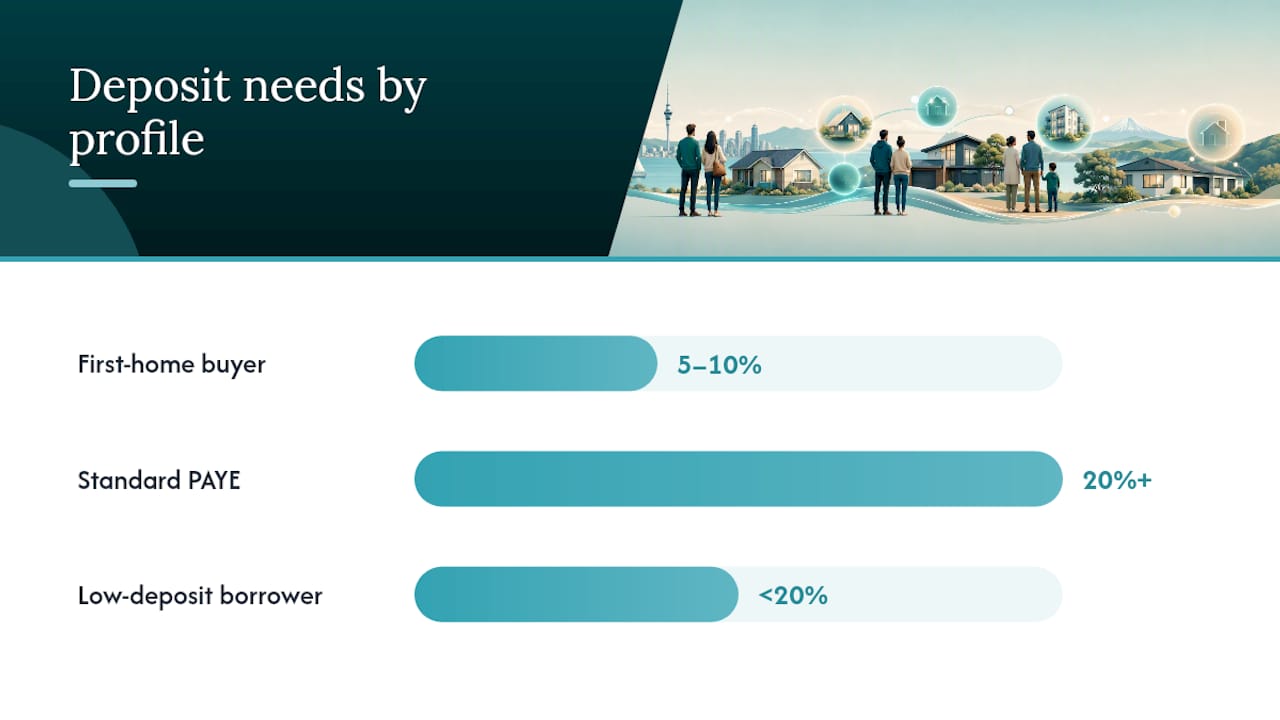
First-home buyer with a 5–10% deposit. Your priority is eligibility, not rate. Look at lenders participating in the Kāinga Ora First Home Loan scheme, which allows eligible buyers to borrow with as little as a 5% deposit under a government-backed guarantee. Major banks and some non-banks participate. A mortgage adviser can confirm current participating lenders and income caps quickly.
Standard PAYE borrower with 20%+ deposit. You have the most negotiating power. Major banks will compete for your business, and you can use rate aggregators like MoneyHub or interest.co.nz to benchmark offers. Prioritise product features (offset, split) and negotiate the carded rate down.
Self-employed or contractor. Banks typically want two years of financial statements and may apply income shading (using a percentage of your declared income rather than the full figure). Some non-bank lenders use bank statement-based income assessment, which can produce a higher usable income figure. The trade-off is a rate premium of roughly 0.5%–2.0% above bank rates.
Low-deposit borrower (under 20%). LVR restrictions mean fewer lenders will consider you, and those who do may apply a low-equity margin on top of the carded rate. Non-bank lenders and specialist products exist for this profile, but the cost is higher. A broker is particularly valuable here because they know which lenders are currently open to high-LVR lending.
Borrower with past credit events. Mainstream banks will generally decline applications with defaults, judgements, or discharged bankruptcies within a certain period. Non-conforming lenders specialise in exactly this profile. Rates are higher, but the goal is re-establishing a clean lending record. See which non-bank lenders mortgage brokers use for a practical overview of what is available.
Property investor needing offset or revolving credit. Investors often benefit from revolving credit facilities or offset structures that reduce interest costs while keeping funds accessible. Not all banks offer these on investment loans, and RBNZ LVR rules for investors differ from owner-occupier rules. Check current LVR limits before assuming a product is available.
Pro Tip: If you are self-employed or have a non-standard income, get your financial statements in order before approaching any lender. A clean, well-presented set of accounts reduces the risk of income shading and speeds up assessment.
How to shop, negotiate, and present your application well
Getting the best home loan deal is part preparation, part process, and part knowing when to ask for more. Here is a practical sequence.
- Pull your credit report first. Errors on your credit file can delay or derail an application. Check your report via Centrix, Equifax, or Illion before any lender does.
- Calculate your realistic LVR. Your loan-to-value ratio determines which lenders will consider you and whether a low-equity margin applies. Be precise — a small increase in deposit can shift you into a better pricing band.
- Gather your financial documents. Banks want three months of bank statements, two years of tax returns (if self-employed), payslips, and a list of liabilities. Having these ready before you approach lenders cuts turnaround time significantly.
- Use rate comparison tools. This gives you a benchmark before any lender conversation.
- Contact at least two or three lenders or use a broker. Sorted recommends shopping around and considering a mortgage broker for their comparative market knowledge and access to dispute-resolution protections. A broker can approach multiple lenders simultaneously and often knows which lenders are running unadvertised specials.
- Request written offers and compare total cost. Do not compare rates in isolation. Ask each lender for a full cost breakdown including fees, and use a mortgage calculator to compare total interest paid over your expected loan term.
- Negotiate. Banks respond to competing offers. If Lender A has offered you a rate and Lender B is cheaper, tell Lender A. Relationship discounts, fee waivers, and cashback contributions are all negotiable, particularly for borrowers with strong profiles.
When choosing a broker, look for someone registered on the Financial Services Providers Register and affiliated with an approved dispute resolution scheme. A good broker discloses their lender panel upfront and explains how they are remunerated. For guidance on what to look for, how to choose a mortgage broker in NZ is a useful starting point.
Pro Tip: The single most effective negotiation lever is a competing written offer. Verbal comparisons rarely move lenders; a written offer from a competitor almost always does.
NZ mortgage market snapshot for 2026
The New Zealand mortgage market in 2026 is more competitive than it has been in several years, with lenders actively competing on fixed-term pricing as the rate cycle shifts.
Non-bank lenders remain a small but important part of the market. For that group, non-bank lenders are not a fallback — they are often the only viable path to ownership.
Non-bank loans typically carry a rate premium above bank rates to reflect the more flexible credit assessment and higher perceived risk. For borrowers who qualify at a bank, that premium is a cost to avoid. For borrowers who do not, it is the price of access.
Brokers have become increasingly central to the market. In 2026, a significant share of new home loan applications in New Zealand are submitted through mortgage advisers rather than directly through bank branches. Brokers bring three concrete advantages: real-time knowledge of which lenders are currently open to specific profiles, access to lender specials that are not publicly advertised, and the ability to negotiate on your behalf. For borrowers with straightforward profiles, a broker saves time. For borrowers with complex situations, a broker can be the difference between approval and decline.
What should you do right now?
You have the framework. Here is how to turn it into action.
- Step 1: Define your profile. First-home buyer, investor, self-employed, low deposit, or refinancing? Your profile determines which lender types are relevant.
- Step 2: Gather your documents. Bank statements, payslips or financial statements, a list of debts, and your KiwiSaver balance if you are a first-home buyer.
- Step 3: Check your credit file. Fix any errors before a lender sees them.
- Step 4: Compare 2–3 offers. Use rate tables at interest.co.nz and MoneyHub, then approach lenders or a broker for actual quotes.
- Step 5: Seek broker help if your situation is complex. Self-employed income, low deposit, past credit issues, or investment lending all benefit from specialist adviser support.
For readers who want to talk through their options with an adviser, Mortgage Managers’ mortgage adviser pages are a practical next step. Based in Hobsonville and servicing Auckland and remotely across New Zealand, the team works with first-home buyers, investors, and borrowers with non-standard situations.
A practical perspective on finding the best home loan in NZ
Most borrowers spend more time researching a new phone than they do comparing mortgage lenders. That is understandable — mortgages are complex, the terminology is unfamiliar, and the stakes feel high. Even a small difference in interest rates, fees or loan structure can add up considerably over the life of a mortgage.
What I see consistently is that borrowers who treat the lender selection process as a negotiation, rather than an application, get better outcomes. Walking into a bank and accepting the first offer is the equivalent of paying the sticker price on a car without asking for a discount. The lender expects you to negotiate. Most borrowers do not.
The other pattern worth naming: borrowers with non-standard profiles often assume the major banks are their only option, or that a non-bank lender is a last resort to be embarrassed about. Neither is true. Non-bank lenders exist precisely because the major banks have rigid credit criteria that do not accommodate every legitimate borrower. Using a non-bank lender for two or three years while you build a stronger financial profile, then refinancing to a bank, is a sensible strategy — not a failure.
Mortgage advisers registered on the Financial Services Providers Register and affiliated with an approved dispute resolution scheme are accountable professionals. The role of mortgage brokers in NZ is worth understanding before you decide whether to go direct or use an adviser.
How Mortgage Managers helps you find the right home loan
Mortgage Managers gives you direct access to a qualified mortgage adviser who does the lender matching, rate negotiation, and application coordination for you — without the cost of going it alone and getting a worse deal.

The team works with first-home buyers navigating Kāinga Ora eligibility, borrowers with low deposits or non-standard income, property investors structuring revolving credit facilities, and anyone refinancing and wanting to know whether their current lender is still competitive. Services cover the full lending process: initial assessment, lender selection, application preparation, and settlement support.
Based in Hobsonville with easy access to West Auckland, the North Shore, and clients remotely across New Zealand, Mortgage Managers operates on a commission basis paid by lenders upon successful approval — meaning the advice costs you nothing out of pocket.
To talk through your situation with an adviser, book a consultation with Mortgage Managers and get a clear picture of which lenders suit your profile and what rate you should realistically be targeting.
Sources
The following resources were used in preparing this article and are worth bookmarking for your own research.
- Standards and requirements for banks | Reserve Bank of New Zealand
- What is non-bank mortgage lending in New Zealand?
- How to compare mortgage rates in NZ (2026)
Recommended
- Why Compare Lenders for Auckland Mortgages
- Home loan comparison tools NZ: pick the right one fast
- What is a good mortgage rate for NZ borrowers: 2026 guide
- 7 Types of Mortgage Lenders Every Kiwi Home Buyer Should Know | Mortgage Managers