
Home mortgage amortization is the process of repaying your home loan through regular payments that combine both principal and interest, gradually reducing your debt until the balance reaches zero. In New Zealand, most home loans are structured as table loans, meaning your repayment amount stays the same each month, but the split between interest and principal shifts dramatically over time. Early payments are weighted heavily toward interest; later payments chip away mostly at the principal. Understanding this split is what separates borrowers who feel in control of their mortgage from those who feel like they’re running on a treadmill.
Here’s what shapes your amortization from day one:
- Principal: the original amount you borrowed
- Interest: the cost of borrowing, charged as a percentage of the outstanding balance
- Loan term: typically 25–30 years for New Zealand home loans
- Repayment frequency: monthly, fortnightly, or weekly payments each affect your total interest cost
- Rate type: fixed, floating, or split loans all produce different amortization paths
On a typical large loan with a 30-year term and an interest rate around 6%, your monthly repayment is fixed, with early payments mostly covering interest and a smaller part reducing principal. By year 20, that split has flipped. The total interest you pay over the life of the loan can exceed the original amount borrowed, which is why understanding amortization early gives you real power to act on it.
How to calculate your home mortgage amortization schedule
Calculating a mortgage payment schedule requires four inputs: your loan principal, the annual interest rate, the loan term in months, and your repayment frequency. From those, you can build a full schedule showing exactly how each payment divides between interest and principal.

The core formula
The standard monthly repayment formula is:
M = P × [r(1+r)^n] ÷ [(1+r)^n − 1]
Where:
- M = monthly repayment
- P = loan principal
- r = monthly interest rate (annual rate ÷ 12)
- n = total number of payments (years × 12)
Building the schedule step by step
- Calculate your monthly rate. Divide the annual rate by 12. For a 5.69% rate, that’s 0.4742% per month.
- Solve for M using the formula above to find your fixed monthly repayment.
- Calculate month 1 interest. Multiply the outstanding balance by the monthly rate.
- Find month 1 principal. Subtract the interest portion from your total repayment.
- Update the balance. Deduct the principal portion from the previous balance.
- Repeat for each subsequent month until the balance reaches zero.
Sample amortization table: $500,000 at 7% over 30 years
This data comes from Calculate.co.nz mortgage fundamentals, illustrating how the principal/interest split evolves:
| Month | Payment | Interest | Principal | Balance |
|---|---|---|---|---|
| 1 | $3,308 | $2,903 | $410 | — |
| 6 | $3,308 | $2,903 | $410 | — |
| 12 | $3,308 | — | — | — |
| 360 | $3,308 | — | — | — |
| 360 | $3,308 | — | — | — |
| 360 | $3,308 | — | $3,308 | $0 |

In month 1, only $410 of each payment reduces the loan balance. By month 360, $3,308 goes to principal. That shift is the entire logic of amortization. Online calculators on sites like Sorted.org.nz can automate this for your specific loan details, saving you the manual maths.
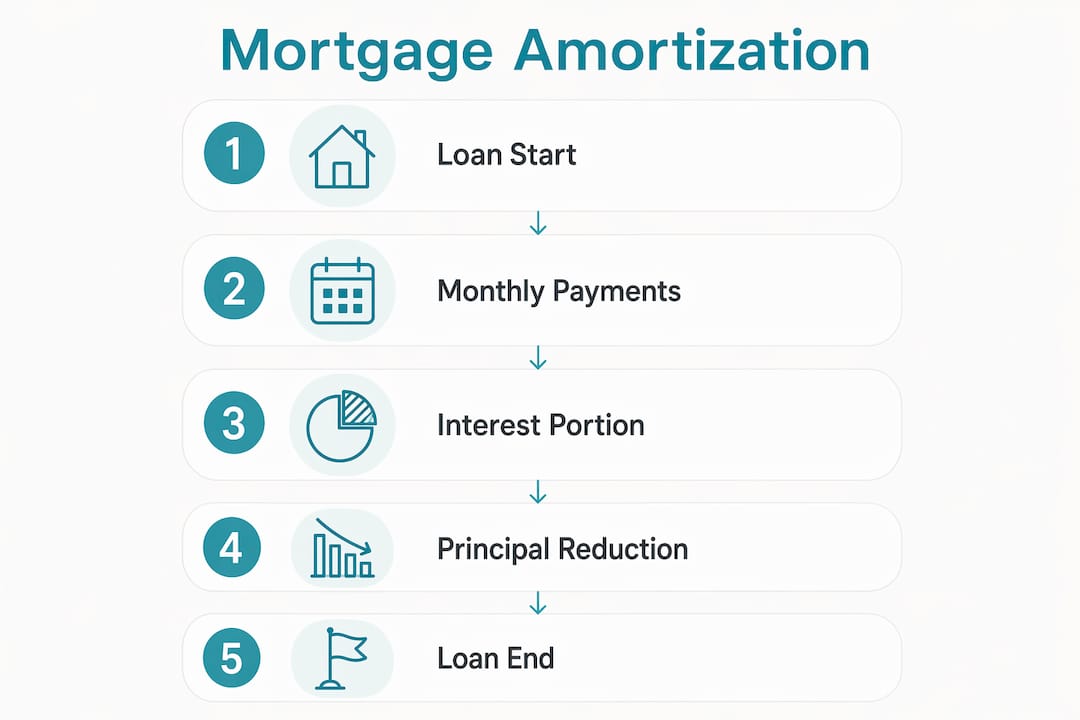
Key factors affecting your repayment costs in New Zealand
1. Current interest rates in 2026
New Zealand’s rate environment shapes every amortization calculation you run right now. According to the Reserve Bank of New Zealand, the average floating mortgage rate is 6.15% and the 2-year fixed rate is 5.69% as of June 2026. After the Reserve Bank raised the OCR by 25 basis points to 2.50% in July 2026, all major banks passed the increase on to floating borrowers in full while leaving fixed rates unchanged. For current rate comparisons across terms, the Mortgagemanagers NZ mortgage rates guide is a practical starting point.
Rate snapshot (June 2026, RBNZ B20 data): Floating: 6.15% | 1-year fixed: about 5.3% | 2-year fixed: 5.69% | 3-year fixed: slightly above 5.8%
2. Repayment frequency
Mortgage interest in New Zealand is calculated daily on the outstanding principal. Switching from monthly to fortnightly payments means you make 26 half-payments per year instead of 12 full ones, effectively squeezing in one extra full payment annually. That extra payment reduces your balance faster, cutting both the loan term and total interest paid.
3. Amortization method
- Principal and interest (table loan): the standard NZ structure; fixed repayments with a shifting split over time
- Interest-only: repayments cover only interest for a set period, so the principal doesn’t reduce; common for investors but extends total loan cost
- Split loans: most NZ borrowers combine a fixed portion for budgeting certainty with a floating portion for repayment flexibility; the floating component allows lump-sum payments without penalty
4. Fees and early repayment costs
Fixed loans typically limit extra repayments to around 5% of the original balance per year before break fees apply. Floating loans allow more flexibility but expose you immediately to OCR movements. Administration fees, valuation costs, and legal fees also add to your total loan cost, though their exact amounts vary by lender and are best confirmed directly with your bank or adviser.
5. Inflation and economic conditions
Rising inflation tends to push interest rates higher, which increases the interest portion of each repayment and slows the rate at which your principal reduces. The Reserve Bank’s current tightening cycle, with annual inflation running at 3.1% in the march 2026 quarter, signals that borrowers should stress-test their budgets against further rate movement.
Expert insights on managing your amortization effectively
Getting your amortization working for you, rather than against you, comes down to a handful of deliberate choices made at the right moments.
Use refixing periods as a reset button. Your amortization schedule is a projection, not a fixed contract. When your fixed term expires, you have a genuine opportunity to reassess your loan term, increase repayments, and shorten your amortization period without penalty. Many borrowers simply roll over at the new rate without adjusting anything, and that passivity costs them years of extra interest.
Make extra repayments early. Adding $100 per month to a 30-year $600,000 loan at 6% saves approximately $45,000 in interest and cuts 2.5 years off the term. The maths works because every extra dollar paid early reduces the principal on which all future interest is calculated. Later in the loan, the same $100 has far less impact.
Pro Tip: A revolving credit facility lets your salary sit against your loan balance each day, reducing the daily interest calculation. You draw out spending money as needed, but your average daily balance stays lower, cutting interest without requiring larger formal repayments.
Key strategies at a glance:
- Switch to fortnightly repayments to make one extra full payment per year
- Increase repayments at each refixing, even by a small amount
- Use the floating portion of a split loan for lump-sum payments
- Check your lender’s break fee policy before making large extra repayments on a fixed loan
- Reassess your loan term whenever you refix, not just your rate
For tailored guidance on repayment strategies that suit your specific situation, speaking with a mortgage adviser is the most direct path to a plan that actually fits your income and goals.
Useful sources for mortgage amortization and home loans in New Zealand
These resources support deeper research and practical mortgage planning:
- Reserve Bank of New Zealand (RBNZ) B20 data: standard mortgage interest rates updated monthly, covering floating and all fixed terms
- Sorted.org.nz: consumer guide covering mortgage types, repayment options, and refixing decisions
- Calculate.co.nz: mortgage fundamentals with worked amortization tables and an online calculator
- Mortgagemanagers: expert articles on amortisation in NZ home loans and calculating repayments
“The amortization schedule is a projection, not a fixed contract. Borrowers should use rate refixing periods to reassess terms and adjust repayments to manage loan duration and costs effectively.” — Sorted.org.nz, Mortgage Types Guide

Your amortization schedule is one of the most powerful tools you have as a homeowner. Knowing how to read it, adjust it, and act on it at the right moments can save you tens of thousands of dollars over the life of your loan. The team at Mortgagemanagers works with borrowers across Auckland and throughout New Zealand to build mortgage structures that match real financial goals. If you’d like a mortgage adviser to run through your specific numbers and options, reach out to Mortgagemanagers today.
Key takeaways
Understanding your home loan amortization schedule and acting on it early, especially by increasing repayments at refixing, is the most effective way to reduce total interest and shorten your loan term.
| Point | Details |
|---|---|
| Early payments are mostly interest; for a mid-sized loan with a typical interest rate, only a small fraction of the initial payment reduces the principal. | |
| NZ rates as of june 2026 | The average floating rate is 6.15% and the 2-year fixed rate is 5.69%, per RBNZ B20 data. |
| Extra repayments pay off | Adding $100 each month early in the loan term can save tens of thousands of dollars in interest and shorten the loan duration. |
| Refixing is a reset opportunity | Use each fixed-term expiry to reassess your loan term and increase repayments, not just roll over. |
| Repayment frequency matters | Daily interest calculation means fortnightly payments reduce your balance faster than monthly ones. |