
Have you every wondered how to provide documents for bad credit loans?
Sorting through paperwork can feel daunting when you are a first-time buyer in Auckland with bad credit.
Every step matters because lenders rely on clear, certified documents like a passport, birth certificate, and up-to-date financial statements to assess your eligibility and identity. This guide breaks down which documents you need, how to keep them organised, and highlights why using government issued identification and financial records makes your application stronger.
Table of Contents
- Step 1: Gather Essential Identification Documents
- Step 2: Collect Recent Financial Statements
- Step 3: Organise Proof of Income Sources
- Step 4: Compile Credit History and Arrears Evidence
- Step 5: Check Document Accuracy and Completeness
- Step 6: Submit Documents to Your Mortgage Adviser
Quick Summary
| Key Point | Explanation |
|---|---|
| 1. Gather Required Identification | Compile essential documents like passport and driver’s licence to establish identity for loans. |
| 2. Collect Recent Financial Statements | Include bank statements and payslips to reflect current financial stability and income sources. |
| 3. Organise Proof of Income Sources | Provide thorough documentation showing income from all sources to support loan repayment potential. |
| 4. Compile Credit History Evidence | Obtain your credit report and contextual explanations for past defaults to demonstrate financial recovery. |
| 5. Ensure Document Accuracy | Review all documents for errors and completeness to avoid delays and strengthen your application. |
Step 1: Gather essential identification documents
When applying for bad credit loans, collecting the right identification documents can make the entire process smoother and faster. You’ll want to compile a comprehensive set of government issued identification that clearly establishes your legal identity and residency status.
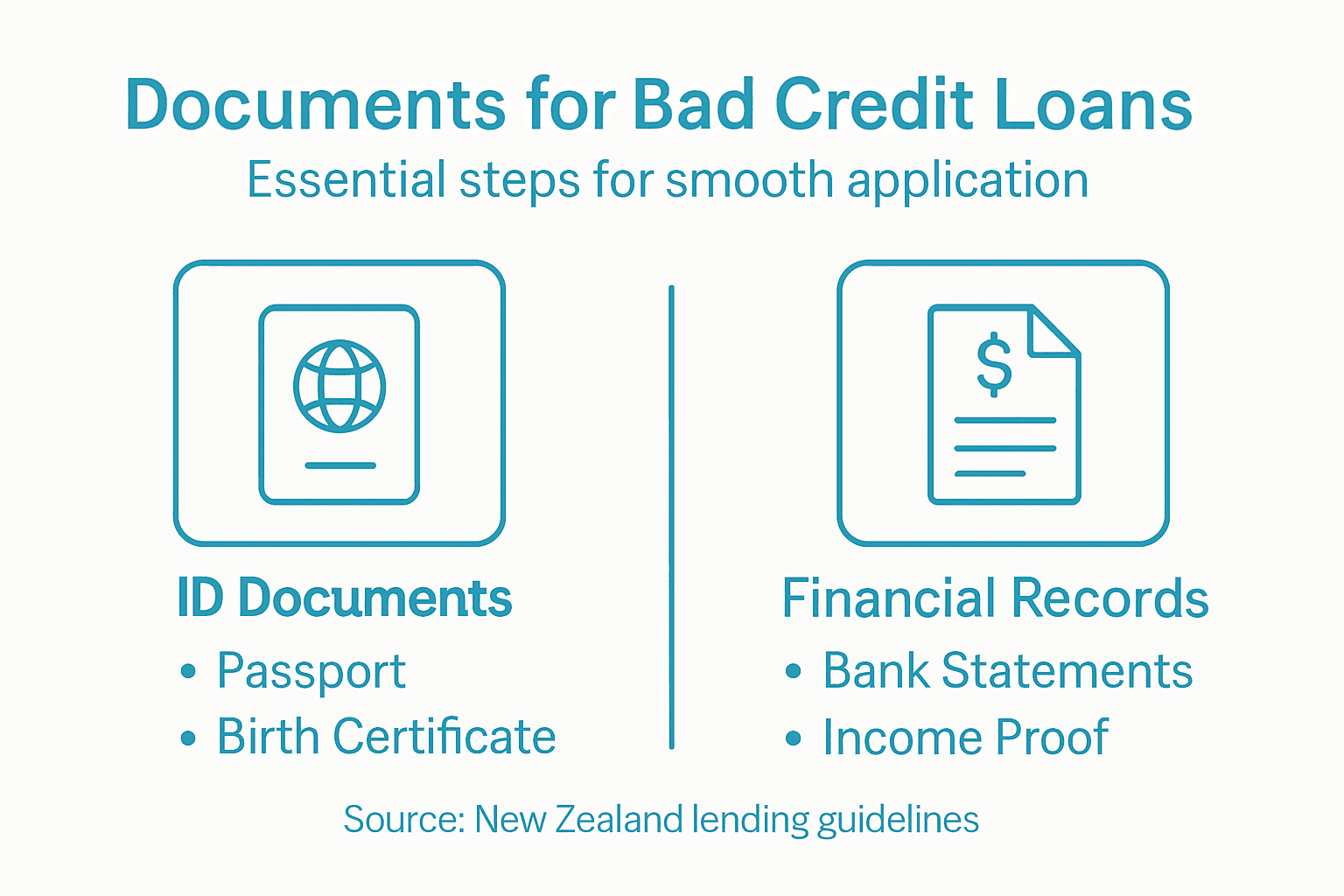
Start by gathering your primary identification documents. This typically includes your current passport, birth certificate, and citizenship or residency certificates. Ensure these documents are current and in good condition. Each document should be a clear, legible copy that accurately represents your full legal name, date of birth, and current residential status. Pro tip: make certified copies to prevent potential loss or damage of original documents.
For financial services applications, lenders often require multiple forms of identification. Beyond your primary documents, consider gathering additional supporting evidence such as a current driver’s licence, utility bills showing your residential address, and recent bank statements. These supplementary documents help verify your identity and provide extra credibility to your loan application.
Quick tip: Always keep your identification documents in a secure, waterproof folder and make digital backups to protect against unexpected loss or damage.
Here’s a summary of typical documents required for a bad credit loan application:
| Document Type | Main Purpose | Key Details Shown | When Usually Required |
|---|---|---|---|
| Passport/Birth Certificate | Establish identity | Full legal name, date of birth | Always, as primary ID |
| Driver’s Licence | Confirm address and identity | Residential address, ID number | Often, as secondary ID |
| Utility Bill/Bank Statement | Prove residency and finances | Address, account activity | Often, supports credit history |
| Payslip/Benefit Statement | Show income capacity | Salary, employer, pay period | Always, proves ability to repay |
| Credit Report | Assess financial history | Defaults, repayments, arrears | Always, determines eligibility |
Step 2: Collect recent financial statements
Collecting recent financial statements is a critical step in preparing your bad credit loan application. These documents will help lenders understand your current financial situation and assess your loan eligibility.

Start by gathering comprehensive financial documentation. This includes recent tax statements from Inland Revenue, bank statements for the past three to six months, payslips, and any additional income documentation. Aim to compile a complete picture of your financial history. These statements should clearly show your income, regular expenses, existing debts, and any financial commitments. Make sure the documents are up to date and reflect your most recent financial activity.
Pay special attention to presenting a transparent financial profile. If you have irregular income or multiple income sources, include documentation that explains these variations. Some lenders might require additional context about your financial situation. Documents from different sources help build a comprehensive view of your financial health, which can be particularly important when applying for a loan with a challenging credit history.
Helpful hint: Organise your financial statements chronologically and create both digital and physical copies to ensure you have backup documentation ready.
Step 3: Organise proof of income sources
Organising your proof of income is a crucial step in strengthening your bad credit loan application. Lenders want to see clear evidence that you have stable and reliable income streams to support loan repayment.
Begin by collecting comprehensive documentation that demonstrates your earning capacity. University records confirm various acceptable income documents, which may include full-time employment payslips, freelance contract agreements, government benefit statements, rental income records, and investment earnings documentation. Ensure each document is current and shows your name and income details clearly. If you have multiple income sources, compile evidence for each one separately to provide a comprehensive financial picture.
For those with complex income situations such as self employment or irregular earnings, additional documentation becomes even more important. Include tax returns, bank statements showing consistent deposits, and official letters from employers or clients verifying your income. The goal is to demonstrate financial stability despite potential credit challenges. By presenting a thorough and transparent income profile, you increase your chances of loan approval.
Helpful hint: Create a digital folder with colour scans of all income documents to ensure you have instant access and backup copies.
Step 4: Compile credit history and arrears evidence
Compiling a comprehensive record of your credit history is essential when applying for bad credit loans. Your goal is to create a transparent and honest representation of your financial journey that demonstrates responsibility and potential for loan repayment.
Start by obtaining your official credit report from New Zealand credit reporting agencies. Criminal record checks can provide additional background context, though they are not direct credit indicators. Request detailed statements that outline your credit activities, including any past defaults, late payments, or arrears. For each negative entry, prepare a concise written explanation that provides context. This might include documentation about temporary financial hardships, job loss, medical emergencies, or other legitimate reasons for previous credit challenges.
When compiling your evidence, focus on demonstrating financial rehabilitation. Include recent bank statements showing consistent income, proof of regular bill payments, and any evidence of improving financial management. If you have resolved previous credit issues, obtain letters from creditors confirming paid settlements or successful debt management plans. By presenting a comprehensive and honest narrative of your credit history, you help lenders understand your financial resilience and commitment to responsible borrowing.
Helpful hint: Create a chronological folder with colour coded documents to make your credit history easy for lenders to review.
Step 5: Check document accuracy and completeness
Ensuring the accuracy and completeness of your loan application documents is a critical step that can significantly impact your chances of approval. Careful review prevents unnecessary delays and demonstrates your attention to detail.
Official document verification processes require meticulous checking of every document. Go through each page systematically, verifying that all information is current, legible, and matches across different documents. Check that your full legal name is consistent, dates are correct, and all pages are included. Pay special attention to financial statements, ensuring they cover the required timeframe and show your most recent financial activity. If any documents are in a language other than English, arrange for certified translations to be included.
Carefully cross reference each document to eliminate any potential discrepancies. Verify that contact information is up to date, addresses match across different documents, and all identification numbers are accurate. Look for any signs of damage, smudging, or unclear printing that might cause confusion. If you find any errors, obtain updated or corrected versions from the original issuing authorities. Remember that even small inconsistencies can raise red flags for lenders reviewing your bad credit loan application.
Helpful hint: Create a checklist of required documents and personally verify each one against the original before submission.
The following table compares how different document types impact the assessment process for bad credit loan applications:
| Document Category | Assessment Impact | Typical Review Focus |
|---|---|---|
| Identification | Legal status verification | Name consistency, expiry |
| Financial Statement | Stability evidence | Income regularity, expenses |
| Income Proof | Repayment capacity | Source reliability, amount |
| Credit History | Risk and rehabilitation | Defaults, recovery efforts |
| Supporting Evidence | Additional credibility | Address confirmation, context |
Step 6: Submit documents to your mortgage adviser
Submitting your documents to a mortgage adviser represents the final critical stage in your bad credit loan application process. Your thorough preparation will now be transformed into a potential pathway towards loan approval.
Government housing resources recommend comprehensive document preparation when approaching mortgage advisers. Arrange a face to face meeting or secure digital submission method with your adviser. Present your documents in a clear, organised manner preferably using a professional folder or digital file system. Ensure all copies are certified and include a comprehensive cover sheet summarising the documents you are submitting. Walk through each document with your adviser, explaining any unique circumstances or context that might help them understand your financial situation more comprehensively.
During the submission process, remain transparent and open to questions. Your mortgage adviser is there to help you navigate the application, not judge your past financial challenges. Be prepared to provide additional clarification or documentation if requested. Some advisers might recommend specific additional steps or documentation based on their initial review of your submitted materials. Maintaining a collaborative and honest approach can significantly improve your chances of securing a suitable loan.
Helpful hint: Make digital and physical copies of everything you submit and request a receipt or confirmation of document receipt from your mortgage adviser.
Simplify Your Bad Credit Loan Document Journey with Expert Mortgage Advisers
Applying for a bad credit loan can feel overwhelming, especially when you need to gather and organise a variety of documents like identification, financial statements, and proof of income as highlighted in the article. The process requires accuracy, completeness, and transparency to improve your chances of approval. This is where specialised support makes all the difference. At Mortgage Managers, we understand the challenges of assembling complex paperwork and navigating credit history issues. Our team of dedicated mortgage advisers in Auckland are ready to guide you step-by-step, ensuring your documents meet lender expectations and showcase your financial reliability clearly.
Access professional guidance that transforms your bad credit loan application journey. Connect with trusted mortgage advisers who specialise in bad credit cases and empower yourself with tailored strategies to submit the right documentation confidently. Take control of your financial future today by visiting Mortgage Managers and discovering support that understands your unique situation. For more insights on preparing your application, explore how to Gather Essential Identification Documents and learn practical advice to Submit Documents Effectively with our local experts.

Frequently Asked Questions
What documents do I need to provide for bad credit loans?
To apply for bad credit loans, gather essential identification documents such as your passport, birth certificate, and proof of residency, like utility bills. Ensure all documents are recent, clear copies, and organised for easy review.
How can I prove my income when applying for a bad credit loan?
To prove your income, collect recent payslips, bank statements, and any additional income documents like rental agreements. Aim to present a comprehensive financial picture by showing documentation for all income sources.
What if I have negative marks on my credit history?
If you have negative marks on your credit history, prepare a detailed explanation for each entry, highlighting any mitigating circumstances. Include evidence of recent good financial behaviour, such as improved payment records, to demonstrate your financial stability.
How do I check the accuracy of my loan documents before submission?
Verify the accuracy of your loan documents by checking that all information, such as your name and date of birth, is consistent across each document. Create a checklist of required documents and ensure everything is legible and up to date before submission.
What should I do after submitting my documents to the mortgage adviser?
After submitting your documents, follow up with your mortgage adviser to confirm receipt and be open to any questions they may have. Maintaining clear communication can help address any concerns promptly and support your application process.
Can I submit my application electronically for bad credit loans?
Yes, many lenders allow electronic submissions for bad credit loan applications. Prepare digital copies of your documents, ensuring they are organised and clearly labelled for easy access during the online application process.
Recommended Reading
- How to Negotiate Home Loans with Bad Credit in NZ
- Bad Credit Home Loan Checklist 2025: Secure Your Mortgage
- 7 Real Bad Credit Mortgage Examples and How They Work
- 7 Mortgage Approval Tips for Bad Credit in New Zealand – Mortgage Managers
- Procedura richiesta diploma online: Guida passo passo – Recupero Anni Scolastici e Diploma Online