
Missing a mortgage payment in West Auckland can feel overwhelming when you are trying to keep your first home dreams on track. A single late payment often comes with penalties up to 10% of the outstanding amount and starts a formal process that affects your credit score and future borrowing options. For first home buyers, understanding what counts as a late payment and how it impacts your finances is crucial. This guide clears up what to expect, explains your lender’s processes, and highlights your options if you fall behind.
Table of Contents
- What Are Late Payments on Mortgages?
- Types of Mortgage Arrears and Defaults
- How Late Payments Affect Credit Score
- Lender Policies on Missed Repayments
- Options for First Home Buyers With Arrears
- Risks, Costs, and Avoiding Further Defaults
Key Takeaways
| Point | Details |
|---|---|
| Understanding Late Payments | Late mortgage payments trigger penalties and can lead to serious consequences, including legal proceedings and potential home loss. Communication with lenders at the first sign of trouble is crucial. |
| Types of Mortgage Arrears | Different arrears types exist, including standard mortgages, home equity loans, and reverse mortgages, each impacting recovery options uniquely. First-time buyers should know how these affect their financial standing. |
| Impact on Credit Score | Missing mortgage payments negatively affects your credit score, making future borrowing more challenging. Proactive communication with lenders can mitigate long-term damage. |
| Options for First Home Buyers | Early intervention through loan restructuring, government assistance, or borrowing against home equity can help manage arrears effectively. Seeking professional advice can lead to better outcomes. |
What Are Late Payments on Mortgages?
A late payment on your mortgage occurs when you fail to pay your instalments by their due date. This is more than just missing a payment or two—it’s a formal default that sets off a chain of events affecting your financial standing and home ownership.
When you miss a payment, penalties up to 10% of the outstanding amount can be applied. Your unpaid instalments become what lenders call arrears, which is the key trigger for further action. The lender will contact you first, but if payments remain outstanding, the situation escalates quickly.
For first home buyers in West Auckland, understanding what happens after missed payments is crucial. Your lender will attempt to contact you directly about the arrears. If you ignore these communications or cannot catch up, they may involve the first mortgagee—essentially taking formal steps toward recovery. This is where things become serious.
The legal process in New Zealand is strict and governed by specific timeframes. If arrears continue unpaid, lenders can request a judgment against you or even initiate property sale proceedings through mortgagee sale. These aren’t quick decisions; there are formal procedures and notice requirements that must be followed. But they will happen if you don’t address the arrears.
What makes late payments different from other debts is the collateral involved. Your home secures the mortgage, so the lender has a powerful legal right to force a sale if necessary. This isn’t a threat—it’s the reality of how mortgage law works in New Zealand.
The good news? Early intervention works. If you’re struggling with payments, talking to your lender about hardship options before missing payments gives you options. Some situations may qualify for penalty waivers under certain conditions, particularly first-time lapses that aren’t deliberate. Getting professional advice from a mortgage adviser at the first sign of trouble can be the difference between managing a temporary setback and facing a mortgagee sale.
Pro tip: Contact your lender immediately if you anticipate missing a payment—don’t wait until after it’s late. Lenders are far more willing to work with borrowers who communicate proactively rather than those who disappear.
Types of Mortgage Arrears and Defaults
Not all mortgage problems look the same. Arrears and defaults can take different forms depending on the type of loan you have and your specific circumstances. Understanding these distinctions helps you recognise your situation early and take action.
The most common type is straightforward payment arrears on your standard mortgage. This happens when you miss one or more regular repayments. Missing a single payment doesn’t immediately mean default, but it becomes arrears immediately. Keep missing payments, and your lender classifies it as a formal default—a serious breach of your loan agreement.
Beyond standard mortgages, home equity loans and top-up loans operate differently and can create their own arrears issues. These secured loans against your property have different structures and repayment schedules than traditional mortgages. If you’re using your home’s equity to borrow additional funds, missing payments on these secondary loans creates compounded problems because both your primary and secondary lenders have claims against your property.
Reverse mortgages present another distinct scenario, particularly for older homeowners. These loans function differently—you’re borrowing against accumulated equity rather than making regular payments. Arrears on reverse mortgages can occur if you fail to meet specific obligations related to the loan agreement, such as maintaining property insurance or paying rates.
There’s also the matter of tax-related arrears. Property interest limitation rules create obligations around residential property lending. If you breach these rules, you may face financial difficulties that exacerbate existing mortgage problems or create new arrears situations.
For first home buyers in West Auckland, the type of default matters because it determines your recovery options and how seriously lenders treat the breach. A missed payment on a standard loan has different consequences than breaching conditions on an equity loan or failing to meet tax-related obligations.
Here’s a summary of common mortgage arrears types and their key characteristics in New Zealand:
| Arrears Type | Main Cause | Impact on Borrower | Resolution Path |
|---|---|---|---|
| Standard mortgage | Missed monthly payment | Immediate penalty fees, risk of default | Payment plan or restructuring |
| Home equity loan/top-up | Missed top-up payment | Multiple lender claims on property | Consolidation or refinance |
| Reverse mortgage | Breach of loan condition | Possible early repayment, risk to equity | Restore compliance or pay charges |
| Tax-related arrears | Breach of interest rules | Tax penalties, potential for combined mortgage risk | Tax compliance or financial advice |
Pro tip: If you have multiple mortgage products secured against your property, track each one’s due dates separately. Missing payments on secondary loans can trigger default clauses on your primary mortgage, creating cascading problems you didn’t anticipate.
How Late Payments Affect Credit Score
Your credit score is a three-digit number that follows you through your financial life. When you miss mortgage payments, that score takes a direct hit. The damage accumulates quickly and lingers for years, affecting everything from loan applications to insurance rates.

Every late payment gets reported to credit agencies. Repeated missed payments harm your credit score, making it harder to secure loans or credit in the future. A single missed payment can drop your score by 30 to 100 points depending on how good your score was before. Multiple missed payments? The damage compounds exponentially.
What makes mortgage arrears particularly damaging is their visibility. Banks and lenders must accurately report your payment history to credit agencies. Inaccurate or misleading reporting of loan limits or arrears can restrict your ability to obtain further finance. Even if a lender makes an error reporting your account, it stays on your record until you fight to correct it.
For first home buyers in West Auckland, understanding this connection is critical. You worked hard to save a deposit and qualify for your mortgage. One financial setback that causes late payments can undo years of building good credit. Future lenders will see those arrears and either decline your application or offer worse interest rates.
The impact extends beyond mortgages. Your credit score affects car loans, personal loans, and even rental applications. Some employers check credit scores before hiring. Late mortgage payments ripple through your entire financial life.
The good news is that damage isn’t permanent. Proactive communication with your lender can sometimes mitigate the harm. Catching up on arrears and staying current rebuilds your score over time. But it takes years to recover from serious payment defaults.
Pro tip: If you’re struggling with payments, contact your lender before missing a payment rather than after. Some lenders offer payment holidays or restructured arrangements that avoid reporting arrears to credit agencies altogether.
Lender Policies on Missed Repayments
Every lender has policies for handling missed payments, and understanding these policies gives you options when finances get tight. Most lenders won’t immediately threaten foreclosure over a single late payment. They follow a structured approach designed to recover the debt while giving borrowers a chance to catch up.
When you miss a payment, your lender will contact you about the shortfall. This is standard procedure. Most lenders apply additional charges on overdue amounts as penalty fees. Beyond that initial contact, they typically offer borrowers the chance to arrange payment plans to avoid escalating the situation. Getting into a conversation with your lender early matters because it demonstrates good faith on your part.
Lenders often work with borrowers to arrange payment plans rather than jumping straight to legal action. These arrangements might include extending your loan term, temporarily reducing payments, or restructuring your debt. However, if arrears persist and you stop communicating, lenders escalate. They’ll notify associated mortgagees and may seek court judgments or initiate foreclosure proceedings.
Responsible lending practices in New Zealand require lenders to treat borrowers fairly. Responsible debt collection mandates clear communication, reasonable contact limits, and flexibility in repayment restructuring, especially when borrowers face hardship. This means lenders must avoid harassment or coercion and act reasonably when you’re struggling.
For first home buyers in West Auckland, this is crucial. You have rights. Lenders cannot simply seize your home without following proper procedures and giving you opportunities to remedy the arrears. However, those opportunities shrink the longer you wait. The window for negotiating payment solutions closes as arrears grow.
The best lender policy is one you never need to test. Staying current on payments keeps you in control of your mortgage and your home. But if hardship hits, knowing that lenders must follow fair practices and offer restructuring options can ease some anxiety.
Pro tip: Request a hardship application form from your lender before missing payments if you anticipate financial difficulty. Many lenders have formal hardship provisions that offer genuine relief, including payment deferrals or restructured arrangements that avoid the damage of reported arrears.
Options for First Home Buyers With Arrears
Falling into arrears as a first home buyer feels like a dead end, but you have more options than you might think. The key is acting quickly before arrears spiral out of control. Several practical pathways exist to help you stabilise your situation and keep your home.
Your first option is loan restructuring through your existing lender. This involves working with your bank to modify your loan terms, extend the repayment period, or temporarily reduce payments. Many lenders offer hardship variations that give you breathing room while you stabilise your finances. This keeps you in control and avoids the cascade of problems that come with formal default.
If you have built equity in your home, borrowing against home equity through top-up loans can help consolidate arrears. This approach rolls missed payments into a new loan structure, essentially giving you a fresh start. However, this only works if you have sufficient equity and your income can support the new arrangement.
Government-backed support also exists for struggling first home buyers. Kāinga Ora provides guidance and loan modifications or assistance to help prevent defaults and support sustained home ownership. Additionally, accessing your KiwiSaver first-home withdrawal or exploring HomeStart Grant eligibility can provide funds to catch up on arrears if you haven’t already used these tools.
For first home buyers in West Auckland dealing with arrears, seeking professional mortgage advice early is critical. A mortgage adviser can identify which option suits your specific circumstances, whether that’s restructuring, equity-based solutions, or accessing government support programmes. They can also negotiate with your lender on your behalf, which often produces better outcomes than trying to manage the conversation alone.
The worst option is doing nothing. Arrears grow exponentially as penalties accumulate. The longer you wait, the fewer solutions remain available to you.
The following table compares the main support options for first home buyers facing arrears:
| Support Option | Typical Benefits | Restrictions | Who Can Apply |
|---|---|---|---|
| Loan restructuring | Lower or deferred payments | Must prove hardship | Most borrowers |
| Home equity top-up | Access to extra funds | Requires sufficient equity | Homeowners with equity |
| Kāinga Ora assistance | Advice, repayment help | Eligibility criteria | First home buyers |
| KiwiSaver withdrawal | Lump sum for arrears | Only if not used before | First home buyers |
Pro tip: Contact your lender or a mortgage adviser within 14 days of missing your first payment. Most hardship options and loan restructuring agreements must be negotiated before arrears become serious, so speed matters enormously.
Risks, Costs, and Avoiding Further Defaults
Mortgage defaults carry cascading consequences that extend far beyond the initial missed payment. Understanding these risks helps you see why taking action early matters so much. The financial and personal costs compound quickly if you don’t intervene.
The most obvious cost is the damage to your credit rating. Once arrears hit your credit file, lenders treat you differently for years. Getting approved for car loans, personal loans, or even rental applications becomes harder. Risks and costs of mortgage default include damaged credit ratings, increased interest costs, and legal expenses, along with potential loss of your home. A single default can cost you tens of thousands in higher interest rates on future borrowing.
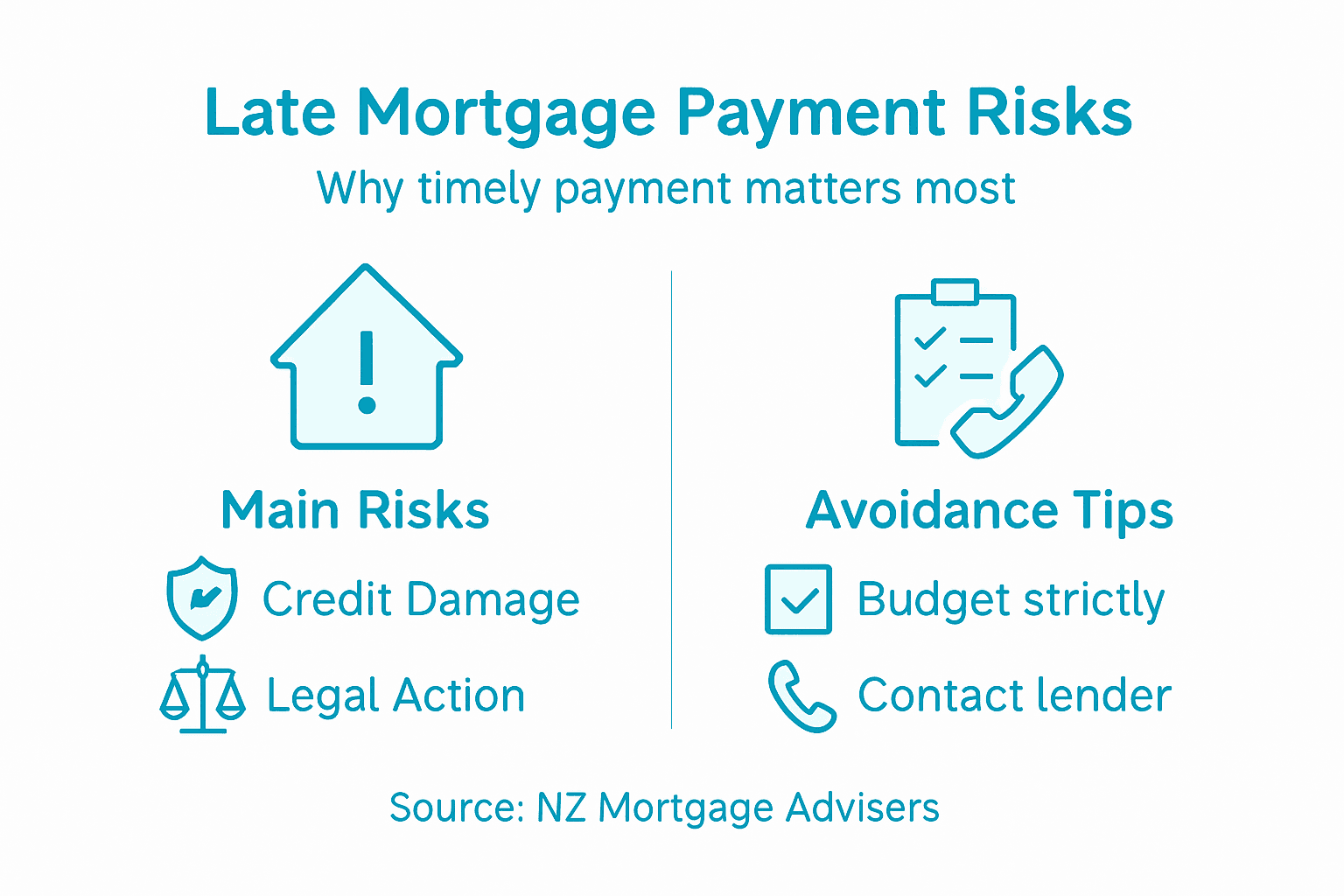
Legal costs mount quickly when defaults escalate. Your lender will hire lawyers to pursue court judgments and foreclosure proceedings. These costs often get added to your arrears, making the debt grow faster. Court processes take months, draining your emotional reserves and creating constant stress about your family’s housing security.
For first home buyers in West Auckland, the most devastating cost is losing the home you worked hard to purchase. Once mortgagee sale proceedings begin, the timeline tightens dramatically. Your property sells at auction, often below market value. Any equity disappears into legal fees and arrears repayment.
Avoiding further defaults starts with budgeting ruthlessly. Track every dollar, identify where you can cut spending, and prioritise your mortgage above almost everything else. If income is the problem, explore options like additional work or upskilling. Managing borrowing costs involves taking advantage of improving mortgage rate trends and increasing income levels to improve home affordability and sustain repayments.
Communication prevents defaults. The moment you sense financial trouble, talk to your lender. Most lenders have hardship teams specifically trained to help borrowers avoid defaults. They can restructure payments, offer payment holidays, or provide other relief. Silence is your enemy. Action is your ally.
Pro tip: Create a dedicated mortgage payment savings account and set up automatic transfers the day after you’re paid. Treating your mortgage like a non-negotiable priority before discretionary spending is the single most effective way to avoid defaults.
Secure Your First Home Despite Late Mortgage Payments
Facing late payments on your mortgage can be overwhelming especially for first home buyers in West Auckland who want to protect their biggest asset and financial future. The risk of arrears growing, damaging your credit score, or even facing mortgagee sale is real but you do not have to face it alone. Understanding terms like loan restructuring, hardship provisions, and equity top-up loans can open doors to solutions that keep you in control.

Take proactive action today with expert guidance from Mortgage Managers. As locally owned mortgage advisers based in Hobsonville we specialise in working with Auckland first home buyers to navigate complex challenges such as mortgage arrears. Our tailored advice and negotiation skills help you explore options like payment plans or government-backed assistance before the situation escalates. Visit us now at Mortgage Managers homepage to start addressing your mortgage difficulties with confidence and secure your dream home.
Act now because every day counts when it comes to managing late payments. Don’t wait until penalties and defaults multiply. Connect with us to regain control of your mortgage and protect your future.
Frequently Asked Questions
What happens if I miss a mortgage payment?
Missing a mortgage payment leads to penalties and unpaid amounts categorized as arrears. Lenders will contact you about the arrears, and if you don’t address the situation, it can result in severe consequences such as a mortgagee sale.
How do late payments affect my credit score?
Late payments significantly damage your credit score, which can drop by 30 to 100 points. This impact persists for years, making it harder to secure future loans and affecting various aspects of your financial life.
What options do I have if I face mortgage arrears?
You can consider loan restructuring with your lender, borrowing against your home equity, or seeking assistance from government programs. Early intervention is crucial, so reach out to a mortgage adviser to explore your options.
How can I avoid further defaults on my mortgage?
To prevent further defaults, create a strict budget prioritising your mortgage payments, communicate promptly with your lender if you anticipate trouble, and consider setting up automatic transfers to a dedicated mortgage payment savings account.