
Yes, you can get an insulation loan in New Zealand. Most major banks offer dedicated home energy loans or mortgage top-ups, often at competitive introductory rates per annum, specifically to fund insulation and related upgrades. Before you borrow a cent, though, check your eligibility for a Warmer Kiwi Homes grant first. Grants cover a substantial share of ceiling and underfloor insulation costs, which can dramatically reduce how much you actually need to borrow. Mortgagemanagers can help you work out the right loan structure once you know what the grant will cover.
Key takeaways
Combining a Warmer Kiwi Homes grant with a bank home energy top-up is the most cost-effective way to finance insulation in New Zealand, and checking grant eligibility before borrowing is the single most important step.
| Point | Details |
|---|---|
| Check grants before borrowing | Warmer Kiwi Homes covers 50%–90% of ceiling and underfloor insulation costs, reducing how much you need to borrow. |
| Headline bank rates are introductory | Offers like 0% for 5 years (Westpac) or 1% for 3 years (ANZ, ASB) revert to standard rates after the fixed period. |
| Stress-test the reversion | Model repayments at 6.5%–7% before committing to a loan size, not just at the promotional rate. |
| Top-up vs personal loan | A home loan top-up gives lower rates but is secured against your property; a personal loan costs more but requires no home equity. |
| Mortgagemanagers | Mortgagemanagers helps NZ homeowners compare green home loan top-ups, package applications, and model post-reversion repayments. |
Table of Contents
- What does an insulation loan actually pay for?
- What are the headline NZ bank offers right now?
- How do Warmer Kiwi Homes grants work with a loan?
- How do lenders structure insulation finance?
- How do you apply for a grant and a loan?
- When does talking to a mortgage adviser actually help?
- A practical perspective on insulation finance
- Mortgagemanagers can help you get the structure right
- Sources
What does an insulation loan actually pay for?
A home energy loan, as New Zealand banks typically call it, is usually structured as a top-up to your existing mortgage or as a separate fixed-rate product sitting alongside it. EECA confirms that most major NZ banks offer these products to fund a range of eligible works, including:
- Ceiling and underfloor insulation
- Double or triple glazing
- Ventilation and extractor fans
- Moisture control measures
- Efficient heaters and heat pumps
- Certain solar panel and battery installations
Borrowing limits across the market vary, though eligibility and caps differ by lender. Some products are available only to existing home loan customers, so your current bank is often the first port of call.
What are the headline NZ bank offers right now?
As at June 2026, EECA lists several banks offering promotional home energy loan rates. The table below shows the key details for the main examples currently on the market.
| Lender | Product name | Intro rate | Fixed period | Max borrowing | Key eligibility note |
|---|---|---|---|---|---|
| Westpac | Greater Choices Home Loan | 0% p.a. | 5 years | $50,000 | Must have existing Westpac home loan |
| ANZ | Good Energy Home Loan | 1% p.a. | 3 years | $80,000 | Must be an ANZ home loan customer |
| ASB | Better Homes Top Up | 1% p.a. | 3 years | $80,000 | Must have an ASB home loan |
| BNZ | Better Future Home Loan Top Up | Refer to BNZ | Refer to BNZ | Refer to BNZ | Must have a BNZ home loan |
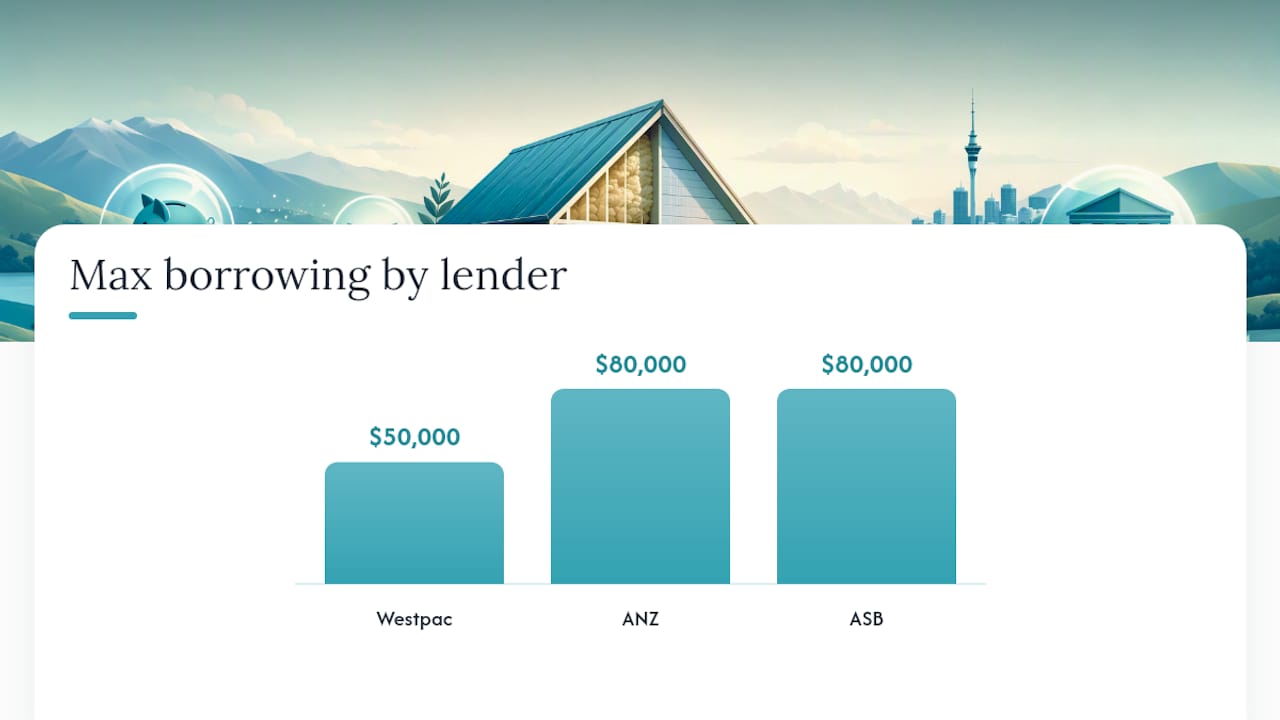
Source: EECA home energy loans listing, June 2026. Rates and terms are subject to change; confirm directly with each lender.
Reversion risk is the detail most borrowers overlook. Every one of these promotional offers reverts to the lender’s standard rate once the fixed period ends. Model your repayments at the post-reversion rate before you commit, not just the headline number.
Pro Tip: EECA recommends checking each lender’s current criteria directly, because promotional rates and eligibility conditions change. What was on offer last month may not be available today.
How do Warmer Kiwi Homes grants work with a loan?
Warmer Kiwi Homes is the first place to look before you arrange any home insulation financing. The programme covers a substantial portion of ceiling and underfloor insulation costs, with typical insulation retrofits costing several thousand dollars. That means your out-of-pocket cost, and therefore your loan size, can vary considerably depending on your grant share.
Eligibility requirements include:
- You own and live in the home as your primary residence
- The home was built before 2008
- You hold a Community Services Card or SuperGold Card, or live in a low-to-middle income area based on deprivation index criteria
- The property is not a holiday home or rental
- Some remote locations are excluded from the programme
Wall insulation is not funded under Warmer Kiwi Homes, which matters when you are planning a full retrofit. If your home needs wall insulation or higher-spec glazing, those costs will need to come from a loan or savings.
The sequencing logic is straightforward: confirm your grant entitlement and get an installer scope of works first, then borrow only what the grant does not cover — as explained in this clear guide for NZ homeowners. This approach, supported by EECA’s programme guidance, often cuts the loan amount by half or more. The New Zealand government also advises that adding the remaining cost to your mortgage is a sensible option when grant funding does not cover everything.
Pro Tip: Use the Warmer Kiwi Homes eligibility checker on the EECA website before you call a bank. A professional energy assessment will also tell you exactly which insulation is missing and what it will cost, so you are not borrowing more than you need.
How do lenders structure insulation finance?
Understanding the product shape matters as much as the rate. There are a few common structures you will encounter.
A home loan top-up adds the insulation cost to your existing mortgage, secured against your property. This is the most common structure for the promotional bank products listed above. The advantage is access to low introductory rates; the trade-off is that your home secures the debt, and the loan affects your loan-to-value ratio.

A separate secured renovation mortgage works similarly but sits as a distinct loan alongside your main mortgage, sometimes with its own term and rate. This can make it easier to track and pay off separately. For a broader overview of how these structures compare, the different home loans guide from Mortgagemanagers walks through the options clearly.
An unsecured personal loan is available if you do not have a home loan or do not qualify for a top-up. or more, so this route makes sense only for smaller amounts or when no other option fits.
Worked example
Suppose your ceiling and underfloor insulation quote comes in at $4,300. fixed for three years.
| Item | Amount |
|---|---|
| Total insulation cost | $4,300 |
| Warmer Kiwi Homes grant (70%) | $3,010 |
| Loan top-up required | $1,290 |
| Monthly repayment at 1% over 3 years | approx. $36 |
| Monthly repayment at 6.5% after reversion (3-year term) | approx. $40 |
The numbers are modest here because the grant does the heavy lifting. For a larger project, say $15,000 for wall insulation and glazing not covered by grants, the post-reversion payment difference becomes much more significant. Use the Mortgagemanagers mortgage calculator to model your own scenario at both the intro and post-reversion rates.
EECA’s research and evaluation shows that insulation and heater retrofits deliver measurable health and energy benefits, which supports the case for financing these upgrades even when grants do not cover the full cost.
Check for early repayment fees before fixing the term.*
How do you apply for a grant and a loan?
The process is more straightforward than most people expect. Work through these steps in order.
- Check grant eligibility. Use the Warmer Kiwi Homes tool on the EECA website to confirm whether your property and household qualify before doing anything else.
- Get an energy assessment and installer quote. A registered installer will assess what insulation is missing and provide a written quote. This quote is required for both the grant application and the loan.
- Gather your documents. You will typically need: photo ID, proof of property ownership, recent payslips or income evidence, your current mortgage details, and the installer’s written quote.
- Contact your lender or a mortgage adviser. If you are applying for a bank top-up, start with your current home loan provider. A mortgage adviser can compare products across lenders if your bank’s offer is not the best fit.
- Apply for the grant first, then the loan. Submit your Warmer Kiwi Homes application before finalising the loan amount, so you know exactly how much you need to borrow.
- Sign the installer contract and arrange payment. Once both the grant and loan are approved, the installer can schedule the work. Grant funds are typically paid directly to the installer.
Timeline to expect: eligibility checks and quotes usually take one to two weeks. Grant processing can take two to four weeks. Loan approval, if you are an existing customer applying for a top-up, often takes a few days to a week. Installation is typically scheduled within two to four weeks of approval. Allow six to ten weeks from first enquiry to completed installation as a realistic estimate.
Most top-up products require you to already hold a home loan with that lender. If you are not an existing customer, you may need to refinance or explore a personal loan option, which is worth discussing with an adviser before you commit. For practical guidance on improving your eligibility position, the home loan eligibility guide from Mortgagemanagers is a useful starting point.
When does talking to a mortgage adviser actually help?
For a straightforward top-up with your existing bank, you may not need an adviser. But the picture changes quickly once you are comparing multiple lenders, weighing grant sequencing against loan timing, or unsure whether a top-up or a separate renovation loan suits your situation better.
A mortgage adviser brings three things that a bank’s own staff cannot: independence across lenders, knowledge of which products are currently accepting applications and on what terms, and the ability to model post-reversion repayments honestly rather than just selling you the headline rate.
Mortgagemanagers offers:
- Local NZ market knowledge, with advisers based in Hobsonville and servicing Auckland, West Auckland, the North Shore, and clients remotely across New Zealand
- Loan packaging that presents your application in the strongest possible light
- Repayment modelling using the mortgage calculator to show you both the introductory and post-reversion cost
- Guidance on sequencing your Warmer Kiwi Homes grant application alongside your loan
- Liaison with lenders on your behalf to clarify criteria and progress your application
The initial conversation costs you nothing. Bring your property details, an idea of the works you are planning, and any installer quotes you have already received.
A practical perspective on insulation finance
Most homeowners focus on the headline rate and miss the more important question: what does this loan cost me after the promotional period ends? Too many borrowers treat the promotional period as the whole story and are then surprised when their repayments increase.
The smarter approach is to treat the low-rate window as an opportunity to pay down the balance aggressively, so the reversion lands on a much smaller amount. Pair that with grant-first sequencing, and you are often borrowing a fraction of the total project cost anyway.
Three things worth acting on before you apply:
- Get the installer assessment done first. You cannot know how much to borrow until you know what the grant will cover and what the actual scope of work is.
- Do not top up to the maximum without stress-testing. Model the repayment at 6.5%–7% before you decide on the loan size, not after.
- Sequence the heater grant separately. If you are also planning a heat pump, Warmer Kiwi Homes has a separate heater grant process. Combining both in the right order can reduce your total out-of-pocket cost further.
The MBIE programme documentation confirms that Warmer Kiwi Homes has been extended and expanded, so availability is not the concern it once was for many regions. The bigger risk is borrowers who skip the grant check and borrow the full project cost unnecessarily.
Mortgagemanagers can help you get the structure right
Sorting through lender criteria, grant timing, and post-reversion risk on your own takes time you may not have. Mortgagemanagers cuts through that by doing the comparison work for you: identifying which green home loan top-up suits your situation, packaging your application to meet lender requirements, and modelling repayments at both the introductory and standard rates so there are no surprises later.

Based in Hobsonville and servicing clients across Auckland and remotely throughout New Zealand, the team at Mortgagemanagers brings genuine local knowledge to every application. Whether you are an existing homeowner looking to add insulation to your mortgage or a first home buyer planning upgrades from day one, the first step is a straightforward conversation. Reach out to the team at Mortgagemanagers to talk through your options with no obligation.
Sources
The sources below are the best places to verify current eligibility, check grant availability, and confirm lender offers before you apply.
- Warmer Kiwi Homes — Insulation and heater grants | EECA
- Paying for home insulation | New Zealand Government
- Warmer Kiwi Homes programme – extension and expansion | MBIE
This article provides general information about insulation financing options in New Zealand. It is not financial advice. Confirm current eligibility criteria and loan terms directly with EECA, your lender, or a qualified mortgage adviser before making any borrowing decisions.
This article is general information, not a substitute for advice from a qualified financial advisor. Consult a qualified financial professional about your own circumstances before acting on anything here.