
You might have heard that banks make good money from mortgages, but have you looked at the lifetime cost of a mortgage?
Choosing your first home in Hobsonville means weighing more than just the sale price, as the true financial commitment lies in the lifetime cost of a mortgage. For many buyers, changing interest rates and loan structures can make a huge difference to the total amount repaid over decades. With weekly mortgage costs rising 27.5% in the year to June 2023 according to Stats NZ, understanding every part of your mortgage can help you avoid surprises and make confident decisions about your future in Auckland.
Table of Contents
- Understanding The Lifetime Cost Of A Mortgage
- Types Of Mortgages Available In New Zealand
- How Interest And Repayment Structures Work
- Factors Influencing Total Mortgage Cost
- Common Mistakes First Home Buyers Make
Key Takeaways
| Point | Details |
|---|---|
| Understand Lifetime Costs | Assessing the total financial commitment of a mortgage includes interest rates, loan duration, and extra fees beyond just the purchase price. |
| Choose the Right Mortgage Type | Different mortgage types, such as fixed-rate or floating-rate, have unique benefits and drawbacks. Selecting the best option depends on personal financial situations and goals. |
| Consider Interest and Repayment Structures | Understanding how interest and repayment structures interact can help borrowers reduce total mortgage costs through strategic payment plans. |
| Avoid Common First Home Buyer Mistakes | Be aware of full ownership costs, maintain emergency savings, and compare multiple lenders to avoid financial strain in the long run. |
Understanding the Lifetime Cost of a Mortgage
When purchasing your first home in Hobsonville, understanding the lifetime cost of a mortgage goes far beyond simply looking at the initial purchase price. The total financial commitment involves complex calculations and long-term financial planning that can significantly impact your household budget.
According to recent Reserve Bank research on mortgage financing, several critical factors influence the lifetime mortgage expense:
- Interest rates and their historical fluctuations
- Length of mortgage term
- Principal loan amount
- Repayment frequency
- Additional fees and charges
Statistical evidence from Stats NZ reveals that mortgage payments have dramatically shifted in recent years. Weekly mortgage costs rose 27.5% in the year ending June 2023, demonstrating how dynamic these expenses can be for homeowners.
Understanding these lifetime costs requires careful consideration of both short-term and long-term financial implications. Homebuyers must factor in potential interest rate changes, potential refinancing opportunities, and how extra repayments could dramatically reduce total loan expenses.
Calculate your potential lifetime mortgage cost using multiple interest rate scenarios to prepare for different financial futures.
Our mortgage calculators can show you what you will pay, but also how to save on what you pay.
Types of Mortgages Available in New Zealand
Navigating the mortgage landscape in New Zealand requires understanding the diverse range of home loan options available to first-time buyers. Mortgage financing structures offer multiple pathways for homeowners to secure their dream property.
The primary mortgage types in New Zealand include:
- Fixed-rate mortgages: Provide stability with locked interest rates for specified periods
- Floating-rate mortgages: Offer flexibility with interest rates that adjust to market conditions
- Split-rate mortgages: Combine fixed and floating rate portions for balanced risk management
- Interest-only mortgages: Allow borrowers to pay only interest for a predetermined period
- Revolving credit mortgages: Integrate home loan with transaction account for more dynamic financial management
Each mortgage type presents unique advantages and challenges for first-time homebuyers. Understanding the nuanced differences helps borrowers select the most suitable option for their financial circumstances and long-term goals.
To help you choose the mortgage type that best matches your financial needs, here’s a quick comparison:
| Mortgage Type | Key Benefit | Potential Drawback | Best For |
|---|---|---|---|
| Fixed-rate | Predictable payments | May miss rate drops | Long-term budget planners |
| Floating-rate | Flexible repayments | Exposed to rate increases | Those expecting lower rates |
| Split-rate | Balances risk | Complex structure to manage | Risk-conscious buyers |
| Interest-only | Lower initial costs | Higher principal later | Short-term cash flow needs |
| Revolving credit | Access to funds | Requires strong financial discipline | Highly active borrowers |
Mortgage selection requires careful consideration of personal financial health, income stability, and future economic projections. Potential homeowners should assess their risk tolerance, anticipated income changes, and overall financial strategy before committing to a specific mortgage structure.
Pro tip: Consult a mortgage professional to analyse your specific financial profile and match you with the most appropriate mortgage type for your circumstances.
How Interest and Repayment Structures Work
Understanding mortgage interest and repayment structures is crucial for first home buyers in New Zealand who want to make informed financial decisions. Mortgage repayment calculations involve complex interactions between loan amount, interest rates, and payment frequencies.
The primary components of mortgage repayments include:
- Principal amount: The original borrowed sum
- Interest charges: Cost of borrowing money
- Repayment frequency: Weekly, fortnightly, or monthly payments
- Amortisation schedule: How payments are allocated between principal and interest
Most New Zealand mortgages use a table loan structure, where each payment contains both principal and interest components. In the early years of the mortgage, a larger proportion of each payment goes towards interest, with the balance shifting towards principal repayment over time.

The total cost of a mortgage depends on several critical factors, including interest rate type, loan term, and repayment strategy. Borrowers can significantly reduce lifetime mortgage expenses by making additional payments, choosing shorter loan terms, or selecting more aggressive repayment frequencies.
Pro tip: Calculate multiple repayment scenarios to understand how small changes in payment frequency can dramatically reduce your total interest costs.
Factors Influencing Total Mortgage Cost
First home buyers must understand the complex landscape of factors impacting mortgage expenses and how global economic dynamics play a significant role in determining the lifetime cost of home ownership in New Zealand.
Key factors influencing total mortgage costs include:
- Interest rates: Fluctuations in domestic and international financial markets
- Loan-to-value ratios (LVR): Regulatory restrictions affecting borrowing capacity
- Credit score: Individual financial history and creditworthiness
- Loan term: Length of mortgage repayment period
- Property location: Regional variations in housing market conditions
- Deposit size: Initial contribution affecting long-term borrowing costs
Macroeconomic conditions significantly shape mortgage expenses. The Reserve Bank of New Zealand continuously monitors and adjusts monetary policies that directly impact borrowing costs, creating a dynamic environment for potential homeowners.
Personal financial strategies can mitigate some of these external influences. Borrowers can potentially reduce their lifetime mortgage costs by improving credit scores, making larger initial deposits, and selecting flexible loan structures that allow additional repayments.
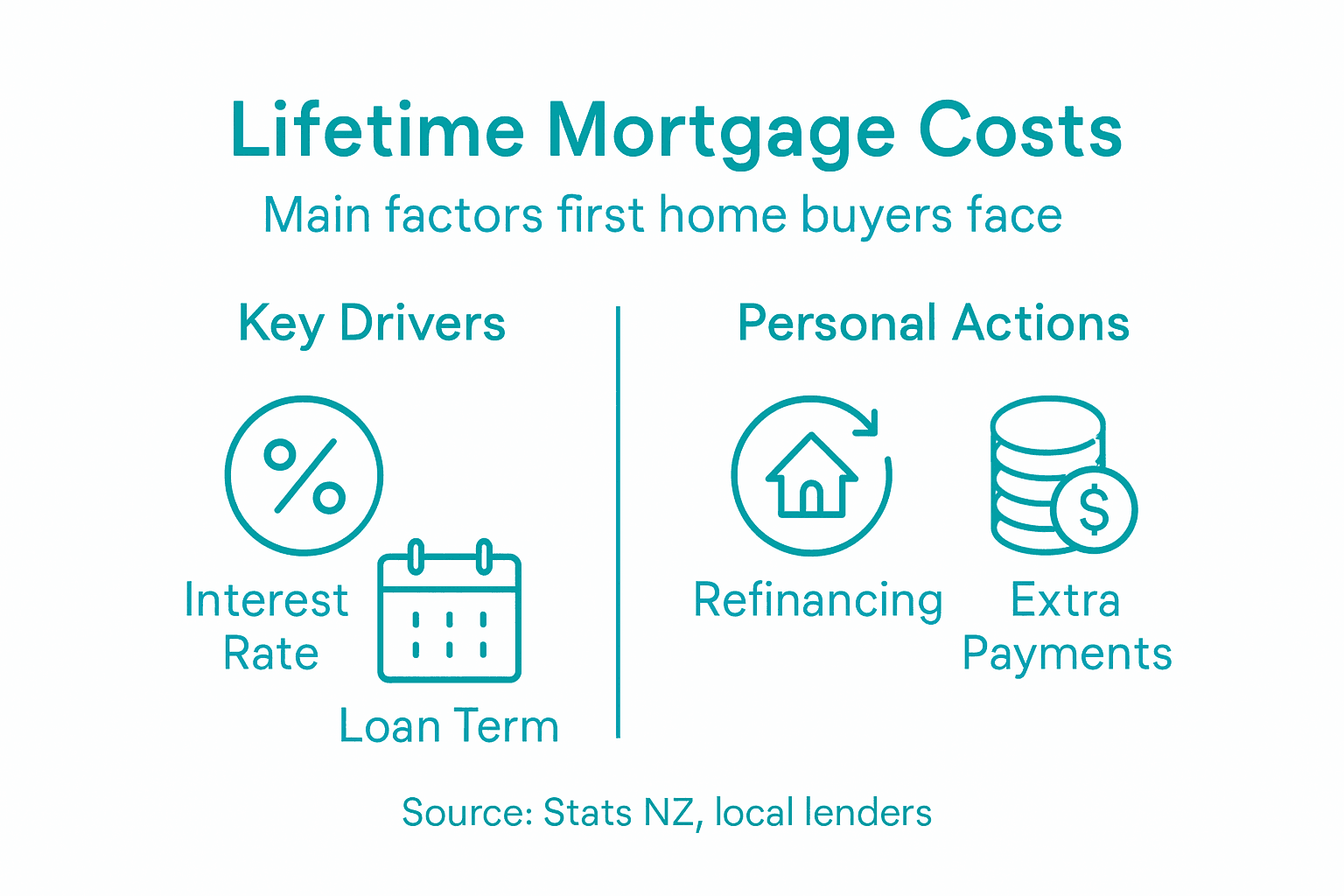
Pro tip: Regularly review your mortgage structure and explore refinancing opportunities to optimise your long-term financial strategy.
Common Mistakes First Home Buyers Make
First home buyers in New Zealand often encounter significant financial challenges that can dramatically impact their long-term mortgage expenses.
Housing cost misconceptions frequently lead to unexpected financial strain and potential economic difficulties.
Common mistakes first home buyers typically make include:
- Underestimating total ownership costs: Beyond mortgage payments
- Neglecting emergency savings: Crucial for unexpected home repairs
- Overlooking additional expenses: Insurance, rates, maintenance costs
- Maxing out borrowing capacity: Leaving no financial buffer
- Ignoring credit score implications: Potentially higher interest rates
- Failing to compare multiple lenders: Missing better loan options
The financial landscape for first home buyers is complex and requires careful navigation. Many individuals mistakenly believe that their initial mortgage assessment represents their total financial commitment, without considering potential rate fluctuations or long-term economic shifts.
Here’s a summary of common mistakes and their long-term financial consequences for first home buyers:
| Mistake | Consequence | Prevention Tip |
|---|---|---|
| Ignoring full ownership costs | Unplanned budget shortfall | Build a detailed household budget |
| Failing to compare lenders | Higher lifetime interest paid | Research multiple offers |
| Neglecting emergency funds | Forced high-interest borrowing | Set aside emergency savings |
| Overlooking credit score impact | Less favourable loan terms | Regularly monitor credit |
Prudent financial planning involves understanding the broader economic context and preparing for potential changes. Borrowers must develop a comprehensive view of their mortgage, considering not just current conditions but potential future scenarios that could impact their financial stability.
Pro tip: Create a comprehensive budget that includes all potential housing expenses, not just mortgage payments, to avoid financial surprises.
Take Control of Your Mortgage Journey with Expert Advice
Understanding the lifetime cost of a mortgage can feel overwhelming with so many factors like interest rates, repayment structures, and hidden expenses to consider. First home buyers often face challenges such as underestimating total ownership costs and navigating complex mortgage types. At Mortgage Managers, we specialise in guiding you through these intricate details to help secure the best mortgage solution tailored to your unique financial situation.

Don’t leave your homeownership dreams to chance.
Partner with one of our experienced Mortgage Advisers in Hobsonville who understand Auckland’s housing market very well and and can help you avoid common pitfalls.
Visit Mortgage Managers today for personalised advice and take the first step towards a lifetime of confident mortgage decisions.
Frequently Asked Questions
What is the lifetime cost of a mortgage?
The lifetime cost of a mortgage includes the total amount paid over the life of the loan, accounting for principal, interest, fees, and other charges. It is influenced by several factors such as interest rates, loan term, and additional costs.
How can I calculate my potential lifetime mortgage cost?
You can calculate your potential lifetime mortgage cost by considering different interest rate scenarios, the principal amount of the loan, the repayment frequency, and additional fees. Using mortgage calculators can help you project these costs more accurately.
What common mistakes do first home buyers make with mortgages?
Common mistakes include underestimating total ownership costs, neglecting emergency savings, failing to compare multiple lenders, and ignoring credit score implications, which can lead to higher interest rates.
What types of mortgages are available for first home buyers?
First home buyers typically have access to several mortgage types, including fixed-rate, floating-rate, split-rate, interest-only, and revolving credit mortgages, each with different benefits and drawbacks.