
TL;DR:
- A pre-settlement inspection is the buyer’s final opportunity to verify the property’s condition before ownership transfer. It focuses on changes since the contract signing and covers damage, chattels, system function, repairs, and cleanliness. Scheduling the walk-through 48 to 72 hours before settlement allows time to address issues legally and practically.
A pre-settlement inspection is the buyer’s final opportunity to confirm a property’s condition matches the sale and purchase agreement before legal ownership transfers. In New Zealand, this walk-through is not a second building inspection. It is a focused, practical check to detect any changes that have occurred since you signed the contract. Whether you are a first-time buyer in Auckland or an investor adding to your portfolio, understanding the pre-settlement inspection process could save you from inheriting someone else’s damage or missing inclusions you paid for.
The standard ADLS/REINZ Agreement used across New Zealand contractually guarantees buyers the right to inspect before settlement. That right is not created by statute, but it is binding. Use it every single time.
What does a pre-settlement inspection cover?
A typical pre-settlement inspection lasts 30–60 minutes and covers five core areas: new damage, chattels, system functionality, completion of agreed repairs, and overall cleanliness. That timeframe is enough because this is a change-detection exercise, not a diagnostic evaluation. You are not assessing the property from scratch. You are comparing its current state to the condition it was in when you signed.
The five areas in practice look like this:
- New damage: Wall scuffs, broken tiles, cracked glass, or holes left from removed fixtures
- Chattels: Every item listed in the contract, such as whiteware, curtains, light fittings, and heat pumps, must still be present and in working order
- System functionality: Test taps, flush toilets, run the dishwasher, switch on the rangehood, and check the hot water cylinder
- Agreed repairs: Any work the vendor committed to completing before settlement must be finished and verifiable
- Cleanliness: The property must be left in a reasonably clean condition, not necessarily spotless, but not a tip either
Many buyers mistake this walk-through for a second building inspection, which is a different exercise entirely. A building inspection, typically conducted by a registered building surveyor before you go unconditional, assesses structural integrity, moisture, and compliance. The pre-settlement check focuses only on what has changed since that earlier inspection was done.
Pro Tip: Bring your original building inspection report and the sale and purchase agreement to the walk-through. Use them as your reference documents, not your memory.

For new builds, the equivalent process is called a practical completion inspection, which is more detailed because you are checking workmanship for the first time. Established properties use the pre-settlement format described here.
When should you schedule your inspection in New Zealand?
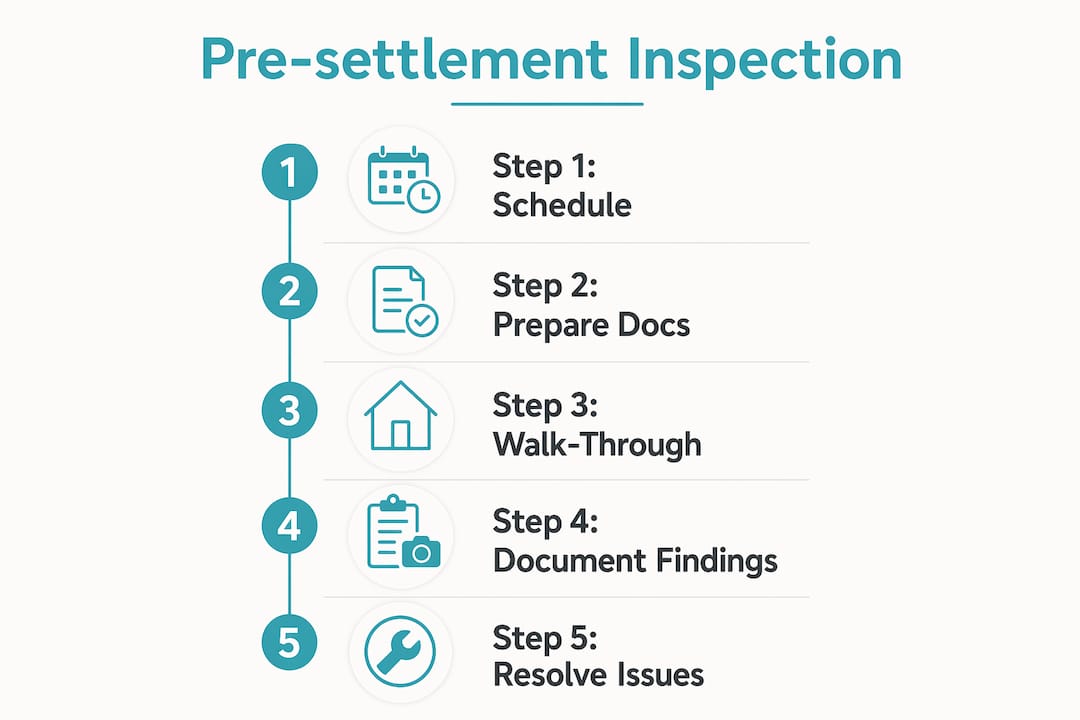
Timing is the single most underestimated factor in the pre-settlement walk-through process. Schedule your inspection at least 48 hours before settlement to give your lawyer enough time to act if something is wrong. The 48–72 hour window is the standard recommended by New Zealand property guides and legal advisers, including DK Legal, because it preserves your options.
Here is why that window matters so much:
- Lawyer intervention time: If you find damage or missing chattels, your lawyer needs time to contact the vendor’s solicitor, negotiate a remedy, and document any agreed adjustment before settlement funds are released.
- Repair completion: In some cases, the vendor may agree to fix an issue before settlement. That requires time to organise a tradesperson and confirm the work is done.
- Settlement fund adjustments: A price reduction or credit can be arranged in lieu of repairs, but only if your lawyer has time to negotiate and document it before the settlement date.
- Dispute escalation: If the vendor refuses to cooperate, your lawyer may need to seek urgent legal advice or apply for a short settlement delay. None of that is possible if you inspect on the morning of settlement.
Reports delivered after 48 hours may be too late to act on before settlement. That is not a technicality. It is a real risk that leaves buyers with no practical recourse once funds have transferred.
The vendor is still living in or managing the property up until settlement day. Damage can occur during the moving process, which is one of the most common sources of post-contract issues. Scheduling your inspection 48–72 hours out gives you a realistic picture of the property’s condition after the vendor’s move has begun.
How to conduct an effective pre-settlement walk-through
A thorough pre-settlement walk-through follows a clear sequence. Rushing through it or treating it as a formality is one of the most costly mistakes buyers make.
- Arrive with your documents. Bring the sale and purchase agreement, your building inspection report, and any written commitments the vendor made about repairs or inclusions. These are your benchmarks.
- Walk every room systematically. Start at the front door and move through the property room by room. Check walls, ceilings, floors, windows, and doors in each space before moving on.
- Test every system you can. Run taps, flush toilets, test light switches, operate the oven and hob, run the dishwasher through a cycle, and check the heat pump with both heating and cooling functions.
- Verify every chattel on the list. Cross-reference the chattels schedule in your contract. If a curtain rod is missing or the dryer listed in the agreement has been removed, note it immediately.
- Check agreed repairs. If the vendor agreed to fix a leaking tap, repaint a wall, or replace a broken window latch, confirm the work has been completed to a reasonable standard.
- Document everything with photos. Photograph every issue you find, including minor ones. Documenting even small scuffs or replaced fittings is advised because all changes post-contract can be significant for any future claim.
Having a witness present, such as your real estate agent, adds an objective record to your findings. If a dispute arises later, a witness who can confirm what was observed at the time carries real weight.
Pro Tip: Use your phone’s video function to do a continuous walk-through recording. A timestamped video is harder to dispute than individual photos and captures context that still images miss.
The inspection is also the right time to collect keys, garage remotes, alarm codes, and any manuals for appliances or systems. These are practical items that are easy to overlook in the excitement of settlement day.
What are your legal rights if issues are found?
Under the standard ADLS/REINZ Agreement, vendors are obligated to deliver the property in substantially the same condition as at the contract date, allowing for fair wear and tear. That obligation is the foundation of your legal position if something is wrong.
Your rights and options when issues are found include:
- Immediate lawyer notification: Contact your lawyer or conveyancer the moment you identify a problem. Do not wait until you get home. Call from the property if needed. Notify your lawyer immediately so adjustments can be made before settlement funds are released.
- Credit adjustment: The vendor may agree to reduce the purchase price by the cost of remedying the issue. This is the most common resolution for minor damage.
- Repairs before settlement: For more significant issues, you can request the vendor complete repairs before settlement proceeds.
- Delayed settlement: In serious cases, your lawyer may negotiate a short extension to allow time for repairs or further assessment.
- Legal escalation: If the vendor refuses to cooperate and the issue is material, your lawyer can advise on further remedies under the contract.
“The key distinction is between new damage that occurred after the contract was signed and pre-existing defects that were present at the time of signing. Your legal recourse applies to the former, not the latter. This is why your building inspection report is such a critical reference document during the pre-settlement walk-through.”
Pre-existing defects that were visible or disclosed before you went unconditional are generally not grounds for a claim at this stage. The pre-settlement inspection is specifically about changes since the contract date. Keeping that distinction clear will help you and your lawyer focus on what is actually actionable.
Key takeaways
The pre-settlement inspection is the buyer’s most powerful tool for protecting their investment in the final days before ownership transfers.
| Point | Details |
|---|---|
| Inspection scope | Check damage, chattels, systems, agreed repairs, and cleanliness in 30–60 minutes. |
| Timing is critical | Schedule 48–72 hours before settlement to give your lawyer time to act on any issues. |
| It is not a building inspection | This is a change-detection exercise comparing current condition to the contract date. |
| Document everything | Photograph and record all findings, including minor issues, to support any future claim. |
| Know your legal rights | Under the ADLS/REINZ Agreement, vendors must deliver the property in substantially the same condition as at contract signing. |
What I have learned from watching buyers skip this step
After years of working alongside first-home buyers and property investors across Auckland and beyond, I have seen the same pattern repeat itself. Buyers who treat the pre-settlement inspection as a box-ticking exercise are the ones who end up on the phone to their lawyer after settlement, frustrated and often out of pocket.
The most common oversight I see is buyers focusing only on the big things and ignoring minor damage. A scuff on a wall or a missing curtain rod feels trivial in the excitement of settlement week. But those small items add up, and more importantly, they can signal that the vendor has been careless during the move-out process. If the minor things are wrong, it is worth looking harder at the major ones.
The second pattern I notice is buyers who inspect too late. Scheduling your walk-through on the morning of settlement feels logical because the property is fully vacated by then. In reality, it leaves you with almost no time to act. Your lawyer cannot negotiate a credit adjustment in two hours. You can read more about preparing for settlement to understand the full timeline and what your lawyer needs from you.
For investors, the stakes are even higher. You may be purchasing a tenanted property or one that has been vacant for months. Either scenario creates conditions where damage can go unnoticed until it is your problem. Treat every pre-settlement inspection as if it is your only chance to catch something, because it is.
The inspection is not about being difficult or distrustful of the vendor. It is about arriving at settlement day with confidence that what you paid for is what you are receiving. That peace of mind is worth every minute of the walk-through.
— Stuart
How Mortgagemanagers supports you through settlement
The pre-settlement inspection is one piece of a larger settlement puzzle. Getting your finances, legal obligations, and timing aligned before settlement day requires careful preparation, and that is where having the right support makes a real difference.

Mortgagemanagers works with first-home buyers and property investors across Auckland, the North Shore, West Auckland, and remotely throughout New Zealand. As locally owned mortgage advisers, the team at Mortgagemanagers helps you secure the right home loan structure so your finances are ready when settlement day arrives. From pre-approval through to settlement, Mortgagemanagers is the guiding light that keeps your purchase on track. You can also explore the full home buying process to understand every step from offer to ownership.
FAQ
What is a pre-settlement inspection in New Zealand?
A pre-settlement inspection is a final walk-through of a property before settlement day to confirm its condition matches the sale and purchase agreement. It covers damage, chattels, system functionality, agreed repairs, and cleanliness.
How long does a pre-settlement inspection take?
A standard inspection takes 30–60 minutes. It is a practical, non-technical check rather than a full building assessment.
When should I schedule my pre-settlement inspection?
Schedule your inspection 48–72 hours before settlement to give your lawyer time to negotiate repairs or a credit adjustment if issues are found.
What happens if I find damage during the inspection?
Contact your lawyer immediately. Under the ADLS/REINZ Agreement, the vendor must deliver the property in substantially the same condition as at the contract date, and your lawyer can negotiate a credit, repair, or settlement delay.
Do I need a professional inspector for the pre-settlement walk-through?
No. The pre-settlement check is a buyer-conducted walk-through, not a technical inspection. Bring your contract, building report, and a witness such as your real estate agent for the best outcome.