
Facing the challenge of a low credit score can make buying your first home in Auckland feel daunting, especially when you want to invest for rental income or future value. Property investment loans in New Zealand offer specialised financial products that consider factors beyond your personal income, focusing on rental yields and investment potential. This guide breaks down what sets investment loans apart, explores helpful deposit strategies, and reveals how understanding these basics can give first-time buyers with credit challenges a better chance at approval.
Table of Contents
- Defining Property Investment Loans In Nz
- Loan Types And Deposit Requirements Explained
- How Credit Scores Impact Loan Approval
- Eligibility, Application Steps, And Kiwisaver Use
- Hidden Costs, Common Risks, And Lending Mistakes
Key Takeaways
| Point | Details |
|---|---|
| Investment Loans Tailored for Investors | Property investment loans in New Zealand cater specifically to investors, considering rental income and property equity during assessment. |
| Loan Types and Deposit Nuances | Various loan structures exist—fixed-rate, variable-rate, and interest-only—each with distinct advantages; substantial deposits of around 30% are often required. |
| Credit Score Considerations | A lower credit score can affect loan approval but does not disqualify; lenders assess overall financial stability and property potential. |
| Anticipating Hidden Costs | Investors should be mindful of hidden expenses such as insurance and vacancy periods, which can significantly impact cash flow and profitability. |
Defining Property Investment Loans in NZ
Property investment loans in New Zealand are specialised financial products designed specifically to help investors purchase, refinance, or improve properties intended for rental income or capital growth. Unlike standard home loans, these loans recognise the unique risks and opportunities that come with investment properties. They’re built to work with the realities of property investing—fluctuating rental incomes, market volatility, and the longer timescales often involved in building wealth through property.
The defining characteristic of investment loans is that they’re assessed differently from owner-occupied mortgages. Lenders evaluate your application based on the property’s potential rental income, your equity position, and your overall financial stability—not just your personal residential income. This matters significantly for Auckland investors with lower credit scores, as it opens doors that might otherwise seem closed. Rather than being locked into a single assessment method, property investment loans factor in the asset itself and its income-generating potential as part of your lending capability.
It’s worth understanding the broader landscape here. New Zealand’s investment loan market includes several varieties: traditional mortgages for rental properties, development finance for those undertaking renovations or construction, and refinancing options to unlock equity in existing properties. Some lenders offer staged funding aligned with project milestones, which proves particularly useful if you’re planning improvements or development work. Interest capitalisation during construction phases and pre-sales requirements are features you’ll encounter, particularly if you venture into property development financing. The key point is that investment loans aren’t one-size-fits-all—they adapt to your specific investing strategy, whether you’re building a rental portfolio or developing land for future sale.
For first-time investors in Auckland with credit challenges, this flexibility is genuinely helpful. Rather than being dismissed outright by mainstream lenders, your application gets evaluated on the investment’s merits alongside your capacity to service the debt. Your mortgage broker acts as a translator here, presenting your application in ways that highlight your investment potential rather than dwelling on past credit difficulties.
Pro tip: Before approaching any lender, calculate your property’s likely rental yield and gather documentation showing the property’s income potential—this shifts the conversation away from your credit history and towards the investment’s genuine viability.
Loan Types and Deposit Requirements Explained
When you’re looking at property investment loans in Auckland, you’ll quickly discover that lenders offer different structures tailored to different investing styles. The three main types you’ll encounter are fixed-rate loans, variable-rate loans, and interest-only loans. Fixed-rate loans lock in your interest rate for a set period, typically three to five years, giving you predictable repayments and protection if rates climb. Variable-rate loans move with market conditions, meaning your repayments can fluctuate, but you often start with lower rates. Interest-only loans let you pay just the interest for an initial period before principal repayments begin—this suits investors focused on cash flow over immediate equity building. Each structure has trade-offs, and your choice depends on your cash flow situation and risk tolerance.
Here’s a summary comparing common property investment loan types available in New Zealand:
| Loan Type | Repayment Structure | Typical Use Case | Key Benefit |
|---|---|---|---|
| Fixed-rate | Set repayments for term | Stable long-term investing | Protection from rate rises |
| Variable-rate | Repayments fluctuate | Flexible cash flow scenarios | Potentially lower start rate |
| Interest-only | Interest paid, principal deferred | Maximising short-term cash flow | Lower repayments initially |
Now, here’s where deposit requirements become critical for investors with lower credit scores. Property investment loans typically demand deposits around 30% because lenders view rental properties as higher risk than owner-occupied homes. That’s significantly more than the 5-20% often expected for primary residences. However, don’t let that number discourage you. You can build your deposit through multiple avenues: accumulated cash savings, equity you’ve built up in existing properties, or co-investment arrangements with family members. Some investors leverage existing home equity through refinancing to access funds for investment property deposits. The key is demonstrating to lenders that you’ve genuinely saved or earned these funds—it shows financial discipline, which matters more when your credit history needs rebuilding.
Understanding Your Options
Lenders also consider your property type when setting deposit requirements. A residential rental property typically requires a higher deposit than a commercial investment, though this varies by lender. Your financial position matters enormously too. If you have stable rental income from existing properties or strong employment income, some lenders become more flexible on deposit percentages, particularly if you’re working with a mortgage broker who understands how to present your application compellingly. Brokers from our Hobsonville office regularly help Auckland investors with credit challenges access lending by focusing the conversation on the investment’s fundamentals rather than past financial difficulties.

The deposit requirement directly affects your borrowing power and monthly repayments. A larger deposit reduces what you need to borrow, lowering your monthly obligations and making the investment more manageable. It also signals serious intent to lenders, which can influence their assessment of your application, especially when credit history raises questions. Rather than seeing yourself as locked out by deposit requirements, think of them as a pathway—each percentage point you save brings you closer to approval and better loan terms.
Pro tip: Build your deposit over time by separating investment savings into a dedicated account, then show lenders 12 months of consistent deposits—this demonstrates financial commitment and strengthens your application regardless of credit score.
How Credit Scores Impact Loan Approval
Your credit score acts as a financial report card for lenders. It tells them whether you’ve paid bills on time, managed debt responsibly, and followed through on financial commitments. When you apply for a property investment loan in Auckland, lenders pull your credit file and assess your score alongside your income, deposit size, and property details. A strong credit score significantly improves your approval chances and unlocks better interest rates, but lower credit scores don’t automatically disqualify you from investment lending—they simply change how lenders evaluate your application.
The relationship between credit scores and loan approval works on a sliding scale. A score above 700 typically positions you well with most mainstream lenders, while scores between 600 and 700 sit in a grey zone where approval depends heavily on other factors. Below 600, traditional lenders become hesitant, but this is precisely where mortgage brokers working from our Hobsonville office become invaluable. Rather than automatically declining your application, brokers present your financial story in context. They highlight compensating factors: a strong deposit you’ve consistently saved, stable rental income from existing properties, or equity positioned strategically across your portfolio. Lenders assess risk differently than they did five years ago, and investment property loans specifically allow for alternative evaluation methods beyond just credit scores.
What matters more than your current score is your trajectory. Lenders want to see that you’ve recognised past issues and taken concrete steps to address them. If your credit challenges stem from a specific period—a business downturn, health crisis, or relationship breakdown—and you’ve since demonstrated responsible behaviour for 12 to 24 months, lenders view this very differently than someone with ongoing late payments. This context is crucial. Your mortgage broker translates your financial history into a compelling narrative that moves the conversation beyond the number on your credit report.
The practical impact of a lower credit score on investment lending typically manifests in three ways: stricter lending conditions (such as higher deposit requirements or lower loan-to-value ratios), higher interest rates to reflect perceived risk, or restrictions on loan structure flexibility. None of these outcomes are permanent. As you rebuild your credit through consistent payments and responsible debt management, you position yourself for refinancing opportunities that improve your loan terms. Many Auckland investors use their first investment property as a stepping stone—they secure financing with a lower score and higher rate, then refinance after 18 months of excellent payment history to access better terms.
Pro tip: Request your credit file from Equifax or Centrix before approaching lenders—this lets you identify errors, dispute inaccuracies, and understand exactly what lenders see, giving you time to address issues before applying.
Eligibility, Application Steps, and KiwiSaver Use
Getting approved for a property investment loan with a lower credit score requires understanding exactly what lenders assess and preparing your application strategically. Basic eligibility hinges on a few key factors: you need to be at least 18 years old, a New Zealand citizen or permanent resident, and able to demonstrate some form of income or financial capacity. Your credit score matters, but it’s not the only gate. Lenders also evaluate your employment history, existing debts, savings patterns, and crucially for investors, the property itself and its income potential. Unlike owner-occupied mortgages where your personal income dominates the assessment, investment property loans factor in rental projections heavily. This shift actually works in your favour if your credit score is the weak link in your application.
The Application Process
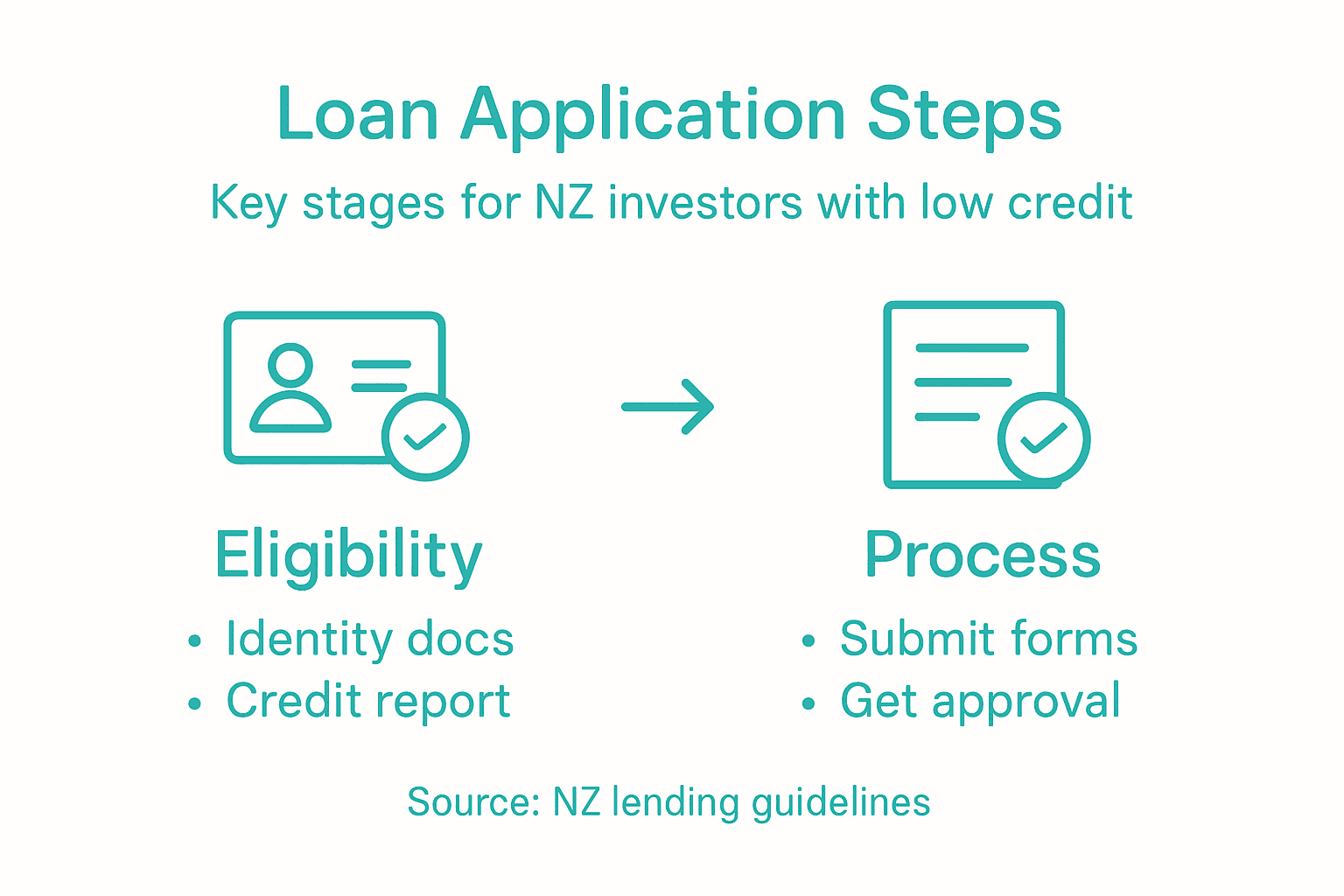
The journey typically unfolds in straightforward stages. First, you’ll gather documentation: payslips or tax returns, bank statements showing consistent savings, a property valuation, and your credit file. Having your credit file already downloaded from Equifax or Centrix puts you in control—you see what lenders see and can prepare explanations for any red flags. Next comes the pre-approval conversation with a mortgage broker. This isn’t formal approval but rather a realistic assessment of what you can borrow and at what rate. Your broker explores your financial situation holistically, identifying compensating factors that offset a lower credit score. If you’ve saved consistently for 12 months, built equity elsewhere, or stabilised your income, these become part of your story. The formal application then goes to lenders who conduct full due diligence, including property valuations and income verification. Processing typically takes 5 to 10 working days, though complex applications may take longer.
Leveraging KiwiSaver for Investment Deposits
Many Auckland first-time investors overlook KiwiSaver as a deposit funding source, but it’s genuinely valuable. You can use KiwiSaver withdrawals for first home purchases once you’ve been a member for three years, provided you haven’t owned a home in the previous two years. For investment properties specifically, the rules differ slightly from owner-occupied homes. You can’t use your full KiwiSaver balance for an investment property the way you would for a residential home, but you can access your balance if you meet certain criteria—essentially when you’re purchasing your first home for investment purposes. The amount you unlock depends on how long you’ve contributed and your employer’s contributions. For someone with a lower credit score, having a larger deposit dramatically improves approval prospects. Rather than a 30% deposit feeling impossible, KiwiSaver can bridge a 5-10% gap, bringing your total closer to that threshold lenders prefer.
The practical advantage here is timing. By the time you’re ready to invest, your KiwiSaver balance represents genuine accumulated wealth. Lenders view this positively—it shows disciplined long-term financial behaviour, which somewhat counteracts credit score concerns. Combine a KiwiSaver withdrawal with savings you’ve accumulated separately, and suddenly you’re presenting a compelling deposit story that shifts the conversation away from past credit difficulties and towards your investment fundamentals.
Pro tip: Contact your KiwiSaver provider six months before you plan to invest and confirm your exact withdrawal eligibility—rules change periodically, and knowing your available balance gives you concrete numbers to work with when discussing loans with your mortgage broker.
Hidden Costs, Common Risks, and Lending Mistakes
When you’re securing a property investment loan with a lower credit score, the approval itself feels like the finish line. But that’s actually the starting line. What happens next—how you structure the loan, what costs you overlook, and which risks you fail to anticipate—often determines whether your investment thrives or becomes a financial burden. Property investing in Auckland comes with inherent risks that extend far beyond interest rates and monthly repayments.
Understanding Hidden Costs and Common Pitfalls
The costs that surprise most first-time investors aren’t the obvious ones. Yes, you’ll pay your mortgage and council rates. But there are quieter expenses that compound over time. Landlord insurance typically costs 5 to 8 percent more than standard home insurance. Property management fees, if you use an agent, run 8 to 10 percent of rental income. Maintenance reserves need to account for unexpected repairs—a hot water cylinder or roof leak can easily cost several thousand dollars. Then there’s the risk of vacancy periods. If your tenant leaves and the property sits empty for two months whilst you find a replacement, that’s lost income you’ve already budgeted into your loan servicing calculations. Many investors underestimate these costs during the approval process, overstating their actual rental yield to lenders. This creates problems later when reality doesn’t match projections.
Another critical area involves hidden costs linked to underwriting errors. Property valuations that seem optimistic, rental income projections based on wishful thinking rather than comparable properties, or ignoring deferred maintenance on the property itself. If you’ve overestimated rental income by even $50 per week to justify your loan application, that compounds into $2,600 annually that you won’t actually receive. When your credit score is already a concern for lenders, the temptation to present the most flattering financial picture becomes stronger. Resist it. Any inaccuracy discovered during underwriting delays your loan or, worse, gets declined entirely.
The table below outlines frequent hidden costs and risks investors should anticipate:
| Cost/Risk Category | Typical Example | Impact on Investor |
|---|---|---|
| Insurance | Higher landlord premium | Increased ongoing expenses |
| Vacancy | Rental downtime | Lost rental income |
| Maintenance | Sudden major repairs | Unplanned financial outlay |
| Market volatility | Property value decline | Reduced net worth |
| Rate increases | Interest rate adjustments | Higher monthly repayments |
Risk Management and Lending Mistakes
Beyond individual property costs sit broader investment risks. Market volatility means property values fluctuate—what you purchase for $650,000 might be worth $580,000 in a downturn. Interest rate changes directly impact your loan serviceability. If your application assumes 5.5 percent interest but rates climb to 7 percent within two years, can you still afford the property? Tenant risks range from non-payment to property damage. Regulatory changes around tenancy laws, brightline test extensions, or rental restrictions can affect your investment strategy fundamentally. Long-term holding periods help cushion against short-term volatility, but only if you’ve selected properties with genuine long-term demand.
Common lending mistakes specifically trip up investors with lower credit scores. The first is rushing the process. You need time to gather accurate documentation, verify income, and prepare realistic financial projections. The second is applying to multiple lenders simultaneously—each application generates a credit inquiry, damaging your score further. A third is accepting the first loan offer without understanding the full terms, particularly around repayment schedules and early exit penalties. With a mortgage broker handling submissions, these mistakes become less likely because professionals manage the process strategically rather than desperately.
Pro tip: Request your property’s rental comparable analysis from a local property manager before submitting your loan application—this gives you realistic yield expectations rather than guesses, and lenders view professionally sourced data far more favourably than informal estimates.
Overcome Credit Challenges with Expert Property Investment Loan Help
Struggling to secure property investment loans due to a low credit score is a common challenge for many aspiring investors in Auckland. You might be feeling frustrated by high deposit demands and tough lender restrictions. The key concepts from the article around demonstrating rental yield, leveraging KiwiSaver, and working with brokers to create compelling applications are crucial strategies. Mortgage Managers, based in Hobsonville, specialises in exactly this kind of personalised mortgage advice tailored for investors facing credit hurdles.

Take control of your investment journey now by partnering with experts who understand the local market and lenders inside out. We focus on your full financial story—not just your credit score—helping you explore options like interest-only loans, fixed or variable rates, and utilising your KiwiSaver balance effectively. Discover how to build the strongest application possible and navigate hidden costs confidently. Visit Mortgage Managers, learn how we can help with property investment loans, and start turning your investment goals into reality today.
Frequently Asked Questions
What types of property investment loans are available?
There are three main types of property investment loans: fixed-rate loans, variable-rate loans, and interest-only loans. Each has different repayment structures suitable for various cash flow scenarios and investor strategies.
How do credit scores impact eligibility for property investment loans?
Credit scores influence lenders’ assessments, but low scores don’t automatically disqualify you. Lenders may consider other factors such as your deposit size and the property’s potential rental income to evaluate your application.
What are typical deposit requirements for property investment loans with low credit scores?
Property investment loans generally require deposits around 30%, which is higher than the 5-20% for primary residences. However, demonstrating financial discipline through savings and equity can help improve your borrowing prospects.
Can I use my KiwiSaver for a deposit on an investment property?
Yes, you can use your KiwiSaver balance to help fund a deposit for an investment property, subject to eligibility criteria. This can bridge the gap required by lenders, making it easier to access financing.
Recommended
- Bad Credit Loans & Non Standard Loans Offered By Non Bank Lenders
- Bad Credit Home Loans – Options for New Zealanders
- Bad Credit Home Loans – Options for New Zealanders
- 7 Real Bad Credit Mortgage Examples and How They Work
- Roofing Financing Options Explained: Complete Guide – J. A. Kelly Contracting Services
- 5 Investment Trusts For Your Pension / Naijatipsland