
TL;DR:
- Unconditional approval is the final lender confirmation that your home loan has no remaining conditions, allowing full property commitment. It requires meeting all lender conditions and obtaining a formal Letter of Offer, especially crucial for auction bidding. Being unconditionally approved enhances negotiating power, speeds up settlement, and reduces legal risks for New Zealand buyers.
Unconditional approval is the formal, final confirmation from a lender that your home loan is fully approved with no remaining conditions attached. In the New Zealand property market, this is the moment you can commit to buying a property with complete confidence. Unlike pre-approval or conditional approval, unconditional approval means the lender has assessed your income, credit, deposit, and the specific property, and is satisfied with all of it. For Kiwi buyers, understanding what is unconditional approval and how it differs from earlier stages can mean the difference between a smooth settlement and a costly mistake.
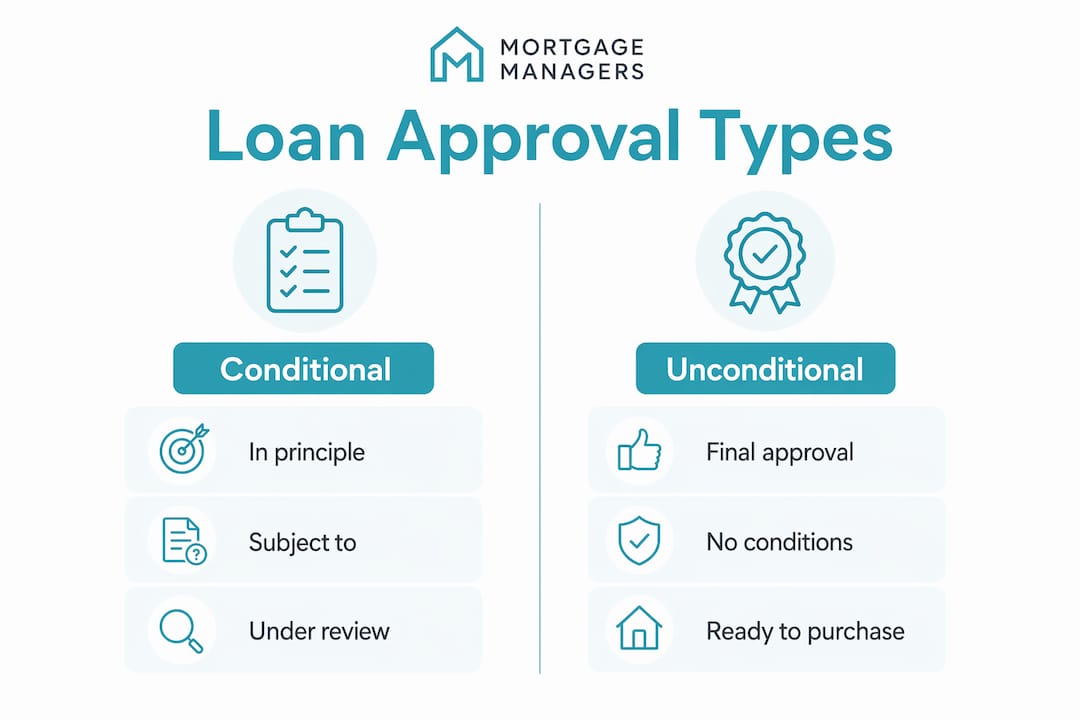
What is the difference between conditional and unconditional approval?
Conditional approval means a lender has agreed, in principle, to lend you money, but only once certain conditions are satisfied. Those conditions typically include a satisfactory property valuation, confirmation of your income, a clear title search, or evidence of your deposit source. You have a green light to keep searching, but you do not yet have a binding loan offer.
Unconditional approval, by contrast, means every single condition has been met and the lender has issued a formal Letter of Offer. This is the definition of unconditional approval in practice: a legally binding commitment from the bank to fund your purchase. Mortgage pre-approval in NZ is usually conditional, valid for 60 to 90 days, and not a guarantee until an unconditional offer specific to a property is issued.
The table below shows how the three stages compare:
| Stage | What it means | Can you commit to a purchase? |
|---|---|---|
| Pre-approval | Indicative borrowing capacity assessed | No. Indicative only. |
| Conditional approval | Loan approved subject to outstanding conditions | No. Conditions must be met first. |
| Unconditional approval | All conditions met, formal Letter of Offer issued | Yes. You can commit fully. |
The key implication for buyers is timing. Finance clauses commonly allow 10 to 15 working days to complete mortgage steps after signing a sale and purchase agreement. That window is your opportunity to move from conditional to unconditional, and it passes quickly.
Common conditions attached to conditional approvals include:
- Registered property valuation meeting the lender’s minimum requirements
- Verification of employment and income documents
- Confirmation of the deposit source (savings, KiwiSaver, gifted funds)
- Satisfactory LIM report or title search
- Building inspection results within acceptable parameters
Understanding pre-approval vs unconditional is one of the most important distinctions any NZ buyer can make before signing anything.
How does the unconditional approval process work?
The unconditional approval process follows a clear sequence, though the timeline depends on how prepared you are and how quickly your lender can complete their checks.
- Submit your full application. Your mortgage adviser or broker lodges a complete application with supporting documents: payslips, bank statements, tax returns if self-employed, and evidence of your deposit.
- Lender assesses your financials. The bank reviews your income, existing debts, living expenses, and credit history. Any inconsistencies at this stage can delay or derail approval.
- Property valuation is ordered. The lender commissions a registered valuation of the specific property you want to buy. Lenders verify income, credit, and property valuation to ensure all conditions in their Letter of Offer are met before proceeding.
- All conditions are satisfied. Once the valuation comes back acceptable and all documentation checks out, the lender clears every outstanding condition.
- Letter of Offer is issued. This is your unconditional approval. You sign and return the Letter of Offer, and your solicitor is notified that finance is confirmed.
The role of a mortgage adviser in this process is significant. Mortgage advisers anticipate lender requirements and help prepare documentation so nothing is missing when the application lands on the lender’s desk. This reduces back-and-forth and keeps the timeline tight.
One factor that catches buyers off guard is financial consistency. If you change jobs, take on new debt, or make large unexplained withdrawals between conditional and unconditional approval, the lender may reassess your application entirely. Your financial picture at the time of unconditional approval must match what you submitted at the start.

Pro Tip: Book your property valuation as early as possible. Valuers in Auckland and other high-demand areas can have wait times of several days, and a delayed valuation is one of the most common reasons buyers miss their finance deadline.
Why unconditional approval matters at auction
Auctions in New Zealand operate under strict rules that make unconditional approval not just helpful but absolutely necessary. When the hammer falls at auction, the winning bidder is immediately and legally committed to the purchase. There is no cooling-off period, no finance condition, and no way to withdraw without forfeiting your deposit.
Buyers aiming to bid at auction must have unconditional finance confirmed for the specific property before bidding. A letter from your bank that still contains outstanding conditions is not sufficient. Sellers and their lawyers will insist on seeing a genuinely unconditional offer before accepting your bid.
The risks of bidding with only conditional approval in place include:
- Losing your deposit if you cannot satisfy conditions in time
- Being held legally liable for the full purchase price
- Facing a valuation shortfall where the bank values the property below your winning bid
- Running out of time within the finance clause window if conditions cannot be cleared
“A buyer needed to act quickly to satisfy valuation conditions to obtain unconditional finance in time for the auction.” — Davenports Law
This real-world example illustrates how thin the margin can be. Even a one-day delay in receiving a valuation report can leave a buyer exposed at auction.
Once unconditional, buyers are legally committed with no cooling-off period. A 10% deposit is typically paid within a few days and held in trust until settlement, which usually occurs 30 to 90 days later. Knowing this before auction day removes any ambiguity about what you are committing to.
Pro Tip: If you are planning to bid at auction, ask your mortgage adviser to confirm in writing that your approval is unconditional and specific to the property address. A generic pre-approval letter is not enough.
What are the benefits of unconditional approval for NZ buyers?
The benefits of unconditional approval extend well beyond simply having your loan confirmed. For New Zealand buyers, it reshapes the entire purchase experience.
- Negotiating strength. Sellers and their agents take unconditionally approved buyers more seriously. In a competitive market, being able to make an unconditional offer can win you a property over a higher-priced conditional offer.
- Confidence to commit. You know exactly how much you can borrow and that the lender is satisfied with the property. There is no lingering uncertainty about whether the deal will proceed.
- Faster settlement. With finance confirmed, your solicitor can focus on the legal transfer rather than waiting on bank approvals. This reduces delays and stress for everyone involved.
- Clarity on financial commitments. You know your repayment amounts, interest rate, and loan structure before signing. There are no surprises after the fact.
- Reduced legal risk. Making an unconditional offer without unconditional approval exposes you to serious legal and financial consequences. Having genuine approval removes that risk entirely.
Unconditional approval is tied to the specific property and borrower conditions being fully met, which means it carries far more weight than any earlier stage of the process. This specificity is precisely what gives it its power as a purchasing tool.
How to improve your chances of getting unconditional approval quickly
Securing unconditional approval efficiently comes down to preparation and consistency. The buyers who move through the process fastest are those who have done the groundwork before they even start looking at properties.
- Organise your documents early. Gather three months of bank statements, two to three payslips, your most recent tax return if applicable, and evidence of your deposit. Lenders cannot proceed without these, and gaps cause delays.
- Maintain financial stability. Avoid changing jobs, applying for new credit cards, or making large purchases during the approval process. Lenders reassess and may require additional checks if your financial position changes between conditional and unconditional approval.
- Work with an experienced mortgage adviser. An adviser who knows the specific requirements of ANZ, ASB, Westpac, BNZ, and other NZ lenders can match you to the right bank and prepare your application to minimise conditions from the outset. You can read more about preparing for a home loan to get a head start.
- Schedule your valuation promptly. As soon as you have a property under contract, contact your adviser to order the valuation immediately. Do not wait for the lender to prompt you.
- Communicate proactively. If your lender requests additional information, respond within 24 hours. Slow responses are one of the most avoidable causes of missed finance deadlines.
Following these steps can speed up your loan approval significantly and reduce the anxiety that comes with waiting on a decision during what is already a high-stakes period.
Key takeaways
Unconditional approval is the only stage of the NZ home loan process that gives you the legal confidence to commit to a property purchase, whether at auction or through a standard sale.
| Point | Details |
|---|---|
| Definition of unconditional approval | All lender conditions are met and a formal Letter of Offer has been issued. |
| Conditional vs unconditional | Conditional approval is subject to outstanding checks; unconditional means every condition is cleared. |
| Auction requirement | You must have unconditional finance confirmed for the specific property before bidding at auction. |
| Typical timeline | Finance clauses allow 10 to 15 working days to move from conditional to unconditional approval. |
| Adviser advantage | Mortgage advisers prepare documentation and anticipate lender requirements to keep timelines on track. |
Stuart’s perspective on unconditional approval readiness
The single biggest misconception I see among first-home buyers is treating pre-approval as a finish line. It is not. Pre-approval tells you roughly what you can borrow. Unconditional approval tells you that this lender will fund this property for this amount. Those are very different things, and confusing them can cost you a property or, worse, land you in legal trouble at auction.
What I have observed over years of working with Auckland buyers is that the people who get to unconditional approval fastest are not necessarily the ones with the strongest finances. They are the ones who are the most organised. They have their documents ready, they respond to lender requests immediately, and they have an adviser who knows exactly what each bank needs before the application is even submitted.
The importance of unconditional approval also goes beyond the transaction itself. When you understand what it means and what it takes to get there, you approach the entire home buying process with a different kind of clarity. You stop guessing and start making decisions from a position of genuine knowledge. That confidence is worth more than any single negotiating tactic.
If you are heading into the NZ property market in 2026, do not wait until you find a property you love to start thinking about this. Get your finances in order, understand the mortgage approval process, and work with an adviser who will tell you the truth about where you stand.
— Stuart
Ready to reach unconditional approval with confidence?
At Mortgagemanagers, we guide New Zealand home buyers from the very first conversation through to a confirmed, unconditional loan offer. Based in Hobsonville and servicing buyers across Auckland, the North Shore, West Auckland, and remotely throughout New Zealand, our advisers know what each lender needs and how to get your application across the line efficiently.

Whether you are buying at auction, making a private offer, or simply trying to understand where you stand financially, our team will match you with the right lender and prepare your application to minimise conditions from day one. Talk to one of our expert mortgage advisers today and take the guesswork out of your home loan journey. You can also visit Mortgagemanagers to learn more about how we work.
FAQ
What does unconditional approval mean in New Zealand?
Unconditional approval means a lender has formally confirmed your home loan with no outstanding conditions, issuing a Letter of Offer that commits them to funding your specific property purchase. It is the final and binding stage of the mortgage approval process.
Can you get unconditional approval before finding a property?
No. Unconditional approval is tied to a specific property, so it can only be granted once the lender has assessed and accepted both the borrower and the property being purchased. Pre-approval is the stage that allows you to search with confidence before finding a property.
How long does it take to get unconditional approval in NZ?
Finance clauses in NZ sale and purchase agreements typically allow 10 to 15 working days after signing for buyers to satisfy mortgage conditions and receive unconditional approval. Having your documents ready and your valuation booked early keeps this timeline on track.
Is conditional approval enough to bid at auction?
No. Auctions in New Zealand require buyers to commit unconditionally the moment the hammer falls. Bidding without unconditional finance confirmed for the specific property exposes you to losing your deposit and potential legal liability.
What happens after unconditional approval?
Once unconditional approval is confirmed, you are legally committed to the purchase. A 10% deposit is typically paid within a few days and held in trust, with settlement completing within the agreed timeframe, usually 30 to 90 days after going unconditional.