
Most first home buyers in Hobsonville feel lost when complex mortgage terms slow their property journey. With many young Australians and New Zealanders in Auckland struggling to save even ten percent for a deposit, competition can feel intimidating. Understanding how mortgage pre-approval works is crucial if you have a limited deposit or past credit challenges. This guide gives clear insights to help you approach lenders with confidence, no matter your financial starting point.
Table of Contents
- Defining Mortgage Pre-Approval In New Zealand
- Types Of Pre-Approval And Key Differences
- Eligibility Criteria And Required Documentation
- How Pre-Approval Strengthens Your Buying Position
- Common Risks, Costs, And Pitfalls To Avoid
- Role Of Mortgage Advisers And Choosing Lenders
Key Takeaways
| Point | Details |
|---|---|
| Mortgage Pre-Approval Importance | It provides a clear understanding of borrowing capacity, enhancing credibility when making offers in Auckland’s competitive market. |
| Types of Pre-Approval | There are three main types: Conditional, Indicative, and Full, each offering different certainty levels and documentation requirements. |
| Eligibility Criteria | Applicants must demonstrate stable income, a good credit history, and provide comprehensive financial documentation to secure pre-approval. |
| Role of Mortgage Advisers | They simplify the lending process by comparing offers, ensuring buyers choose the most suitable lenders and save on costs. |
Defining Mortgage Pre-Approval in New Zealand
A mortgage pre-approval is a preliminary assessment by a lender that determines how much money you can potentially borrow for a home purchase in Auckland. This critical financial evaluation provides first home buyers with a clear understanding of their borrowing capacity before they start house hunting. By obtaining a pre-approved home loan, buyers gain significant advantages in New Zealand’s competitive property market.
Mortgage pre-approval involves a comprehensive review of your financial situation, including income, credit history, existing debts, and potential borrowing limits. Lenders will examine your financial documents, assess your creditworthiness, and provide a conditional commitment to lend a specific amount. Unlike a full mortgage approval, pre-approval is not a guaranteed loan, but rather a strong indication of your potential borrowing power. The process typically involves submitting proof of income, bank statements, identification documents, and allowing the lender to conduct a credit check.
In the New Zealand context, mortgage pre-approval serves several strategic purposes for homebuyers. It helps you understand exactly how much you can spend, provides credibility when making offers, and demonstrates to real estate agents that you are a serious buyer. By knowing your borrowing capacity in advance, you can narrow your property search to homes within your financial range, preventing disappointment and wasted time. Additionally, understanding the mortgage approval process can help you prepare stronger loan applications and increase your chances of successful home ownership.
Pro tip: Before seeking pre-approval, review your credit report and address any potential issues that might impact your borrowing capacity, ensuring you present the strongest possible financial profile to lenders.
Types of Pre-Approval and Key Differences
Mortgage pre-approvals in New Zealand are not a one-size-fits-all process, with lenders offering several distinct types tailored to different financial circumstances. These variations include conditional pre-approval, indicative pre-approval, and full pre-approval, each providing different levels of certainty and documentation requirements for potential homebuyers. Mortgage pre-approval insights reveal that understanding these distinctions is crucial for making informed purchasing decisions.
Conditional pre-approval represents the most common type, where lenders provide a preliminary indication of how much they might lend based on an initial financial assessment. This preliminary evaluation typically requires basic documentation like proof of income, bank statements, and credit history. However, it remains subject to further verification and does not guarantee final loan approval. Indicative pre-approval goes a step further, involving more comprehensive financial scrutiny and providing a more reliable borrowing estimate, though still not a final commitment.
Full pre-approval represents the most robust assessment, requiring extensive documentation and a thorough examination of your financial profile. At this stage, lenders conduct detailed credit checks, verify all income sources, and assess potential risks more comprehensively. This type of pre-approval offers the highest level of confidence for homebuyers, often giving them a significant advantage in competitive property markets like Auckland. Bank pre-approval limitations should be carefully considered, as each lender’s approach can vary significantly.
Pro tip: Request pre-approval documentation in writing and carefully review the specific conditions and validity period to understand exactly what financial commitments and limitations apply to your specific situation.
Here’s a comparison of mortgage pre-approval types commonly offered in New Zealand:
| Type of Pre-Approval | Certainty Level | Documentation Needed | Typical Use Case |
|---|---|---|---|
| Conditional | Moderate certainty | Basic financial details | Early budgeting, initial search |
| Indicative | Higher certainty | Financial overview and verification | Refining buyer’s price range |
| Full | Strongest certainty | Full financial assessment | Active bidding, competitive offers |
Eligibility Criteria and Required Documentation
Mortgage pre-approval eligibility in Auckland involves a comprehensive assessment of an individual’s financial health and borrowing capacity. Lenders evaluate several critical factors to determine whether a potential homebuyer qualifies for pre-approval. Pre-approved home loans typically require applicants to meet specific criteria that demonstrate financial stability and repayment potential.

The primary eligibility criteria encompass several key areas of financial assessment. Income requirements are paramount, with lenders typically seeking stable employment history and consistent earnings. Most financial institutions prefer applicants with at least two years of continuous employment, though some may consider shorter periods with compelling circumstances. Credit history plays a crucial role, with lenders examining credit scores, existing debts, payment histories, and overall financial behaviour. Potential borrowers should aim for a clean credit report, minimising outstanding debts and demonstrating responsible financial management.
Documentation requirements for mortgage pre-approval are extensive and rigorous. Applicants must typically provide comprehensive financial evidence, including:
- Proof of income (payslips, tax returns, employment contracts)
- Bank statements covering the past three to six months
- Identification documents (passport, driver’s licence)
- Proof of current assets and liabilities
- Evidence of genuine savings (typically 10% of the proposed property value)
- Details of existing financial commitments and expenses
Pro tip: Compile all financial documentation in advance and consider obtaining a copy of your credit report to identify and address any potential issues before submitting your pre-approval application.
How Pre-Approval Strengthens Your Buying Position
Mortgage pre-approval transforms a homebuyer’s approach to property hunting in Auckland’s competitive real estate market, providing a strategic advantage that goes far beyond simple financial preparation. Mortgage pre-approval insights demonstrate that buyers with pre-approval are viewed more seriously by sellers and real estate agents, creating a powerful negotiating platform.
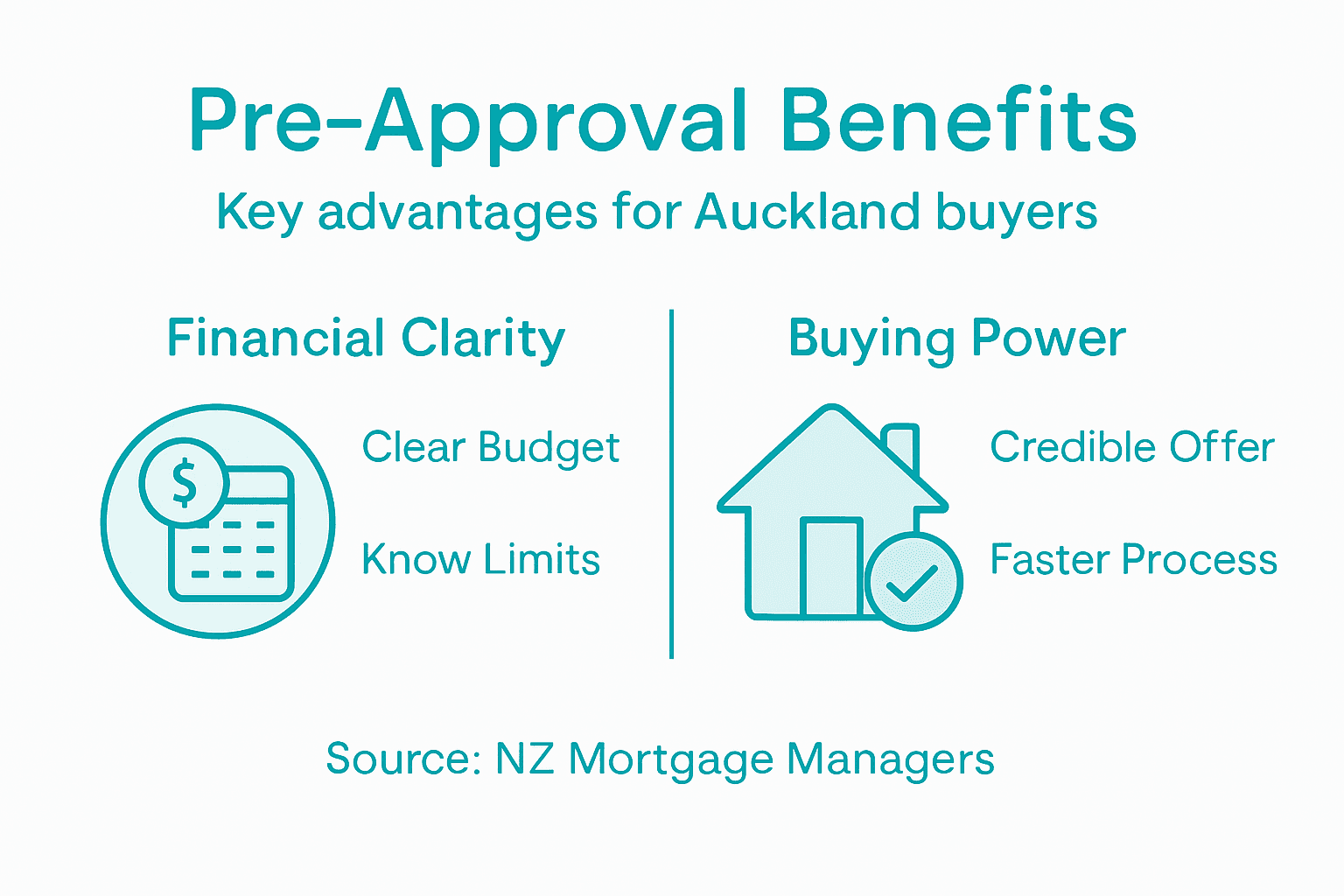
The most significant advantage of pre-approval is the credibility it brings to property offers. When sellers receive an offer from a pre-approved buyer, they recognise that the potential purchaser has already undergone rigorous financial assessment. This reduces uncertainty about the buyer’s ability to secure financing, making their offer substantially more attractive compared to competing buyers who lack pre-approval. In a market like Auckland, where multiple offers are common, this financial validation can be the decisive factor in having your offer accepted.
Pre-approval also provides buyers with a clear and defined budget, allowing for more focused and strategic property searching. By understanding exactly how much they can borrow, buyers can narrow their search to properties within their financial range, preventing potential disappointment and wasted time. This targeted approach is particularly crucial in Auckland’s dynamic property landscape, where price variations can be significant. Mortgage application strategies emphasise the importance of aligning property expectations with financial capabilities, and pre-approval does exactly that.
Pro tip: Get your pre-approval updated every three to six months to ensure your borrowing capacity reflects current financial circumstances and market conditions.
Common Risks, Costs, and Pitfalls to Avoid
Navigating mortgage pre-approval requires a sophisticated understanding of potential financial risks and strategic challenges inherent in the home buying process. Home loan pre-approval insights highlight critical considerations that can significantly impact a buyer’s financial journey in Auckland’s complex property market.
One of the most significant risks is the conditional nature of pre-approval. While many buyers assume pre-approval guarantees final lending, lenders retain the right to reassess financial circumstances before final approval. Unexpected changes in employment, additional debt, or adverse credit events can potentially invalidate a pre-approval. Critical factors that might trigger re-evaluation include sudden job loss, taking on new significant financial commitments, or substantial changes in credit score. Buyers must maintain financial stability throughout the property purchasing process and avoid making major financial decisions that could compromise their pre-approval status.
Financial costs associated with pre-approval can also catch buyers off guard. Application fees, valuation costs, and potential lender’s mortgage insurance can add substantial expenses to the home buying process. Some lenders charge comprehensive assessment fees that range from $200 to $500, which are typically non-refundable even if the pre-approval does not result in a final loan. Additionally, low deposit scenarios might trigger mandatory lender’s mortgage insurance, further increasing overall costs. Mortgage application strategies recommend thoroughly understanding these potential expenses before committing to a pre-approval process.
Pro tip: Maintain a comprehensive financial record and avoid making any significant financial changes or purchases during the pre-approval and home buying process to preserve your lending eligibility.
Below is a summary of common risks and costs associated with securing mortgage pre-approval in Auckland:
| Risk or Cost | Typical Impact | What To Watch For |
|---|---|---|
| Conditional approval withdrawal | Loan may be declined later | Job changes, increased borrowing |
| Application fees | Upfront expense, non-refundable | $200–$500, varies by lender |
| Mortgage insurance | Additional ongoing costs | Required for low deposits |
| Credit score changes | Reduces loan eligibility | New debts or missed payments |
Role of Mortgage Advisers and Choosing Lenders
Mortgage advisers play a critical role in simplifying the complex landscape of home lending, acting as expert navigators through New Zealand’s intricate financial terrain. Mortgage lending insights demonstrate that these professionals provide invaluable support by comparing offers from multiple lenders, helping buyers identify the most suitable financing options tailored to their unique financial circumstances.
The strategic value of a mortgage adviser extends far beyond simple loan comparison. These professionals bring deep market knowledge, understanding nuanced differences between bank and non-bank lenders that can significantly impact a buyer’s long-term financial health. They assess critical factors such as interest rates, loan terms, hidden fees, and flexibility of repayment structures. Role of mortgage advisers reveal that their expertise can potentially save buyers thousands of dollars by identifying more competitive lending options and negotiating more favourable terms.
Choosing the right lender requires a comprehensive approach that considers multiple financial variables. Mortgage advisers help buyers evaluate lenders based on criteria beyond just interest rates, including loan-to-value ratio requirements, early repayment options, potential penalties, and alignment with the buyer’s specific financial goals. This holistic assessment ensures that buyers select a lender who not only offers competitive rates but also provides a lending solution that matches their individual financial strategy and future aspirations.
Pro tip: Request a detailed written comparison from your mortgage adviser that breaks down the total cost of different lending options, including fees, interest rates, and potential future adjustments.
Secure Your Home Buying Advantage with Expert Mortgage Advice
Understanding your true borrowing power through mortgage pre-approval is essential in Auckland’s competitive property market. If you want to avoid surprises, reduce stress and confidently make offers, getting professional help can make all the difference. The challenge many buyers face is navigating complex eligibility criteria, managing conditional approvals and choosing the right lender without wasting time or money.
At Mortgage Managers, our Auckland mortgage advisers specialise in personalised pre-approval guidance that simplifies these challenges. We help you compile the correct documentation, improve your credit profile and provide clear insights into your borrowing limits. With us on your side, you gain not only clarity but also the strategic advantage that serious buyers demand.

Take control of your homeownership journey today with tailored support from Mortgage Managers. Explore how we can help you get a reliable pre-approved home loan and learn about the mortgage approval process to strengthen your buying position. Don’t let uncertainty hold you back – connect with our expert advisers now to secure your pre-approval and start your search with confidence.
Frequently Asked Questions
What is mortgage pre-approval?
Mortgage pre-approval is a preliminary assessment by a lender that indicates how much money you can potentially borrow for a home purchase. It considers your financial situation, including income, credit history, and existing debts.
What are the benefits of getting mortgage pre-approval?
The main benefits include understanding your borrowing capacity, gaining credibility with sellers, and streamlining your property search to focus on homes within your budget.
How does mortgage pre-approval differ from full mortgage approval?
Mortgage pre-approval is not a guaranteed loan; it is a conditional commitment based on an initial assessment. Full mortgage approval requires a comprehensive review and documentation verification.
What documentation do I need to apply for mortgage pre-approval?
Typically, you will need proof of income, bank statements, identification documents, evidence of genuine savings, and details of existing financial commitments.