
Buying your first home in Auckland can feel impossible when banks demand deposits as high as 20%. For Australians and locals alike in areas like Hobsonville, housing affordability remains a major hurdle. The government-backed Welcome Home Loan stands out with a bold promise: eligible buyers can get started with a deposit as low as 5%. This introduction highlights how the scheme works, who it supports, and why it is transforming opportunities for first home buyers facing low savings or credit challenges.
Table of Contents
- Welcome Home Loan Definition And Purpose
- Eligibility And Application Requirements In 2026
- Minimum Deposit Rules And Income Limits
- Costs, Fees, And Insurance Premiums
- Risks, Pitfalls, And Lender Conditions
- Comparing Welcome Home Loan With Alternatives
Key Takeaways
| Point | Details |
|---|---|
| Government Support | The Welcome Home Loan facilitates first home buyers in New Zealand with reduced deposit requirements and financial backing from Kāinga Ora. |
| Eligibility Criteria | Applicants must meet specific income thresholds and cannot currently own residential property, ensuring the programme supports genuine first-time buyers. |
| Low Deposit Advantage | A minimum deposit of 5% lowers the financial barrier for entry into the housing market, making homeownership more accessible. |
| Comparing Alternatives | The Welcome Home Loan is one option among various government programmes, each catering to different financial needs and scenarios for first-time buyers. |
Welcome Home Loan definition and purpose
The Welcome Home Loan is a government-supported mortgage programme designed specifically to help first home buyers in Auckland and across New Zealand overcome traditional financial barriers to property ownership. Administered by Kāinga Ora’s home ownership initiative, this unique loan scheme enables eligible buyers to enter the housing market with significantly reduced deposit requirements.
Unlike traditional mortgage products, the Welcome Home Loan allows borrowers to purchase property with deposits as low as 5%, compared to standard bank requirements of 20%. This substantially lowers the initial financial hurdle for first-time buyers. By providing financial underwriting, Kāinga Ora enables participating lenders to offer loans that might otherwise not meet conventional lending criteria, making homeownership more accessible for New Zealanders with limited savings.
The core purpose of the Welcome Home Loan programme extends beyond simply providing financial assistance. It represents a strategic government approach to addressing housing affordability challenges by creating pathways to property ownership for individuals and families who might struggle under traditional lending models. Specifically designed for first home buyers, the loan supports those with steady incomes but limited capacity to accumulate large deposits, effectively bridging the gap between potential homeowners and the property market.
Pro tip: Before applying for a Welcome Home Loan, check your eligibility carefully and prepare comprehensive documentation to streamline your application process.
Eligibility and application requirements in 2026
To qualify for the Welcome Home Loan in 2026, applicants must meet several specific criteria designed to support first-time home buyers across New Zealand. Comprehensive eligibility guidelines outline strict requirements that potential borrowers must satisfy, focusing on ensuring the programme supports genuine first-home purchasers with limited financial resources.
The income thresholds are a critical component of the eligibility framework. As of 2026, individuals without dependents can earn up to $95,000 annually before tax, while those with dependents or multiple buyers can qualify with combined incomes up to $150,000. Applicants must be New Zealand citizens, permanent residents, or resident visa holders ordinarily residing in the country. Crucially, they must not currently own residential property (with the exception of Māori land) and must intend to occupy the purchased property as their primary residence.
The application process involves several key steps and documentation requirements. Prospective buyers must demonstrate a minimum 5% deposit, which can be compiled from various sources including personal savings, government grants, first-home withdrawals, and gift funds. Applicants will need to provide comprehensive documentation proving identity, income, residence status, and deposit availability. Home ownership application preparation typically involves obtaining pre-approval from participating lenders, which provides an initial assessment of borrowing capacity before final loan confirmation.
Pro tip: Gather all financial documentation in advance and consider seeking pre-approval to understand your exact borrowing potential before beginning your property search.
Here’s a summary of the key eligibility requirements for the Welcome Home Loan in 2026:
| Requirement | Description | Why It Matters |
|---|---|---|
| Citizenship/Residency | NZ citizen, permanent resident, or resident visa | Ensures support for locals |
| Property Ownership | Must not own residential property (except Māori land) | Targets genuine first-home buyers |
| Deposit Minimum | At least 5% of purchase price | Lowers entry barrier for buyers |
| Income Threshold | $95,000 single / $150,000 combined | Prioritises those with limited means |
| Occupancy Intent | Must live in the property as primary residence | Prevents investment-based applications |
Minimum deposit rules and income limits
The Welcome Home Loan introduces a groundbreaking approach to home ownership by dramatically reducing traditional deposit barriers. First home decision requirements demonstrate that first-time buyers can now access home loans with a remarkably low 5% deposit, compared to conventional lending models demanding 20% upfront savings.
Income limits are strategically designed to support those most in need of financial assistance. Single applicants without dependents must earn $95,000 or less annually before tax, while those with dependents or multiple buyers can qualify with combined incomes up to $150,000. These carefully structured thresholds ensure the Welcome Home Loan targets genuine first-home buyers who might otherwise struggle to enter the property market. The income caps prevent higher-earning individuals from accessing the programme, maintaining its focus on supporting those with limited financial resources.
The 5% deposit requirement represents a significant breakthrough for Auckland buyers facing escalating property prices. Prospective homeowners can compile their deposit from diverse sources, including personal savings, government grants, first-home withdrawals, and even gift funds. This flexible approach recognises the varied financial circumstances of first-time buyers and provides multiple pathways to achieve the minimum deposit threshold. By lowering the initial financial barrier, the Welcome Home Loan makes home ownership a tangible goal for many New Zealanders who would have previously been priced out of the market.
Pro tip: Calculate your exact borrowing capacity by using online mortgage calculators and gathering all potential deposit sources before beginning your home-buying journey.
Costs, fees, and insurance premiums
The Welcome Home Loan involves specific financial considerations that potential borrowers must carefully understand. Home ownership product changes demonstrate the evolving nature of loan-associated costs, with recent adjustments to insurance premiums and associated fees designed to balance borrower support and institutional risk management.

A key financial component is the Lender’s Mortgage Insurance (LMI), which from 1 July 2025 increased from 0.5% to 1.2% of the total loan value. Borrowers have flexibility in paying this premium, with options to either pay upfront or spread the cost across the loan’s duration. This insurance protects lenders against potential default, enabling them to offer loans with lower deposit requirements. Additional costs may include standard loan application fees, which vary depending on the specific lending institution participating in the Welcome Home Loan programme.
Beyond the initial loan costs, prospective homeowners must budget for ongoing expenses. Home insurance is mandatory, protecting the property against potential damages. Borrowers should also anticipate standard costs such as council rates, maintenance expenses, and potential body corporate fees for apartment properties. These ongoing financial obligations are crucial to consider alongside the loan’s insurance premiums and application fees, ensuring a comprehensive understanding of the total financial commitment involved in home ownership.
Pro tip: Request a comprehensive fee breakdown from your lender and factor in all potential costs when calculating your home ownership budget.
Risks, pitfalls, and lender conditions
Navigating the Welcome Home Loan requires a comprehensive understanding of potential risks and strict lending criteria for home loans. The programme, while designed to support first-time buyers, imposes stringent conditions that borrowers must carefully evaluate before committing to the loan.
Lender conditions are particularly rigorous, focusing on borrowers’ financial stability and ability to maintain loan repayments. Potential borrowers must demonstrate consistent income, excellent credit history, and a realistic capacity to service the loan. The critical requirements include living in the property as a primary residence, maintaining no other residential property ownership, and meeting specific income thresholds. Lenders retain discretionary power to assess creditworthiness, meaning even meeting initial criteria does not guarantee automatic loan approval.
Significant financial risks accompany the Welcome Home Loan that borrowers must comprehensively understand. These include potential financial strain from loan repayments, unexpected home maintenance costs, and the mandatory Lender’s Mortgage Insurance premium. Borrowers must realistically assess their long-term financial resilience, considering potential changes in employment, interest rates, and personal circumstances. The lower deposit requirement, while attractive, does not mitigate the fundamental responsibility of consistent, reliable loan repayment.
Pro tip: Conduct a thorough personal financial audit and create a comprehensive budget simulation to ensure you can comfortably manage loan repayments and associated homeownership expenses.
Comparing Welcome Home Loan with alternatives
The Welcome Home Loan represents just one pathway to homeownership, with several alternative government-supported programmes designed to address diverse financial circumstances. Home ownership resources reveal multiple strategies for first-time buyers seeking property entry points beyond traditional lending models.
Key alternatives include the First Home Partner programme, a shared ownership model where Kāinga Ora co-purchases a property with eligible buyers. This approach differs from the Welcome Home Loan by enabling buyers to enter the market with an even lower initial financial commitment. The Kāinga Whenua Loan provides specialised support for Māori whānau seeking to build or purchase homes on multiply-owned Māori land, offering a targeted approach for specific cultural and community needs. Additionally, KiwiSaver first-home withdrawals can supplement or replace traditional loan approaches, providing flexibility for buyers with accumulated savings.
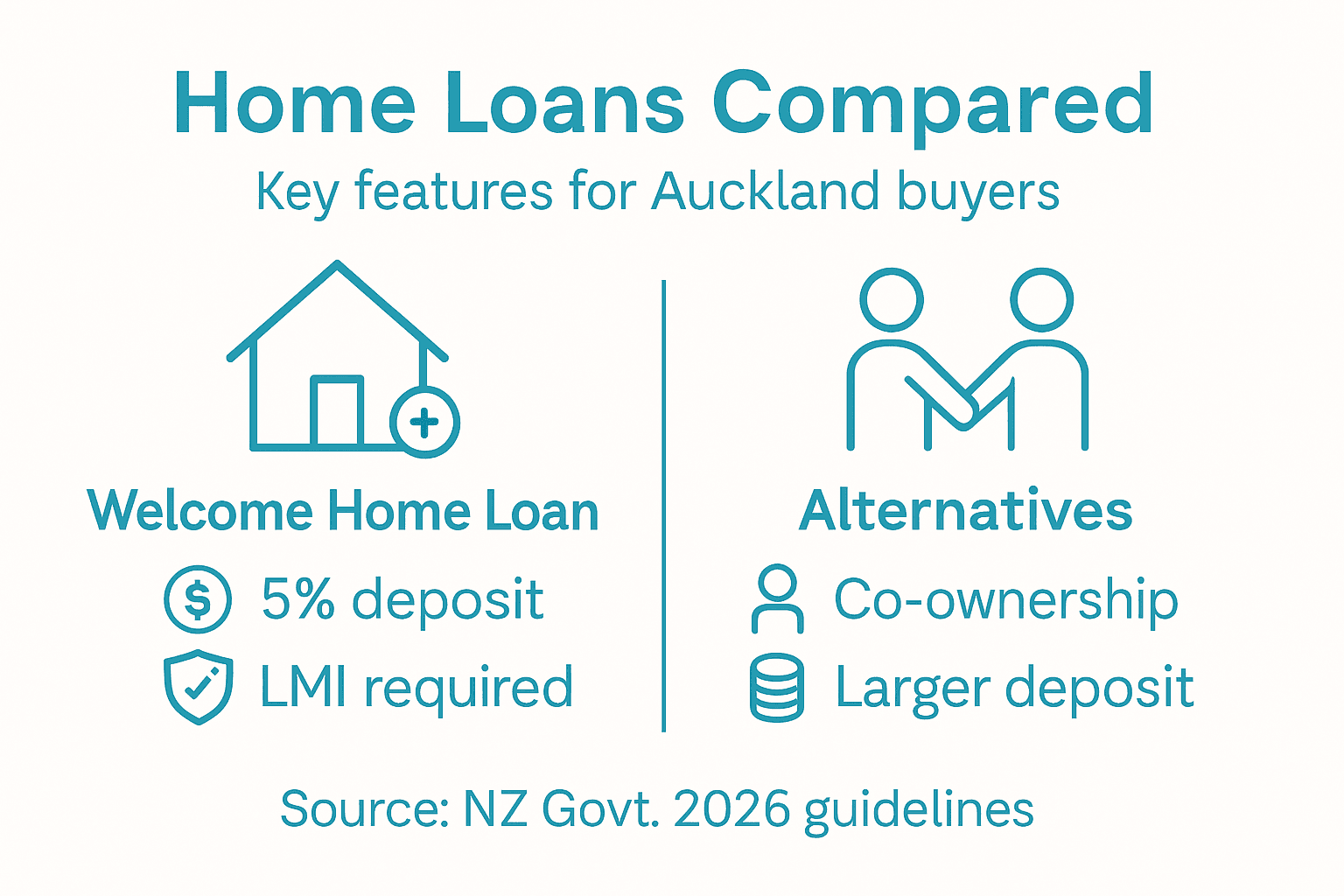
While each alternative offers unique advantages, the Welcome Home Loan remains particularly attractive for those with consistent income but limited deposit savings. The shared ownership and specialised loans provide nuanced options that address different financial scenarios, from cultural land ownership to collaborative property purchasing. Prospective buyers should carefully evaluate their individual circumstances, considering income, savings, cultural background, and long-term financial goals when selecting the most appropriate homeownership pathway.
The following table compares the Welcome Home Loan with two major alternatives for first home buyers in New Zealand:
| Programme | Main Feature | Deposit Needed | Target Group |
|---|---|---|---|
| Welcome Home Loan | Standard mortgage with low deposit | 5% minimum | First-time buyers |
| First Home Partner | Shared ownership with Kāinga Ora | Less than 5% possible | Buyers needing extra support |
| Kāinga Whenua Loan | Loans for Māori land ownership | Depends on institution | Māori whānau groups |
Pro tip: Consult a mortgage adviser to comprehensively assess which homeownership programme aligns most closely with your specific financial situation and personal objectives.
Secure Your First Home with Expert Help from Mortgage Managers
Understanding the Welcome Home Loan and its specific requirements can feel overwhelming when trying to step into Auckland’s challenging property market. Many first home buyers struggle with gathering the right deposit, meeting income thresholds, and navigating lender conditions while aiming to secure a 5% deposit loan. If you want to avoid costly mistakes and ensure your application is strong from day one, expert guidance is essential.

Take the next step with confidence by working alongside experienced Auckland mortgage advisers who specialise in the Welcome Home Loan and other first home ownership options. At Mortgage Managers we are locally owned and perfectly positioned in Hobsonville to support buyers across Auckland including West Auckland and the North Shore. Discover personalised solutions that fit your financial situation and learn how to maximise your borrowing capacity and deposit sources. Don’t delay your dream of homeownership any longer. Visit Mortgage Managers today to get started and turn the Welcome Home Loan into your reality.
Frequently Asked Questions
What is the Welcome Home Loan?
The Welcome Home Loan is a government-supported mortgage program designed to help first home buyers in New Zealand by allowing them to purchase a property with a deposit as low as 5%. This reduces the financial barriers typically associated with homeownership.
Who is eligible for the Welcome Home Loan?
To qualify, applicants must be New Zealand residents, not currently own a residential property, and have a maximum income of $95,000 or $150,000 for those with dependents. Additionally, they must intend to live in the purchased property as their primary residence.
What are the costs and fees associated with the Welcome Home Loan?
Borrowers should be aware of Lender’s Mortgage Insurance, which increased to 1.2% of the total loan value, along with standard application fees and mandatory home insurance costs. Ongoing expenses like council rates and maintenance should also be considered.
How does the Welcome Home Loan compare to other homeownership options?
The Welcome Home Loan is one option among several, including the First Home Partner programme, which offers shared ownership, and the Kāinga Whenua Loan, tailored for Māori land ownership. Each option has unique benefits designed for different financial circumstances.