
Sorting through home loan options can feel overwhelming when you are about to buy your first property in Hobsonville, Auckland. Choosing the right structure matters because it impacts your monthly budget, how you handle interest rate changes, and even which deposit options are available to you. A split home loan stands out by combining both fixed and floating rates, giving you a mix of stability and flexibility. This introduction breaks down how split home loans work and why they could be a practical choice for first-time buyers with unique deposit sizes or credit questions.
Table of Contents
- What Is A Split Home Loan?
- Key Types And How They Differ
- How Split Home Loans Work In Nz
- Interest Rate Choices And Deposit Options
- Risks, Costs And Common Mistakes
Key Takeaways
| Point | Details |
|---|---|
| Definition of Split Home Loans | A split home loan divides the total loan amount into fixed and floating interest rate portions, allowing for financial risk management. |
| Risk Mitigation Benefits | By employing a split loan strategy, borrowers can protect themselves from market fluctuations while enjoying some flexibility. |
| Loan Structure Variability | Split home loans can be tailored by enabling different percentages of fixed and floating rates for individual financial goals. |
| Importance of Professional Advice | Consulting a mortgage professional is crucial for optimal loan structuring and to align the loan with financial objectives. |
What Is a Split Home Loan?
A split home loan offers homeowners in New Zealand a strategic way to manage their mortgage by dividing the total loan amount into different interest rate portions. This flexible financing approach allows borrowers to balance the benefits of both fixed and floating interest rates within a single mortgage arrangement. Split home loan strategies provide an intelligent solution for managing financial risk and potential savings.
With a split home loan, you can allocate different percentages of your total mortgage to fixed and floating rate segments. For instance, you might choose to keep 60% of your loan at a stable fixed rate while allowing 40% to fluctuate with market conditions. This strategy enables you to hedge against potential interest rate changes while maintaining some flexibility in your repayment structure.
The primary advantage of split home loans is risk mitigation. By diversifying your loan’s interest rate exposure, you protect yourself from dramatic market shifts. If floating rates increase, only a portion of your mortgage will be affected, while the fixed-rate segment provides predictable repayments. Conversely, if rates decrease, the floating portion allows you to potentially benefit from lower interest charges.
Pro tip: Before splitting your home loan, carefully analyse your financial goals and risk tolerance, and consult a mortgage professional who understands New Zealand’s specific lending landscape.
Key Types and How They Differ
New Zealand homeowners can explore multiple home loan types that offer unique financial strategies. The primary mortgage variations include table loans, revolving credit loans, offset loans, reducing loans, and interest-only loans, each designed to meet different financial objectives and risk profiles. Split home loans represent a sophisticated approach that combines elements from these traditional loan structures.

Table loans are the most common mortgage type, where repayments are calculated to ensure both principal and interest are paid consistently over the loan term. Revolving credit loans function more like an advanced bank account, allowing borrowers to offset their mortgage balance with income and providing greater financial flexibility. Offset loans enable you to use your savings to reduce the interest charged on your mortgage, potentially saving significant amounts over the loan’s lifetime.
Here’s a quick comparison of the main home loan types available in New Zealand:
| Loan Type | Repayment Structure | Flexibility Level | Best for Borrowers Who |
|---|---|---|---|
| Table Loan | Fixed repayments | Low | Prefer steady budgeting |
| Revolving Credit | Variable repayments | Very high | Want control over cashflow |
| Offset Loan | Linked to savings balance | Moderate | Have significant ongoing savings |
| Reducing Loan | Declining repayments | Low | Want to minimise total interest |
| Interest-Only | Interest-only initially | Moderate | Require low payments at the start |
| Split Home Loan | Combination of above types | High | Value risk hedging and flexibility |
The key distinction with split home loans is their hybrid nature. Unlike traditional fixed or floating loans, split loans allow you to divide your mortgage into different segments with varying interest rate characteristics. This means you could allocate 60% of your loan to a fixed rate for stability, while keeping 40% on a floating rate to potentially benefit from market fluctuations. This approach provides a strategic balance between predictability and opportunity, making split loans an attractive option for risk-conscious borrowers.
Pro tip: Consult a mortgage professional to model different split loan scenarios and understand how various percentage allocations might impact your long-term financial strategy.
How Split Home Loans Work in NZ
Split home loans in New Zealand offer a sophisticated financial strategy that allows borrowers to customise their mortgage structure with remarkable flexibility. By dividing the total loan amount into multiple segments, typically with different interest rate arrangements, homeowners can balance risk and potential savings. The most common approach involves splitting the mortgage between fixed and floating rate portions, each serving a distinct financial purpose.
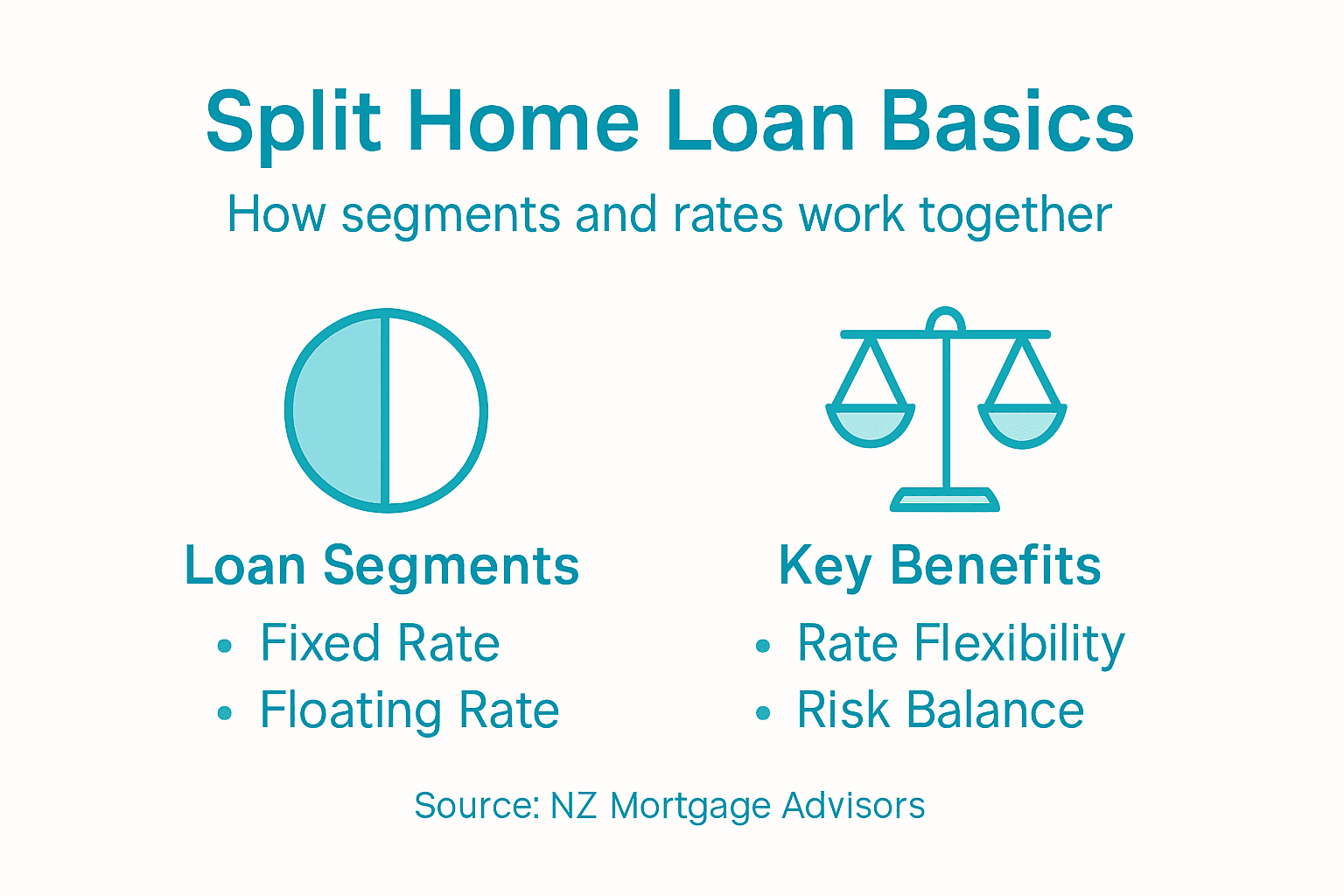
The mechanics of split home loans are relatively straightforward. For example, a borrower might choose to allocate 60% of their loan to a fixed interest rate, providing predictable repayments and protection against potential interest rate increases. The remaining 40% could be maintained on a floating rate, allowing the opportunity to benefit from potential market rate reductions. This strategic division enables homeowners to hedge against financial uncertainties while maintaining some adaptability in their mortgage management.
Each segment of a split home loan operates under its own terms. The fixed-rate portion locks in an interest rate for a predetermined period, usually between one and five years, offering stability and precise budgeting. Conversely, the floating rate segment moves in alignment with broader market conditions, potentially providing opportunities for reduced interest charges when economic indicators are favourable. Borrowers can periodically reassess and adjust their split proportions, making this an incredibly dynamic mortgage approach tailored to individual financial circumstances.
Pro tip: Review and potentially rebalance your split home loan segments annually, considering current market trends and your personal financial objectives.
Interest Rate Choices and Deposit Options
Navigating split home loan deposit requirements in New Zealand involves understanding the intricate relationship between interest rates and initial investment. Most lenders prefer borrowers to have a deposit of at least 20% of the property’s value, which can significantly impact the loan’s interest rate structure and overall borrowing terms. This threshold allows homeowners to access more competitive rates and potentially reduce their long-term financial burden.
Interest rate choices for split home loans typically range from six-month to five-year fixed terms, with each segment offering distinct advantages. Borrowers might choose to fix 60% of their loan at a stable rate while maintaining 40% on a floating rate, creating a balanced approach to interest rate management. The fixed-rate portion provides predictability and protection against potential market fluctuations, whereas the floating segment allows flexibility to capitalise on potential rate reductions.
Deposit strategies play a crucial role in split home loan configurations. A larger deposit not only improves loan approval chances but can also unlock more favourable interest rate options. Some New Zealand lenders offer more competitive rates for borrowers who can demonstrate a substantial initial investment, potentially saving thousands of dollars over the loan’s lifetime. Additionally, borrowers can strategically split their deposits across different loan segments, optimising their overall financial approach and risk management.
Pro tip: Calculate your optimal deposit amount by comparing how different deposit percentages impact your potential interest rates and total loan costs.
Risks, Costs and Common Mistakes
Split home loans carry nuanced risks that borrowers must carefully evaluate, with potential financial implications requiring thorough understanding. Homeowners frequently encounter lending mistakes that can substantially impact their long-term financial health. The primary risks include unexpected increases in floating rate segments, potential penalties for early repayments, and the complexity of managing multiple loan portions with different interest rate structures.
Cost considerations are equally critical in split home loan arrangements. Borrowers might encounter higher fees associated with maintaining multiple fixed-term segments, additional administrative charges for loan adjustments, and potential break fees if restructuring becomes necessary. Some lenders impose significant penalties for early termination of fixed-rate portions, which can unexpectedly inflate the overall loan expenses. Understanding these potential costs requires meticulous financial planning and a comprehensive review of all loan documentation.
Summary of potential risks and costs associated with split home loans:
| Risk or Cost | Example Situation | Typical Result |
|---|---|---|
| Floating rate increases | Market rates rise sharply | Higher repayments on some split |
| Early repayment penalty | Breaking a fixed agreement early | Additional charges apply |
| Complex loan management | Managing multiple loan portions | Increased admin and confusion |
| Missed review opportunity | Not reassessing structure annually | Reduced savings, higher costs |
Common mistakes in split home loan management often stem from inadequate financial advice and limited understanding of loan mechanics. Borrowers frequently underestimate the impact of interest rate fluctuations, fail to regularly review their loan structure, and neglect to consider potential market changes. Some individuals mistakenly allocate loan segments without considering their personal financial goals, long-term income stability, and risk tolerance. These oversights can lead to suboptimal loan configurations that may increase financial stress and reduce overall economic flexibility.
Pro tip: Consult a mortgage professional annually to review your split home loan structure and ensure it continues to align with your evolving financial circumstances.
Achieve Mortgage Flexibility with Expert Split Home Loan Advice
Navigating the complexities of a split home loan can feel overwhelming when dealing with multiple interest rate segments and balancing risk in uncertain markets. If you want to avoid the common pitfalls of managing floating and fixed portions or worry about unexpected rate rises and penalties, Mortgage Managers is here to guide you every step of the way. Understanding options like deposit strategies and how to optimise your loan structure will empower you to make confident financial decisions tailored to your unique needs.

Contact Mortgage Managers, a trusted local service based in Hobsonville with expert mortgage advisers across Auckland and New Zealand. Let our team help you design a split home loan strategy that matches your goals and minimises costly mistakes. Visit Mortgage Managers today to start your customised mortgage journey and secure flexibility and peace of mind with your home loan choices. Don’t wait – getting professional support now could save you thousands over your loan’s lifetime.
Frequently Asked Questions
What is a split home loan?
A split home loan divides your total mortgage into different portions, allowing you to set a fixed rate for part of it and a floating rate for the remainder. This offers a mix of stability and flexibility for managing your repayments.
What are the advantages of using a split home loan?
The primary advantage is risk mitigation. By dividing your loan into fixed and floating segments, you protect yourself from rising interest rates while still having the opportunity to benefit from lower rates in the market.
How do I determine the best split percentage for my home loan?
It is essential to analyse your financial goals and risk tolerance. Many borrowers choose commonly split ratios such as 60% fixed and 40% floating, but personal circumstances can influence the optimal split.
What are common mistakes people make with split home loans?
Common mistakes include underestimating the impact of interest rate fluctuations, failing to regularly review the loan structure, and misallocating segments without considering personal financial goals and risks.
Recommended
- Brokers Help Get You Lower Home Loan Rates
- Getting The Lowest Fixed Rate Mortgages
- 7 Types of Home Loans Every Kiwi Home Buyer Should Know – Mortgage Managers
- Why Compare Home Loans in New Zealand
- “Lokaty czy Self Storage? Sprawdź, gdzie Twoje pieniądze mogą zarabiać więcej!” – Inwestycje w self storage