
Securing your first mortgage in Hobsonville can feel out of reach when your deposit is small or your credit report has a few marks. For many Auckland buyers, understanding the basics of lender criteria is the first step toward homeownership. These standards, shaped by New Zealand laws and responsible lending rules, determine who can get approved and on what terms. This guide shines a light on what banks and alternative lenders look for, helping you plan your next move with confidence.
Table of Contents
- Lender Criteria Basics For Home Loans
- Key Types: Low Deposit And Bad Credit Lending
- Eligibility Rules For Auckland First Home Buyers
- How Lenders Assess Income, Debt, And Credit
- Risks, Costs, And Common Lending Mistakes
Key Takeaways
| Point | Details |
|---|---|
| Lender Assessment Criteria | Lenders evaluate an applicant’s financial position, repayment capacity, and credit history to ensure responsible lending and mitigate risks. |
| Low Deposit and Bad Credit Options | Specialised lending categories exist for those with limited savings or poor credit histories, providing alternative pathways to homeownership. |
| Eligibility for First Home Buyers | Auckland first home buyers must meet specific income and residency requirements, alongside deposit conditions, to qualify for home loans. |
| Avoiding Common Mistakes | First home buyers should ensure precise documentation and financial planning to prevent errors that could hinder loan approval. |
Lender Criteria Basics For Home Loans
Home loan lenders in New Zealand operate within a structured framework designed to protect both financial institutions and potential borrowers. The core objective of lender criteria is to assess an individual’s capacity to repay a mortgage while managing potential financial risks. These criteria encompass multiple dimensions that determine a buyer’s eligibility and loan terms.
Under the Credit Contracts and Consumer Finance Act, lenders must adhere to critical responsibility principles that guide their assessment process:
- Evaluating borrower’s current financial position
- Assessing repayment capacity
- Considering potential financial hardship risks
- Ensuring transparent and fair lending practices
- Providing clear contractual information
Lenders typically examine several key factors when determining home loan eligibility. These comprehensive criteria help mitigate potential default risks and ensure responsible lending:
- Income stability and consistency
- Credit history and credit score
- Existing debt obligations
- Employment status and job security
- Deposit size and savings history
The legal requirements mandate that lenders conduct thorough due diligence. This means they cannot simply approve loans without careful consideration of an applicant’s financial circumstances. Responsible lending involves a holistic assessment that goes beyond simple numerical calculations.
Lenders aim to create lending agreements that are sustainable and unlikely to cause substantial financial hardship for borrowers.
Credit worthiness remains the cornerstone of home loan assessments. Financial institutions use sophisticated scoring models that evaluate an applicant’s historical financial behaviour, current economic situation, and potential future earning capacity.
Pro tip: Build a strong lending profile by maintaining consistent employment, managing existing debts responsibly, and developing a demonstrable savings history before applying for a home loan.
Key Types: Low Deposit And Bad Credit Lending
Navigating home loans can be challenging for first-time buyers with limited financial resources or imperfect credit histories. Microfinance options offer alternative lending pathways for New Zealanders who might otherwise struggle to secure traditional mortgage financing.
Two primary lending categories exist for those with financial constraints:
-
Low Deposit Lending
- Requires minimal upfront deposit (often 5-10%)
- Higher interest rates typically applied
- Enables homeownership for those without substantial savings
-
Bad Credit Lending
- Designed for borrowers with challenging credit histories
- Usually involves more stringent assessment processes
- May require additional security or guarantors
Low deposit lending provides opportunities for buyers who have struggled to accumulate traditional 20% home loan deposits. These specialised loan products recognise that many first-time buyers face significant challenges in saving large upfront amounts.
Alternative lending models prioritise financial inclusion over strict traditional banking criteria.
Bad credit lending acknowledges that past financial difficulties do not necessarily predict future financial responsibility. Lenders increasingly use comprehensive assessment models that consider multiple factors beyond simple credit scores.
Here’s how low deposit lending compares with bad credit lending options:
| Lending Feature | Low Deposit Options | Bad Credit Options |
|---|---|---|
| Typical Deposit Required | 5-10% upfront | Varies, often higher with risk |
| Interest Rate Impact | Slightly higher rates | Significantly higher rates |
| Approval Focus | Buyer savings ability | Credit rehab and debt history |
| Extra Security Needed | Not usually required | Commonly requests guarantors |
| Target Borrower | Those with limited savings | Those with impaired credit |
Credit rehabilitation becomes crucial for borrowers in these categories. Financial institutions want to see evidence of:
- Recent financial stability
- Consistent income
- Debt management improvements
- Positive banking conduct
- Realistic borrowing expectations
Pro tip: Improve your lending prospects by maintaining transparent financial records, consistently meeting existing financial obligations, and proactively addressing any historical credit challenges.
Eligibility Rules For Auckland First Home Buyers
First home buyers in Auckland face a unique set of eligibility requirements that can significantly impact their path to homeownership. First home loan schemes offer specific pathways for local buyers navigating complex lending criteria.
Key eligibility criteria for Auckland first home buyers include:
-
Income Thresholds
- Maximum annual income limits
- Combined household income restrictions
- Varies based on region and property type
-
Deposit Requirements
- Minimum 5% deposit for most schemes
- KiwiSaver withdrawal options
- Government assistance programs
Eligibility hinges on multiple financial and personal factors that lenders and government programs carefully assess. These comprehensive checks ensure that first home buyers are financially prepared for homeownership and can sustain their mortgage commitments.
Auckland first home buyers must demonstrate financial stability and meet specific residency and employment criteria.
Residency requirements play a crucial role in determining eligibility. Buyers typically must:
- Be a New Zealand citizen or permanent resident
- Live in the property as their primary residence
- Be purchasing within specific price caps
- Have no previous property ownership
- Meet credit and income verification standards
The Auckland property market presents unique challenges, with higher property values and more competitive lending environments compared to other regions in New Zealand. This means first home buyers must be particularly diligent in meeting eligibility criteria.
Pro tip: Prepare comprehensive financial documentation, maintain a clean credit history, and consult with mortgage specialists who understand Auckland’s specific first home buyer landscape.
How Lenders Assess Income, Debt, And Credit
Lenders employ sophisticated assessment techniques to evaluate a borrower’s financial health and lending risk. Comprehensive underwriting processes analyse multiple financial indicators to determine mortgage eligibility and potential lending terms.
The primary assessment categories include:
-
Income Evaluation
- Consistent and stable income sources
- Verification of employment history
- Assessment of income sustainability
- Documentation of earnings over past 12 months
-
Debt Analysis
- Current debt-to-income ratio
- Outstanding loan and credit commitments
- Repayment history and patterns
- Types of existing credit facilities
Financial institutions conduct thorough background checks to understand an applicant’s complete financial landscape. This holistic approach helps mitigate potential lending risks and ensures responsible credit allocation.
Lenders seek borrowers who demonstrate financial stability and consistent economic performance.
Credit assessment involves examining multiple dimensions of a borrower’s financial history:
- Credit score and rating
- Previous loan performance
- Length of credit history
- Credit utilisation rates
- Number of credit enquiries
Understanding how lenders evaluate these factors can significantly improve a borrower’s chances of securing a favourable home loan. Each element contributes to creating a comprehensive financial profile that determines lending decisions.

Pro tip: Maintain detailed financial records, minimise unnecessary credit applications, and consistently demonstrate responsible financial management to improve your lending prospects.
Risks, Costs, And Common Lending Mistakes
First home buyers frequently encounter complex financial challenges when navigating mortgage lending. Lending rule changes impact borrower assessments dramatically, making understanding potential risks critical for successful home loan applications.
Common lending risks and mistakes include:
-
Financial Overextension
- Borrowing beyond realistic repayment capacity
- Underestimating ongoing property expenses
- Ignoring potential interest rate fluctuations
- Failing to budget for maintenance costs
-
Documentation Errors
- Incomplete income verification
- Inconsistent financial reporting
- Missing critical supporting documents
- Inaccurate personal financial statements
Lenders scrutinise every aspect of a borrower’s financial history, making transparency and precision paramount. Each financial mistake can potentially derail home loan approval or result in less favourable lending terms.
Responsible borrowing requires comprehensive financial planning and meticulous documentation.
Cost implications extend beyond simple loan amounts and include:
Below is a summary of common costs first home buyers in New Zealand may face:
| Cost Type | Description | Potential Amount (NZD) |
|---|---|---|
| Application Fee | Charged for processing loan application | $200 – $600 |
| Lender’s Mortgage Insurance | Protects lender with low deposit borrowers | 0.5% – 2.0% of loan |
| Account Maintenance Fee | Ongoing charge for loan account | $5 – $15 per month |
| Valuation Fee | Independent report on property value | $500 – $1,000 |
| Legal/Conveyancing Fee | Covers legal work for property transfer | $1,000 – $2,500 |
- Lender’s Mortgage Insurance (LMI)
- Application fees
- Ongoing account maintenance charges
- Potential refinancing penalties
- Interest rate loading for perceived risks
Understanding these potential financial pitfalls helps borrowers develop more strategic approaches to home loan applications. Preparation and knowledge can significantly mitigate lending risks and improve approval prospects.
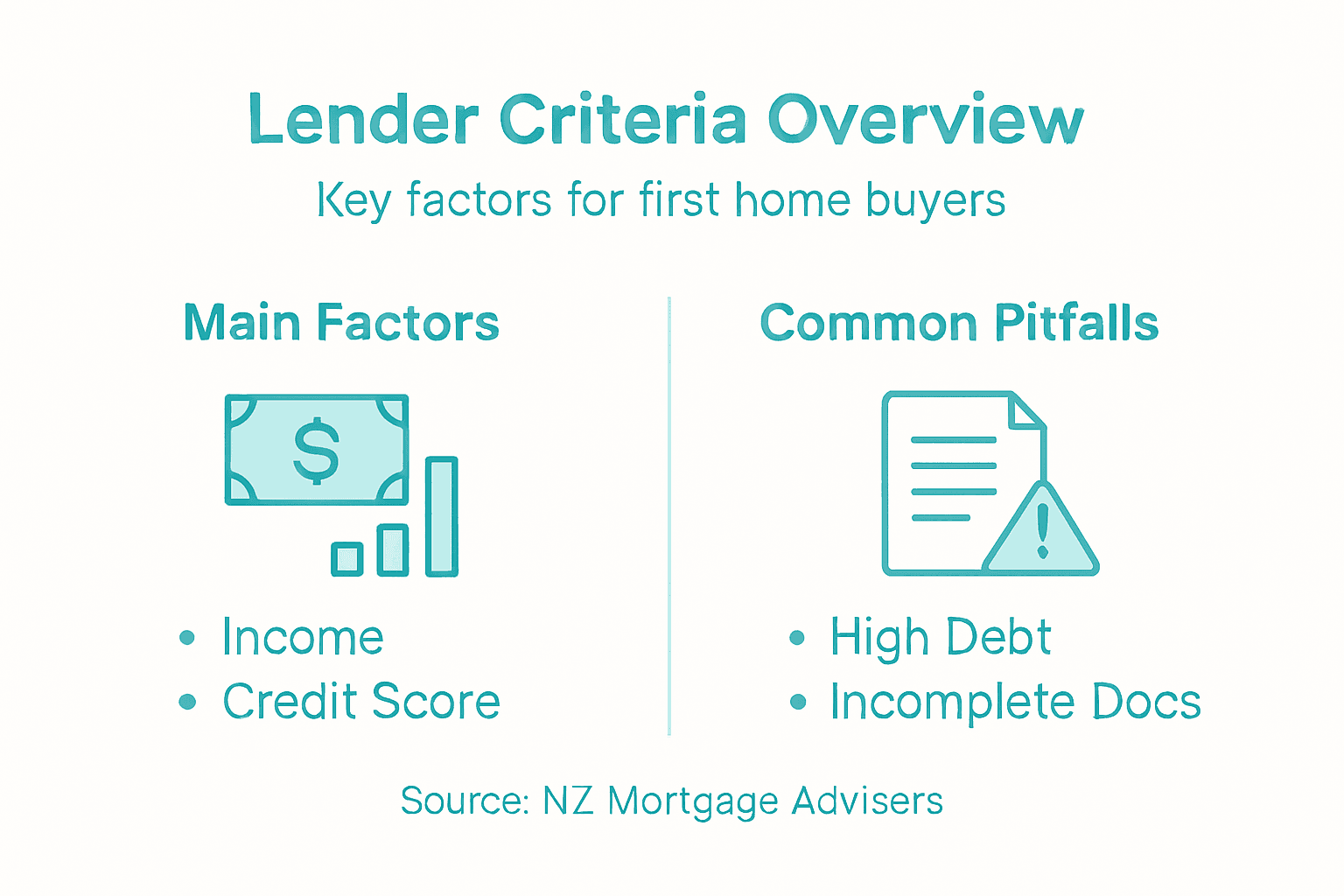
Pro tip: Conduct a thorough personal financial audit before applying, gathering comprehensive documentation and addressing any potential credit vulnerabilities in advance.
Take Control of Your Home Loan Journey with Expert Guidance
Navigating lender criteria can be daunting, especially when you are a first home buyer facing income thresholds, deposit requirements and credit assessments. Understanding complex lending terms like low deposit lending and bad credit lending is key to finding a solution that fits your unique situation. At Mortgage Managers, we know how critical it is to build a strong lending profile and manage financial risks effectively so you can secure a home loan that works for you.

Start your home loan journey with confidence by partnering with Auckland’s trusted mortgage advisers. Whether you are in Hobsonville, West Auckland or the North Shore, our local expertise helps you navigate eligibility rules, assess income and credit factors and avoid common lending mistakes. Visit Mortgage Managers now to get tailored advice and clear steps to improve your borrowing prospects. Unlock your path to homeownership today with trusted guidance at https://mortgagemanagers.co.nz.
Frequently Asked Questions
What are the main criteria lenders consider for home loans?
Lenders assess an individual’s income stability, credit history, existing debt obligations, employment status, and deposit size to determine eligibility for home loans.
How does a low deposit affect my home loan application?
Low deposit lending typically requires 5-10% upfront and may come with higher interest rates, making it a viable option for buyers without substantial savings.
What should I do if I have bad credit and want to apply for a home loan?
Consider applying for bad credit lending, which is specifically designed for borrowers with challenging credit histories. This option often involves a more stringent assessment process.
How can I improve my chances of getting approved for a home loan?
Maintain a strong financial record by demonstrating stable income, responsible debt management, a clean credit history, and adequate savings before applying for a mortgage.