
Many first home buyers believe mortgage rejections happen randomly or unfairly, leaving them confused and frustrated. The reality is quite different. Lenders follow clear criteria when assessing applications, and understanding these reasons can significantly improve your chances of approval. This guide explains the main factors behind mortgage rejections in New Zealand, from financial position and credit history to documentation errors and property concerns. You’ll discover practical steps to strengthen your application and alternative options if traditional banks decline your request.
Table of Contents
- Key takeaways
- Common reasons lenders reject mortgage applications
- How lenders assess your financial position and creditworthiness
- Alternative lending options when your application is rejected
- Steps to improve your chances and avoid rejection
- How mortgage advisers can help you secure approval
- Why do lenders reject mortgage applications?
Key Takeaways
| Point | Details |
|---|---|
| Common rejection causes | Understanding the main reasons lenders reject applications helps you address weaknesses before you submit your loan application. |
| Income stability matters | Lenders favour steady, well documented income and may scrutinise casual or fluctuating earnings more closely. |
| Debt and credit impact | High existing debt reduces borrowing capacity because lenders assess your total commitments against income. |
| Documentation and property risks | Incomplete or inaccurate paperwork can delay approval, and property type or valuation issues may limit how much lenders will advance. |
Common reasons lenders reject mortgage applications
Mortgage rejections typically stem from a handful of predictable factors that lenders scrutinise carefully. Recognising these reasons helps you address potential weaknesses before submitting your application.
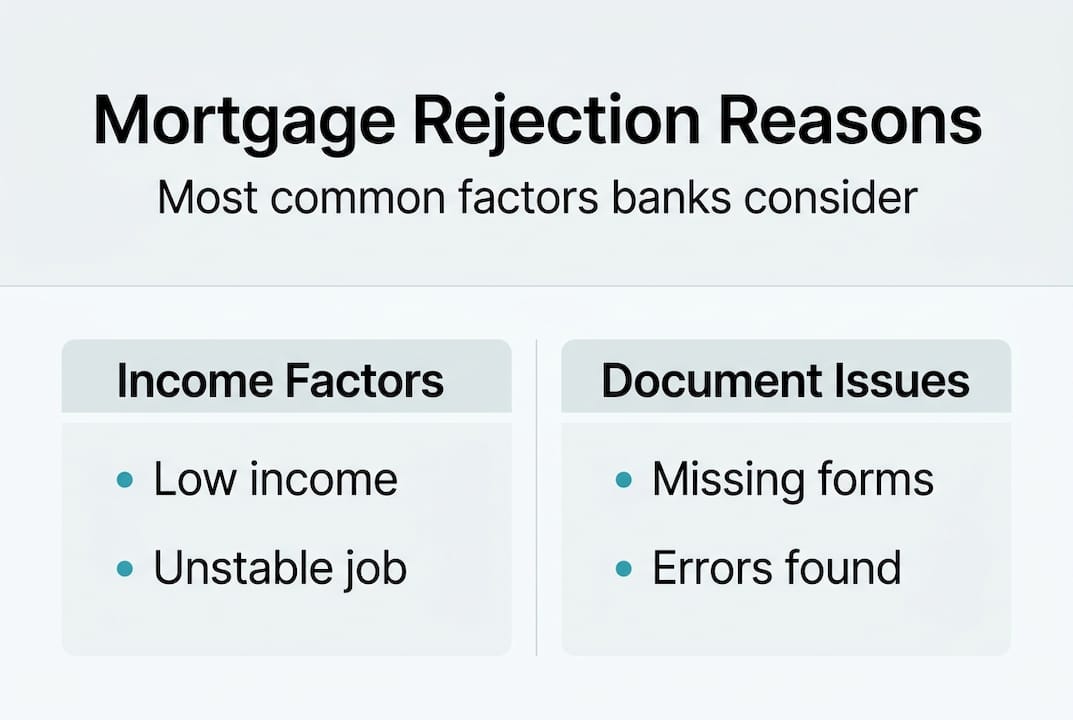
Insufficient or unstable income remains one of the most frequent rejection triggers. Lenders need confidence you can maintain regular repayments over many years. If your income fluctuates significantly, comes from casual employment, or lacks proper documentation, lenders view your application as higher risk. Self-employed applicants often face additional scrutiny because their income can vary seasonally or annually.
High existing debt reduces your borrowing capacity substantially. When lenders calculate how much you can borrow, they assess all your current financial commitments including credit cards, personal loans, car finance, and student loans. If these debts consume too much of your income, lenders worry you won’t manage another large repayment. This debt-to-income assessment directly influences approval decisions.
Poor or limited credit history damages lender confidence in your reliability. Your credit score reflects your past borrowing behaviour, including late payments, defaults, or court judgements. Even if you’ve never borrowed before, a thin credit file can work against you because lenders have no evidence of your repayment habits. Checking your credit report before applying reveals any issues you can address.
Incomplete or inaccurate documentation causes unnecessary delays and outright declines. Lenders require specific paperwork to verify your identity, income, employment, assets, and liabilities. Missing bank statements, outdated payslips, or inconsistent information raises red flags. Some applicants underestimate how thorough lenders are when cross-checking details.
Unrealistic property valuations or unsuitable property types can derail otherwise strong applications. If the property you want to buy appraises lower than the purchase price, lenders won’t advance the full amount you need. Certain property types like leasehold homes, properties on Māori land, or those requiring major repairs may not meet standard lending criteria. Understanding these limitations before house hunting saves disappointment.
Common rejection factors include:
- Unstable employment history or recent job changes
- Undisclosed debts or financial obligations
- Gambling activity showing in bank statements
- Insufficient deposit or savings history
- Mistakes homeowners make like taking on new debt before settlement
Pro Tip: Double-check every document for accuracy and completeness before submitting your application. A simple error like a missing signature or outdated statement can delay approval by weeks or result in outright rejection.
How lenders assess your financial position and creditworthiness
Lenders use systematic processes to evaluate whether you can afford the mortgage you’re requesting. Understanding these assessment methods helps you present your finances in the strongest possible light.
Income stability carries enormous weight in lending decisions. Lenders examine not just how much you earn, but how consistently you’ve earned it and whether that income will continue. Permanent employees with long tenure at the same company generally receive more favourable assessments than contractors or casual workers. Lenders now primarily focus on income and debt levels when determining how much they’ll lend.

Total debt levels directly reduce your borrowing capacity through debt-to-income calculations. Lenders add up all your monthly debt obligations and compare them to your gross income. If this ratio exceeds their comfort threshold, typically around 40-45%, they’ll either reduce the loan amount or reject the application entirely. Paying down existing debts before applying can significantly improve your position.
Credit scores reflect your borrowing reliability and influence both approval decisions and interest rates offered. Scores range from poor to excellent based on your payment history, credit utilisation, length of credit history, and types of credit used. A low score suggests you’ve struggled with debt management previously, making lenders hesitant to approve new lending. Bad credit doesn’t automatically disqualify you, but it complicates the process.
Debt-to-income ratios provide lenders with a snapshot of your financial health and repayment capacity. They calculate this by dividing your total monthly debt payments by your gross monthly income. Lower ratios indicate you have more income available to service a new mortgage. Many lenders set maximum thresholds that vary by applicant circumstances.
| Financial metric | What lenders assess | Impact on approval |
|---|---|---|
| Income stability | Employment type, tenure, consistency | High – determines maximum loan amount |
| Total debt | Credit cards, loans, other commitments | High – reduces borrowing capacity |
| Credit score | Payment history, defaults, credit enquiries | Medium to high – affects approval and rates |
| Debt-to-income ratio | Monthly debts vs gross income | High – must stay within lender limits |
| Deposit size | Savings, gifts, equity | Medium – larger deposits improve terms |
| Living expenses | Actual spending patterns from bank statements | Medium – realistic assessment required |
Lenders also scrutinise your bank statements for spending patterns that might indicate financial stress. Regular gambling, frequent overdrafts, unpaid direct debits, or dishonour fees all raise concerns. They want to see consistent savings behaviour and sensible money management.
Pro Tip: Improve your financial profile three to six months before applying by paying down debts, avoiding new credit applications, and building a clear savings pattern. These actions demonstrate financial discipline that lenders value highly.
Alternative lending options when your application is rejected
Traditional bank rejection doesn’t mean the end of your home ownership journey. Several alternative pathways exist for applicants who don’t meet mainstream lending criteria.
Banks maintain strict lending policies because they answer to regulators and shareholders who prioritise risk minimisation. These conservative approaches mean some perfectly capable borrowers get declined despite having genuine repayment ability. Banks typically reject applicants with credit issues, non-standard income, or unique property situations.
Non-bank lenders provide more flexible assessment criteria that consider individual circumstances rather than rigid rules. These specialist lenders evaluate applications banks reject, often approving loans for self-employed individuals, those with past credit problems, or buyers purchasing unusual properties. They charge higher interest rates to offset the additional risk they accept.
Understanding when to approach non-bank lenders helps you make informed decisions about your borrowing strategy. If you’ve been declined by multiple banks for the same reason, a non-bank lender might offer a solution. They’re particularly useful for bridging short-term gaps, like when you’re rebuilding credit or waiting for probation periods to end.
| Comparison factor | Traditional banks | Non-bank lenders |
|---|---|---|
| Credit requirements | Strict – limited flexibility for poor credit | Flexible – consider circumstances |
| Income verification | Detailed proof required | More accepting of varied income sources |
| Approval timeframe | 2-4 weeks typically | Often faster, 1-2 weeks |
| Interest rates | Lower, competitive rates | Higher rates reflecting increased risk |
| Loan-to-value ratios | Standard LVR restrictions apply | May accept higher LVRs in some cases |
| Property types | Prefer standard residential | More flexible on property types |
Approaching non-bank lenders requires realistic expectations about costs and terms. While they provide access when banks won’t, you’ll pay a premium through higher interest rates and potentially larger fees. View these options as stepping stones rather than permanent solutions.
Practical steps after rejection:
- Request detailed feedback from the lender explaining specific rejection reasons
- Address identified issues before reapplying elsewhere
- Consider whether waiting six to twelve months would strengthen your position
- Explore non-bank lenders through a mortgage adviser who knows the market
- Investigate government schemes or programmes supporting first home buyers
- Review whether a guarantor could help you meet lending criteria
Some applicants benefit from a staged approach where they use a non-bank lender initially, then refinance to a bank once their situation improves. This strategy works well for self-employed borrowers building income history or those recovering from credit setbacks.
Steps to improve your chances and avoid rejection
Taking proactive steps before applying dramatically increases your approval likelihood and can secure better interest rates and terms.
Preparing complete and accurate documentation eliminates one of the most common rejection causes. Gather everything lenders need before starting your application including recent payslips, bank statements, identification, proof of deposit, and employment confirmation. Double-check that all documents are current, legible, and consistent with each other.
Delaying big purchases or new debt commitments before applying protects your borrowing capacity. That new car loan or furniture package might seem affordable, but it reduces how much lenders will approve for your mortgage. Avoid applying for credit cards, changing jobs, or making large unexplained deposits during the application process.
Checking and improving your credit report addresses issues before lenders discover them. Obtain your free credit report from credit bureaus and review it carefully for errors or outdated information. Dispute any inaccuracies and ensure old debts are marked as paid. Building positive credit history through responsible credit card use helps if your file is thin.
Getting pre-approval advice from experienced mortgage advisers provides clarity about your borrowing capacity and identifies potential obstacles. Advisers understand what different lenders look for and can steer you toward those most likely to approve your specific situation. Applying expert tips and proper preparation increases mortgage approval chances significantly.
Recommended actions to strengthen your application:
- Save a larger deposit to reduce the loan-to-value ratio and demonstrate financial discipline
- Maintain stable employment for at least six months, preferably longer, before applying
- Close unused credit cards and reduce limits on those you keep
- Pay all bills on time for at least three months leading up to application
- Avoid overdrafts and ensure your accounts stay in positive balance
- Document any unusual deposits or income sources with clear explanations
- Research properties within your realistic price range based on income and deposit
- Address any outstanding debts or defaults before applying
Timing your application strategically can also improve outcomes. Applying after receiving a pay rise, completing probation, or paying off a significant debt strengthens your position. Rushing an application before you’re truly ready often leads to rejection and wasted effort.
Pro Tip: Working with a mortgage adviser early in your home buying journey, even before you start house hunting, helps you understand exactly what you need to do to get approved. They can create a personalised roadmap addressing your specific circumstances and connecting you with the right lenders.
How mortgage advisers can help you secure approval
Navigating mortgage applications alone often leads to avoidable mistakes and missed opportunities. Professional mortgage advisers bring expertise that significantly improves your approval chances.

Mortgage advisers act as your personal shoppers for a home loan, comparing options across multiple lenders to find the best fit for your situation. They understand which lenders have appetite for different applicant types and can match you with those most likely to approve your application. This targeted approach saves time and protects your credit score from multiple enquiries.
Advisers assist with preparing your application to meet specific lender requirements and avoid common documentation errors. They review your paperwork before submission, ensuring everything is complete, accurate, and presented in the most favourable light. This professional preparation reduces rejection risk substantially.
Experienced advisers can negotiate with lenders on your behalf, sometimes securing approval for borderline applications that might otherwise be declined. Their established relationships with lending managers and understanding of lender policies give them leverage individual applicants lack. Auckland mortgage brokers who understand local market conditions provide particularly valuable insights for first home buyers in competitive markets.
Contacting advisers early, ideally six to twelve months before you plan to buy, gives you time to address any issues they identify. The role of a mortgage adviser extends beyond just arranging loans to include strategic planning and ongoing support throughout your home ownership journey.
Why do lenders reject mortgage applications?
What is the most common reason for mortgage rejection?
Insufficient income or high debt levels represent the most frequent rejection cause. Lenders need confidence you can afford repayments alongside your existing financial commitments. If your debt-to-income ratio exceeds their acceptable threshold, they’ll decline the application regardless of other factors.
Can I reapply after being rejected for a mortgage?
Yes, you can reapply after addressing the specific issues that caused rejection. Request detailed feedback from the lender, fix identified problems, and wait at least three to six months before trying again. Reapplying immediately without changes typically produces the same result.
Does mortgage rejection affect my credit score?
The application itself creates a credit enquiry that slightly impacts your score temporarily. Multiple rejections and applications within a short period can damage your score more significantly. Working with a mortgage adviser who submits to appropriate lenders minimises unnecessary enquiries.
How long does a mortgage rejection stay on my record?
Credit enquiries from mortgage applications remain visible on your credit report for five years in New Zealand. However, their impact on your score diminishes over time, becoming minimal after twelve months. The rejection itself isn’t recorded, only the enquiry.
What should I do immediately after mortgage rejection?
Request specific written feedback explaining the rejection reasons. Review this carefully to understand what needs improvement. Avoid applying elsewhere immediately, as this creates additional enquiries without addressing underlying issues. Consider consulting a mortgage adviser for expert guidance on your next steps.