
Securing your first home loan in Auckland can feel overwhelming, especially if you are worried about a small deposit or a checkered credit history. Lenders in New Zealand follow a detailed process called risk assessment, shaped by strict legal and regulatory frameworks. Understanding how banks measure your ability to repay and the impact of rules like the Loan-to-Value Ratio (LVR) restriction helps you avoid surprises and make smarter decisions on your path to homeownership.
Table of Contents
- What Lender Risk Assessment Means In NZ
- Types Of Risks Lenders Evaluate
- Key Factors: Income, LVR And Credit Score
- Lender Policies For Low Deposits Or Bad Credit
- Common Mistakes And How To Prepare
Key Takeaways
| Point | Details |
|---|---|
| Transparent Assessment Process | Lender risk assessment in New Zealand is a structured, regulated system designed to evaluate borrowers fairly and ensure responsible lending. |
| Income, LVR, and Credit Score | Lenders primarily focus on income stability, Loan-to-Value Ratio, and credit history to assess borrowing capacity and risk. |
| Navigating Low Deposits and Bad Credit | Borrowers with low deposits or poor credit histories may still secure loans, but they should expect stricter scrutiny and possibly higher rates. |
| Preparation is Key | Thorough preparation, including organised documentation and understanding financial metrics, significantly increases the chances of mortgage approval. |
What Lender Risk Assessment Means In NZ
When you approach a bank or mortgage broker in Auckland about getting a home loan, you’re stepping into a process that’s driven entirely by risk assessment. Lender risk assessment isn’t some mysterious black box—it’s a structured system that banks use to figure out whether you’re likely to repay the money they’re about to lend you. In New Zealand, this process is shaped by both government regulations and the legal obligations lenders must follow to protect consumers and maintain the stability of the financial system.
At its core, lender risk assessment in New Zealand means evaluating whether you can actually afford the mortgage and whether lending to you would expose the bank to unnecessary financial danger. Lenders must comply with the Credit Contracts and Consumer Finance Act, which requires them to assess your ability to repay and ensure the loan is suitable for your circumstances. This isn’t just good business practice—it’s a legal requirement. Banks must verify that lending won’t cause you substantial hardship and that you’ve received clear information about the loan before committing. This responsible lending framework exists to protect you from being trapped in a mortgage you can’t manage.
The Reserve Bank of New Zealand also plays a critical role by setting prudential requirements that control how much risk lenders can take on. The most visible of these is the Loan-to-Value Ratio (LVR) restriction, which limits high-risk lending through careful regulation of lending above 80% LVR to owner-occupiers. Essentially, the Reserve Bank is saying: if you’re borrowing more than 80% of the property’s value, that’s considered riskier, and lenders face stricter requirements. This regulatory framework exists to keep the entire financial system stable and prevent the kind of mortgage crisis that can destabilise communities.
What does this mean for you as a first-home buyer? It means lenders aren’t just looking at one factor—they’re conducting a thorough assessment across multiple areas:
- Your income and employment stability – Do you have regular income? Is your job secure? Have you been in your current role long enough to demonstrate reliability?
- Your existing debts – What other financial obligations do you have? How much are you already committed to paying each month? (This is where understanding the debt-to-income ratio becomes crucial)
- Your credit history – Have you paid previous bills on time? Does your credit file show responsible financial behaviour?
- The deposit size – How much of your own money are you putting into this purchase? A larger deposit means less risk for the lender
- The property value – What’s the property worth? Is it a reasonable investment in your area?
Lender risk assessment isn’t about rejecting you—it’s about understanding your situation fairly and ensuring both you and the bank enter into an agreement that works for everyone.
When a lender says “no” or requires special conditions, they’re not being difficult. They’re following rules designed to protect the financial system and, honestly, to protect you from overcommitting. If a bank is concerned you can’t afford the repayments, that’s valuable feedback. It might mean waiting another year to save a bigger deposit, paying down other debts first, or working with a broker who understands alternative lending options.
The key takeaway here is that lender risk assessment in New Zealand is transparent, regulated, and designed with your protection in mind. Yes, it can feel like a lot of hoops to jump through when you’re eager to buy your first home. But this system exists specifically because banks and the Reserve Bank have learned from history that careful assessment protects everyone involved.
Pro tip: Before approaching a lender, run your own risk assessment first—calculate your debt-to-income ratio, check your credit file for errors, and gather proof of your income and employment. Walking in prepared shows lenders you’re serious, and it gives you a realistic picture of what you might actually qualify for.
Types Of Risks Lenders Evaluate
When a lender pulls your file and starts assessing your mortgage application, they’re not just doing a casual review. They’re systematically evaluating different categories of financial risk to determine whether lending to you makes sense for their business. Understanding what types of risks lenders look at gives you insight into why they ask certain questions and why some applications get approved whilst others don’t.
Lenders evaluate several distinct categories of risk. The most obvious is credit risk—this is the danger that you won’t repay the loan as agreed. Banks look at your credit history, payment patterns, and existing debts to gauge whether you’re a reliable borrower. But credit risk assessment goes deeper than just checking if you’ve missed payments. Lenders also consider your income stability, employment history, and whether your financial situation is likely to improve or deteriorate. If you’ve changed jobs five times in two years, that’s a red flag. If your industry is facing cutbacks or automation risks, lenders notice that too.
Market risk is the second major category lenders evaluate. This refers to the possibility that the property value might drop, leaving them holding a mortgage worth more than the asset itself. Property markets in Auckland, Wellington, and Christchurch don’t move in lockstep—location matters enormously. A property in a growing suburb with strong infrastructure is lower market risk than one in a declining area. Lenders use property valuations and market analysis to gauge this risk. They also consider interest rate risk: if rates spike, your ability to refinance or maintain the loan becomes shakier.
Operational risk is less obvious but equally important. This covers everything from fraud risk (Are you being honest about your income? Is this property purchase legitimate?) to system failures on the lender’s end. Banks also evaluate behavioural risk—the tendency people have to make poor financial decisions under stress. If you’re borrowing the maximum possible amount with no buffer for emergencies, you’re signalling higher behavioural risk.
Here’s what lenders specifically examine when evaluating these risk categories:
Here’s a quick summary of the main risk categories and how they affect NZ mortgage approval:
| Risk Type | What It Means For Borrowers | Lender Impact | Typical Actions Lenders Take |
|---|---|---|---|
| Credit Risk | Past repayment behaviour matters | Determines approval and terms | May require higher rates or more checks |
| Market Risk | Property value can fluctuate | Protects lender from asset loss | Requires property valuation, stricter LVR |
| Operational Risk | Documentation and accuracy vital | Prevents fraud and errors | Checks all paperwork, may request clarification |
- Income verification – They want proof your salary is real, stable, and likely to continue
- Employment history – Multiple job changes or contract work raises concerns
- Debt-to-income ratio – How much of your income is already committed to debt repayments
- Credit file accuracy – Payment history, defaults, and any signs of financial distress
- Property valuation – Does the property’s value match your purchase price? Is it in a safe market?
- Loan-to-value ratio – Are you borrowing more than 80% of the property’s value (higher risk) or less?
- Savings and emergency reserves – Can you handle a financial shock without defaulting?
- Employment contract terms – Is your job permanent, fixed-term, or casual?
What makes this even more complex is that lenders weight these risks differently depending on your situation. First-home buyers often face stricter scrutiny because you have no mortgage history. Self-employed people face tougher assessment because income is less predictable. Property investors face different risk profiles than owner-occupiers. This is why working with a mortgage broker who understands how different lending criteria apply across various lenders can be invaluable.
The types of risks lenders evaluate aren’t arbitrary or punitive—they’re based on decades of data about which borrowers succeed and which ones struggle.
One important context: if you’ve had credit difficulties or your situation is unconventional, non-bank lenders often evaluate risk differently. They might weight recent positive behaviour more heavily than a single past default, or they might be comfortable with more complex income situations. This is why some borrowers who can’t qualify with traditional banks still find lending options available.
The bottom line is that lenders aren’t trying to reject you arbitrarily. They’re running sophisticated risk models based on statistical reality. When they identify a risk factor, they’re giving you genuine information about your financial position. That feedback—whether it’s a rejection or approval with conditions—is worth taking seriously.
Compare how traditional banks and non-bank lenders handle challenging mortgage applications:
| Lender Type | Assessment Style | Flexibility With Bad Credit | Documentation Required |
|---|---|---|---|
| Traditional Bank | Strict, rule-based | Low, old issues carry weight | Higher, thorough examination |
| Non-bank Lender | Case-by-case assessment | Higher, recent behaviour matters | Usually more documents, but flexible |
Pro tip: Before applying, identify which risk categories might work against you and develop a strategy to address them—whether that’s paying down existing debt, building your savings buffer, or getting pre-approval to show you’re a serious buyer before making offers.
Key Factors: Income, LVR And Credit Score
When a lender opens your file, three numbers sit at the top of their assessment list. Income, Loan-to-Value Ratio (LVR), and credit score form the foundation of every mortgage decision in New Zealand. These aren’t arbitrary metrics—they’re the quantitative measures lenders use to answer a single question: can you repay this loan? Understanding how each one works gives you a realistic picture of where you stand.
Income: Your Repayment Capacity
Income is where lenders start, and it’s the most straightforward factor they assess. When you apply for a mortgage, the bank wants documented proof that you earn enough to cover the repayments without stretching yourself thin. This isn’t just about your gross salary—lenders dig into the stability, reliability, and sustainability of that income.
Lenders now prioritise income verification because it directly tells them whether you can afford the loan. A bank manager cares far less about your investment portfolio than your reliable monthly income stream. They want to see payslips, tax returns, and employment contracts. If you’re self-employed, they’ll want two to three years of financial statements. If you’ve just changed jobs, they’ll want evidence your new role is permanent or at least that the income is comparable to your previous position.
Lenders also assess income quality. A salary from a stable employer in a secure industry looks different to contract work that dries up seasonally. If you work in a declining sector facing automation or redundancies, lenders view your income as higher risk. They’re not being harsh—they’re being realistic about statistical patterns.
Here’s what lenders examine regarding your income:
- Employment stability – How long have you been in your current role?
- Industry outlook – Is your sector growing or contracting?
- Income growth trajectory – Has your income been rising, flat, or declining?
- Secondary income – Do you have rental income, dividends, or other reliable sources?
- Documentation quality – Can you provide recent payslips and tax returns?
- Contract terms – If employed on a fixed term, how much runway remains?
Loan-to-Value Ratio: Your Deposit Position
The Loan-to-Value Ratio is a technical term for something simple: how much you’re borrowing compared to the property’s value. If a property is worth $500,000 and you’re borrowing $400,000, your LVR is 80%. If you’re borrowing $450,000, your LVR is 90%.

LVR restrictions imposed by the Reserve Bank directly affect your borrowing capacity and the interest rates you’ll qualify for. Loans above 80% LVR are considered higher risk—if property values drop even slightly, you’re left owing more than the asset is worth. This is why first-home buyers with smaller deposits face stricter lending criteria.
Your LVR determines more than just whether you can borrow. It affects your interest rate, your loan approval chances, and whether you’ll need to pay mortgage insurance. A buyer with a 20% deposit (80% LVR) will get better rates and easier approval than a buyer with a 10% deposit (90% LVR). This isn’t punishment—it’s risk management. The bank has more safety margin if property values decline.
What matters about your LVR:
- Your deposit size – Larger deposits = lower LVR = better rates and approval odds
- Current property market – Property values affect LVR assessments
- Mortgage insurance costs – High LVR loans often require insurance
- Interest rate premiums – Higher LVR typically means higher rates
- Refinancing flexibility – Lower LVR gives you more borrowing options later
Credit Score: Your Payment History
Your credit score reflects your financial behaviour over time. It answers the question: when you’ve borrowed money before, have you paid it back on time? Banks access your credit file through credit agencies and see every credit application, payment record, and default in your history.
A poor credit score doesn’t automatically disqualify you, but it raises red flags. A missed payment from five years ago carries less weight than recent defaults. A single missed bill from seven years back impacts you far less than multiple recent late payments. Lenders look for patterns, not isolated incidents.
Understanding how credit scores shape mortgage decisions helps you appreciate why lenders behave as they do. They’re not judging your character—they’re predicting statistical probability. Decades of lending data show that borrowers with poor payment histories are more likely to default. It’s that simple.
Your credit file should show:
- On-time payment history – Do you pay bills when they’re due?
- Credit utilisation – Are you maxing out credit cards or using credit responsibly?
- Account age diversity – Do you have multiple types of credit (mortgage, car loans, credit cards)?
- Recent enquiries – Multiple recent credit applications look risky
- Defaults or arrears – Any unpaid debts or late payments?
- Public records – Judgements, bankruptcies, or court orders?
The three factors—income, LVR, and credit score—work together, not independently. Strong income can sometimes offset a lower deposit. A stellar credit history might help compensate for a newer job. But weakness in all three makes approval nearly impossible.
These three factors aren’t isolated. A lender weighs them together. You might have exceptional income but a 90% LVR and average credit. Or you might have perfect credit and strong savings (low LVR) but variable contract income. Lenders run complex algorithms that balance these factors, but broadly speaking, strength in one area can help offset weakness in another.
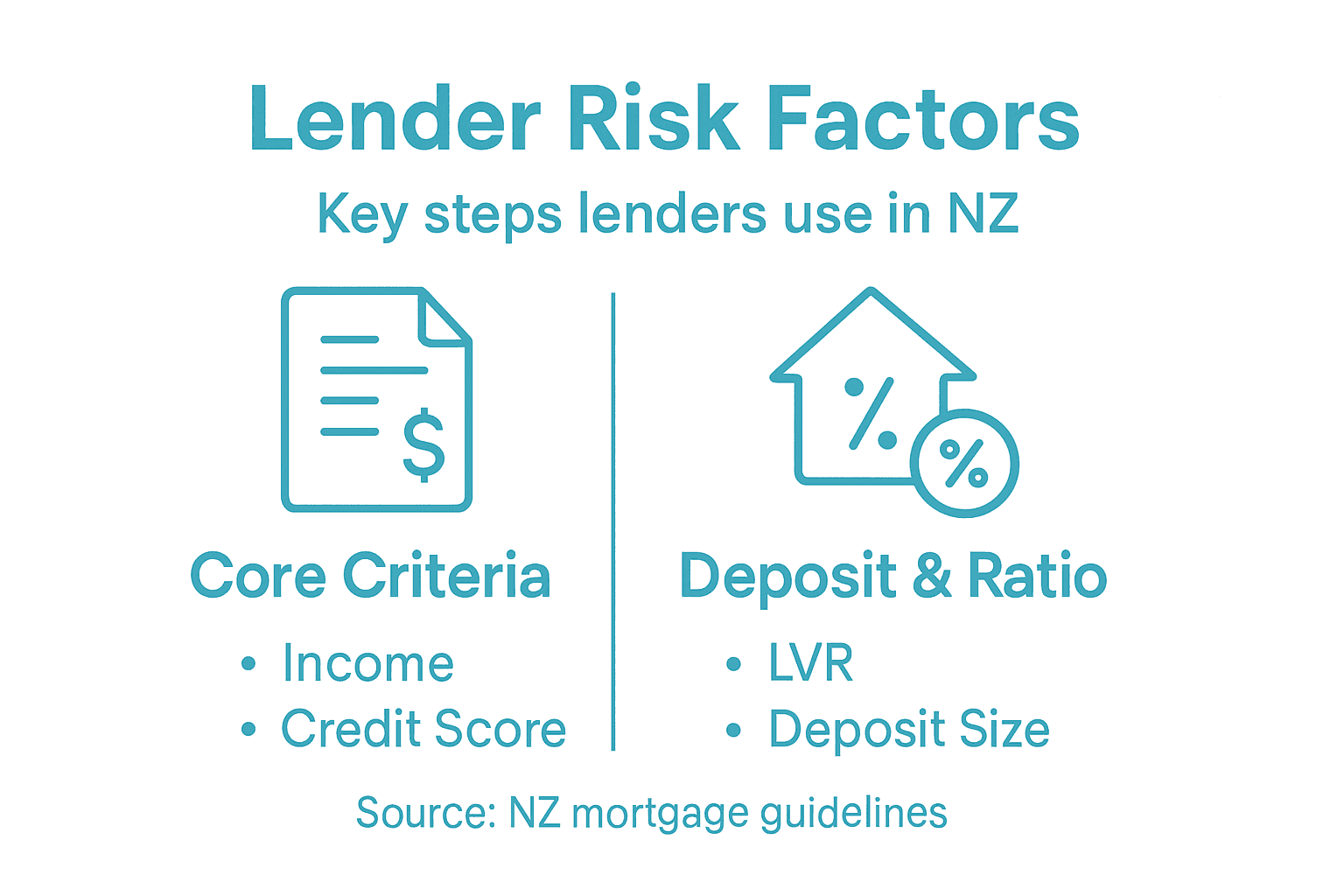
When preparing your mortgage application, focus on the factors you can control before applying. You can’t change your LVR without saving more or finding a cheaper property, but you can clean up your credit file, gather organised income documentation, and ensure your employment situation is clear. These steps matter.
Pro tip: Request your credit file from a free provider like Equifax before applying for a mortgage—fix any errors and ensure you understand what lenders will see, then address any red flags with clear explanations before the bank even asks.
Lender Policies For Low Deposits Or Bad Credit
If you’re a first-home buyer in Auckland with a small deposit or a credit blemish on your file, you’re wondering whether mortgage lenders will even consider you. The short answer is yes—but the policies they apply are stricter, the rates may be higher, and the process requires more documentation. Understanding how lenders approach these situations helps you navigate the system strategically.
The Reserve Bank of New Zealand has set specific regulatory guardrails around lending to borrowers in higher-risk categories. High Loan-to-Value Ratio restrictions limit how much banks can lend above 80% LVR, which directly affects borrowers with low deposits. Banks can’t just lend freely to anyone with a 5% or 10% deposit—the Reserve Bank caps the proportion of high-LVR loans each bank can issue. This regulatory reality shapes everything from approval odds to interest rate pricing for low-deposit buyers.
When you have a low deposit, lenders view you as carrying more risk. Here’s their thinking: if property values drop 10%, you’re suddenly underwater on your mortgage. With less skin in the game, you’re statistically more likely to walk away from the loan. That’s why low-deposit borrowers typically face:
- Higher interest rates – You’ll pay a premium compared to borrowers with larger deposits
- Stricter income verification – Lenders dig deeper to confirm you can actually afford repayments
- Mortgage insurance requirements – Most loans above 80% LVR require lenders mortgage insurance (LMI)
- Larger documentation requirements – You’ll need more payslips, bank statements, and proof of savings
- Limited lender options – Some banks have tighter policies on low-deposit lending than others
- Conditional approvals – Your approval might depend on you meeting specific conditions before settlement
Bad credit presents a different challenge. A poor credit history doesn’t automatically mean “no.” Instead, lenders conduct what’s called a comprehensive creditworthiness assessment. They ask: why did you miss those payments? Have you fixed the underlying issues? What’s your track record in the past two years? Lenders want to understand the story behind the numbers.
New Zealand law actually requires lenders to exercise professional judgment with borrowers facing credit challenges. Responsible lending standards require lenders to make reasonable enquiries before lending to anyone with bad credit, ensuring the loan won’t cause substantial hardship. This sounds restrictive, but it actually creates an opening: if you can demonstrate that you’ve addressed your credit problems and can genuinely afford the loan, lenders have a legal obligation to consider you fairly.
What lenders look for when assessing bad credit applications:
- Time elapsed – How long ago was the default? One year? Five years? Older issues carry less weight
- Frequency of problems – A single missed payment looks very different to chronic late payments
- Reason for default – Were you facing temporary hardship that’s now resolved, or chronic mismanagement?
- Recent behaviour – What does your credit file look like in the past 12–24 months?
- Explanation letters – Can you articulate what went wrong and how you’ve fixed it?
- Compensating factors – Strong income, large deposit, or stable employment can offset credit issues
Bad credit doesn’t close the door to homeownership in New Zealand—it just means you’ll need to work harder, provide more documentation, and possibly accept higher interest rates whilst you rebuild your borrowing credibility.
When you combine low deposits AND bad credit, approval becomes tougher, but it’s not impossible. Mortgage brokers who specialise in working with complex applications can help you navigate lenders with more flexible criteria. Non-bank lenders often evaluate risk differently than traditional banks—they might weight recent positive behaviour more heavily or be comfortable with less conventional income situations.
Your strategy when facing these challenges should focus on controlling what you can:
- Get your credit file cleaned up – Fix errors, obtain written explanations for defaults, and demonstrate recent on-time payments
- Maximise your deposit – Even an extra 2–3% saves you money on interest and improves approval odds significantly
- Document your income thoroughly – Gather everything: payslips, tax returns, employment contracts, bank statements showing regular deposits
- Build a narrative – Write a brief letter explaining your credit situation and how you’ve addressed it
- Consider mortgage insurance – LMI costs money, but it can unlock lending that wouldn’t otherwise be available
- Work with a specialist broker – Mortgage Managers understands lenders with flexible policies and can position your application strategically
The key insight is that lender policies for low deposits or bad credit aren’t designed to punish you—they’re risk management strategies. Higher rates, mortgage insurance, and stricter documentation reflect the genuine statistical risk these applications carry. But that risk is manageable, and thousands of New Zealand first-home buyers with limited deposits or credit challenges successfully secure mortgages every year.
Pro tip: If you have bad credit, request your credit file immediately and spend 2–3 months building a clean payment history before applying for a mortgage—this recent positive behaviour often matters more to lenders than old defaults, and it can significantly improve your approval odds and interest rates.
Common Mistakes And How To Prepare
Most mortgage applications fail not because borrowers can’t afford the loan, but because they approach the process unprepared. Lenders assess thousands of applications annually, and the ones that sail through approval share one thing in common: meticulous preparation. Understanding the mistakes other borrowers make—and how to avoid them—gives you a significant advantage when you submit your application.
The Biggest Mistakes Borrowers Make
The most frequent error is incomplete or disorganised financial information. You hand over a few payslips and tax returns, but the lender is drowning in questions. Did you declare all your income sources? Are there gaps in your employment history? Why do your bank statements show irregular deposits? Common borrower mistakes include failing to provide complete financial information, which forces lenders to spend time chasing you for clarification instead of assessing your application quickly.
Another critical error is underestimating your actual living expenses. You calculate your budget based on bare minimums—rent, food, petrol—but forget about car maintenance, phone bills, insurance, and annual expenses like car registration. When a lender stress-tests your budget using realistic figures, suddenly your loan-to-income ratio looks much tighter than you thought. This is especially true for first-time homebuyers who haven’t managed a mortgage before.
Third is making major financial moves during the application process. You’ve been approved in principle, so you think it’s safe to buy a new car with financing. Wrong. You apply for a credit card to consolidate other debts. You change jobs. Any of these actions can torpedo your approval because they change the risk profile lenders assessed. New credit enquiries, higher debt-to-income ratios, or employment uncertainty all raise red flags.
Fourth is misrepresenting your financial situation. This might seem obvious, but pressure makes people do strange things. You exaggerate your income, downplay existing debts, or claim overtime as permanent income when it’s irregular. Lenders verify everything. Tax returns, employment letters, and bank statements will contradict lies, and you’ll be declined—or worse, face fraud investigation.
How To Prepare Like A Pro
Start by getting organised at least three months before you apply. This gives you time to fix issues and build a strong application file. Here’s what preparation looks like:
- Request your credit file – Check for errors and dispute inaccuracies immediately
- Gather financial documents – Collect 2–3 years of tax returns, recent payslips (ideally 6 months), and bank statements
- Document your income accurately – If self-employed, organise profit and loss statements, invoices, and business accounts
- List all existing debts – Credit card balances, car loans, student loans, rent—everything with a monthly payment
- Calculate your actual living expenses – Be ruthlessly honest about utilities, groceries, transport, insurance, and discretionary spending
- Save your deposit – Demonstrate you can save by building a regular savings pattern lenders can see in your bank statements
- Stabilise your employment – Stay in your current job if possible; if you must change roles, ensure the new position is permanent
When you submit your application, include written explanations for anything that looks odd. Credit default from five years ago? Explain it briefly. Gap in employment? Explain it. Income dip last year? Explain it. These narratives matter because they help lenders understand your situation as a human being, not just a data point.
Another crucial preparation step is understanding your numbers before the lender does. Calculate your debt-to-income ratio. Find out your LVR. Research interest rates and stress-test your budget at 2–3% higher rates than current offerings. When you walk into a broker’s office or click “submit” on an online application, you should already know whether you’re likely to be approved. This prevents wasting time on applications you won’t qualify for.
One more mistake: applying with multiple lenders simultaneously. Each application creates a credit enquiry, and multiple enquiries signal financial desperation. Apply to one lender (or work with a broker who applies to lenders on your behalf), get feedback, make adjustments if needed, then apply elsewhere. Sequential applications look much better than a scatter-gun approach.
Preparation isn’t about deceiving lenders—it’s about presenting your genuine situation as clearly and organised as possible, which dramatically improves approval odds and outcomes.
Misunderstanding loan terms is another trap. Some borrowers don’t realise they’re signing up for interest-only loans, variable-rate mortgages, or loans with early repayment penalties. Understanding loan terms prevents costly surprises down the track. Read your offer carefully, ask your broker to explain anything unclear, and ensure you understand what you’re committing to before you sign.
Finally, don’t try to do this alone if your situation is complex. Self-employed income, bad credit, low deposit, employment changes—these are all reasons to engage a mortgage broker. Brokers know which lenders are flexible with which situations. They position your application strategically. They know how to package your circumstances for approval. The broker fee (usually paid by the lender) is worth every dollar when it means the difference between approval and rejection.
Pro tip: Create a “mortgage file” three months before applying containing organized copies of every document a lender might request—tax returns, payslips, bank statements, proof of identification, asset documentation—so you can respond to requests within 24 hours instead of scrambling, which signals serious intent and speeds up approval.
Take Control of Your Home Loan Journey with Expert Guidance
Navigating the complexities of lender risk assessment in New Zealand can be daunting. From understanding your income stability and Loan-to-Value Ratio to managing your credit score, each factor plays a critical role in securing your mortgage approval. If you are feeling overwhelmed by these challenges or unsure how to position your application effectively, you are not alone. The right advice and strategic support can make all the difference in turning a “no” into a confident “yes”.

At Mortgage Managers, our locally owned and operated team of Auckland mortgage advisers specialises in simplifying this process for first-home buyers and experienced purchasers alike. We know how lenders assess risk and how to present your unique financial situation in the strongest light. Whether you need help improving your credit profile or advice on managing deposit size and lending policies, we are perfectly placed to assist you across Hobsonville, West Auckland, the North Shore, and remotely throughout New Zealand. Visit Mortgage Managers today to start your tailored mortgage strategy. Discover how you can better prepare to meet lender requirements and secure your dream home sooner with expert mortgage advisers you can trust.
Explore more about lender criteria and first-home loans and take the first step with confidence.
Frequently Asked Questions
What is lender risk assessment?
Lender risk assessment is the process banks use to evaluate your ability to repay a loan. It involves analysing various factors, including your income, existing debts, credit history, and the property value, to determine the financial risk of lending to you.
How do lenders assess my income stability?
Lenders assess your income stability by reviewing your employment history, consistency in your job role, and the reliability of your income sources. They may request documentation such as payslips, tax returns, and employment contracts.
What factors affect my Loan-to-Value Ratio (LVR)?
Your Loan-to-Value Ratio (LVR) is affected by the size of your deposit compared to the property’s value. A smaller deposit results in a higher LVR, which is considered higher risk by lenders and may lead to higher interest rates and stricter lending criteria.
How does my credit score impact my mortgage application?
Your credit score reflects your past borrowing behaviour, specifically your repayment history. A higher credit score can improve your chances of mortgage approval and lead to better interest rates, while a lower score may raise concerns for lenders about your reliability as a borrower.
Recommended
- What Is the Mortgage Process NZ? Complete Guide
- How to Improve Home Loan Eligibility for Kiwi Buyers
- 7 Steps for a Home Loan Checklist New Zealand Buyers Need
- Mortgage Approval Process Guide NZ Home Loans – Mortgage Managers
- Lending Criteria’s Role – Shaping Investor Cash Flow | Elite Wealth Creators
- Borrowing Money for Your Business: 8 Mistakes to Avoid | Summit SCALE® Coaching