
TL;DR:
- Understanding builders’ terminology in New Zealand construction contracts is vital for homeowners to manage budgets and avoid surprises. Provisional sums and prime cost items are allowances that impact costs significantly, and reviewing them before signing contracts helps protect your finances. Complying with legal steps like building consent, resource consent, and obtaining a Code Compliance Certificate ensures your property is legally compliant and insurable.
Builders terms are the specialised vocabulary used in construction contracts, site communications, and council documentation throughout New Zealand. If you are a first home buyer or homeowner planning a build or renovation, understanding this language is the difference between confident decision-making and costly surprises. Terms like provisional sums, prime cost items, building consent, and Code Compliance Certificates appear in almost every NZ building contract. Getting a clear explanation of builders terms before you sign anything is one of the most practical steps you can take.
What are provisional sums and prime cost items?
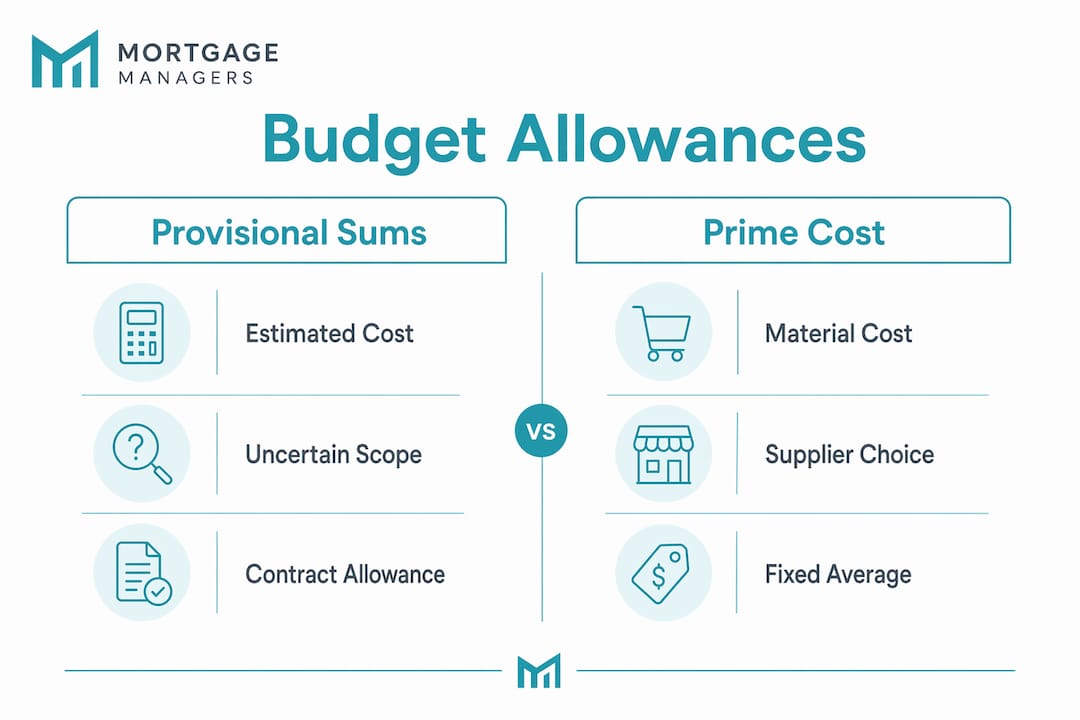
Provisional sums and prime cost items are the two most commonly misunderstood allowances in New Zealand building contracts, and confusing them can leave your budget seriously exposed.
A Provisional Sum (PS) is an estimated allowance included in a contract for work where the full scope or cost is not yet known. Think of it as a placeholder. Excavation is a classic example: your builder cannot know exactly how much earth needs to be removed until work begins, so they include a PS to cover the expected cost. If the actual cost comes in higher, you pay the difference. If it comes in lower, you receive a credit.
A Prime Cost Item (PC) works differently. It is a budgeted allowance for a specific product or material that has not yet been selected, such as tapware, light fittings, or floor tiles. Your builder prices the contract using a nominated PC amount, and the final cost adjusts once you make your selections. Choosing a tapware set that costs more than the PC allowance means you pay the gap.
Here is why both matter for your budget:
- PS items can shift significantly if site conditions are unexpected, such as poor soil or hidden services.
- PC items are entirely within your control. Selecting products early and within budget prevents cost overruns.
- A contract with many PS and PC allowances is not a fixed-price contract, regardless of how it is presented.
- Reviewing every PS and PC figure with your builder before signing gives you a realistic picture of your total exposure.
Pro Tip: Ask your builder to walk you through every PS and PC item in the contract and explain the basis for each allowance. If an allowance seems low, request a written explanation. Low allowances are a common source of budget blowouts on NZ builds.
A preliminary building agreement, sometimes called “pre-lims,” is often signed before the full contract and covers early assessments, drawings, and consent costs ranging from $5,000 to $25,000. Understanding what this covers prevents confusion about what you are paying for before construction even begins.
Building consent, resource consent, and the CCC explained
New Zealand’s building approval process involves three distinct legal steps, and missing any one of them carries serious consequences for your property’s value and insurability.
-
Building consent is the official permission from your local council to begin construction. You apply through your council or a building consent authority, submitting plans and specifications. Work cannot legally begin until consent is granted. Attempting to build without it can result in fines, demolition orders, and difficulties selling the property later.
-
Resource consent applies when your proposed build affects the environment or does not comply with your district plan’s zoning rules. Zoning rules cover height limits, setbacks from property boundaries, lot coverage, and parking requirements. If your design breaches any of these, you need resource consent before building consent can proceed. Getting zoning advice early prevents expensive redesigns.
-
Code Compliance Certificate (CCC) is the final legal sign-off issued by your council after construction is complete and inspections confirm the work meets the Building Code. The CCC legally confirms your home meets building standards. Without it, your home is not legally compliant, and many lenders will not release final mortgage funds until it is issued.
Many homeowners mistakenly believe that practical completion is the final legal sign-off. It is not. Practical completion means the build is substantially finished and you can move in, but the CCC confirms legal compliance. Delays in CCC issuance can directly affect your mortgage drawdown timeline, which is a real financial pressure point for Kiwi homeowners.
Pro Tip: Keep a written record of every council inspection date and outcome. Councils can take weeks to process CCC applications, and missing an inspection can add months to your timeline. Build inspection milestones into your contract schedule.
Common structural terms in NZ homes
Understanding the physical language of your home helps you follow site conversations and read plans with confidence. These are the terms you are most likely to encounter on a typical New Zealand residential build.

| Term | Plain-English meaning |
|---|---|
| Dwangs | Short horizontal timber pieces fixed between wall studs to add rigidity and provide fixing points |
| Lintel | A horizontal beam above a door or window opening that carries the load from above |
| Truss | A prefabricated triangular roof frame that spans the building and supports the roof cladding |
| Load-bearing wall | A wall that carries structural weight from above and cannot be removed without engineering approval |
| Soffit | The underside of an eave or overhang, often used for ventilation |
| Building envelope | The complete outer shell of a building, including roof, walls, windows, and foundations |
Dwangs are a distinctly New Zealand term that often confuses homeowners from other countries. In Australian or British construction, the same element is called a “nogg” or “noggin.” Knowing this helps when reading imported building guides or working with tradespeople from overseas.
Cladding refers to the external material applied to the outside of your wall framing. In New Zealand, common cladding types include weatherboard, brick veneer, fibre cement, and plaster systems. The choice of cladding affects weatherproofing, maintenance requirements, and insurance costs. Your building envelope’s performance depends heavily on how well the cladding, windows, and roof intersect.
What is the difference between a refresh, renovation, and remodel?
The four renovation tiers used in New Zealand are defined by scope, cost, and whether structural changes are involved. Knowing which tier your project falls into tells you whether you need council permits and how much to budget.
Renovation tiers in New Zealand range from a cosmetic Refresh ($300 to $2,500) through to a full Remodel involving structural changes ($25,000 to $150,000 and above). The key test for whether you need building consent is simple: do walls move? If your project involves removing or relocating walls, you are in remodel territory and building consent is required.
| Tier | Typical cost range | Walls move? | Building consent needed? |
|---|---|---|---|
| Refresh | $300 to $2,500 | No | No |
| Update | $2,000 to $15,000 | No | Rarely |
| Renovation | $10,000 to $50,000 | Sometimes | Often |
| Remodel | $25,000 to $150,000+ | Yes | Yes |
Differentiating renovation from remodel by whether walls move clarifies permit needs and design complexity. A kitchen refresh might mean new paint and handles. A kitchen remodel means moving plumbing, removing walls, and engaging a structural engineer. The cost and timeline difference is substantial, and so is the paperwork. Understanding which tier you are in before approaching a builder prevents scope creep and budget shock.
For homeowners considering renovation finance options, knowing your tier also helps lenders assess risk and structure your borrowing appropriately.
Contract terms every homeowner should know
Building contracts contain language that can significantly affect your costs and rights. These are the terms most likely to catch you off guard.
Estimates vs quotes: Estimates are non-binding rough cost predictions, while quotes are detailed and fixed in price. A true quote involves detailed quantity take-offs and subcontractor pricing. A brief document containing many allowances is not a true quote, regardless of what it is labelled. Always confirm in writing whether you are receiving an estimate or a fixed-price quote before proceeding.
Variations: A variation is any change to the agreed scope of work after the contract is signed. Variations must be documented in writing, including the cost and time impact, before the work is carried out. Verbal agreements about variations are a leading cause of disputes on NZ building projects.
Extension of time (EOT): An EOT is a formal mechanism allowing the builder to extend the completion date due to events outside their control, such as weather delays, council hold-ups, or supply chain issues. EOT clauses protect builders from liquidated damages claims. As an owner, you should understand what triggers an EOT and whether the contract requires written notice within a set timeframe.
The rock clause: The rock clause protects builders from unforeseen excavation costs if solid rock is encountered during foundation work. Rock removal is expensive, and this clause shifts that cost to you as the homeowner. The definition of “rock” can be subjective, which creates potential for disputes. Ask your builder to define what constitutes rock under the contract and whether a geotechnical report would reduce your exposure.
Pro Tip: Before signing any building contract, request a plain-English summary of every clause that could result in additional costs. If your builder cannot explain a clause clearly, that is a signal to seek independent legal advice before proceeding.
Understanding these terms also connects directly to your home loan terminology, since lenders assess contract structure when approving finance for new builds and renovations.
Key takeaways
Understanding builders terms before signing any contract is the single most effective way to protect your budget and avoid disputes on a New Zealand build or renovation.
| Point | Details |
|---|---|
| PS and PC items affect your budget | Provisional sums and prime cost items are adjustable allowances, not fixed costs. Review every one before signing. |
| CCC is the legal finish line | Practical completion is not legal sign-off. The Code Compliance Certificate is required for compliance and mortgage drawdown. |
| Renovation tier determines permits | Whether walls move is the key test. Remodels require building consent; refreshes and updates generally do not. |
| Estimates are not quotes | A true fixed-price quote involves detailed take-offs. A document full of allowances is not a binding price. |
| Rock clause shifts risk to you | Understand what triggers the rock clause and consider a geotechnical report to reduce unexpected excavation costs. |
Stuart’s take on builders jargon and talking to your builder
First home buyers in New Zealand consistently underestimate how much builders jargon affects their experience on site and at the contract table. I have seen clients sign contracts containing dozens of PS and PC items, genuinely believing they had a fixed price. The gap between expectation and reality can be tens of thousands of dollars.
My honest advice is this: do not wait until something goes wrong to ask what a term means. Before your first meeting with a builder, read through a standard NZ building contract and write down every term you do not understand. Bring that list to the meeting. A good builder will welcome the questions. One who dismisses them is telling you something important.
The CCC is the term I see most consistently misunderstood. Homeowners move in, feel settled, and assume everything is done. Then they try to refinance or sell and discover the CCC was never issued. That situation is expensive and stressful to resolve. Treat the CCC as a non-negotiable milestone in your project timeline, not an afterthought.
If you are preparing to build or renovate, getting your finance structure right is just as important as understanding the construction language. Connecting with a mortgage adviser in Auckland early in the process means your borrowing is structured to match your project milestones, including consent stages and drawdown triggers.
— Stuart
How Mortgagemanagers supports your building journey
Building or renovating a home in New Zealand involves more than just understanding construction language. It requires finance that is structured to match your project’s milestones, from pre-lims through to CCC.

Mortgagemanagers is a locally owned Auckland-based team of mortgage advisers who specialise in helping Kiwi homeowners and first home buyers secure the right finance for builds and renovations. Whether you are funding a kitchen remodel or a full new build, the team at Mortgagemanagers can help you understand your borrowing options, structure drawdowns around consent milestones, and avoid the finance pitfalls that catch many homeowners off guard. Based in Hobsonville with remote access across New Zealand, Mortgagemanagers is ready to be your financial GPS from first conversation to final sign-off.
FAQ
What is a provisional sum in a NZ building contract?
A provisional sum is an estimated allowance for work where the full cost is not yet known at the time of signing. The final cost adjusts up or down once the actual scope is confirmed.
Do I need building consent for a renovation in New Zealand?
Building consent is required when structural changes are involved, such as removing or relocating walls. Cosmetic work like painting, new flooring, or replacing fixtures generally does not require consent.
What is the difference between practical completion and a CCC?
Practical completion means the build is substantially finished and habitable. The Code Compliance Certificate is the council’s legal confirmation that all work meets the Building Code and is required for full compliance.
What does the rock clause mean for homeowners?
The rock clause means that if solid rock is discovered during excavation, the additional removal costs are passed to the homeowner. Requesting a geotechnical report before signing can reduce this risk.
What is the difference between an estimate and a quote?
An estimate is a non-binding rough cost prediction. A quote is a detailed, fixed price based on quantity take-offs and subcontractor pricing. Confusing the two is one of the most common causes of cost overruns on NZ building projects.