
Buying your first home in Auckland often feels overwhelming, especially if banks start using unfamiliar words about deposits, eligibility, and loan criteria. Understanding what terms like First Home Loan, KiwiSaver withdrawal, loan-to-value ratio, and credit history actually mean gives you confidence when applying—even with a low deposit or imperfect credit. This guide breaks down the terminology lenders use so you can make clear decisions and access government support designed for New Zealand first-time buyers.
Table of Contents
- What First Home Buyer Terminology Means
- Essential Mortgage And Property Terms Explained
- Understanding Deposits, LVR, And Lending Criteria
- Legal Agreements, Reports, And Key Documents
- Financial Risks, Common Traps, And How To Avoid Them
Key Takeaways
| Point | Details |
|---|---|
| Understanding Mortgage Terms | Familiarise yourself with key terms like Deposit, LVR, and Interest Rate to make informed financial decisions. |
| The Importance of Budgeting | Develop a realistic budget that accounts for all home ownership costs beyond the mortgage, including rates and maintenance. |
| Risks of Overextending | Avoid borrowing the maximum amount approved by lenders, as it could exceed your comfort level and affect your lifestyle. |
| Request Essential Reports | Always obtain and review Land Information Memorandums and builder’s reports before making an offer to avoid unexpected costs. |
What First Home Buyer Terminology Means
Mortgage terminology can feel like learning a foreign language when you’re buying your first home in Auckland. Banks and lenders use specific terms that have precise meanings, and understanding them puts you in control of your decisions.
A first home buyer is legally defined as someone who has not previously owned property in New Zealand. This definition matters because it determines whether you qualify for government support schemes like the First Home Loan or KiwiSaver first-home withdrawal options. Understanding first home buyer eligibility is your first step toward accessing financial help available specifically for your situation.
Here are the core terms you’ll encounter:
- Deposit: The upfront cash you pay toward the property purchase price. Most lenders require between 5% and 20% of the property value.
- Loan-to-Value Ratio (LVR): The percentage of the property price you’re borrowing. A 90% LVR means you’re borrowing 90% and providing a 10% deposit.
- Principal: The original amount of money you borrowed. Interest is charged on this amount.
- Interest Rate: The percentage cost of borrowing money. Fixed rates stay the same; floating rates change with the market.
- Mortgage: The legal agreement securing the loan against your property. If you don’t pay, the lender can take the house.
Understanding these foundational terms transforms confusing conversations into informed decisions about your financial future.
Lenders also discuss serviceability, which means your ability to actually afford the loan repayments based on your income and expenses. They’ll assess whether you can comfortably meet monthly payments even if interest rates rise.
When comparing loan offers, you’ll hear about fees—application fees, valuation fees, and legal fees. These add to your total borrowing costs, so ask lenders to itemise them clearly.
Many Auckland first-time buyers benefit from understanding how mortgage servicing impacts your loan, including how lenders calculate what you can borrow.
Your credit history is crucial. Banks check this to assess risk. Late payments, defaults, or high credit card balances can reduce how much you can borrow or increase your interest rate.
Pro tip: _Get a mortgage pre-approval before house hunting. It shows sellers you’re serious, clarifies your budget instantly, and eliminates surprises later.
Essential Mortgage And Property Terms Explained
Property ownership in New Zealand involves its own terminology, and it’s easy to get lost in the details. Knowing what different ownership structures and property terms mean protects you from costly mistakes.
Ownership Types
Fee simple is outright ownership of both the land and building. You own it completely, with no restrictions from landlords or body corporates.

Leasehold means you own the building but rent the land from the landowner for a set period (often 99 years). When the lease expires, the property reverts to the landowner unless renewed.
Cross-lease properties share the land with other properties. You own your building and a share of the common land, managed jointly with neighbours.
Body corporate applies to apartments and units. All owners collectively manage common areas like gardens, parking, and building maintenance through shared fees and decisions.
Understanding property ownership structures helps you understand your long-term rights and responsibilities.
Here’s how key property ownership types in New Zealand compare:
| Ownership Type | What You Own | Main Ongoing Cost | Typical Buyers |
|---|---|---|---|
| Fee simple | Land and physical building | Council rates, maintenance | Families, investors |
| Leasehold | Building only (land rented) | Ground rent, lease renewal | City/apartment buyers |
| Cross-lease | Share of land and building | Shared maintenance costs | Unit/townhouse owners |
| Body corporate | Unit/apartment | Body corporate fees | Apartment dwellers |
Property Information Terms
A Land Information Memorandum (LIM) is a council report detailing the property’s history, including past building consents, resource consents, and any issues on record.
The title is the legal document proving ownership. It shows boundaries, encumbrances (like easements), and any registered interests in the property.
Here are other critical terms:
- Budget: Annual forecast of body corporate or council maintenance costs
- Easement: A right to use part of someone else’s property (for utilities, access, etc.)
- Encumbrance: Any claim against the property that affects ownership rights
- Valuation: Professional assessment of the property’s market value
Knowing these terms stops you from inheriting hidden costs or discovering ownership restrictions after purchase.
Budget and Financial Terms
Your budget is how much you can actually afford to spend, including deposit, fees, and ongoing ownership costs. Don’t confuse this with how much lenders will lend.
An appraisal or valuation assesses what the property is worth to the lender. This affects your borrowing power and LVR.
Lending criteria are the lender’s rules about who qualifies for loans. These typically include minimum income, credit history, and deposit requirements.
Pro tip: Request a Land Information Memorandum before making an offer. It reveals council issues, building history, and future rates changes that could affect affordability.
Understanding Deposits, LVR, And Lending Criteria
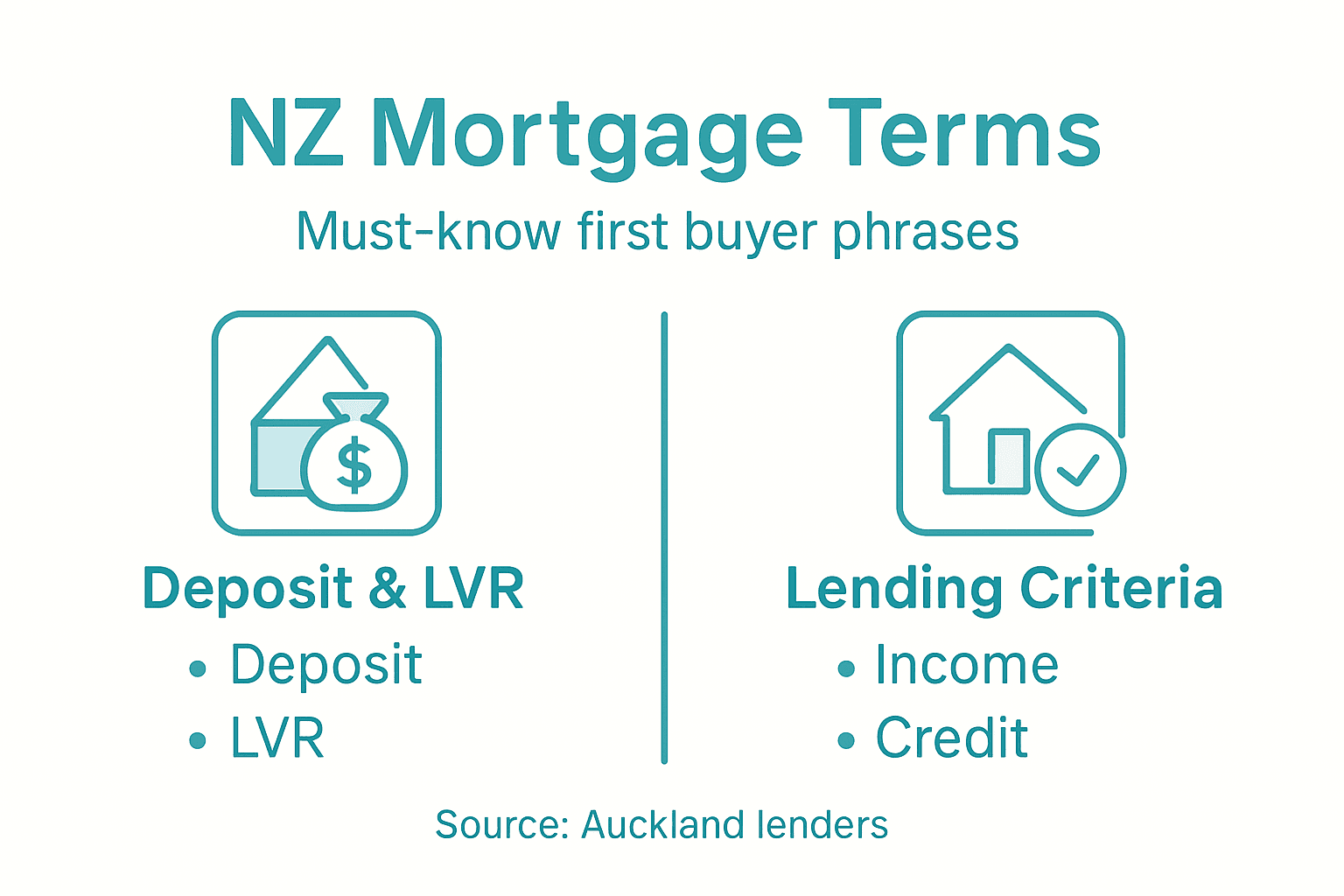
Deposits, loan-to-value ratios, and lending criteria form the foundation of mortgage approval. Understanding how they interconnect helps you plan realistically and avoid rejection surprises.
What Your Deposit Really Means
Your deposit is the cash you contribute upfront. If you buy a property for $600,000 with a $60,000 deposit, you’re borrowing $540,000.
Deposits matter because lenders want reassurance you’re financially committed. A larger deposit signals lower risk to the bank. It also reduces how much you need to borrow, which affects interest calculations and your monthly repayments.
Traditionally, lenders wanted 20% deposits. That’s $120,000 on a $600,000 property. For most Auckland first-time buyers, saving that takes years. Government-backed first home loan schemes now let you put down just 5%, making homeownership achievable sooner.
Understanding Loan-to-Value Ratio
Loan-to-Value (LVR) expresses your loan as a percentage of the property value. If you borrow $540,000 for a $600,000 property, your LVR is 90%.
LVRs work like this:
- 80% LVR: You borrow 80%, deposit 20% ($120,000 on $600,000)
- 90% LVR: You borrow 90%, deposit 10% ($60,000 on $600,000)
- 95% LVR: You borrow 95%, deposit 5% ($30,000 on $600,000)
Higher LVRs carry more risk for lenders. At 95% LVR, if property prices drop 5%, you’ve lost your entire deposit. To protect themselves, lenders charge higher interest rates or require mortgage insurance on high-LVR loans.
Your LVR directly influences your interest rate and whether you’ll pay lender’s mortgage insurance.
Lending Criteria Explained
Lenders assess lending criteria to decide if you qualify and how much you can borrow. These aren’t arbitrary rules—they protect lenders from defaults.
Common lending criteria include:
- Income verification: Recent payslips, tax returns, employment letters
- Credit history: No defaults, late payments, or excessive debt
- Employment stability: Ideally 2+ years in current role
- Property assessment: Valuation confirming the property is worth the purchase price
- Serviceability: Ability to afford repayments if interest rates rise 3%
Lenders stress-test your finances. If rates climbed from 5.5% to 8.5%, could you still meet payments? If not, they’ll reduce how much they’ll lend.
The Complete Picture
Your deposit size affects your LVR. Your LVR affects your interest rate and mortgage insurance costs. Your income and credit history determine whether you meet lending criteria.
These three elements work together. A strong deposit supports approval. Meeting lending criteria unlocks better interest rates. Lower LVR means avoiding extra insurance fees.
Pro tip: Save your deposit strategically. Even an extra 5% deposit (moving from 5% to 10% LVR) reduces your interest rate and eliminates lender’s mortgage insurance, saving thousands over the loan term.
Legal Agreements, Reports, And Key Documents
Property transactions involve multiple legal documents and agreements. Understanding what each one does protects you legally and prevents costly surprises down the track.
The Sale and Purchase Agreement
The Sale and Purchase Agreement is the binding contract between buyer and seller. It specifies the property, purchase price, settlement date, and conditions of the sale. Once you sign, you’re legally committed.
This document includes crucial details like whether chattels (furniture, appliances) are included, what happens if the property fails inspection, and your rights if the seller changes their mind.
Always read every clause carefully. Don’t rely on verbal promises from real estate agents—they must be in writing to be legally enforceable.
Real Estate Agency Agreements
When working with an agent, you’ll sign an agency agreement. This specifies their commission, how long they’re authorised to sell the property, and what marketing they’ll provide.
Understand this agreement before signing. Commission rates vary, and some agents charge additional marketing fees. Clarify whether they can market the property to other buyers or have exclusive rights.
Essential Reports and Documents
Key property documents like Land Information Memorandums reveal critical information before you commit.
These reports and documents include:
- Land Information Memorandum (LIM): Council report showing property history, building consents, and zoning information
- Builder’s Report: Professional inspection assessing structural condition, weathertightness, and maintenance issues
- Title Documents: Legal proof of ownership, boundaries, and any mortgages or easements
- Certificate of Compliance: Council confirmation that building work meets current standards
- Building Code Compliance Certificate: For newer builds, confirmation of compliance with building regulations
Never skip these reports. A $500 builder’s report can reveal $50,000 in hidden repairs.
The Conveyancing Process
Conveyancing is the legal process transferring property ownership. Your conveyancer (lawyer or conveyancer professional) handles document preparation, searches, and settlement.
They’ll conduct title searches, check for liens or disputes, arrange insurance, and ensure funds transfer correctly on settlement day. This protects you from buying properties with hidden debts or legal issues.
Conveyancing fees typically cost $800–$1,500 depending on property complexity.
What You Need to Know
Always request these documents before making an offer or immediately after. Don’t feel rushed—take time to read them or ask your conveyancer to explain clauses.
Many first-time buyers skip reports to save money. This is false economy. Discovering structural problems after settlement leaves you liable for repairs.
Pro tip: Request your builder’s report and LIM before making an offer. If issues arise, you can renegotiate the price or walk away without penalty—but only if these aren’t settlement conditions.
Financial Risks, Common Traps, And How To Avoid Them
First-time home buyers often make financial mistakes that cost thousands. Knowing common pitfalls helps you navigate confidently and protect your long-term wealth.
The Budget Overextension Trap
The biggest mistake first-time buyers make is borrowing more than they can comfortably afford. Just because a lender approves you for $700,000 doesn’t mean you should borrow it all.
Lenders stress-test at 3% above your current rate. But they’re assessing your minimum capacity, not your comfort level. Many buyers discover after six months that monthly repayments squeeze their lifestyle too tightly.
Financial risks like overextending your budget affect your entire life for decades. Create your own budget based on actual living expenses—groceries, transport, utilities, insurance, childcare—not just loan serviceability calculations.
Hidden Ownership Costs
Mortgage repayments are only part of home ownership costs. First-time buyers often overlook:
- Council rates: Annual property tax ranging from $2,000–$5,000+ depending on location
- Body corporate fees: For apartments, $150–$400+ monthly for maintenance and insurance
- Maintenance reserves: Budgeting $1,000–$2,000 yearly for repairs and upkeep
- Insurance: Building insurance typically $800–$1,500 annually
- Utilities: Heating, water, electricity can total $150–$250 monthly
These costs don’t decrease when interest rates rise. They’re committed expenses regardless of financial circumstances.
Compare upfront and ongoing costs for first home buyers:
| Cost Type | Example Amount | When Paid | What It Covers |
|---|---|---|---|
| Deposit | $30,000–$120,000 | Upfront | Lender security, lowers LVR |
| Legal fees | $800–$1,500 | At settlement | Conveyancing, agreements |
| LIM/Builder’s report | $500–$1,500 | Before purchase | Property checks, risk reduction |
| Body corp. fees | $1,800–$4,800 annually | Ongoing (if relevant) | Common area maintenance |
| Insurance | $800–$1,500 annually | Ongoing | Home/building protection |
| Council rates | $2,000–$5,000+ annually | Ongoing | Local property tax |
Budget for total ownership costs, not just the mortgage. A $400,000 loan might cost $2,500 monthly in repayments but $4,000 total including rates, insurance, and maintenance.
Interest Rate Risk
Fixed-rate mortgages lock your rate for 1–5 years. When they expire, you refinance at the market rate. If rates have risen significantly, your repayments increase dramatically.
Floating-rate mortgages change monthly with the Reserve Bank. During rising rate cycles, your payment can jump $200–$300 monthly in weeks.
Always stress-test your finances at 2–3% above current rates. If rates climbed to 8%, could you still pay?
Property Defect Risks
Skipping builder’s reports, structural inspections, or LIMs saves $500–$1,500 upfront but risks $20,000–$100,000 in repairs post-settlement. Once you settle, you own any defects—the seller’s liability disappears.
Common hidden issues include leaking roofs, rotting timber, damp, faulty electrical wiring, and non-compliant building work. These require expensive remedial work.
Predatory Lending and Poor Advice
Some lenders target first-time buyers with high interest rates, aggressive penalties, or unsuitable loan structures. Not all mortgage advice is independent or unbiased.
Always compare offers from multiple lenders. Understand fees, penalties, and rate locks before committing.
Pro tip: Stress-test your budget at 8% interest rates before borrowing. If repayments would cripple you, borrow less or save a larger deposit first.
Take Control of Your First Home Journey with Expert Guidance
Understanding complex mortgage terminology is the first step to securing your dream home in Auckland. Terms like deposit, loan-to-value ratio, and lending criteria can feel overwhelming but are crucial for your success. If you want to avoid costly mistakes and confidently navigate every stage of the process, expert advice tailored to your unique situation is invaluable.

Choose Mortgage Managers, a trusted local team of Auckland mortgage advisers based in Hobsonville, ready to help you decode every mortgage detail. We specialise in supporting first home buyers just like you, turning confusion into clarity and stress into confidence. Discover practical solutions for your deposit, loan approvals, and budgeting by visiting Mortgage Managers. Start your journey now by learning more about first home buyer support and how our advisers can guide you through lending criteria and loan options with personalised care and expert knowledge.
Frequently Asked Questions
What is a deposit when buying a home?
A deposit is the upfront cash you pay towards the property’s purchase price. Most lenders require a deposit between 5% and 20% of the property’s value.
What does Loan-to-Value Ratio (LVR) mean?
LVR is the percentage of the property’s price that you are borrowing. For instance, a 90% LVR means you are borrowing 90% of the property value and providing a 10% deposit.
What is the importance of having a good credit history when applying for a mortgage?
A good credit history affects how much you can borrow and your interest rate. Lenders use your credit history to assess risk, and negative factors like late payments or defaults can restrict loan approvals.
What should first-time home buyers know about hidden ownership costs?
First-time buyers should budget for ongoing costs beyond mortgage repayments, such as council rates, body corporate fees, maintenance reserves, and insurance, to avoid financial strain later on.