
Yes, you can get a leasehold mortgage in New Zealand — but whether a lender will approve yours depends almost entirely on how many years remain on the lease and what the lease says about ground rent and mortgaging rights.
The single most important qualifier: Most mainstream NZ banks prefer a remaining lease term of at least 80 years. Once a lease drops below 50–60 years, financing becomes materially harder and often requires specialist lenders, a larger deposit, or both.
Here is how lenders typically react based on remaining lease length:
- 80+ years remaining: Most mainstream banks will consider lending, though they may still require a higher deposit than for a comparable freehold property.
- 50–80 years remaining: Lending is possible but lenders often reduce the loan-to-value ratio (LVR) or require a specialist assessment. Fewer banks will participate.
- Under 50 years remaining: Very difficult to finance through standard channels. Specialist or non-bank lenders may help, but expect significantly tighter terms and a much larger deposit.
Your immediate next steps: order the lease document and a Guaranteed Search from a title search provider, then speak with a mortgage adviser before making an offer.
Pro tip: Do not wait until you have a signed sale and purchase agreement to check the lease. Lenders routinely decline to finalise offers until their solicitor is satisfied with the lease wording, consent clauses, and rent review terms.
Key takeaways
Getting a leasehold mortgage in New Zealand is achievable, but lease length, ground rent terms, and lender selection determine whether your application succeeds or stalls.
| Point | Details |
|---|---|
| Lease length is the primary filter | Most mainstream banks prefer 80+ years remaining; under 60 years typically requires specialist lenders. |
| Lenders require the full lease and a Guaranteed Search | A solicitor review of the registered lease and a $45.90 Guaranteed Search are standard lender requirements. |
| Ground rent affects borrowing capacity | Lenders include ground rent in serviceability calculations, which can reduce how much you can borrow. |
| Risks concentrate at lease expiry | Reversion, reduced capital growth, and falling marketability are real risks as the remaining term shortens. |
| Mortgagemanagers assists leasehold buyers | The team matches lease profiles to lenders and coordinates document flow across Auckland and NZ remotely. |
This article provides general information only and is not a substitute for professional legal or financial advice. Confirm current lender criteria and lease terms with a qualified solicitor and mortgage adviser before making any purchasing decision.
Table of Contents
- What leasehold actually means in New Zealand (and how it differs from other title types)
- How the remaining lease term shapes your mortgage options
- What lenders and your solicitor will check before approving a leasehold mortgage
- Ongoing costs that affect affordability on a leasehold property
- Key risks for buyers of leasehold properties
- Practical actions to improve your chance of mortgage approval
- A step-by-step due diligence checklist before you sign
- How a mortgage adviser helps with leasehold applications
- What I see most often go wrong with leasehold mortgage applications
- Mortgagemanagers can help you through a leasehold mortgage application
- Sources
What leasehold actually means in New Zealand (and how it differs from other title types)
When you buy a leasehold property, you purchase the right to occupy and use the land for a fixed period — not the land itself. The landowner (the lessor or freeholder) retains ownership of the ground beneath your home. You own the building and improvements, but the land reverts to the landowner when the lease expires. Settled that this distinction shapes what buyers should check before purchasing any title type.
Understanding how leasehold sits alongside other NZ title types matters because lenders treat each differently.
| Title type | You own | Land ownership | Key lender concern |
|---|---|---|---|
| Freehold (fee simple) | Land and buildings | You | Lowest risk; standard criteria apply |
| Leasehold | Buildings and improvements only | Landowner (lessor) | Lease term, ground rent, mortgaging consent |
| Unit title | Your unit and share of common areas | Body corporate (land) | Body corporate levies, Unit Titles Act 2010 compliance |
| Cross-lease | Your flat and shared lease of land | All flat owners jointly | Consent requirements, flat plan accuracy |
Banks prefer fee simple titles because the security is clean and straightforward. For leasehold, unit title, and cross-lease properties, lenders add extra checks because the security is more complex and the risks are less predictable.
A few practical distinctions worth knowing:
- Leasehold properties often appear in prime locations — waterfront, CBD-adjacent, or resort areas — and tend to have lower purchase prices than comparable freeholds. Trade Me Property notes that this price advantage comes at the cost of weaker capital growth and reduced marketability over time.
- Unit title properties governed by the Unit Titles Act 2010 carry body corporate levies that lenders include in serviceability calculations — an often-overlooked cost that directly affects how much you can borrow.
- Cross-lease titles require all flat owners to consent to certain changes, which can complicate refinancing and resale.
How the remaining lease term shapes your mortgage options
Lease length is the single variable lenders scrutinise most closely on a leasehold mortgage application. The logic is straightforward: a lender’s security must outlast the loan, and a lease that expires before the mortgage is repaid leaves the bank holding a depreciating asset.
MoneyBalance’s leasehold mortgage guidance confirms that lenders typically reduce LVR or require larger deposits as the remaining term shortens, with some setting de facto thresholds around 70–80 years preferred.
| Remaining lease term | Typical lender stance | Likely LVR ceiling | Deposit expectation |
|---|---|---|---|
| 80+ years | Mainstream banks may lend | Up to 80% (standard) | 20% or more |
| 60–80 years | Reduced appetite; specialist review likely | 60–70% | 30–40% |
| Under 60 years | Very limited; specialist/non-bank lenders only | Case by case | 40%+ |
Two scenarios illustrate the difference in practice:
-
Buyer A is purchasing a leasehold apartment with 95 years remaining. A mainstream bank reviews the lease, confirms the ground rent is modest and the review clause is capped, and approves a standard 80% LVR loan. The process feels similar to buying a freehold unit.
-
Buyer B is purchasing a leasehold home with 55 years remaining. Every mainstream bank declines. A specialist non-bank lender agrees to lend at 60% LVR, requiring a 40% deposit and a higher interest rate to reflect the added risk.
The gap between those two outcomes is not just about the lease length — it is also about how the lease is written. A lease with an uncapped ground rent review clause, or one that restricts the leaseholder’s right to mortgage the property without landowner consent, can push even a long-lease application into the “specialist only” category.
Pro Tip: Before you fall in love with a leasehold property, ask your solicitor to check whether the lease contains a mortgaging consent clause. If the landowner must approve your mortgage, that approval needs to be secured before your bank will proceed.
What lenders and your solicitor will check before approving a leasehold mortgage
Banks do not take leasehold security at face value. Certificate of Title’s guidance confirms that lenders routinely require a solicitor review of the registered lease and a Guaranteed Search before approving any mortgage on a leasehold property. A Guaranteed Search currently costs a small fee, typically under $50. and confirms the title details, any encumbrances, and registered interests against the property.
The documents your lender and solicitor will want to see:
- The registered lease in full: Not a summary — the actual registered document, including all schedules, variations, and any consent deeds.
- Ground rent amount and review dates: Lenders want to know the current ground rent, when the next review falls, and what mechanism governs the review (market value, CPI, fixed percentage, or uncapped).
- Landowner identity and contact details: Particularly important if the lease requires mortgaging consent from the landowner.
- Evidence of any existing encumbrances: Mortgages, caveats, or other registered interests that could affect the bank’s security position.
- Body corporate records (if unit title): Meeting minutes, levy schedules, and financial statements for the past two to three years. Lenders include body corporate levies in serviceability calculations.
- Guaranteed Search / title search: Ordered from a title search provider (such as Landonline via LINZ) to confirm the registered title details and any encumbrances.
The sequence matters. Banks routinely refuse to finalise conditional offers until their solicitor is satisfied with the lease wording, consent processes, and rent review clauses. Ordering these documents early — ideally before you make an offer — saves weeks.
- Order the Guaranteed Search and full title from a title search provider.
- Obtain the full registered lease from the vendor or their solicitor.
- Provide both to your solicitor for review before your lender’s solicitor sees them.
- Ask your solicitor to flag any clauses that restrict mortgaging, subletting, or renovating.
- Supply the reviewed documents to your lender as part of your pre-approval application.
Pro Tip: Share the lease and Guaranteed Search with your mortgage adviser at the same time as your solicitor. Advisers familiar with leasehold applications can flag lender-specific concerns before the bank’s solicitor raises them, which can cut approval timelines significantly.
Ongoing costs that affect affordability on a leasehold property
The purchase price is only part of the financial picture. Leasehold ownership adds a layer of recurring costs that freehold buyers do not face, and lenders factor these into their serviceability assessments when calculating how much you can borrow.
Recurring costs to budget for:
- Ground rent: Paid annually (or sometimes quarterly) to the landowner. This is the most significant leasehold-specific cost and is subject to periodic review.
- Body corporate levies: Applicable to leasehold apartments and unit title properties. Levies cover building insurance, maintenance of common areas, and the body corporate’s operating fund.
- Rates: Council rates apply to leasehold properties in the same way as freehold, though the rateable value may differ.
- Building insurance: If you own a standalone leasehold house, you are responsible for insuring the building. In a body corporate, this is usually covered by the levy.
- Maintenance: You are responsible for maintaining the improvements (the building) even though you do not own the land.
Ground rent reviews are where the financial risk concentrates. Canstar’s leasehold explainer notes that reviews commonly occur every seven or 21 years depending on the lease, and outcomes can materially increase ongoing costs. A review tied to unimproved land value in a rising market can double or triple the ground rent at a single review point.
To illustrate the serviceability impact: if a lender is assessing a borrower with a gross income of $120,000 per year, and the property carries $8,000 per year in ground rent, the lender will treat that $8,000 as a committed expense before calculating how much mortgage debt the borrower can service. That single cost can reduce borrowing capacity by $80,000–$100,000 depending on the lender’s debt-to-income methodology.
When evaluating a leasehold property, always ask for the ground rent review history and the next scheduled review date. A lease where the ground rent was last reviewed 18 years ago and is due for review in three years carries a very different risk profile from one reviewed recently at a known market rate.
Key risks for buyers of leasehold properties
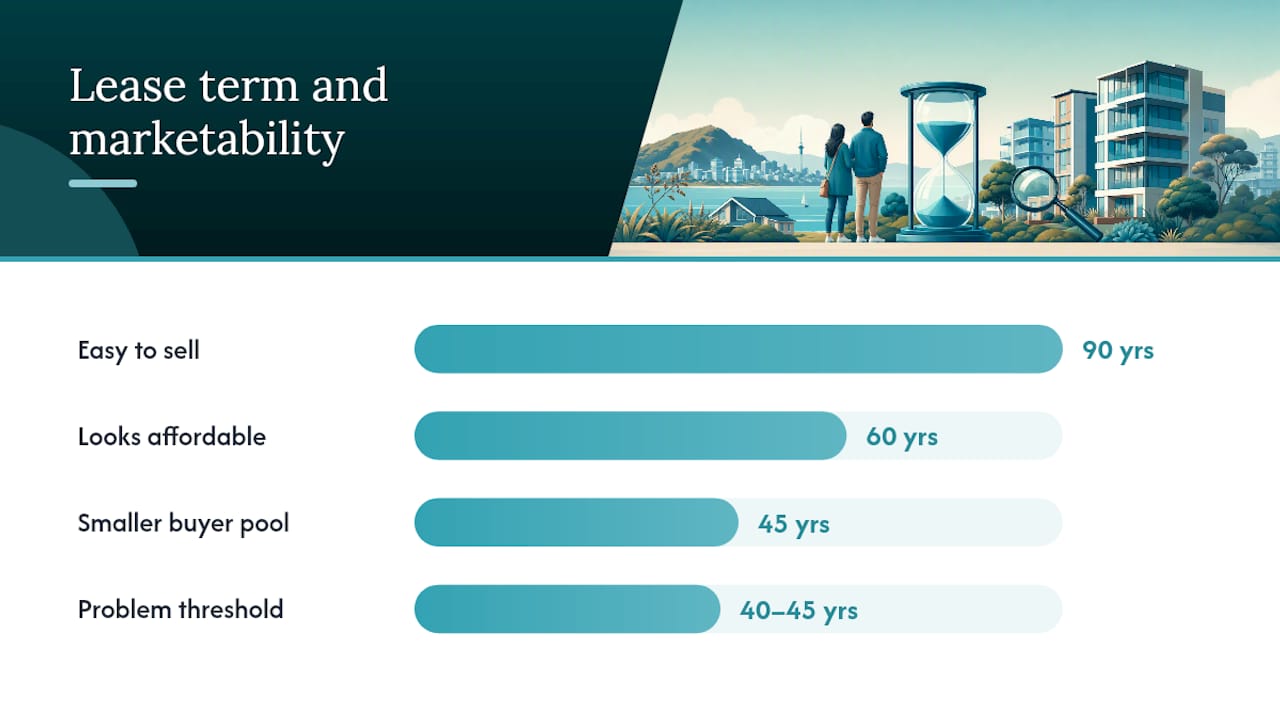
Leasehold ownership is not inherently a bad deal — but the risks are real and worth understanding clearly before you commit.
The main risks to weigh:
- Lease expiry and reversion: When the lease expires, the land (and potentially the improvements) reverts to the landowner. You may have no right to renewal, and negotiating an extension can be costly.
- Reduced capital growth: Because you do not own the land, your property’s value is tied to the building and the remaining lease term. As the lease shortens, the property becomes harder to sell and typically appreciates more slowly than comparable freeholds.
- Falling marketability: Buyers and lenders alike become more cautious as the remaining term drops. A property with 90 years left is relatively easy to sell; one with 45 years left has a much smaller pool of potential buyers.
- Ground rent increases: An uncapped review clause can produce dramatic rent increases that make the property unaffordable or unsaleable.
- Restrictions on use: Many leases restrict the leaseholder’s ability to renovate, extend, sublet, or use the property for certain purposes without landowner consent. These restrictions affect both your enjoyment and the property’s resale appeal.
- Transfer of improvements: Some older leases provide that improvements made to the property become the landowner’s property at lease expiry. Check this clause carefully.
The scenario that catches buyers off guard: A leasehold property looks affordable and well-located today. But if the lease has 60 years remaining and no extension mechanism, the property will be very difficult to sell in 15–20 years when the remaining term drops below 40–45 years. You may find yourself unable to sell at any reasonable price — not because the building has deteriorated, but because no lender will finance a buyer.
What happens at lease expiry depends entirely on the lease terms. Some leases include a right of renewal, which gives the leaseholder the option to negotiate a new lease. Others do not. Freehold conversion — buying the land from the landowner — is theoretically possible in some cases but is rarely straightforward and can be expensive.
- Check whether the lease includes a right of renewal or a freehold purchase option.
- If neither exists, model the resale scenario at 20 and 30 years from now.
- Ask your solicitor whether the lease restricts renovations, subletting, or commercial use.
- Confirm whether improvements revert to the landowner at expiry.
Practical actions to improve your chance of mortgage approval
If you have found a leasehold property you want to buy, there are concrete steps you can take to strengthen your application and widen your lender options.
- Increase your deposit: A larger deposit reduces the lender’s exposure and can move you into an LVR band where more lenders will participate. Aim for at least 30–40% if the lease has fewer than 80 years remaining. Our deposit requirements guide explains how deposit thresholds shift by property type.
- Use a specialist or non-bank lender: Mainstream banks apply the strictest leasehold criteria. Non-bank lenders often have more flexible policies for shorter leases or unusual lease structures, though their rates are typically higher.
- Secure landowner consent early: If the lease requires the landowner’s consent to mortgage the property, obtain written consent before submitting your application. A lender will not proceed without it.
- Budget ground rent into your serviceability: Present your lender with a clear picture of all ongoing costs, including ground rent and body corporate levies. Lenders who can see you have budgeted accurately are more likely to approve.
- Negotiate favourable lease variations: If the lease contains an uncapped ground rent review clause, ask your solicitor whether a variation can be negotiated with the landowner before settlement. Even a capped review mechanism can make the property significantly more financeable.
When is a lease extension worth pursuing? If the remaining term is below 80 years and you plan to hold the property for more than 10 years, the cost of negotiating an extension or purchasing the freehold is often worth modelling. The cost varies widely depending on the landowner and the unimproved land value, but the benefit — a longer, more financeable lease — can materially increase the property’s value and your ability to refinance or sell.
- Get a solicitor’s opinion on whether the lease is extendable and at what likely cost.
- Obtain a registered valuation of the unimproved land value to anchor any negotiation.
- Approach the landowner through your solicitor — direct approaches without legal representation rarely produce favourable outcomes.
- Factor the extension cost into your total purchase budget before making an offer.
Pro Tip: The best time to negotiate a lease extension or freehold purchase is before you sign the sale and purchase agreement, not after. Vendors are more motivated to assist when the deal is still contingent on the outcome.
A step-by-step due diligence checklist before you sign
Buying a leasehold property requires more upfront investigation than a standard freehold purchase. This sequence keeps you protected and your application moving.
- Order a Guaranteed Search and full title: Do this as soon as you identify a property you are serious about. The $45.90 Guaranteed Search confirms registered interests and encumbrances. Do not rely on the vendor’s copy of the title.
- Obtain the full registered lease: Request this from the vendor’s solicitor. Read every clause, not just the summary. Pay particular attention to ground rent review mechanisms, mortgaging consent requirements, and use restrictions.
- Ask the vendor for ground rent review history: Find out when the last review occurred, what the outcome was, and when the next review is scheduled.
- Request body corporate records (if applicable): For leasehold apartments or unit title properties, ask for the last two to three years of meeting minutes, levy schedules, and financial statements.
- Consult a property lawyer: Have your solicitor review the lease before you go unconditional. This is not optional — it is the step that protects you from clauses that could make the property unfinanceable or unsaleable.
- Get pre-approval from a lender or mortgage adviser: Share the lease and Guaranteed Search with your adviser at the pre-approval stage. This surfaces lender-specific concerns before you are committed. See the steps to get a mortgage in New Zealand for the full application sequence.
- Confirm landowner identity and consent requirements: If the lease requires mortgaging consent, identify the landowner and initiate the consent process immediately.
When to pause or walk away: If the lease has fewer than 50 years remaining and no extension mechanism, if the ground rent review clause is uncapped and a review is imminent, or if the landowner is uncontactable or unwilling to provide mortgaging consent — these are genuine red flags. Pausing to get legal advice before proceeding is the right call.
- Typical solicitor review cost for a leasehold property: $800–$1,500 depending on complexity.
- Guaranteed Search: approximately $45.90.
- Registered valuation (if required by lender): $800–$1,200.
- Allow two to four weeks for lender solicitor review on top of standard approval timelines.
Pro Tip: Build a leasehold property condition into your sale and purchase agreement that gives you the right to withdraw if the lease terms are unsatisfactory. A standard finance condition alone may not protect you if the lease wording is the problem, not your borrowing capacity.
How a mortgage adviser helps with leasehold applications
Leasehold mortgage applications are among the more complex cases a NZ lender processes. An experienced mortgage adviser — particularly one familiar with non-standard titles — adds real, practical value at every stage of the process.
Here is what a good adviser does for leasehold buyers:
- Identifies which lenders will consider the property: Not all banks lend on leasehold, and policies vary. An adviser who knows bank criteria can match your lease profile to the lenders most likely to approve.
- Interprets lease terms for lenders: Advisers translate lease clauses into the language lenders need to assess risk — particularly around ground rent review mechanisms and mortgaging consent.
- Coordinates solicitor liaison and title searches: A well-connected adviser can refer you to solicitors experienced in leasehold conveyancing and help sequence the document flow to avoid delays.
- Structures the loan to reflect leasehold costs: Ground rent and body corporate levies affect serviceability. An adviser structures your application to present these costs accurately and favourably.
- Negotiates lender concessions where possible: For borderline cases — a lease with 65 years remaining, for example — an adviser can present a case to a lender’s credit team that a standard application would never reach.
- Discloses fees transparently: Mortgage advisers in New Zealand are typically paid by commission from the lender upon settlement. Your adviser should disclose this clearly at the outset, as required under the Financial Markets Conduct Act 2013.
Mortgagemanagers, based in Hobsonville, works with leasehold buyers across Auckland and remotely throughout New Zealand. The team accesses both mainstream banks and specialist non-bank lenders, which matters considerably when the lease profile rules out standard bank financing.
Pro Tip: When you first contact a mortgage adviser about a leasehold property, bring the lease document (or at least the key terms) to the initial conversation. An adviser who can see the lease upfront will give you a far more accurate picture of your options than one working from a verbal description.
| Point | Details |
|---|---|
| Adviser value on leasehold | Advisers match lease profiles to lenders, interpret clauses, and coordinate document flow. |
| Lender access | Specialist and non-bank lenders are often the only option for leases under 60–70 years. |
| Serviceability structuring | Ground rent and body corporate levies must be presented accurately to avoid declined applications. |
| Transparent fees | NZ advisers are commission-paid by lenders; disclosure is required under financial services law. |
What I see most often go wrong with leasehold mortgage applications
Working with Auckland buyers on leasehold properties, the same three issues come up repeatedly — and all three are avoidable.
The first is buyers discovering the lease has a mortgaging consent clause only after they have gone unconditional. At that point, getting landowner consent becomes urgent and stressful, and some landowners use the leverage to extract concessions. The fix is simple: check the lease for consent requirements before you sign anything.
The second is underestimating the impact of an upcoming ground rent review. A lease with a review due in two years, tied to unimproved land value, can look affordable today and become genuinely unaffordable after the review. Lenders are increasingly aware of this risk and some will stress-test the ground rent at a higher rate when assessing serviceability.
The third is assuming that because a property is priced attractively, the financing will be straightforward. Leasehold properties are often cheaper precisely because they are harder to finance and carry more risk. That price discount is not free money — it reflects the constraints the title imposes on you and future buyers.
A leasehold property can still be a sensible purchase when the lease is long, the ground rent is modest and capped, and the location genuinely justifies the trade-offs. When those conditions are not met, the price advantage rarely compensates for the financing difficulty and resale risk. Get the lease reviewed by a solicitor and talk to a mortgage adviser before you commit.
Mortgagemanagers can help you through a leasehold mortgage application
Leasehold property financing is not something to navigate alone, and the difference between a smooth approval and a stressful decline often comes down to preparation and lender selection.

Mortgagemanagers works with leasehold buyers across Auckland and remotely throughout New Zealand, handling the parts of the process that trip buyers up most: identifying which lenders will consider your lease profile, coordinating solicitor reviews and title searches, structuring your application to account for ground rent and body corporate costs, and presenting your case to specialist lenders when mainstream banks are not the right fit. The team accesses a wide range of lenders — including non-bank specialists — that most buyers would not find on their own.
To get started, book a conversation with the Mortgagemanagers team. Bring the lease document or the key terms if you have them, along with your income details and an idea of your deposit. The first meeting is about understanding your situation and giving you a clear picture of what is possible — no obligation, no pressure.
Sources
The sources below are the primary references used in this article. Each is worth bookmarking if you are researching leasehold property financing in New Zealand.
- What Your Bank Checks on Your Property Title Before Approving a Mortgage in NZ
- Leasehold property — risks, ground rent and mortgage access | MoneyBalance
- What is a leasehold property in NZ? Everything you need to know | Trade Me Property
- Unit Titles Act 2010 — New Zealand legislation
- Settled