
TL;DR:
- Buying your first home in Auckland can be complex, but understanding market processes and requirements makes it manageable. Gathering essential documents, reviewing updated LIM reports, and obtaining mortgage pre-approval are key steps to avoid costly mistakes. Working with an experienced Auckland mortgage adviser improves your chances of securing the right loan and navigating unique local risks effectively.
Buying your first home in Auckland can feel like standing at the edge of a maze with no map. Between deciphering LIM reports, comparing loan options, navigating Auckland Council requirements, and figuring out whether you even qualify for low-deposit lending, the process can seem impossibly complex. But here’s the truth: with the right information and a clear workflow, buying property in Auckland becomes far more manageable. This guide breaks down every stage of the process in plain language, so you know exactly what to expect, what to prepare, and how to avoid the pitfalls that catch so many buyers off guard.
Table of Contents
- What you need before starting: Prerequisites for Auckland buyers
- The step-by-step property purchase workflow
- Loan types and approval in Auckland: Which pathway fits?
- Avoiding mistakes: Due diligence, FAQs, and pitfalls unique to Auckland
- Why Auckland’s property purchase workflow is changing and what most guides miss
- Expert support throughout your Auckland property journey
- Frequently asked questions
Key Takeaways
| Point | Details |
|---|---|
| Auckland LIMs simplified | Recent LIM updates make it easier for buyers to assess hazards—but you must still read them closely. |
| Low-deposit loan options | Kāinga Ora’s First Home Loan allows some buyers to enter the market with just a 5% deposit. |
| Clear workflow steps | Following a local step-by-step workflow avoids common mistakes in Auckland’s property market. |
| Start with pre-approval | Getting loan pre-approval before property hunting saves time and strengthens your offer. |
| Avoid local pitfalls | Understanding recent Auckland changes and getting expert advice can prevent costly errors. |
What you need before starting: Prerequisites for Auckland buyers
Now that you recognise the overall confusion, it helps to know what is needed before you get underway. Getting your foundations right before you even browse listings will save you enormous stress later.
Key documentation to gather
Start by pulling together the essentials. Lenders and conveyancers will ask for these, and having them ready signals that you are a serious buyer:
- Valid photo identification (passport or driver licence)
- Three to six months of bank statements showing your savings and regular income
- A copy of your credit report (you can access this free through services like Centrix or Equifax NZ)
- Proof of KiwiSaver balance if you plan to use it as part of your deposit
- A clear, written household budget showing your income, regular expenses, and projected mortgage repayments
- Employment details including payslips or, if self-employed, two years of financial statements
Understanding LIM reports in Auckland
A Land Information Memorandum, or LIM, is a document issued by Auckland Council that summarises all known information about a property. This includes drainage, flooding risk, building consents, and natural hazard information. LIMs matter because they reveal issues that are not visible during a simple property inspection.
Importantly, Auckland Council updated natural hazard information on LIMs from 15 October 2025, making it easier for buyers to find and understand hazard data. This is a meaningful improvement. Previously, hazard details were scattered throughout the document and easy to miss. Now the information is clearer and more structured, helping you ask better questions during due diligence.
Deposit and loan eligibility at a glance
| Deposit level | Loan type available | Notes |
|---|---|---|
| 20% or more | Standard bank mortgage | Most common, broadest lender choice |
| 10% to 19% | Some bank lending with LMI | Fewer lenders, higher cost |
| 5% | Kāinga Ora First Home Loan | Eligibility criteria apply |
| Less than 5% | Very limited options | Generally not available |
If you are a first home buyer in Auckland, it is worth checking early whether you qualify for any government-supported lending. Kāinga Ora’s First Home Loan allows some eligible buyers to purchase with as little as a 5% deposit, which is a genuine game-changer in a city where average property prices remain high.
Pro Tip: Order your LIM and commission a builder’s report before making any offer on a property. The cost of these reports is small compared to the risk of discovering a major issue after you have signed a sale and purchase agreement.
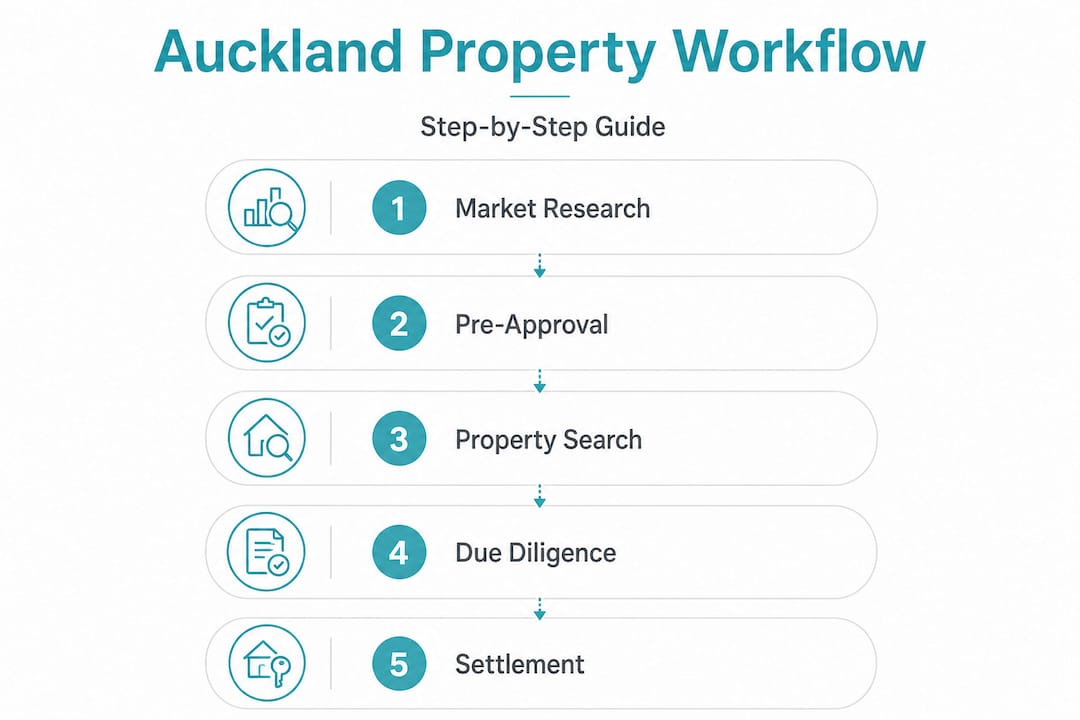
The step-by-step property purchase workflow
With your documentation and budget in place, you are ready to follow the workflow itself. Think of this as your financial GPS for the Auckland market.
-
Research your market. Spend time understanding Auckland suburbs, their price ranges, and what your budget realistically allows. Use platforms like OneRoof and homes.co.nz to track recent sales data.
-
Get mortgage pre-approval. This is not optional in Auckland’s competitive market. Pre-approval tells you exactly how much you can borrow and puts you in a strong position when you find the right property. Your mortgage adviser will assess your income, expenses, debts, and deposit at this stage.
-
Begin your property search. Now that you know your budget, you can search with purpose. Attend open homes, ask agents for disclosure documents, and start building relationships with real estate agents in your target suburbs.
-
Commission due diligence reports. For any property you are seriously considering, order a LIM from Auckland Council and engage a licensed building inspector. Since the LIM changes in October 2025, natural hazard information is presented more clearly, so read this section with particular care.
-
Make your offer. Work with your solicitor to prepare your sale and purchase agreement. Decide whether to make an unconditional offer or one subject to finance, LIM, and building inspection. In Auckland, conditional offers are common and sensible.
-
Secure final loan approval. Once your offer is accepted, your lender will do a formal valuation and confirm final approval. This is separate from pre-approval and is property-specific.
-
Settlement. Your solicitor manages the settlement process, transferring funds and registering the title in your name. You get the keys.
Comparing your loan pathways during the workflow
| Loan type | Minimum deposit | Income cap applies? | Property price cap? |
|---|---|---|---|
| Standard bank mortgage | 20% | No | No |
| Kāinga Ora First Home Loan | 5% | Yes | Yes |
| Bank low-equity lending | 10 to 15% | No | No |
Most buyers use standard bank lending, but as New Zealand government guidance confirms, low-deposit pathways exist for eligible buyers. The right path depends entirely on your deposit, income, and the property you are targeting.
Following a structured Auckland home buyer workflow guide can help you avoid missing stages or rushing steps that deserve careful attention. If you are eligible for the Kāinga Ora First Home Loan, your workflow will include additional eligibility checks at the pre-approval stage.
Pro Tip: Do not wait until you find your dream home to sort out pre-approval. In Auckland, quality properties attract multiple offers quickly. Buyers without pre-approval often miss out because they cannot move fast enough.
Loan types and approval in Auckland: Which pathway fits?
With the workflow mapped, your next major hurdle is finding the right loan pathway. Choosing the wrong one can cost you time, money, and opportunities.
Standard bank mortgage
This is the most common route. You bring a deposit of at least 20% of the property’s value, and a bank lends the remaining 80%. In Auckland, where the median house price regularly exceeds $900,000, a 20% deposit represents a significant sum. Lenders assess your income, expenses, existing debt, and employment history before approving you.

The benefits are clear: a wider choice of lenders, lower interest rates because you are seen as a lower-risk borrower, and no government eligibility conditions to meet. The trade-off is the sheer size of the deposit required.
Kāinga Ora First Home Loan
This is a government-backed low-deposit option that allows eligible buyers to purchase with just a 5% deposit. The loan is issued by participating banks, not Kāinga Ora directly, but Kāinga Ora provides a government guarantee that encourages lenders to accept lower deposits.
To qualify, you must meet income caps (currently $95,000 per year for a single buyer and $150,000 combined for two or more buyers), and the property you are buying must fall within regional price caps. In Auckland, these caps have historically been set higher than the rest of New Zealand to reflect local market conditions, but you should always verify the current figures when you apply.
Speak with a mortgage adviser about the Kāinga Ora loan details before assuming you either do or do not qualify. The eligibility rules are more nuanced than they first appear.
Practical Auckland examples
Consider two buyers. Buyer A earns $85,000 per year, has saved $60,000 in KiwiSaver and cash savings, and is targeting a $700,000 property. With a 20% deposit requirement, they need $140,000. They fall short, but they may qualify for a Kāinga Ora First Home Loan with their $60,000 deposit representing approximately 8.5% of the purchase price, which exceeds the 5% minimum.
Buyer B earns $160,000 combined with their partner, has $180,000 saved, and is looking at a $900,000 property. They comfortably meet the 20% deposit threshold but exceed the Kāinga Ora income cap. Standard bank lending is their pathway.
Understanding mortgage pre-approval in New Zealand before you start searching is essential, as it clarifies exactly which pathway applies to your situation and prevents wasted effort chasing properties outside your realistic reach.
Avoiding mistakes: Due diligence, FAQs, and pitfalls unique to Auckland
Understanding your loan and workflow is crucial, but avoiding mistakes can save you time, money, and stress.
Common Auckland buying errors
- Skipping pre-approval. Buyers who skip pre-approval often find themselves unable to proceed when a great property appears. Pre-approval is not bureaucratic box-ticking; it is your proof of buying power.
- Misreading LIM reports. Even experienced buyers can struggle with LIM interpretation. The October 2025 Auckland Council changes have made natural hazard sections clearer, but you should still ask your solicitor or mortgage adviser to walk you through any unfamiliar terms.
- Not comparing loan types. Many first-time buyers simply walk into their existing bank and take whatever is offered. This can result in a loan that is not well-suited to their circumstances or a missed opportunity to access better rates elsewhere.
- Underestimating purchase costs. Beyond your deposit, budget for legal fees, building inspection costs, LIM fees, moving costs, and potential mortgage establishment fees. These can add up to $5,000 to $10,000 or more.
- Missing grant and loan eligibility windows. Some buyers assume they will not qualify for assistance without actually checking. Always verify eligibility before ruling out Kāinga Ora support.
“The biggest mistake I see first home buyers make is not getting professional advice early enough. By the time they realise they need help, they have already narrowed their options or made commitments they cannot easily reverse.”
Auckland-specific considerations for 2026
Auckland’s property market moves quickly, and council requirements add layers that buyers in smaller centres do not always encounter. Reading LIM reports carefully is especially important in Auckland suburbs with known flood, coastal erosion, or unstable land risks. These are not rare occurrences; significant portions of Auckland’s residential land carry some form of natural hazard notation.
Use the tips in our Auckland mortgage approval guide to maximise your chances of a smooth process. And if you want to understand the mistakes first home buyers make most often, it is worth reviewing common pitfalls before you get too deep into the search process.
Pro Tip: Always engage a conveyancing solicitor who is familiar with Auckland Council processes specifically. Not all solicitors have the same depth of experience with Auckland’s unique consent history, LIM structures, and council requirements.
Why Auckland’s property purchase workflow is changing and what most guides miss
Stepping back, here is a hard-won perspective Auckland buyers rarely hear before it is too late.
Most property buying guides treat the process as if it were universal. Research, save, borrow, buy. But Auckland is not a generic market. It is a city with one of the highest property-to-income ratios in the world, a council that manages hazard-prone land across a complex volcanic and coastal geography, and a lending landscape that includes government-backed schemes specifically because standard lending is out of reach for so many residents.
The 2025 LIM changes from Auckland Council are a perfect example of why Auckland buyers need locally specific guidance. These are not minor administrative tweaks. They represent a shift in how risk information is communicated, and that changes the questions you should be asking during due diligence. A buyer who reads an updated LIM for a Glenfield property will now see hazard data formatted very differently to what buyers saw just a year or two ago. Missing that shift means potentially misreading risk.
There is also a deeper issue. Many buyers in Auckland approach the process as a solo endeavour, researching online and assuming they can piece together the right strategy from general guides. But the value of working with an experienced Auckland mortgage adviser is not just about getting a loan. It is about structuring the loan correctly from the start, understanding which lender’s criteria best match your profile, and having someone who can read a LIM alongside you and flag concerns before they become costly problems.
The buyers who navigate Auckland’s market most successfully are not necessarily those with the most money. They are the ones who sought the right advice early, understood their loan options clearly, and treated due diligence as an investment rather than a cost.
Expert support throughout your Auckland property journey
Ready to act on your property plans? The right guidance makes all the difference.
Buying a home in Auckland involves more moving parts than most buyers anticipate. A knowledgeable mortgage adviser acts as your guide from the first conversation about deposit size right through to settlement day. They help you interpret LIM reports, compare lending options across multiple banks, and navigate eligibility requirements for government-supported schemes.

At Mortgage Managers, our team of Auckland mortgage brokers is based in Hobsonville and serves buyers across West Auckland, the North Shore, and beyond. Whether you are ready to apply for your Auckland mortgage right now or still working through your options, we are here to help. Think of us as your personal home loan advisers, shopping across lenders to find the structure that genuinely suits your goals, not just the one that is easiest to approve.
Frequently asked questions
What has changed in Auckland LIM reports since 2025?
Auckland Council updated LIM reports in October 2025 to make natural hazard information easier to locate and interpret, helping buyers assess property risks with greater clarity and confidence.
Can I buy a home in Auckland with less than a 20% deposit?
Yes, some eligible buyers can access Kāinga Ora’s First Home Loan with as little as a 5% deposit, subject to income and property price caps.
What are the main steps in the Auckland property purchase workflow?
The main steps are researching the market, securing pre-approval, conducting your property search, completing due diligence (LIM and builder’s report), making an offer, receiving final loan approval, and settling the purchase.
Do LIM changes affect what I should check during due diligence?
Yes, since the October 2025 update natural hazard information is more clearly presented in LIMs, so pay close attention to these sections and discuss any concerns with your solicitor before proceeding.
Is pre-approval necessary before searching for homes?
Pre-approval is strongly recommended, as it defines your borrowing capacity and significantly strengthens your negotiating position in Auckland’s fast-moving property market.
Recommended
- First-time buyer workflow: Step-by-step guide for Auckland homes
- Buying Investment Property Guide for Auckland Investors
- Step-by-step home buying guide for NZ first buyers
- Apply for a mortgage in Auckland: 2026 guide for first home buyers
- Moving Into Your First Home in Singapore: The Ultimate First-Timer’s Guide – The Muscle & Truck Co.