
TL;DR:
- A mortgage loan secures property as collateral, allowing borrowers to access large sums for home purchase. Repayments include principal and interest over a typical 25–30-year term, with interest rates fixed, floating, or split. Borrowers must pass stress tests, understand key terms, and choose suitable loan structures to meet their financial goals.
A mortgage loan is a secured loan where your property acts as collateral, allowing you to borrow a large sum to purchase a home and repay it with interest over an agreed term. Understanding how a mortgage loan works is the first step toward making confident property decisions in New Zealand. The core elements are straightforward: you borrow a principal amount, pay interest on that balance, and repay the full debt over a loan term that typically spans 25–30 years. Longer terms reduce your monthly repayments but increase the total interest you pay over the life of the loan. Mortgagemanagers works with New Zealand borrowers every day to make these mechanics clear and manageable.
How does mortgage interest work in New Zealand?
Interest is the cost of borrowing, expressed as an annual percentage of your outstanding loan balance. Every repayment you make covers two things: a portion of the principal and a portion of the interest. What changes over time is the ratio between those two portions.
Most New Zealand mortgages use a table loan structure, where your repayment amount stays fixed but the split between principal and interest shifts. Early repayments mostly cover interest; later repayments allocate more to principal, accelerating debt reduction. This is called amortisation. Understanding your amortisation schedule helps you see exactly when your debt starts shrinking meaningfully, which is useful when you are weighing up prepayment or refinancing options.
New Zealand borrowers choose between three main rate types:
- Fixed rate: Your interest rate is locked for a set term, usually 6 months to 5 years. Repayments are predictable, which makes budgeting straightforward.
- Floating rate: Your rate moves with the market. You can make extra repayments or lump sum payments at any time without penalty.
- Split structure: You fix part of the loan and leave the rest floating. Split loan structures give you budgeting certainty on the fixed portion and flexibility on the floating portion.
Banks do not simply assess your ability to repay at today’s rates. Lenders apply serviceability stress tests that check whether you could still meet repayments if interest rates rose 2–3% above current levels. Passing this test is a condition of approval, not an optional hurdle.
Pro Tip: If you are on a fixed rate and want to make extra repayments, check your loan contract first. Breaking a fixed rate early can trigger a break fee that wipes out any interest saving.
What are the main types of mortgage loans in New Zealand?
New Zealand borrowers have access to several loan structures, each suited to different financial situations and goals.

| Loan type | How it works | Best suited to |
|---|---|---|
| Table loan | Fixed repayments; interest-heavy early, principal-heavy later | Most owner-occupiers |
| Fixed rate mortgage | Rate locked for a set term | Borrowers who want payment certainty |
| Floating rate mortgage | Rate moves with market; flexible repayments | Borrowers expecting lump sum payments |
| Split rate mortgage | Part fixed, part floating | Borrowers wanting both certainty and flexibility |
| Kāinga Ora First Home Loan | Low deposit option backed by Kāinga Ora | First home buyers with limited deposit |
The loan-to-value ratio, known as LVR, is the percentage of the property’s value you are borrowing. A 20% deposit gives you an 80% LVR. Most New Zealand banks require at least a 20% deposit for standard lending, though low-deposit products like the Kāinga Ora First Home Loan allow eligible buyers to purchase with as little as 5%. A lower LVR generally means a lower interest rate, because the lender carries less risk.
Loan terms in New Zealand typically run 25–30 years. Choosing a shorter term increases your repayments but reduces total interest paid. Choosing a longer term keeps repayments lower but costs more over time. The right term depends on your income, goals, and how aggressively you want to pay down debt.
How does the mortgage approval process work?
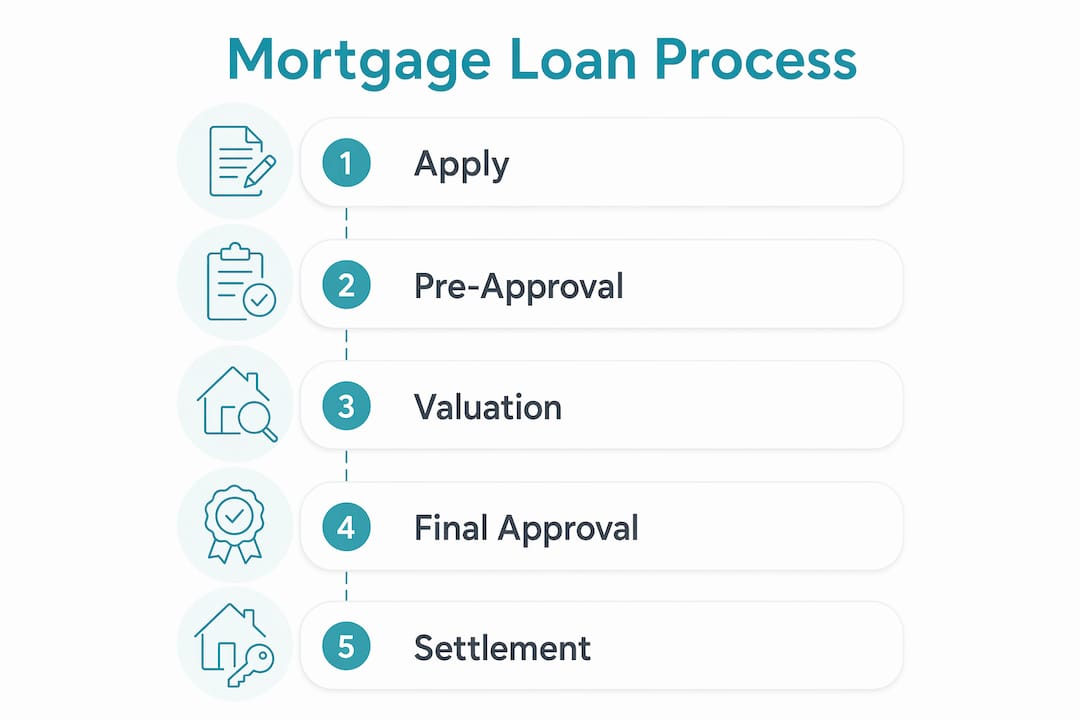
Getting mortgage approval in New Zealand follows a clear sequence. Knowing each step reduces surprises and keeps your purchase on track.
- Check your borrowing capacity. The Reserve Bank of New Zealand’s debt-to-income rules cap owner-occupier borrowing at six times gross household income. For a household earning $120,000 per year, that means a maximum loan of around $720,000, assuming no other debts.
- Gather your documents. Lenders require proof of income (payslips or tax returns for the self-employed), at least three months of bank statements, evidence of your deposit, and identification.
- Apply for pre-approval. Pre-approval is a conditional offer from a lender confirming how much they are willing to lend. Pre-approval is typically valid for 60–90 days, giving you a defined window to find a property.
- Make an offer with a finance condition. Your Sale and Purchase Agreement should include a finance condition. This protects you if formal approval is declined after pre-approval.
- Complete the valuation. The lender orders an independent property valuation to confirm the security is worth what you are paying.
- Receive unconditional approval. Pre-approval is not a guarantee; final unconditional approval is issued only after the valuation and a check that your financial position has not changed.
Pro Tip: Self-employed borrowers should expect the pre-approval process to take up to two weeks. Prepare two years of financial statements and tax returns before you apply, not after.
Processing times vary: straightforward employed applicants typically receive pre-approval within 3–5 business days, while complex cases can take up to two weeks.
What are the key mortgage terms every borrower should know?
Mortgage documents use specific language that can feel unfamiliar. These are the terms you will encounter most often.
- Principal: The amount you borrow, not including interest. Every repayment reduces your principal over time.
- Interest: The cost the lender charges for providing the loan, calculated as a percentage of your outstanding principal.
- Loan term: The agreed period over which you repay the loan, commonly 25–30 years in New Zealand.
- LVR (loan-to-value ratio): Your loan amount expressed as a percentage of the property’s value. An LVR above 80% is considered high and attracts stricter lending conditions.
- Equity: The portion of the property you own outright. Equity grows as you repay principal and as the property’s value increases.
- Amortisation: The process of paying off a loan through regular repayments. An amortisation schedule shows exactly how much of each payment goes to interest versus principal at every stage of the loan.
- Prepayment: Making extra repayments beyond your minimum. On floating rate loans, prepayments reduce your principal faster and cut total interest paid.
- Break fee: A charge applied when you exit a fixed rate loan before the term ends. Break fees can be significant, so always check before switching.
Mortgage advisers, also called mortgage brokers, help you interpret these terms and match loan products to your situation. The Financial Markets Authority requires New Zealand mortgage advisers to disclose their remuneration, which is usually a commission paid by the lender. Some advisers also charge a client fee. Knowing how your adviser is paid helps you assess their recommendations clearly. You can read more about how this works in Mortgagemanagers’ guide to the role of a mortgage adviser.
Key takeaways
A mortgage loan works by securing a lender’s funds against your property, with repayments covering both principal and interest across a loan term that typically spans 25–30 years in New Zealand.
| Point | Details |
|---|---|
| Table loan structure | Most NZ mortgages use fixed repayments where interest dominates early and principal dominates later. |
| Interest rate options | Fixed, floating, and split structures each suit different budgeting needs and repayment goals. |
| Borrowing limits | The Reserve Bank caps owner-occupier borrowing at six times gross household income. |
| Pre-approval window | Pre-approval lasts 60–90 days and is conditional, not a guaranteed loan offer. |
| Adviser transparency | NZ mortgage advisers must disclose all remuneration, including lender commissions and client fees. |
What I have learned from helping New Zealand borrowers
The question I hear most often is not “what rate should I fix at?” It is “am I even eligible?” Most first home buyers underestimate their position and overestimate the complexity. That gap between perception and reality is where a lot of anxiety lives, and it is entirely avoidable.
The single biggest mistake I see is treating pre-approval as a done deal. Pre-approval is a conditional offer. If your financial situation changes between pre-approval and settlement, or if the property valuation comes in below the purchase price, the lender can pull back. I have seen buyers lose their deposit because they changed jobs after pre-approval and did not tell anyone. Always disclose changes to your lender or adviser immediately.
The second mistake is fixating on the headline interest rate and ignoring everything else. The structure of your loan matters as much as the rate. A split loan, for example, can save you money in a rising rate environment while still giving you the flexibility to make lump sum payments. Most borrowers would not arrive at that structure on their own. That is exactly where a good mortgage adviser earns their place.
Mortgagemanagers works with borrowers across Auckland and remotely throughout New Zealand. The benefits of working with a mortgage broker go beyond access to multiple lenders. A good adviser reads your full financial picture and structures a loan that fits your life, not just your income.
— Stuart
Mortgagemanagers can help you get the right loan structure
Choosing the right mortgage is not just about finding the lowest rate. It is about matching the loan structure, term, and rate type to your income, goals, and risk tolerance.

Mortgagemanagers is a locally owned Auckland mortgage advisory business serving clients across West Auckland, the North Shore, and remotely throughout New Zealand. The team acts as your personal mortgage shopper, comparing products across multiple lenders and managing the application process from pre-approval through to settlement. Adviser remuneration is fully disclosed upfront, so you always know where the advice is coming from. Whether you are a first home buyer or refinancing an existing loan, Mortgagemanagers gives you clear, tailored guidance at every step.
FAQ
What is a mortgage loan?
A mortgage loan is a secured loan where the property you purchase acts as collateral for the debt. You borrow a principal amount from a lender, repay it with interest over an agreed term, and the lender holds a legal claim over the property until the loan is fully repaid.
How long does mortgage pre-approval last in New Zealand?
Mortgage pre-approval in New Zealand is typically valid for 60–90 days. After that window, lenders require updated financial documents before extending or reissuing the offer.
What is the debt-to-income cap for New Zealand borrowers?
The Reserve Bank of New Zealand caps owner-occupier borrowing at six times gross household income. A household earning $120,000 per year can borrow a maximum of around $720,000, subject to other affordability checks.
What is the difference between a fixed and floating mortgage?
A fixed rate mortgage locks your interest rate for a set term, giving you predictable repayments. A floating rate mortgage moves with the market and allows flexible or lump sum repayments without penalty.
Do mortgage advisers in New Zealand charge fees?
New Zealand mortgage advisers are required by the Financial Markets Authority to disclose all remuneration. Most are paid a commission by the lender, though some also charge a direct client fee. Your adviser must explain both before you proceed.