
TL;DR:
- Getting a house loan in New Zealand requires meeting deposit, income, and credit assessment criteria. Eligible first-home buyers can qualify with a 5% deposit through Kāinga Ora, below the standard 20%. Preparing the necessary documents and understanding the approval process improves your chances of success.
Getting a house loan in New Zealand requires meeting a deposit threshold, proving your income, and passing a lender’s credit assessment. These are the three pillars every bank or non-bank lender evaluates before approving your mortgage application. The standard deposit is 20% of the property’s purchase price, though eligible first-home buyers can access a 5% deposit option through Kāinga Ora. The Reserve Bank of New Zealand also sets lending restrictions, including Debt-to-Income limits, that shape how much you can borrow. Understanding what you need to get a house loan before you apply puts you firmly in control of the process.
What eligibility criteria must you meet to qualify for a home loan?
Qualifying for a home loan in New Zealand starts with four core factors: residency status, deposit size, income, and credit history. Each factor carries real weight, and a weakness in any one area can reduce your borrowing power or delay approval.

Residency and visa status
To purchase residential property in New Zealand, you must meet specific residency requirements. You need to have lived in NZ for 12 months, hold a residence class visa, and have been present in the country for more than 183 days in the preceding year. Overseas residents can obtain pre-approved consent, which remains valid for one year at no extra cost.
Deposit requirements
The standard deposit is 20% of the property’s value for most borrowers. Under the Kāinga Ora First Home Loan scheme, eligible buyers can purchase with as little as 5%. That lower threshold makes a significant difference for buyers who have savings but have not yet reached the full 20% mark.
Income and credit standards
Lenders assess your income to confirm you can service the loan comfortably. They also apply a stress test at higher rates, typically 2–3% above the current rate, to confirm you could still repay if rates rise. This constraint often reduces the maximum amount you can borrow more than the headline interest rate does. Credit scores below 500 typically result in rejection from mainstream banks, though some non-bank lenders will approve applicants with higher rates attached.
- You must be a New Zealand citizen, permanent resident, or hold an eligible visa
- A minimum 20% deposit applies in most cases, or 5% under Kāinga Ora schemes
- Income caps for the First Home Loan are $95,000 for a single applicant and $150,000 for joint applicants
- Your credit score directly affects both approval and the interest rate you receive
- Debt-to-Income limits set by the Reserve Bank of New Zealand cap total borrowing relative to your earnings
Pro Tip: Check your credit report through Centrix or Equifax before you apply. Errors on your report are more common than most people expect, and fixing one can lift your score enough to change your outcome.
What documents do you need for a home loan application?
The documents needed for a mortgage application fall into four categories: identity, income, savings, and liabilities. Preparing these before you approach a lender speeds up the process considerably.
-
Proof of identity. Provide a current passport or New Zealand driver’s licence. Lenders require at least one form of government-issued photo ID to satisfy anti-money laundering obligations.
-
Income evidence. Salaried employees need recent payslips covering at least three months and a signed employment letter confirming your role, salary, and employment type. Self-employed applicants must provide two years of tax returns and accountant-prepared financial statements. Lenders treat self-employed income more conservatively, so having clean financials matters.
-
Bank statements. Three months of bank statements show your savings pattern, regular expenses, and any existing debt repayments. Lenders look for consistent savings behaviour, not just a lump sum sitting in your account. Irregular deposits or large unexplained transfers attract scrutiny.
-
Debt and liability details. List all existing debts: credit cards, personal loans, hire purchase agreements, and student loans. Even a credit card you rarely use counts against your borrowing capacity because lenders assess the full credit limit, not just the outstanding balance.
-
Additional supporting documents. If your deposit includes KiwiSaver funds, provide a recent KiwiSaver statement. Gifted deposits require a gift letter and a statutory declaration from the donor confirming the funds are not a loan. Rental income applicants should include tenancy agreements and rental history.
Pro Tip: Organise all your documents into a single folder before your first meeting with a lender or adviser. Delays in document collection are the most common reason pre-approval timelines blow out.
How does the home loan approval process work in New Zealand?
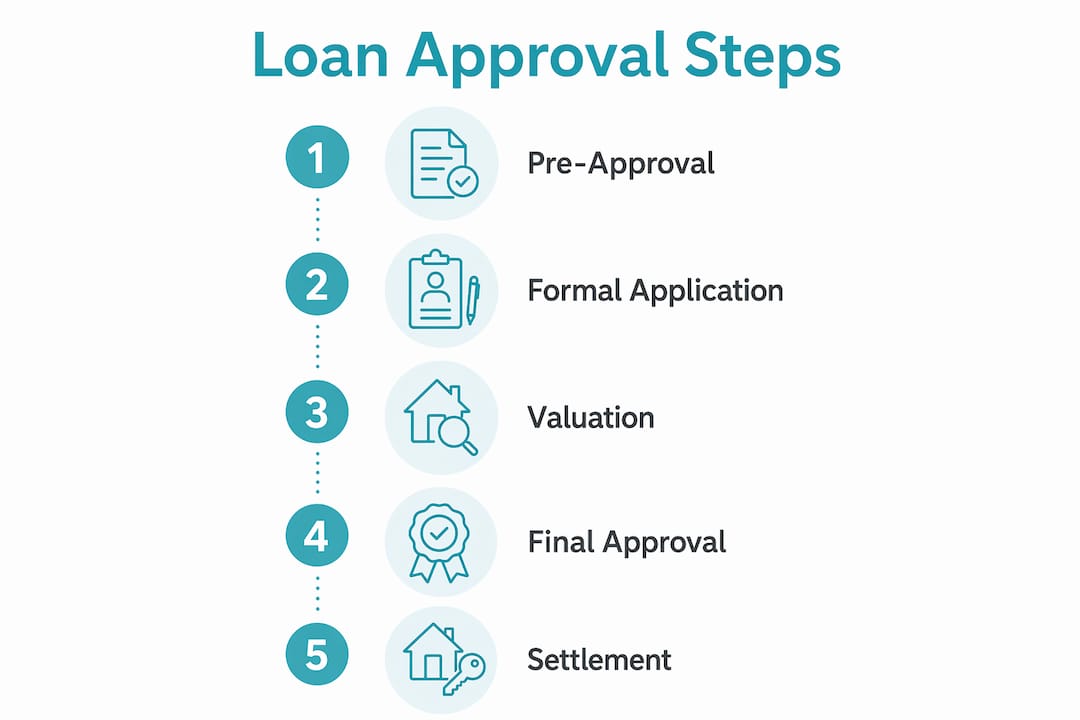
The mortgage approval process in New Zealand moves through four distinct stages: pre-approval, formal application, valuation, and settlement. Knowing what happens at each stage removes a lot of the anxiety from the process.
Pre-approval
Mortgage pre-approval is a lender’s conditional commitment that gives you an indicative borrowing limit and interest rate before you find a property. Pre-approval typically takes 3–7 business days and remains valid for 60–90 days. It makes your offer more credible to vendors and speeds up the formal approval once you find the right home. Pre-approval does not guarantee final funding. The lender will still verify your documents and assess the specific property before issuing formal approval.
Formal approval and finance conditions
Once you sign a Sale and Purchase Agreement, you enter the formal approval stage. A finance condition clause in the agreement gives you 5–15 working days to secure bank approval without penalty. This clause protects you if the lender declines the loan or if the property valuation comes in below the purchase price. Formal approval typically takes an additional 5–10 days after the signed agreement is received.
| Stage | Typical timeframe | Key action |
|---|---|---|
| Pre-approval | 3–7 business days | Submit documents, receive indicative limit |
| Finance condition period | 5–15 working days | Lender verifies property and financials |
| Formal approval | 5–10 business days | Valuation completed, loan confirmed |
| Settlement | As agreed in contract | Funds transferred, title transferred |
- Avoid changing jobs, taking on new debt, or making large purchases between pre-approval and settlement
- A drop in your credit score during this period can trigger a reassessment
- The lender orders an independent property valuation to confirm the security value matches the purchase price
What government support exists for first-home buyers?
The Kāinga Ora First Home Loan is the primary government-backed scheme for eligible New Zealand buyers. It allows a 5% deposit for first-home buyers without the premium interest rates that normally apply to low-deposit loans. The government underwrites the risk, which means participating banks offer standard rates rather than a low-equity margin.
Eligibility and income caps
Income caps apply strictly. Single applicants must earn no more than $95,000 per year. Joint applicants must earn no more than $150,000 combined. Regional house price caps also apply, so the scheme works differently depending on whether you are buying in Auckland, Wellington, or a smaller regional centre. You must also be a first-home buyer and intend to live in the property.
Standard loans versus government-backed options
A standard 20% deposit loan gives you access to the full range of lenders and typically the most competitive rates. The First Home Loan scheme reduces the deposit barrier significantly but comes with income and price cap restrictions. If you earn above the income cap, you need to reach the 20% deposit threshold or explore other low-equity options with your lender directly.
Pro Tip: KiwiSaver funds can contribute to your deposit under the First Home Withdrawal scheme. Check your KiwiSaver balance and eligibility early. Many buyers are surprised by how much they have accumulated.
What challenges can affect your ability to get a house loan?
Credit history, insufficient deposit, and high living expenses are the three most common barriers to mortgage approval in New Zealand. Each one is addressable with the right preparation.
- Credit issues. Credit scores below 500 typically lead to rejection from mainstream banks. Paying down overdue accounts, reducing credit card limits, and avoiding new credit applications for six months before applying all help lift your score.
- Insufficient deposit. If you are short of the 20% threshold, check your eligibility for the Kāinga Ora First Home Loan. Alternatively, a family member can gift part of your deposit, provided you supply the required statutory declaration.
- High expenses and unsecured debt. Lenders scrutinise your spending patterns through bank statements. Reducing discretionary spending and consolidating high-interest debts before applying improves your debt-to-income ratio and your overall picture.
- Inconsistent income. Casual or contract workers face tighter scrutiny. Demonstrating 12 months of consistent income from the same source strengthens your application considerably.
- Working with a mortgage adviser. The Financial Markets Authority notes that mortgage advisers are obligated to clearly disclose their fee structures, including any clawback costs that may apply if you move your loan early. A good adviser knows which lenders suit your specific situation, which saves you time and protects your credit file from multiple hard enquiries.
Key takeaways
Securing a house loan in New Zealand requires a minimum 20% deposit, verified income, a credit score above 500, and a full set of supporting documents before a lender will issue formal approval.
| Point | Details |
|---|---|
| Deposit requirement | Standard loans need 20%; Kāinga Ora First Home Loan allows 5% for eligible buyers. |
| Income verification | Payslips and employment letters for employees; two years of financials for self-employed applicants. |
| Credit score threshold | Scores below 500 typically face rejection from mainstream NZ banks. |
| Pre-approval timing | Pre-approval takes 3–7 business days and is valid for 60–90 days. |
| Finance condition clause | Gives buyers 5–15 working days to secure formal approval after signing a purchase agreement. |
Stuart’s take on getting your home loan right
The part most buyers underestimate is how much preparation matters before they ever speak to a lender. I have seen applicants with solid incomes and good deposits get delayed by something as simple as a credit card they forgot to close two years ago. The paperwork for a house loan is not complicated, but it needs to be complete and consistent.
The stress test that lenders apply, assessing your ability to repay at rates 2–3% higher than today’s, catches a lot of people off guard. You might feel comfortable at the current rate, but the bank needs to know you can handle a rate rise. That is not pessimism. It is the lender protecting both of you.
For first-home buyers especially, I would encourage you to look at the Kāinga Ora First Home Loan early in your planning. Many buyers assume they need a full 20% deposit and spend years saving toward a target they did not need to hit. A mortgage adviser in New Zealand can map out your actual options in a single conversation, which is often the most valuable hour you will spend in the whole process.
One more thing: do not apply to multiple lenders at once. Every hard credit enquiry leaves a mark on your file. A mortgage adviser submits to one lender at a time, which keeps your credit profile clean and your options open.
— Stuart
How Mortgagemanagers can help you secure your home loan
Mortgagemanagers is a locally owned Auckland mortgage advisory business based in Hobsonville, serving buyers across West Auckland, the North Shore, and remotely throughout New Zealand. The team works as personal shoppers for home loans, comparing lenders and negotiating on your behalf so you do not have to approach each bank individually.

Whether you are a first-home buyer working out your deposit options, a self-employed applicant with complex financials, or someone who has been told no by a bank before, Mortgagemanagers has the lender relationships and criteria knowledge to find a path forward. The team handles the paperwork, explains every step, and keeps you informed from pre-approval through to settlement. Reach out to Mortgagemanagers to get clear, personalised guidance on your home loan options today.
FAQ
What is the minimum deposit to get a house loan in New Zealand?
The standard minimum deposit is 20% of the property’s purchase price. Eligible first-home buyers can access a 5% deposit through the Kāinga Ora First Home Loan scheme, subject to income and price caps.
What documents do you need for a mortgage application?
You need photo identification, three months of payslips or two years of financial statements if self-employed, three months of bank statements, details of all existing debts, and proof of your deposit source including KiwiSaver statements or gift letters where applicable.
How long does mortgage pre-approval take in New Zealand?
Pre-approval typically takes 3–7 business days and remains valid for 60–90 days. Formal approval after a signed purchase agreement takes an additional 5–10 business days.
What credit score do you need to get a home loan in NZ?
Mainstream NZ banks generally require a credit score above 500. Scores below that threshold typically result in rejection from standard lenders, though some non-bank lenders will consider lower scores at higher interest rates.
Can a mortgage adviser help if the bank has already said no?
Yes. A mortgage adviser has access to a wider range of lenders, including non-bank options, and understands each lender’s specific criteria. They can identify which lender suits your situation without damaging your credit file through multiple applications.