
TL;DR:
- Mortgage repayments depend mainly on loan amount, interest rate, and loan term, with shorter terms reducing interest paid. Paying more frequently or making extra payments can lower total interest and shorten the loan duration. Borrowers should model different scenarios and be aware of rate changes and fees for accurate planning.
On a $500,000 principal and interest loan over 30 years at a 5.69% two-year fixed rate (the average advertised by New Zealand banks as at June 2026). Your monthly repayment works out to roughly $2,895 and your fortnightly repayment to roughly $1,335. Scale that up to $600,000 and you’re looking at approximately $3,474 per month or $1,602 per fortnight. These figures assume a standard table mortgage (principal and interest), no fees, and a static rate for the full term.
Quick assumptions: 5.69% p.a. nominal rate, 30-year term, principal and interest, no lender fees included, daily interest compounding converted to payment frequency.
A few things to keep in mind before you read further:
- Loan amount is the single biggest lever on your repayment size.
- Interest rate has a dramatic effect, especially over 30 years.
- Repayment frequency (monthly, fortnightly, weekly) changes both your cash flow and total interest paid.
- Repayment type (principal and interest vs interest-only) determines whether you’re actually reducing your debt.
The estimates above come from the standard amortisation formula used by Sorted’s mortgage calculator, cross-checked against the ANZ, BNZ, and Westpac New Zealand home loan calculators. Results will vary based on your deposit, the rate your lender actually offers you, and any fees attached to your loan.
Table of Contents
- How are mortgage repayments calculated?
- Which NZ mortgage calculators should you use?
- Worked examples: $500k and $600k mortgages
- What else affects your repayments?
- How can you lower your mortgage repayments?
- What happens to your repayments when rates change?
- How the example numbers were calculated
- Key takeaways
- What borrowers get wrong about mortgage repayments
- Ready to get your own repayment estimate?
How are mortgage repayments calculated?
Your repayment amount is set by four inputs: the loan amount, the interest rate, the loan term, and how often you pay. Change any one of them and your regular payment shifts.
- Loan amount: The larger the loan, the higher every repayment. Increasing the borrowing amount at the same rate and term results in a meaningful increase in monthly repayments.
- Interest rate: Even a 0.5% difference moves repayments meaningfully. Small differences in interest rates can meaningfully affect monthly repayments for a loan over 30 years.
- Loan term: A 30-year term produces lower monthly payments than a 20-year term, but you pay far more interest overall. Shorter loan terms produce higher monthly payments but reduce total interest paid over the life of the loan.
- Repayment frequency: Paying fortnightly or weekly rather than monthly can reduce total interest because lenders calculate interest daily, so more frequent payments chip away at the balance faster.
How amortisation works
New Zealand home loans typically use a table mortgage structure, also called an annuity mortgage. Your repayment amount stays fixed during the fixed-rate period, but the split between interest and principal shifts constantly. In the early years, the bulk of each payment covers interest. By the final years, nearly all of it reduces principal. This is why paying a little extra early in the loan has such an outsized effect on total interest paid.
Principal and interest vs interest-only
Principal and interest (P&I) repayments reduce your loan balance with every payment. Interest-only (IO) repayments cover only the interest charge, leaving the principal untouched. IO loans are generally available to investors for a limited period and are rarely offered to owner-occupiers for extended terms. The risk is straightforward: when the IO period ends, your repayments jump because you now need to repay the same principal over a shorter remaining term.
Pro Tip: If you’re comparing P&I and IO repayments, always model what the P&I repayment will be when the IO period ends. The step-up can be significant, especially if rates have also risen.
Which NZ mortgage calculators should you use?
Running your own numbers takes less than two minutes with the right tool. Here’s how to get a reliable result.
- Enter the loan amount after your deposit. If you’re buying a $750,000 property with a 20% deposit, your loan amount is $600,000.
- Enter the interest rate. Use the current advertised rate for the term you’re considering, or a slightly higher rate to stress-test your budget.
- Set the loan term. Most NZ home loans run 25–30 years, though shorter terms are worth modelling if your income supports it.
- Choose repayment type. Select principal and interest unless you have a specific reason for interest-only.
- Select repayment frequency. Try monthly first, then fortnightly, to see the difference in total interest paid.
- Add fees if supported. Some calculators let you include establishment fees or annual fees, which affect the true cost of the loan.
Recommended NZ calculators
- Sorted mortgage calculator: The most flexible free tool for NZ borrowers. Supports weekly, fortnightly, and monthly frequencies, split loans, IO vs P&I, and shows total interest paid across the full term. Start here.
- ANZ home loan repayment calculator (anz.co.nz): Clean and straightforward. Good for quick monthly estimates and comparing fixed terms.
- Westpac home loan calculator (westpac.co.nz): Useful for modelling extra repayments and seeing how they shorten the loan.
- BNZ home loan calculator (bnz.co.nz): Includes a breakdown of interest vs principal over time, which helps visualise amortisation.
- Mortgagemanagers mortgage calculator: Built specifically for New Zealand borrowers, with guidance on what the numbers mean for your situation and access to adviser support when the calculator raises more questions than it answers.
Pro Tip: Run every scenario at the same effective annual rate and exclude fees from one pass, then include them in a second pass. That way you’re comparing apples with apples across tools.
Worked examples: $500k and $600k mortgages
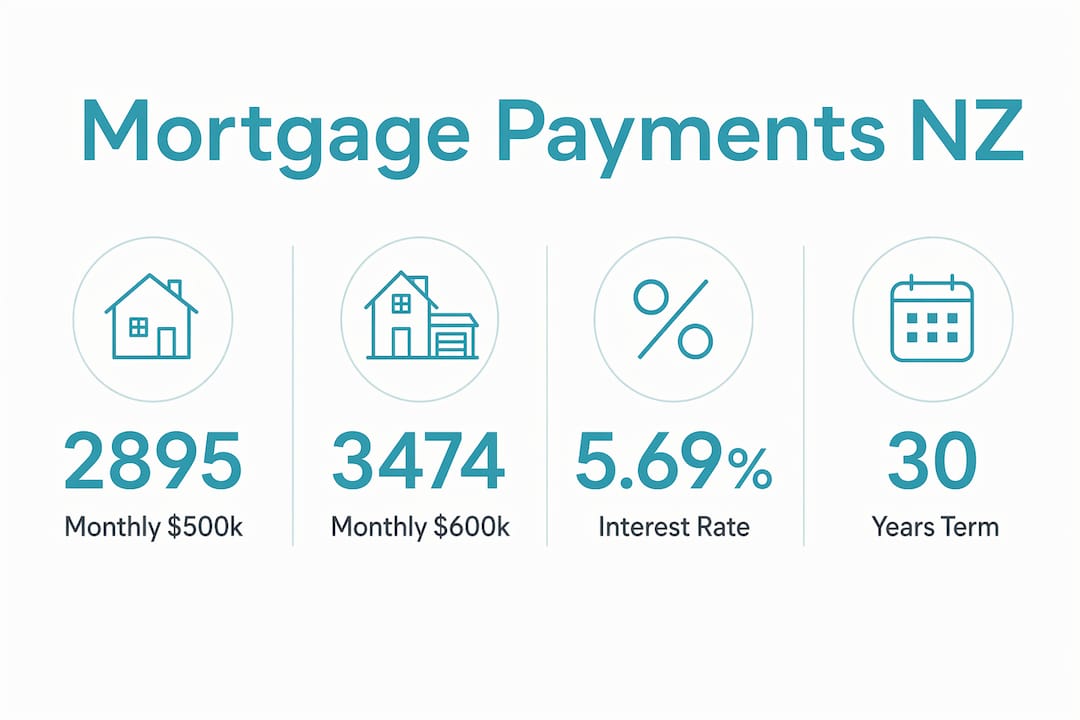
The table below uses the standard amortisation formula with a nominal annual rate of 5.69% (the average two-year fixed rate advertised by NZ banks in June 2026). All examples assume principal and interest repayments, no fees, and daily interest compounding converted to the relevant payment frequency.

| Loan amount | Rate (p.a.) | Term | Frequency | Regular payment | Total repaid | Total interest |
|---|---|---|---|---|---|---|
| — | 5.69% | 30 yrs | Monthly | — | — | — |
| — | 5.69% | 30 yrs | Fortnightly | — | — | — |
| $500,000 | 5.69% | 30 yrs | Monthly | $2,895 | — | — |
| $500,000 | 5.69% | 30 yrs | Fortnightly | $1,335 | — | — |
| $600,000 | 5.69% | 30 yrs | Monthly | $3,474 | — | — |
| $600,000 | 5.69% | 30 yrs | Fortnightly | $1,602 | — | — |
| $500,000 | 5.69% | 20 yrs | Monthly | — | — | — |
| $600,000 | 5.69% | 20 yrs | Monthly | — | — | — |
A few things stand out in these numbers. Shortening the term from 30 to 20 years on a $500,000 loan raises your monthly payment by about $635, but cuts total interest by roughly $195,000. The fortnightly vs monthly difference in total interest is modest at these rates, but the fortnightly schedule does reduce the balance slightly faster because of daily interest calculations.
- The rate has the biggest proportional impact on total interest paid over the life of the loan.
- The term has the biggest impact on your monthly cash flow.
- Frequency matters most when you’re trying to shave years off the loan with minimal budget impact.
Assumptions: Nominal rate 5.69% p.a., compounded daily, converted to fortnightly or monthly equivalent. Principal and interest. No establishment fees, no annual fees. Figures are rounded to the nearest dollar. These are estimates only; your lender’s actual calculation may differ slightly.
What else affects your repayments?
The calculator gives you a clean number, but the real-world repayment on your offer letter can look different. Here’s what moves it.
- Lender fees: Establishment fees (typically a few hundred dollars) and annual fees add to the true cost of the loan, even if they don’t change the regular repayment figure directly.
- Deposit and LVR: A smaller deposit means a higher loan-to-value ratio (LVR). RBNZ lending guidance includes LVR and debt-to-income (DTI) restrictions that limit how much lenders can offer high-LVR borrowers, and many lenders charge a higher rate or require mortgage insurance when LVR exceeds 80%.
- Fixed vs floating rate: Fixed rates give you certainty for the fixed period. The floating rate (6.15% as at June 2026 per RBNZ data) is currently higher than most short-term fixed rates, so most borrowers fix for one or two years. See home loan interest rates for a current comparison.
- Repayment frequency: Switching from monthly to fortnightly payments reduces total interest slightly and aligns better with fortnightly pay cycles for many borrowers.
- Offset accounts: An offset account reduces the balance on which interest is calculated. If you have $20,000 sitting in an offset against a $500,000 loan, you’re only paying interest on $480,000.
- Advertised vs actual rate: Banks set rates based on funding costs, margins, and competition. The advertised “carded” rate is a starting point, not a guarantee. Brokers regularly negotiate better rates, particularly for borrowers with strong equity or complex circumstances.
For a full breakdown of how repayment frequency options affect your total cost, it’s worth running the scenarios side by side.
How can you lower your mortgage repayments?
There are several levers available, and the right one depends on where you are in the loan.
- Increase your deposit. Borrowing less is the most direct way to reduce repayments. Every extra dollar saved before you buy reduces both the loan amount and potentially the interest rate tier you fall into.
- Lengthen the loan term. Extending from 25 to 30 years reduces monthly payments, though you’ll pay more interest overall. Use this as a cash-flow tool, not a permanent strategy.
- Refinance to a lower rate. If your current rate is above what’s available in the market, refinancing can cut repayments immediately. Factor in any break fees on a fixed loan before you move.
- Use an offset account. Parking savings in an offset reduces the interest charged daily without locking money away.
- Switch to interest-only (with caution). IO can free up cash flow short-term, but it’s usually restricted to investors and limited in duration. When the IO period ends, repayments rise sharply.
- Make extra repayments or lump sums. This is the most powerful long-term strategy. Even small regular additions compound significantly over a 30-year term.
Pro Tip: Adding just $40 extra per fortnight to a $500,000 loan can save tens of thousands in interest and cut years from the loan term. Use the extra payment savings calculator to model your own scenario before committing to a repayment structure.
One important caveat: if you’re on a fixed-rate loan, check whether your lender allows extra repayments without penalty. Many NZ lenders cap the extra repayment amount during a fixed term, and exceeding that cap can trigger an early repayment charge.

What happens to your repayments when rates change?
Rate movements hit borrowers at different times depending on their loan structure. Understanding the timing helps you budget sensibly.
- On a floating rate loan: A rate change flows through almost immediately. If the RBNZ cuts the Official Cash Rate (OCR) and your bank passes it on, your next repayment reflects the new rate.
- On a fixed rate loan: You’re shielded until your fixed term ends. A borrower on a two-year fix won’t feel a rate rise until rollover, which could be months or years away.
- Pass-through timing: Research from the Reserve Bank of New Zealand shows that a 1% change in the OCR moves average two-year mortgage rates by about 0.34% within one month, with the peak effect of around 0.80% arriving roughly six months later. The pass-through is real but gradual.
To put that in practical terms, here’s what a rate shift does to a $500,000 loan over 30 years:
- At 5.69%: ~$2,895 per month
- At 6.19% (+0.50%): ~$3,060 per month (roughly $165 more)
- At 6.69% (+1.00%): ~$3,230 per month (roughly $335 more)
A $335 monthly increase is meaningful for most households. The sensible approach is to understand how OCR changes flow through to your rate, and to budget at a rate at least 1.0–1.5% above your current fixed rate when stress-testing affordability.
How the example numbers were calculated
The repayment figures in this guide use the standard annuity (table mortgage) formula:
M = P × [r(1+r)^n] ÷ [(1+r)^n − 1]
Where:
- M = regular repayment amount
- P = loan principal (amount borrowed)
- r = periodic interest rate (annual rate ÷ number of periods per year)
- n = total number of repayment periods (years × periods per year)
For a $500,000 loan at 5.69% p.a. over 30 years with monthly repayments:
- r = 5.69% ÷ 12 = 0.4742% per month
- n = 30 × 12 = 360 payments
- M = $500,000 × [0.004742 × (1.004742)^360] ÷ [(1.004742)^360 − 1] ≈ $2,895
For fortnightly repayments, the annual rate is divided by 26 and the term multiplied by 26. This approach mirrors the method used by Sorted and the major NZ bank calculators.
| Assumption | Value used |
|---|---|
| Nominal annual rate | 5.69% (RBNZ June 2026 average two-year fixed) |
| Compounding convention | Daily interest, converted to periodic rate |
| Repayment type | Principal and interest |
| Fees | Excluded from all examples |
| Rounding | Nearest dollar |
Most online calculators, including those from ANZ, BNZ, and Westpac, assume a static interest rate for the full modelled period. In practice, your rate will change at each rollover. The worked examples here are estimates, not guarantees, and your lender’s system may produce slightly different figures due to rounding conventions or fee inclusions. For a deeper walkthrough of the repayment calculation method, the Mortgagemanagers guide covers NZ-specific scenarios in detail.
Key takeaways
Your monthly repayment on a $500,000 principal and interest loan at 5.69% over 30 years is approximately $2,895, and the interest rate and loan term are the two inputs that move that figure most dramatically.
| Point | Details |
|---|---|
| Ball-park monthly repayments | $2,895/month for $500k; $3,474/month for $600k at 5.69% over 30 years. |
| Rate and term drive the number | A 1% rate rise on a $500k loan adds roughly $335 per month; cutting to 20 years saves ~$195k in interest. |
| Fortnightly beats monthly (slightly) | Paying fortnightly reduces total interest modestly because interest is calculated daily on the outstanding balance. |
| Stress-test your budget | Model repayments at 1.0–1.5% above your current rate to check you can absorb a rate rise at rollover. |
| Mortgagemanagers can help | Mortgagemanagers offers personalised affordability checks, rate negotiation, and adviser support for NZ borrowers. |
What borrowers get wrong about mortgage repayments
Most people who come to us with a calculator printout have done the maths correctly. The number on the screen is usually right. What catches them out is everything the calculator doesn’t show.
The most common mistake is treating the advertised carded rate as the rate they’ll actually pay. Banks publish those rates as a starting point, and a broker’s job is to push past them. Borrowers with a 20% deposit, stable income, and a clean credit history often qualify for a rate meaningfully below the carded figure. Going direct to a single bank means you’ll never know what the other lenders on the panel would have offered.
The second mistake is ignoring the rollover cliff. A borrower who fixes for two years at a comfortable rate and then doesn’t plan for what happens at rollover can face a genuine budget shock. The RBNZ data on pass-through timing makes this concrete: rate changes accumulate over months, and by the time your fixed term ends, the market rate may look very different from when you signed. Building a buffer into your budget from day one is far less stressful than scrambling to refinance under pressure.
Interest-only loans deserve a mention too. They’re sometimes presented as a clever cash-flow tool, but the step-up when the IO period ends is real and often underestimated. If you’re considering IO, model the P&I repayment you’ll face afterwards and make sure your income can support it.
Ready to get your own repayment estimate?
Calculators give you a useful starting point, but the number that actually matters is the one on your loan offer. That figure depends on the rate your lender is willing to offer you, your deposit, your income, and how well your situation is presented.

Mortgagemanagers works with first home buyers, existing homeowners, investors, and borrowers with low deposits or non-standard circumstances across Auckland and throughout New Zealand. As mortgage advisers, the team shops your application across multiple lenders, negotiates on rate, and helps you structure repayments in a way that fits your budget now and at rollover. Whether you need a quick affordability check, help comparing fixed terms, or support with a complex lending situation, the Mortgagemanagers team is ready to help. Get in touch today to talk through your numbers with an adviser who knows the NZ market.
Useful sources and tools
- Sorted mortgage calculator: Free NZ tool supporting weekly, fortnightly, and monthly frequencies, IO vs P&I, and full interest breakdown across the loan term.
- ANZ home loan repayment calculator (anz.co.nz): Quick monthly estimates and fixed-term comparisons for NZ borrowers.
- Westpac home loan calculator (westpac.co.nz): Models extra repayments and shows how they shorten the loan.
- BNZ home loan calculator (bnz.co.nz): Includes an interest vs principal breakdown over time.
- Mortgagemanagers mortgage calculator: NZ-focused calculator with adviser support for when the numbers raise questions.
- RBNZ mortgage rate data (B20): Official average advertised rates for all fixed terms and floating, updated monthly.
- RBNZ lending guidance: LVR and DTI restrictions that affect loan availability and rates for NZ borrowers.
- RBNZ OCR pass-through research: Explains how and when OCR changes flow through to mortgage rates.
- Mortgagemanagers repayment guide: Worked examples and calculation walkthrough for NZ borrowers.
This article is general information only and does not constitute financial advice. Interest rates, lending criteria, and regulatory requirements change regularly. Confirm current rates and your own eligibility with a qualified mortgage adviser or your lender before making any borrowing decisions.