
VA home loans and their credit requirements are a United States programme exclusively. They do not apply to buying property in New Zealand. If you searched for “va home loan credit score” hoping it might help you here, the short answer is: it won’t. What matters for your NZ home loan is your Equifax or illion credit profile, your repayment history, and your serviceability. Here are your two immediate next steps:
- Check your NZ credit report with Equifax (scored 0–1,000) or illion (scored 0–1,200) before approaching any lender.
- Speak to a mortgage broker such as Stuart at Mortgagemanagers if your credit is low, patchy, or non-standard. A broker knows which lenders are flexible and which doors are genuinely open to you.
This article explains what VA loans actually are, how NZ lenders assess credit, what realistic options exist if your score is low, and how Mortgagemanagers can help you find a path forward.
Table of Contents
- What is a VA home loan, and why doesn’t it apply in New Zealand?
- How do credit scores affect home loan approval in New Zealand?
- What does the NZ home loan process cost and how long does it take?
- What are your options if your credit score is low in New Zealand?
- How do you choose a mortgage broker in New Zealand?
- Practical next steps you can take today
- Key takeaways
- A broker’s honest view on credit and home loans
- Mortgagemanagers: your local guide for non-standard home loans
- Useful sources and further reading
What is a VA home loan, and why doesn’t it apply in New Zealand?
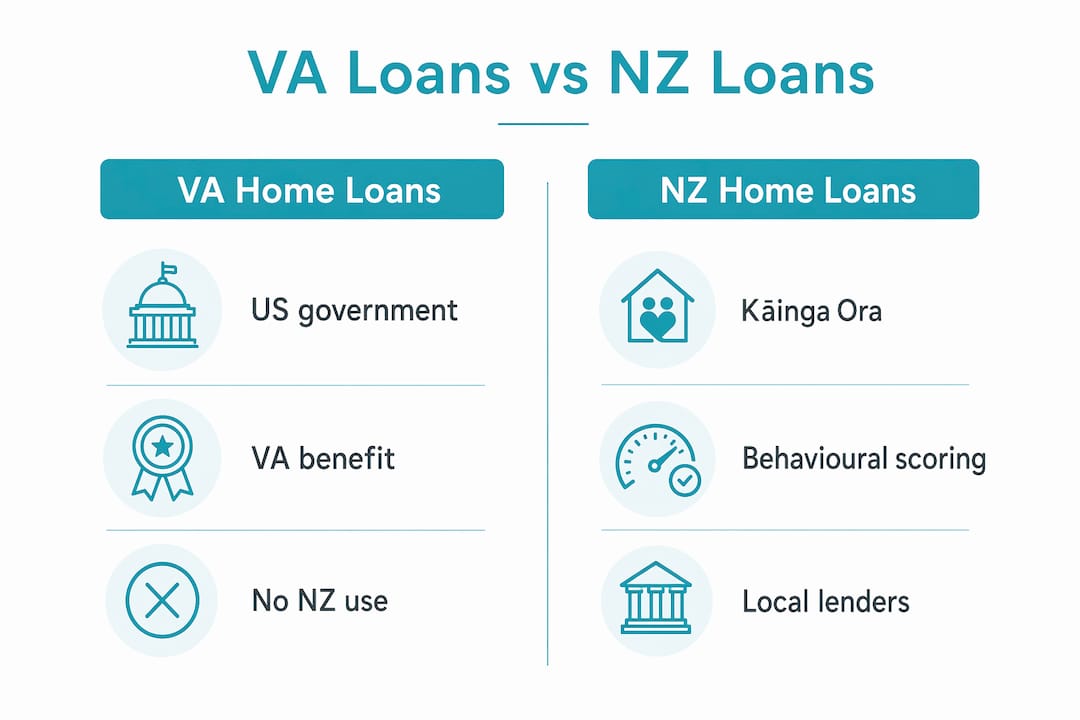
A VA home loan is a mortgage backed by the US Department of Veterans Affairs for eligible American veterans and active-duty service members. To access one, a borrower must obtain a Certificate of Eligibility (COE) and satisfy both VA occupancy rules and the lender’s own approval criteria. The property must be located in the United States or a recognised US territory.
That last point is the critical one. VA loans cannot finance property outside the United States and its territories. New Zealand is not covered, full stop.
The VA home loan is a benefit tied to US soil. No matter your service history or credit profile, it cannot be used to purchase a home in New Zealand. Kiwi buyers need to work within NZ lending frameworks entirely.
For NZ readers, the local equivalent programmes to consider are Kāinga Ora’s First Home Loan (which reduces the deposit requirement to 5% for eligible buyers) and standard bank or non-bank lending. These operate under completely different rules, assessed by NZ lenders using NZ credit data.
Pro Tip: If you have served overseas and retain genuine US VA eligibility, you can still use that benefit to purchase property located within the United States while you’re abroad. It simply cannot substitute for NZ lending when buying here.
How do credit scores affect home loan approval in New Zealand?
NZ lenders don’t use a single universal credit score. Two credit bureaus operate here: Equifax (0–1,000) and illion (0–1,200), and each lender may check one or both. According to Consumer Protection NZ, a score above 700 is generally considered good for mortgage purposes.

| Score band (Equifax) | Typical lender access |
|---|---|
| 700–1,000 | Strong bank access; competitive rates likely |
| 500–599 | Most major banks will consider; some conditions may apply |
| Below 500 | Non-bank or specialist lenders; higher rates expected |
Beyond the number itself, lenders dig into the detail behind it. They check for defaults, missed payments, the number of recent credit enquiries, employment stability, income, existing debts, and your deposit size. A borrower with a score of 620 and a clean two-year repayment history often fares better than one with a 650 score and a default from 18 months ago.
- Scores of 600+ generally give you access to most major NZ banks.
- Scores of 500–599 may still get bank approval, but expect more scrutiny and possible conditions.
- Scores below 500 typically mean non-bank lenders, which charge 1%–4% more than standard bank rates.
- A deposit of 20% or more can offset a weaker score in some cases.
Pro Tip: NZ credit scoring is behavioural. A single recent default often carries more weight than a middling score. Lenders look for patterns over the past 12–24 months, so recent clean behaviour matters enormously when you’re preparing an application.
What does the NZ home loan process cost and how long does it take?
The typical NZ home loan journey moves through three phases: pre-approval, conditional approval, and settlement. Pre-approval usually takes 3–5 business days once your documents are in order. Conditional approval, where the lender assesses the specific property, can take 1–3 weeks depending on valuation complexity. Settlement is then scheduled with your solicitor, typically 4–6 weeks after the sale and purchase agreement is signed.
Delays most often come from incomplete documentation, valuation issues on unusual properties, or lenders requesting additional income verification for non-standard borrowers. A broker who knows what each lender needs upfront can cut weeks off this process.
Budget for more than just the deposit. First-time buyers often underestimate the ancillary costs that sit alongside the purchase price. Getting these wrong can stall settlement at the worst possible moment.
Typical costs to plan for include:
- Registered valuation: generally $700–$1,200, and mandatory for most low-deposit loans.
- Legal and conveyancing fees: usually $1,500–$3,000 depending on complexity.
- Lender establishment fees: many major banks charge $0 for standard owner-occupier loans, but non-bank lenders often charge $200–$500.
- Lender’s Mortgage Insurance (LMI): under the Kāinga Ora First Home Loan, the LMI premium is 1.2% of the loan amount, which can be capitalised into the loan rather than paid upfront.
On broker fees: most NZ mortgage brokers, including Mortgagemanagers, are paid by the lender on settlement, not by you. Always ask your broker to confirm their fee structure in writing before you proceed.
What are your options if your credit score is low in New Zealand?
Low credit doesn’t mean no options. It means different options, usually at a higher cost. The Financial Markets Authority recommends using a broker for non-standard or low-credit profiles precisely because brokers know which lenders apply discretionary credit policies and can package applications to mitigate single negative items.
Your realistic lending pathways include:
- Non-bank lenders: accessible at lower scores but typically 1%–4% above bank rates.
- Specialist credit providers: designed for impaired-credit borrowers; terms are stricter but approval is possible.
- Guarantor loans: a family member with equity can support your application and reduce lender risk.
- Larger deposit strategies: increasing your deposit to 20% or more reduces lender exposure and can offset a weaker credit profile.
- Co-borrower arrangements: adding a creditworthy co-borrower can strengthen an otherwise marginal application.
The trade-off with non-bank lending is real. Higher rates mean higher repayments, and some specialist lenders require larger deposits or charge additional fees. The goal for most borrowers is to use non-bank lending as a stepping stone, refinance to a major bank once credit improves, and rebuild credit systematically in the meantime.
Stuart at Mortgagemanagers works with borrowers in exactly this position. The team can access non-bank and specialist loan options that aren’t widely advertised and can structure applications to present your file in the strongest possible light. A good starting point is the Bad Credit Home Loan Checklist 2025, a practical resource that helps you prepare your application before you speak to a lender.
Pro Tip: Negative items on your credit report generally stay for four to five years. If a default is close to dropping off, waiting a few months before applying can meaningfully change which lenders are available to you.
How do you choose a mortgage broker in New Zealand?
The right broker can be the difference between a declined application and a settled loan. When you’re assessing a prospective broker, ask these questions directly:
- How many lenders are on your panel, and do you include non-bank and specialist lenders?
- Have you worked with borrowers with defaults or impaired credit before?
- How are you paid, and will you confirm that in writing?
- What’s your typical turnaround from first meeting to application submission?
A broker who promises guaranteed approval is a red flag, not a reassurance. No broker can guarantee a lender’s decision. What a good broker can do is match you to the right lender, prepare your file thoroughly, and negotiate conditions on your behalf.
Watch for pressure to accept a loan you don’t fully understand, or reluctance to explain fee structures clearly. Both are warning signs.
The typical broker engagement works like this: an initial assessment of your financial position and credit profile, followed by document gathering (payslips, bank statements, identification), lender matching based on your profile, application submission, and then negotiation and settlement support. Stuart at Mortgagemanagers handles this process personally for clients across Auckland and remotely throughout New Zealand. Ask to see case studies or client testimonials, and confirm the broker holds a current Financial Advice Provider licence.
Practical next steps you can take today
Before you contact a lender or broker, work through this checklist:
- Get a free copy of your credit report from Equifax and illion, and check both for errors.
- Dispute any inaccurate listings with the relevant credit reporting company before applying.
- List all current debts, including credit cards, personal loans, and buy-now-pay-later balances.
- Calculate a realistic deposit figure and check whether you meet Kāinga Ora First Home Loan income caps.
- Gather your last three months of payslips and bank statements.
- Avoid applying for any new credit in the 3–6 months before your home loan application.
- Review the credit improvement steps relevant to your situation.
Once you’ve done this groundwork, book a no-obligation assessment with Mortgagemanagers. Coming prepared makes the first conversation far more productive.
Key takeaways
VA loans are a US-only programme; NZ buyers must work within local lending frameworks, where credit behaviour and serviceability carry more weight than any single score.
| Point | Details |
|---|---|
| VA loans don’t apply in NZ | VA home loans are a US benefit and cannot finance property purchases in New Zealand. |
| NZ credit scoring | Equifax (0–1,000) and illion (0–1,200) are the two NZ bureaus; scores above 700 are generally mortgage-friendly. |
| Low credit has options | Non-bank lenders, guarantor loans, and larger deposits are realistic pathways, though usually at higher rates. |
| Behaviour beats the number | A recent default weighs more than a middling score; lenders focus on the last 12–24 months of repayment history. |
| Mortgagemanagers can help | Stuart and the team specialise in non-standard and low-credit applications across Auckland and throughout NZ. |
A broker’s honest view on credit and home loans
There’s a pattern I see regularly: borrowers who’ve spent months worrying about their credit score in isolation, when the real issue is something more specific on their report. A single default from three years ago, or a cluster of credit enquiries from shopping around, can do more damage than a score in the 500s with clean recent behaviour.
What Mortgagemanagers does differently is look at the whole file. We don’t just pull a number and match it to a lender’s minimum. We look at what caused the credit issue, how long ago it was, what’s happened since, and which lender’s credit policy is most likely to view that history fairly. That’s where the value of a broker sits. Not in finding a loophole, but in knowing which lender’s criteria actually fit your situation.
For borrowers with impaired credit, the worst thing you can do is apply directly to multiple banks in quick succession. Every declined application and every credit enquiry makes the next one harder. Come to a broker first, get a clear picture of where you stand, and then apply once, to the right lender.
Mortgagemanagers: your local guide for non-standard home loans

When your credit profile isn’t straightforward, going directly to a bank often means a flat decline and no explanation. Mortgagemanagers gives you something different: a broker who knows the NZ lending market, has access to bank and non-bank lenders, and can structure your application to give it the best possible chance.
Stuart and the team specialise in bad-credit and non-standard loans, First Home Loan navigation, and lender matching for borrowers who don’t fit the standard mould. Most clients pay nothing directly. Mortgagemanagers is paid by the lender on settlement, so your first conversation costs you nothing.
Book a free assessment and find out exactly where you stand.
This article is general information only and does not constitute financial advice. Please confirm your specific situation with a qualified mortgage adviser or the relevant government agency before making lending decisions.
Useful sources and further reading
| Source | What it covers |
|---|---|
| VA Home Loans (US Department of Veterans Affairs) | Official overview of the US VA home loan programme and eligibility |
| VA Loan Eligibility (VA.gov) | COE requirements and lender process for US VA loans |
| VA Loans Overseas (Veterans United) | Clarifies geographic limits and overseas service member use cases |
| Credit Checks, Scores and History (Consumer Protection NZ) | NZ government guide to credit scores, reports, and improving your history |
| Credit Score and Mortgage NZ (MoneyBalance) | Equifax and illion score bands and NZ lender expectations |
| Getting Mortgage Advice (FMA) | FMA guidance on using a broker for non-standard lending |
| First Home Loan Brochure (Kāinga Ora) | Deposit requirements, income caps, and LMI details for the First Home Loan |
| Bad Credit Home Loan Checklist 2025 (Mortgagemanagers) | Practical checklist for preparing an impaired-credit application |
| Rebuild Credit for Mortgage Success (Mortgagemanagers) | Step-by-step credit improvement guidance for NZ borrowers |
| Non-Bank and Bad Credit Loans (Mortgagemanagers) | Specialist lending options available through a broker |