
Sorting through mortgage contracts in Hobsonville can feel daunting, especially when terms like break fees appear. For many Auckland first home buyers, the idea of paying extra charges just to change a loan can be confusing and stressful. Learning the ins and outs of mortgage break fees helps you plan smarter, avoid costly surprises, and keep your budget on track as you take important steps toward owning your first home.
Table of Contents
- Mortgage Break Fees In New Zealand Explained
- Types, Triggers And When Fees Apply
- How Banks Calculate Break Fees
- Legal Rules And Borrower Protections
- Cost Impacts, Risks And Common Pitfalls
- Budgeting And Alternatives For Auckland Buyers
Key Takeaways
| Point | Details |
|---|---|
| Understanding Break Fees | Mortgage break fees can significantly impact the cost of exiting a fixed-rate mortgage before the term ends; hence, borrowers should be aware of these potential charges. |
| Variability of Fees | Break fees vary based on factors such as remaining loan duration and current market interest rates, emphasising the need for personalised calculations from lenders. |
| Borrower Protections | Legal regulations in New Zealand provide protections for borrowers, including mandatory fee disclosures and transparent calculation methods to prevent excessive charges. |
| Strategic Planning | Consider alternative mortgage structures and regular financial reviews to mitigate the risk of unexpected break fees and enhance financial flexibility. |
Mortgage Break Fees in New Zealand Explained
Mortgage break fees are financial charges that impact home loan borrowers when they exit a fixed-rate mortgage before the contracted term ends. Understanding mortgage contract terms becomes crucial for Auckland homebuyers navigating these potential expenses.
In New Zealand, break fees represent the bank’s method of recovering potential financial losses when a borrower terminates a fixed-rate loan prematurely. These fees compensate lending institutions for the interest income they anticipated receiving over the original loan term. The complexity of break fees stems from several key factors:
- Interest rate differences between the original fixed rate and current market rates
- Remaining duration of the fixed-rate period
- Total loan amount outstanding
- Individual bank calculation methodologies
Break fees can vary significantly depending on market conditions and the specific terms of your mortgage agreement. Fixed-rate mortgages typically carry more substantial break fees compared to floating rate loans, as banks invest more predictability in these structured arrangements.
Breaking a fixed-rate mortgage early could cost thousands of dollars, making careful financial planning essential.
Important considerations for Auckland buyers include understanding how these fees are calculated and their potential financial impact. Banks calculate break fees based on their estimated loss of anticipated interest, which means the amount can fluctuate dramatically depending on current economic conditions.
Pro tip: Always request a precise break fee calculation from your lender before making any early mortgage repayment decisions.
Types, Triggers and When Fees Apply
Mortgage break fees in New Zealand manifest differently across various loan types, with specific triggers for different mortgage products. Understanding these nuanced variations is crucial for Auckland homebuyers seeking to minimise unexpected financial penalties.
The primary mortgage types associated with break fees include:
- Fixed-rate mortgages: Most likely to incur substantial break fees
- Reverse mortgages: May have unique early repayment conditions
- Equity release loans: Often carry specific early termination charges
- Secured property loans: Can include complex break fee structures
Break fees are typically triggered by several common scenarios that borrowers should carefully consider. These potential fee-generating events include:
- Selling the property before fixed-rate term completion
- Refinancing with a different lender
- Making additional lump sum repayments beyond agreed limits
- Switching from a fixed to a floating rate mortgage
Break fees can significantly impact your financial planning, potentially costing thousands of dollars in unexpected charges.
Floating rate mortgages generally offer more flexibility, typically avoiding break fees altogether. However, this comes with the trade-off of potentially less predictable interest rates compared to fixed-rate options.
Here’s a comparison of how different mortgage types handle break fees in New Zealand:
| Mortgage Type | Break Fee Likelihood | Typical Financial Impact | Flexibility Level |
|---|---|---|---|
| Fixed-rate Mortgage | High | Often substantial fees | Low; preset terms |
| Floating-rate Mortgage | Low | Minimal or no fees | High; rates can change |
| Reverse Mortgage | Moderate | Variable, special conditions | Depends on provider rules |
| Equity Release Loan | Moderate to High | Specific charges on early exit | Moderate; depends on contract |
Pro tip: Always request a detailed break fee calculation from your lender before making any significant changes to your mortgage arrangement.
How Banks Calculate Break Fees
Break fees represent a complex financial calculation that banks use to protect their projected income streams. When borrowers terminate a fixed-rate mortgage early, banks employ sophisticated methods to estimate potential income losses through detailed mathematical models.
The primary components in break fee calculations typically include:
- Current market interest rates: Comparison between original fixed rate and present rates
- Remaining loan term: Unexpired duration of the fixed-rate period
- Total loan balance: Outstanding principal amount
- Funding replacement costs: Bank’s expenses in reallocating the funds
Banks calculate break fees using a complex formula that essentially measures the financial difference between the original contracted interest rate and the current market rates. This process involves several key steps:
- Determine the difference between original and current interest rates
- Calculate the present value of lost future interest payments
- Factor in administrative and funding replacement costs
- Apply any contractual penalty multipliers
Break fee calculations can result in significant financial penalties, potentially costing borrowers thousands of dollars in unexpected charges.
Interest rate differentials play a crucial role in determining the final break fee amount. When current market rates are lower than the original fixed rate, banks will typically charge a more substantial fee to compensate for their potential lost income.

Pro tip: Request a detailed breakdown of potential break fees before making any decisions about changing your mortgage arrangement.
Legal Rules and Borrower Protections
New Zealand’s legal framework provides critical safeguards for mortgage borrowers, with comprehensive consumer protection guidelines governing mortgage break fees. These regulations ensure transparency, fairness, and reasonable financial practices in the lending industry.
Key legal protections for borrowers include:
- Mandatory fee disclosure: Banks must outline potential break fees upfront
- Transparent calculation methods: Clear explanations of how fees are determined
- Reasonable fee limitations: Preventing excessive or punitive charges
- Right to challenge fees: Borrowers can request detailed fee breakdowns
The legal framework requires lenders to adhere to several critical standards when implementing break fees:
- Provide complete fee information before loan agreement
- Explain calculation methodologies in plain language
- Ensure fees reflect actual financial losses
- Allow borrowers to request comprehensive fee explanations
Legal protections are designed to prevent banks from imposing arbitrary or excessive break fees that could unfairly burden borrowers.
Borrower rights extend beyond simple fee disclosure. The regulations demand that financial institutions demonstrate the mathematical reasoning behind each break fee, ensuring borrowers understand the precise financial implications of early mortgage termination.
Pro tip: Always request a written breakdown of potential break fees and consult a financial adviser to understand the full legal implications before making any mortgage changes.
Cost Impacts, Risks and Common Pitfalls
Break fees can dramatically alter financial strategies for Auckland homeowners, with significant refinancing risks that demand careful consideration. Understanding these potential financial landmines is crucial for making informed mortgage decisions.
The most common financial risks and pitfalls include:
- Unexpected fee magnitudes: Break fees potentially exceeding anticipated interest savings
- Timing complications: Breaking loans during unfavourable market conditions
- Cashflow disruption: Substantial upfront costs impacting personal finances
- Opportunity cost: Money spent on fees could be invested elsewhere
Borrowers frequently encounter several critical risk scenarios:
- Underestimating total break fee expenses
- Failing to compare long-term financial impacts
- Rushing decisions without comprehensive calculations
- Neglecting alternative refinancing strategies
Break fees can transform a seemingly smart financial move into a costly mistake, potentially negating any intended economic benefits.
Financial calculations require meticulous attention to detail. Borrowers must thoroughly analyse potential fees against projected savings, considering both immediate and long-term financial implications of their mortgage choices.
Pro tip: Always model multiple financial scenarios and consult a professional mortgage adviser before making any decisions that could trigger substantial break fees.
Budgeting and Alternatives for Auckland Buyers
Auckland homebuyers must strategically approach mortgage planning, carefully considering borrowing options and financial flexibility to minimise potential break fee risks. Understanding alternative mortgage structures can significantly impact long-term financial outcomes.
Key budgeting strategies for managing potential break fees include:
- Short-term fixed rates: Reducing potential fee exposure
- Partial fixed, partial floating splits: Diversifying interest rate risk
- Offset accounts: Creating financial buffers
- Regular financial reviews: Proactively managing loan structures
Alternative mortgage approaches for Auckland buyers offer several strategic options:
- Choose shorter fixed-rate periods (1-2 years)
- Maintain flexible floating rate portions
- Build substantial emergency savings
- Negotiate flexible repayment conditions
Strategic mortgage planning can save thousands in potential break fees and provide greater financial flexibility.
Financial modelling becomes crucial in navigating Auckland’s complex property market. Buyers must carefully balance potential interest savings against the risk of substantial break fees, considering both immediate and long-term financial implications.
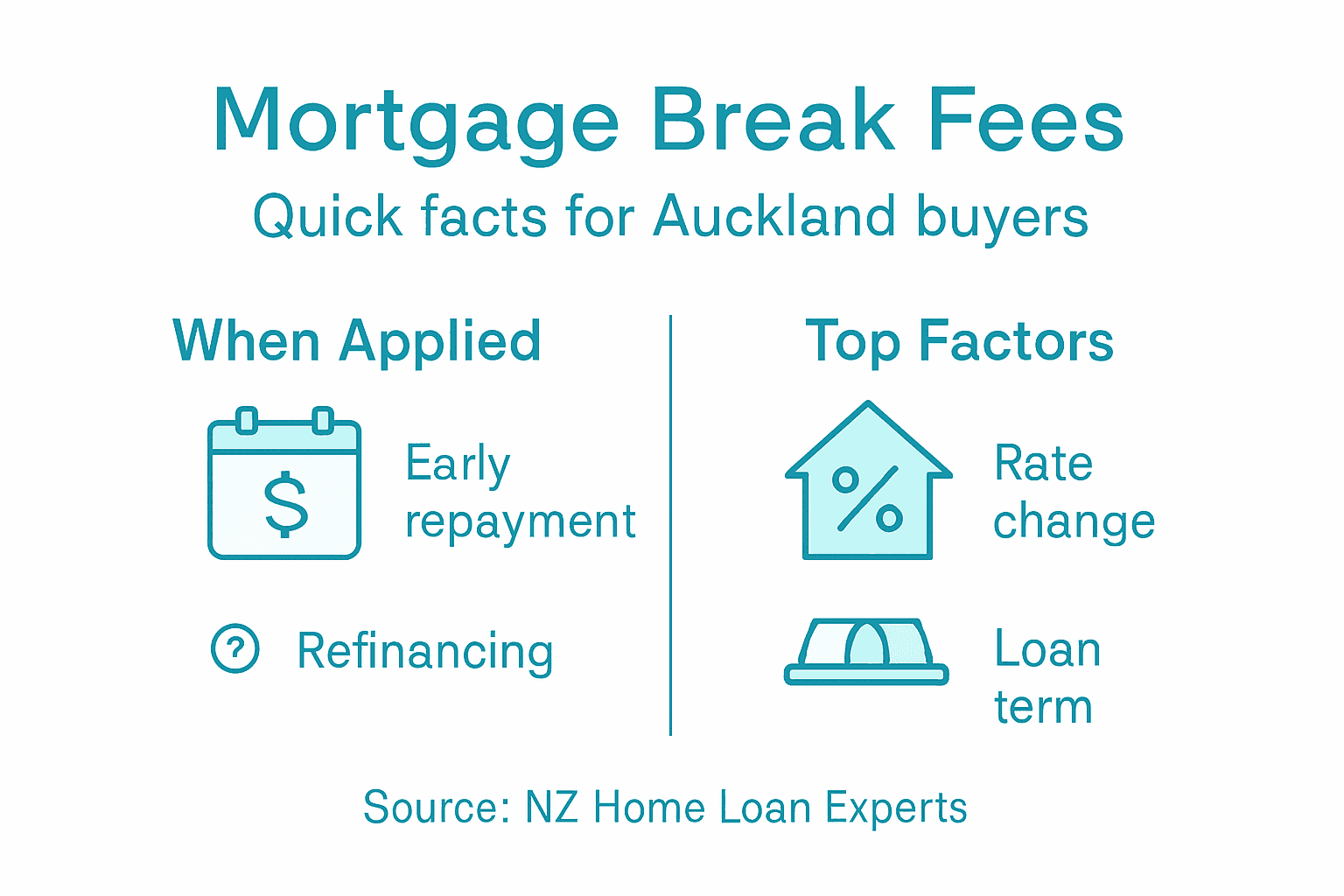
To help Auckland buyers budget and avoid pitfalls, here’s a summary of strategic mortgage planning approaches:
| Strategy | Core Benefit | Risk Reduction | Long-term Outcome |
|---|---|---|---|
| Shorter fixed-rate terms | Smaller break fee potential | Greater repayment flexibility | Better adaptability |
| Split fixed & floating | Diversifies interest rate risk | Reduces exposure to fees | Balanced financial planning |
| Offset accounts | Provides financial cushion | Eases cashflow disruptions | Increased savings potential |
| Regular reviews | Proactive adjustment opportunities | Catch emerging risks early | Improved financial resilience |
Pro tip: Consult a mortgage professional to model multiple scenarios and understand the precise financial trade-offs before committing to any specific loan structure.
Navigate Mortgage Break Fees with Confidence Using Expert Advice
Facing mortgage break fees as an Auckland homebuyer can feel overwhelming given their complex calculations and potentially high costs. The key challenges include understanding how fees are calculated, managing the risks of early fixed-rate loan termination, and budgeting to avoid unexpected financial setbacks. With terms like fixed-rate mortgage, break fee calculation, and refinancing risks in mind, having trusted guidance can make all the difference.

Take control of your mortgage journey today by working with Mortgage Managers, a team of local Auckland mortgage advisers based in Hobsonville. We specialise in helping you navigate these tricky fees and tailor borrowing options to your unique needs across West Auckland, the North Shore and beyond New Zealand. Visit Mortgage Managers for personalised support, insights on borrowing options and financial flexibility, and strategies to minimise break fee risks so you can make confident decisions now. Don’t let break fees catch you off guard – get expert advice and protect your investment today.
Frequently Asked Questions
What are mortgage break fees?
Mortgage break fees are charges incurred by borrowers when they exit a fixed-rate mortgage before the end of the contract term. These fees help banks recover potential financial losses due to lost interest income.
How are break fees calculated by banks?
Break fees are calculated based on factors such as the difference between the original fixed rate and current market rates, the remaining term of the fixed-rate period, and the total outstanding loan amount. Banks use complex formulas to estimate lost future interest payments and related costs.
When do mortgage break fees apply?
Mortgage break fees typically apply in scenarios like selling a property, refinancing with another lender, making additional lump sum repayments, or switching from a fixed to a floating rate mortgage.
What strategies can help minimize break fees for borrowers?
To minimize potential break fees, borrowers can consider shorter fixed-rate terms, a mix of fixed and floating rate options, building an emergency savings buffer, and regularly reviewing their mortgage arrangements.
Recommended
- Early Repayment Charges – Impact on Auckland Home Loans
- Early Repayment Penalties – How They Affect Auckland Buyers
- Mortgage Clause – Crucial for Auckland Home Buyers
- Discover the Best Mortgage Brokers in New Zealand – Mortgage Managers
- Roofing Financing Options Explained: Complete Guide – J. A. Kelly Contracting Services