
TL;DR:
- Solicitors’ fees in New Zealand include professional charges, GST at 15%, and disbursements for third-party costs. Billing typically occurs in 6-minute increments and is influenced by factors like expertise, complexity, and outcomes; transparency through engagement letters is essential. Understanding these components helps clients budget effectively and avoid surprises in their legal costs.
Solicitors’ fees are the charges clients pay to lawyers for professional legal services, covering professional fees, disbursements, and GST. In New Zealand, these charges must be fair and reasonable under Law Society guidelines, meaning the amount you pay reflects far more than just the hours your solicitor spends at their desk. Whether you are buying your first home in Auckland, updating a will, or resolving a property dispute, understanding what drives legal costs puts you in a far stronger position to budget confidently and avoid unwelcome surprises on your invoice.
What are solicitors’ fees and how are they structured?
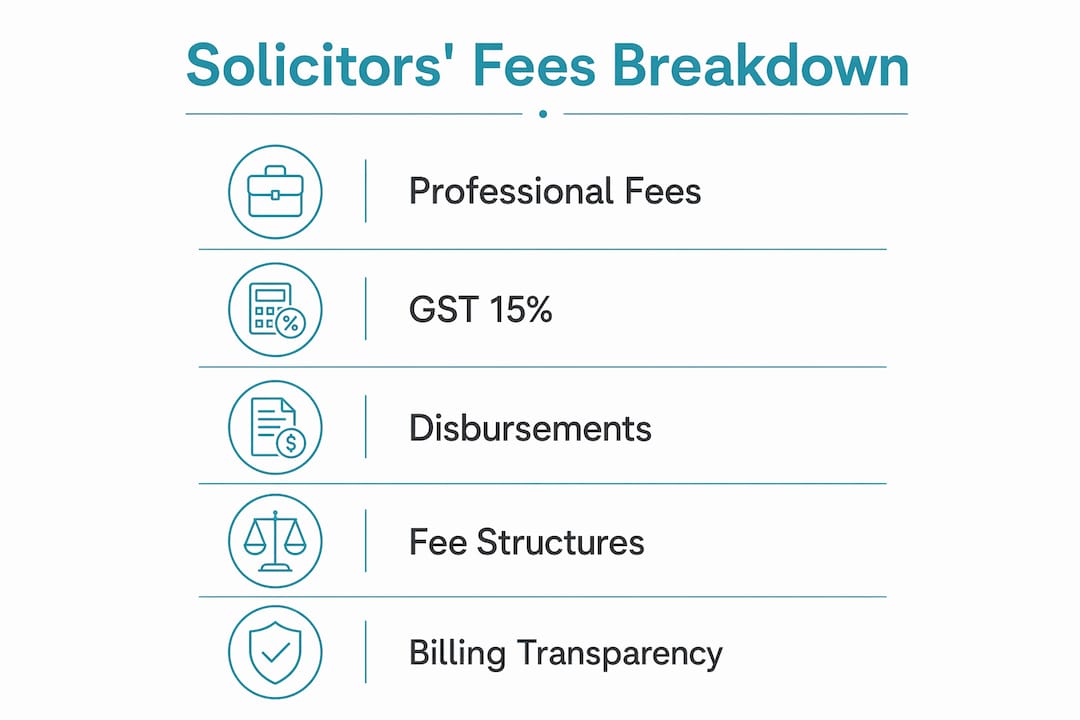
Solicitors’ fees are payments made to a lawyer for their professional services, plus any additional costs incurred on your behalf. Every invoice you receive from a New Zealand solicitor typically breaks down into three distinct buckets: professional fees, GST on those fees, and disbursements. Understanding each component separately is the clearest way to make sense of what you are actually paying for.

Professional fees represent the solicitor’s time and expertise. GST in New Zealand sits at 15% on professional fees, charged as a separate line item on your invoice rather than being baked into the quoted rate. Disbursements are third-party costs your solicitor pays on your behalf, such as court filing fees, Land Information New Zealand search fees, or courier charges. Some disbursements, like government filing fees, are GST-exempt and passed through to you without any GST added. Others, such as fees from GST-registered expert witnesses or couriers, will carry GST.
The solicitors fee structure in New Zealand can take several forms depending on the nature of your matter. Hourly billing, fixed fees, scale charges, and conditional fee arrangements all exist within the local legal market. Knowing which method applies to your situation before work begins is one of the most practical steps you can take.
How do solicitors charge their fees in New Zealand?
Most New Zealand solicitors use time-based billing as their default method. Time is recorded in 6-minute increments, equivalent to one-tenth of an hour, and rounded up to the next unit. A two-minute phone call, for example, is billed as six minutes. A 25-minute meeting becomes 30 minutes. These increments accumulate quickly across a complex matter, which is why asking your solicitor upfront how they record time is genuinely worthwhile.
The main billing methods you will encounter include:
- Hourly rate billing: The solicitor records all time spent and multiplies it by their hourly rate. This is the most common approach for matters where the scope is uncertain.
- Fixed fees: A set price agreed in advance for a defined scope of work. Common for straightforward conveyancing, wills, and company incorporations.
- Scale or itemised charges: Sometimes used in court matters, where fees follow a prescribed schedule rather than pure time recording.
- Conditional fee arrangements: Fees contingent on the outcome of a matter, subject to specific regulatory rules in New Zealand.
- Subscription arrangements: Less common, but some firms offer ongoing legal support for a monthly retainer.
Fixed fee scopes must be clearly defined in writing, including what work is included, what falls outside the scope, and what triggers a shift to hourly billing. Scope creep is one of the most common reasons clients receive a higher bill than expected. If your matter becomes more complex than originally anticipated, your solicitor is obligated to notify you before charging additional fees.
Pro Tip: Ask your solicitor at the very first meeting whether a short phone call or a brief email will be billed as a full 6-minute increment. Some firms have minimum charge policies that apply to every interaction, no matter how brief.
What factors influence the amount of solicitors’ fees?
Fee fairness in New Zealand is a multi-factor test. Time spent is one consideration, but the Law Society recognises that a highly experienced specialist can justifiably charge more than a junior solicitor for the same task, because the outcome and efficiency differ significantly.
The key factors that influence how much do solicitors cost in any given matter include:
- Time and labour: The total hours and effort required to complete the work.
- Skill and specialisation: A solicitor with deep expertise in property law or commercial transactions commands a higher rate than a generalist.
- Complexity and urgency: Matters requiring rapid turnaround or involving unusual legal questions attract higher charges.
- Importance of the matter: The financial or personal significance of the outcome to you as the client.
- Degree of responsibility: The risk and liability the solicitor assumes on your behalf.
- Results achieved: In some contexts, a particularly favourable outcome can justify a higher fee.
- Practice running costs: Overheads including office location, support staff, and technology all feed into the hourly rate.
“Fee fairness in NZ law is a multi-factor test, meaning time spent is important but lawyers can justifiably charge more for their expertise, complexity, and outcomes.” — Lockhart Legal, Terms of Engagement
This multi-factor approach means that comparing solicitor hourly rates alone does not give you the full picture. A solicitor charging $400 per hour who resolves your matter in two hours may represent better value than one charging $250 per hour who takes five hours to reach the same result.
What are typical solicitor hourly rates and costs in New Zealand?
Average solicitor charges in New Zealand vary considerably based on experience, location, and the nature of the work. The table below provides a realistic framework for what you might expect to pay across common legal services.
| Service or rate type | Typical range (NZD, excl. GST) |
|---|---|
| Junior solicitor hourly rate | $180 to $280 per hour |
| Senior solicitor hourly rate | $300 to $500 per hour |
| Partner or specialist hourly rate | $450 to $700+ per hour |
| Residential conveyancing (fixed fee) | $1,200 to $2,500 |
| Simple will (fixed fee) | $200 to $500 |
| Company incorporation (fixed fee) | $500 to $1,200 |
| Court filing disbursement (example) | $200 to $600 (GST-exempt) |
These figures reflect general market conditions and will shift depending on the firm’s size, Auckland versus regional location, and the complexity of your specific matter. GST is quoted separately at 15% on top of professional fees, so a $2,000 conveyancing quote becomes $2,300 once GST is added. Disbursements sit on top of that again.
For home buyers, legal fees in property transactions typically include the solicitor’s professional fee, Land Information New Zealand search fees, title registration costs, and any mortgage documentation fees your lender requires. Budgeting $1,500 to $3,000 all-in for a standard residential purchase is a reasonable starting point, though complex titles or leasehold properties will push costs higher.
Pro Tip: Always ask for a fee estimate in writing before work begins, and confirm whether that estimate includes or excludes GST and disbursements. Ambiguity over GST inclusions is one of the most common sources of billing disputes in New Zealand.
How do engagement letters and billing transparency work?
An engagement letter is the formal document that sets out the terms of your relationship with your solicitor, including how fees will be charged, what the scope of work covers, and how billing will be handled. In New Zealand, engagement letters must specify the fee charging method, whether that is hourly, fixed, or another arrangement, and must be updated if costs are expected to exceed the original estimate.
Here is what a well-structured engagement letter should cover:
- Fee method: Whether you are being charged hourly, on a fixed fee, or by another arrangement.
- Scope of work: A clear description of what is included and what falls outside the agreed fee.
- Billing frequency: How often invoices will be issued and when payment is due.
- Disbursements policy: How third-party costs will be handled and whether GST applies to each.
- Rate review: Hourly rates are typically reviewed annually, and your engagement letter should state when and how you will be notified of any changes.
- Retainer or prepayment requirements: Some firms require a deposit before commencing work.
Transparency in billing is not just good practice. It is a professional obligation. In 2026, the NZ Law Society Standards Committee fined lawyers for failing to communicate material updates and for delayed invoicing, reinforcing that clients have a right to timely, clear information about their legal costs. If your solicitor has not provided an engagement letter or has been vague about costs, you are within your rights to ask for written clarification before authorising further work.
How can clients manage and understand solicitors’ fees better?
You do not need a law degree to manage your legal costs effectively. A few straightforward habits make a significant difference to your final bill and your overall experience working with a solicitor.
- Ask about billing increments early. Find out whether your firm bills in 6-minute units and whether minimum charges apply to emails and phone calls. Small interactions can convert to meaningful fees when rounded up consistently.
- Request a written fee estimate with scope limitations. A good estimate specifies what is included, what is not, and at what point additional costs will be discussed with you.
- Clarify GST and disbursements upfront. Ask whether quoted figures are GST-inclusive or exclusive, and request a list of likely disbursements so you can budget accurately.
- Review each invoice carefully. Check the three components separately: professional fees, GST, and disbursements. Query any line item that is unclear before paying.
- Communicate changes promptly. If your circumstances change or the matter becomes more complex, contact your solicitor immediately. Waiting allows costs to accumulate without your knowledge.
- Keep copies of all invoices and correspondence. If a dispute arises, a clear paper trail is your strongest tool.
The NZ Law Society Standards Committee has reinforced that solicitors carry a proactive obligation to keep clients informed. That obligation works best when clients are equally engaged and willing to ask questions.
Key takeaways
Solicitors’ fees in New Zealand comprise professional fees, GST at 15%, and disbursements, with fairness determined by a multi-factor test that goes well beyond hours spent.
| Point | Details |
|---|---|
| Fee structure has three parts | Every invoice separates professional fees, GST at 15%, and disbursements paid to third parties. |
| Billing increments matter | Time is recorded in 6-minute units rounded up, so even brief calls and emails carry a charge. |
| Fairness is multi-factor | Skill, complexity, urgency, and outcomes all influence whether a fee is considered fair and reasonable. |
| Engagement letters are your protection | A clear engagement letter specifying scope, method, and rates is your best defence against unexpected costs. |
| Ask questions before work begins | Request written estimates, clarify GST treatment, and confirm what triggers additional charges outside the agreed scope. |
Stuart’s take on understanding your legal bill
After working alongside home buyers navigating property transactions for years, the pattern I see most often is this: clients are surprised by their legal bill not because the solicitor did anything wrong, but because no one explained the mechanics of billing before work started. A $350-per-hour rate sounds manageable until you realise that every email reply, every two-minute call, and every document review rounds up to six minutes. Across a complex property purchase, those increments add up to real money.
My honest view is that fixed fees offer the clearest value for straightforward matters like residential conveyancing or a simple will. You know the number going in, and there are no billing surprises at settlement. The catch is that fixed fees only work when the scope is genuinely well-defined. If your property has a complicated title, a cross-lease arrangement, or an unusual vendor condition, a fixed fee quote may not hold.
The single most useful thing you can do before engaging a solicitor is ask for the engagement letter and read it carefully. Check whether the rate is GST-exclusive, confirm what disbursements are expected, and ask what happens if the scope changes. Solicitors who are confident in their pricing will answer these questions clearly and without hesitation. That transparency is a good signal about the working relationship ahead. For home buyers especially, understanding your legal and mortgage costs together gives you a far more accurate picture of what your purchase will actually cost.
— Stuart
How Mortgagemanagers can help you plan for legal costs
Buying a home in New Zealand means managing multiple costs at once, and solicitors’ fees are one piece of a larger financial picture that includes your deposit, loan structure, and ongoing repayments.

Mortgagemanagers is a locally owned Auckland-based mortgage advisory business that helps Kiwi home buyers understand the full cost of purchasing property, not just the loan itself. When you work with a Mortgagemanagers mortgage adviser, you get clear guidance on how to budget for legal fees alongside your home loan, so nothing catches you off guard at settlement. Based in Hobsonville and servicing clients across Auckland, the North Shore, West Auckland, and remotely throughout New Zealand, Mortgagemanagers is ready to help you move forward with confidence.
FAQ
What are solicitors’ fees made up of in New Zealand?
Solicitors’ fees in New Zealand comprise three components: professional fees for the solicitor’s time and expertise, GST at 15% on those fees, and disbursements covering third-party costs such as court filing fees and property search fees.
How much do solicitors cost per hour in NZ?
Hourly rates in New Zealand typically range from $180 to $280 for junior solicitors and $300 to $700 or more for senior solicitors and specialists, all excluding GST.
What is a fixed fee and when does it apply?
A fixed fee is a set price agreed in advance for a clearly defined scope of work. It is common for residential conveyancing, wills, and company incorporations, but scope changes can trigger additional hourly charges.
Why do small tasks like emails still appear on my invoice?
New Zealand solicitors commonly bill in 6-minute increments rounded up, meaning even a brief email or two-minute phone call is charged as one unit. These small charges accumulate across a matter.
What should I do if I think my solicitor’s fee is too high?
Ask your solicitor for a detailed breakdown of all charges and compare it against your engagement letter. If you believe the fee is not fair and reasonable, you can raise a complaint with the New Zealand Law Society.