
TL;DR:
- Most New Zealand borrowers can access mortgage rates at least 0.5% below the market average for their loan term. Improving your deposit size and preparing your paperwork can significantly enhance your chances of securing better rates. Comparing lenders and negotiation with a broker can help you find genuinely competitive mortgage offers.
For most New Zealand borrowers today, a good mortgage rate sits noticeably below the market average for your chosen term. As of 19 July 2026, Opes Partners reports the lowest 6-month fixed rate at 4.49% (offered by ASB and Kiwibank) and the lowest 1-year fixed rate at 4.65%, while the Reserve Bank of New Zealand (RBNZ) reports the average floating rate at 6.15% and the 2-year fixed rate at 5.69% as of June 2026. A practical rule of thumb: if your offered rate is more than 0.5% below the market average for that term, you’re doing better than most borrowers. Your first step is to check your loan-to-value ratio (LVR) and, if you’re not already working with a broker, speak with Mortgagemanagers to see what’s genuinely available for your situation.
What makes a rate ‘good’ depends on three things:
- Your LVR — most special rates require at least 20% equity (80% LVR or better)
- Your loan term — a 4.49% 6-month fix looks great today but may reset higher
- Your borrower profile — credit history, income stability, and loan size all affect what lenders will offer you
Rates checked against RBNZ published data and major NZ bank advertised rates as of June–July 2026. Live rates change frequently — verify directly with lenders or a mortgage adviser before making decisions.
Table of Contents
- Current NZ mortgage rate benchmarks by product type
- How the RBNZ, funding costs and lender decisions actually set your rate
- Fixed, variable, or split: which product gives you the best rate for your situation?
- How to compare mortgage offers properly — beyond the headline rate
- Practical steps to improve the mortgage rate you’re offered
- What to expect when you switch or refinance in New Zealand
- Is 4.75% good? Is 6% good? Will rates return to 3%?
- How we define ‘good’ and the sources behind the benchmarks
- Key takeaways
- What a local adviser actually sees when shopping rates for clients
- Mortgagemanagers: your rate-shopping partner across New Zealand
- Useful sources for checking live NZ mortgage rates
Current NZ mortgage rate benchmarks by product type
Understanding where the market sits right now gives you the clearest picture of whether a quoted rate deserves a second look or a polite decline.
| Term | Market average (owner-occupier) | Lowest available (special) | Notes |
|---|---|---|---|
| Floating | 6.15% | — | Requires strong credit and LVR |
| 6-month fixed | — | 4.49% | ASB, Kiwibank (July 2026) |
| 1-year fixed | 4.71% | 4.65% | Opes Partners (July 2026) |
| 2-year fixed | 5.69% | — | RBNZ June 2026 average |
| 3-year fixed | — | — | Canstar average |
| 5-year fixed | — | — | Canstar average |
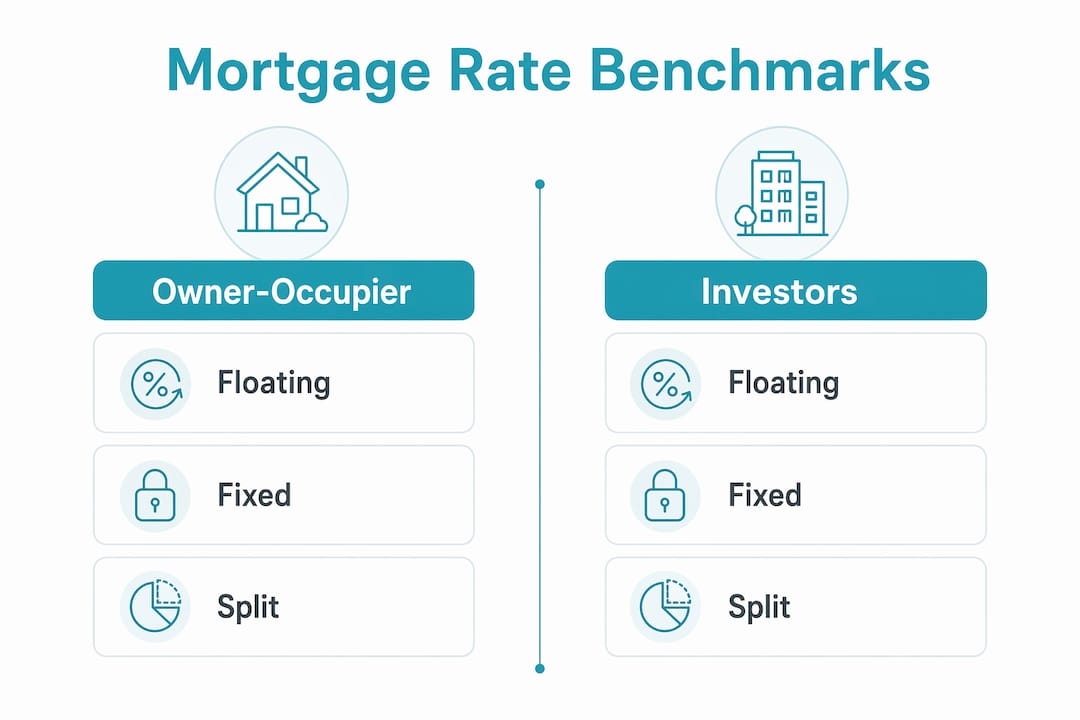
Sources: RBNZ June 2026; Canstar NZ; Opes Partners July 2026. Averages reflect standard advertised rates; special rates require minimum 20% equity and may carry additional conditions.
Conditions that typically sit behind the lowest advertised rates:
- Minimum 20% deposit or equity (80% LVR) — special rates require this as a baseline across most NZ lenders
- New lending or refinance from another bank (retention specials differ)
- Salary credited to the lending bank in some cases
- Clean credit history with no recent defaults or arrears
Sample repayment comparison — owner-occupier vs investor
Owner-occupier example: A typical loan amount with a standard term and fixed rate will have a certain monthly repayment and total interest over the fixed term.
Investor example: Investor loans generally have slightly higher rates, resulting in somewhat higher repayments for similar loan amounts and terms. Investor rates across most NZ lenders sit marginally higher than owner-occupier rates for equivalent terms, reflecting the different risk profile lenders assign to investment lending.
Pro Tip: Run your own numbers using Mortgagemanagers’ repayment calculator guidance — even a 0.25% rate difference on a $600,000 loan adds up to thousands of dollars over a 25-year term.
How the RBNZ, funding costs and lender decisions actually set your rate
Your mortgage rate is not set in a vacuum. It is the product of at least three layers of decision-making, and understanding each one helps you know when a quoted rate is genuinely competitive and when it is not.

The Reserve Bank of New Zealand sets the Official Cash Rate (OCR), which is the overnight rate at which banks borrow from the central bank. When the OCR rises, banks’ short-term funding costs increase, and retail mortgage rates follow. When the OCR falls, the reverse tends to happen, though not always immediately or in equal measure. The OCR’s impact on consumer mortgage pricing is real but filtered — banks do not pass on every OCR movement dollar-for-dollar.
Above the OCR, lenders factor in their own funding costs (including the rates they pay depositors and wholesale money markets), their credit risk appetite, and competitive pressure from other banks. This is why two banks can offer meaningfully different rates on the same day for the same loan type. Lenders also price by LVR band — borrowers with 20% or more equity access special rates, while those below that threshold typically pay a higher standard rate or a low-equity premium.
Borrower-side factors that directly affect your offered rate:
- Deposit size and LVR — the single biggest lever most borrowers can control
- Credit score and credit history — defaults, arrears, and multiple recent credit applications all push rates up
- Income stability and serviceability — PAYE employment is viewed more favourably than self-employment in many cases
- Loan size — larger loans sometimes attract better pricing, particularly through a broker
- Loan features chosen — offset accounts, revolving credit, and redraw facilities can carry a small rate premium
Pro Tip: Mortgage interest is calculated daily on your outstanding balance, which means even a 0.5% rate reduction has a compounding effect over time. Improving your LVR from 85% to 80% before applying — even by saving an extra few months — can unlock a materially lower rate.
Fixed, variable, or split: which product gives you the best rate for your situation?
The headline rate is only part of the story. Whether that rate is genuinely good for you depends on the product it is attached to.

| Feature | Fixed | Variable (floating) | Split |
|---|---|---|---|
| Rate certainty | High — locked for term | None — moves with market | Partial — fixed portion locked |
| Flexibility | Low — break fees apply | High — repay any time | Moderate — floating portion flexible |
| Likely cost trajectory | Predictable | Uncertain | Balanced |
| Break costs | Can be significant | None | Applies to fixed portion only |
| Best for | Certainty seekers, budgeters | Those expecting rate falls | Borrowers wanting both |
When a lower fixed rate is worth the trade-off:
- You are on a tight budget and need certainty in your repayments for the next 1–3 years.
- You believe rates are more likely to rise than fall over your chosen term.
- You do not plan to sell or refinance during the fixed period, avoiding break fees.
When floating or split makes more sense:
- You expect to receive a lump sum (inheritance, bonus, property sale proceeds) and want to make a large repayment without penalty.
- You think rates will fall further and want to capture that downside quickly.
- You want the flexibility to switch lenders without a break-cost calculation.
Sorted NZ recommends a split mortgage as a practical middle path — fix the bulk of your loan for predictability and keep a smaller floating portion for extra repayments and agility. For many NZ borrowers, this is the most sensible structure rather than going all-in on either product. As of mid-2026, many advisers report clients choosing slightly longer fixed terms to lock in certainty while the rate environment remains uncertain.
How to compare mortgage offers properly — beyond the headline rate
A low headline rate can mask a loan that costs you more in the long run. Here is what to check before you sign anything.
Checklist for comparing offers:
- Comparison rate: Does the lender publish a comparison rate that includes fees? If not, calculate the effective cost yourself.
- Application and establishment fees: Some lenders charge $0; others charge several hundred dollars.
- Ongoing fees: Monthly or annual account-keeping fees add up over a 25-year term.
- Conditional special-rate terms: Is the special rate contingent on salary crediting, a minimum loan size, or a specific LVR? Confirm you qualify before comparing.
- LVR bands: Confirm which LVR band your deposit puts you in — the rate can change significantly at the 80% threshold.
- Redraw and offset features: These can save you interest but sometimes carry a rate premium. Weigh the cost against the benefit.
- Repayment flexibility: Can you make extra repayments on a fixed loan? Some lenders cap this at $500–$1,000 per year without penalty.
- Break costs: Understand the break-fee formula before fixing. On a large loan, breaking a fixed term early can cost thousands.
Red flags to watch for:
- A rate advertised without any LVR or credit conditions stated
- Fees buried in the fine print that are not included in the headline comparison
- A “special” rate that requires you to bundle insurance or other products you do not need
- Investor rates presented as owner-occupier rates — investor rates are typically higher across all terms
Questions to ask a lender or broker when reviewing an offer:
- What LVR do I need to qualify for this rate?
- Are there any conditions on extra repayments during the fixed term?
- What is the break-fee formula, and can you give me an estimate based on my loan?
- Does this rate include all fees, or are there establishment or ongoing charges on top?
- Is this rate available to investors, or is it owner-occupier only?
Practical steps to improve the mortgage rate you’re offered
Getting a better rate is rarely about luck. It is about preparation, timing, and knowing which levers actually move the needle.
- Check your LVR first. If you are sitting at 82% LVR, it may be worth saving for a few more months to cross the 80% threshold. The rate difference between standard and special pricing can be 0.5% or more.
- Tidy your bank statements. Lenders review three to six months of statements. Reduce discretionary spending, clear any overdrafts, and avoid large unexplained deposits or withdrawals in the months before you apply.
- Gather your income documents early. Two years of tax returns for self-employed borrowers, three months of payslips for PAYE earners, and any rental income statements. Having these ready speeds up the process and signals to lenders that you are organised.
- Get quotes from multiple lenders. Do not accept the first offer. ANZ, ASB, Westpac, and Kiwibank all price differently on any given day, and the gap between the best and worst offer for the same borrower can be meaningful.
- Ask for a rate match. If you have a competing offer in writing, present it to your current lender and ask them to match or beat it. Banks often will — especially for retained business — but they rarely volunteer this.
- Use a broker for complex situations. If you have a low deposit, a non-standard income, or an investment loan, a broker like Mortgagemanagers can access lenders and products that are not available directly to the public. Brokers can negotiate better offers on your behalf and know which lenders are most competitive for your specific profile right now.
What banks will typically negotiate on:
- The interest rate itself (especially with a competing offer)
- Establishment fees (often waived for refinancers)
- Cashback offers for switching
What banks rarely budge on:
- LVR-based pricing tiers
- Low-equity premiums for sub-80% LVR borrowers
- Investor vs owner-occupier rate distinctions
Pro Tip: Presenting multiple current lender offers, demonstrating strong serviceability, and asking whether a lender can match a competitor’s special rate are the three tactics that most consistently produce a better outcome. A mortgage adviser does this on your behalf across a panel of lenders simultaneously.
What to expect when you switch or refinance in New Zealand
Refinancing can save you a significant amount over the life of your loan, but it comes with costs and a timeline you should plan for.
Typical refinance timeline:
- Preparation (1–2 weeks): Gather documents, check your current loan’s break-fee position, and get quotes from alternative lenders or through a broker.
- Application (1–2 weeks): Submit your application with the new lender. Processing times vary by lender and complexity.
- Valuation (3–7 days): Most lenders require a registered valuation or desktop valuation, particularly if your LVR is close to a pricing threshold.
- Approval and offer (1–2 weeks): Conditional approval, then formal offer once all conditions are met.
- Settlement (1–2 weeks): Legal work, discharge of the old mortgage, and registration of the new one. Your solicitor handles this.
Typical costs to factor in:
- Break fee (if breaking a fixed term early): varies widely — can be $0 or several thousand dollars depending on the rate differential and remaining term
- Valuation fee: approximately $500–$900 for a registered valuation
- Legal fees: approximately $1,000–$1,500 for a straightforward refinance
- New lender establishment fee: $0–$400 depending on the lender
Break-even example:
Say you are refinancing a $550,000 loan and your new rate saves you $150 per month in repayments. Your total switching costs are $2,500 (break fee + legal + valuation). At $150 per month in savings, you break even in approximately 17 months. If you plan to stay in the property for at least two years, the switch is likely worth it. If you are planning to sell within 12 months, the maths probably does not stack up.
Use Mortgagemanagers’ mortgage repayment guidance to run your own break-even numbers before committing to a switch.
Is 4.75% good? Is 6% good? Will rates return to 3%?
These are the questions that come up most often, and the honest answers depend on context.
Is 4.75% a good mortgage rate in New Zealand right now?
Yes, for most borrowers. With the 1-year fixed market average at 4.71% and the lowest available 6-month rate at 4.49%, a rate of 4.75% is close to market average for short fixed terms. For a 2-year or longer fix, 4.75% would be well below average and genuinely competitive. If you are being offered 4.75% on a 2-year or 3-year fixed, accept it. If it is on a floating rate, keep shopping.
Is 6% a good mortgage rate in New Zealand right now?
Not particularly, unless it is a floating rate. The RBNZ reports the average floating rate at 6.15% as of June 2026, so 6% floating is marginally below average. For any fixed term, 6% is above the market average across all terms currently published. If you are being quoted 6% on a fixed rate, you should be asking why and comparing alternatives.
Will mortgage rates return to 3%?
This is the question every borrower wants answered, and the honest response is: probably not in the near term. The sub-3% rates seen in 2020–2021 were a product of emergency monetary policy during the COVID-19 pandemic. The RBNZ’s own data shows the 2-year fixed rate has moved from a high of 7.48% in January 2024 down to 5.69% by June 2026, a meaningful easing cycle. Whether rates fall further depends on inflation, global economic conditions, and RBNZ OCR decisions. Most economists expect further gradual easing, but a return to 3% would require economic conditions that are not currently on the horizon.
The RBNZ’s published 2-year fixed rate fell from 7.48% in January 2024 to 5.69% by June 2026 — a drop of 1.79 percentage points in 18 months.
How we define ‘good’ and the sources behind the benchmarks
A ‘good’ mortgage rate, as used throughout this article, means a rate that is at least 0.5% below the market average for the equivalent term and LVR band, or within the advertised lowest band for borrowers with 80% LVR or better. This definition follows the practical benchmark used by NZ Bulletin’s rate comparison methodology.
| Source | What it provides | Date checked |
|---|---|---|
| RBNZ (B20 data table) | Average floating and fixed rates advertised by NZ banks | June 2026 |
| Canstar NZ | Owner-occupier and investor averages, min/max by term | July 2026 |
| Opes Partners | Lowest available special rates by term and lender | 19 July 2026 |
| RateMate NZ | Live lender rate listings and LVR condition details | July 2026 |
Assumptions behind the repayment examples:
- Loan amounts of $600,000 and $550,000 are used as representative figures for NZ urban property markets
- 25-year principal-and-interest repayment structure
- Rates used are the market averages or lowest specials as published at the date of checking
- Repayment figures are approximate and calculated on a standard amortisation basis
For live rate checks, use the sources listed in the useful sources section below. Rates move frequently — a weekly check during active shopping is reasonable, and a monthly check for existing borrowers monitoring the market.
Key takeaways
A good mortgage rate in New Zealand today means landing noticeably below the market average for your term — and with the right LVR and preparation, that is genuinely achievable.
| Point | Details |
|---|---|
| Current benchmarks | Official statistics report average floating and fixed rates around current market levels; specials are typically below these averages. |
| LVR is the key lever | Most special rates require a deposit position above a certain threshold, such as 80% LVR — improving your deposit position unlocks materially better rates. |
| Product choice matters | The same numerical rate on different product types can have different implications for borrowers. |
| Compare beyond the headline | Check fees, break costs, repayment flexibility, and LVR conditions before accepting any offer. |
| Mortgagemanagers can help | Brokers shop across multiple lenders and negotiate on your behalf, especially helpful in complex or low-deposit scenarios. |
What a local adviser actually sees when shopping rates for clients
There is a gap between what the rate tables show and what borrowers actually get — and it is wider than most people expect.
The clients who consistently land the best rates are not always the ones with the highest incomes. They are the ones who arrive prepared: clean bank statements, a clear picture of their LVR, and a willingness to consider more than one lender. When you walk into a bank alone, you are one customer. When a broker presents your file to three or four lenders simultaneously, you become a competitive opportunity — and lenders respond differently to that dynamic.
First-home buyers, borrowers with smaller deposits, and investors with multiple properties tend to benefit most from broker support. These are the situations where lender criteria vary most significantly, where the difference between the right and wrong lender can be tens of thousands of dollars over the loan term, and where the paperwork and process complexity genuinely warrants having someone in your corner who knows the system.
The most common quick win? Borrowers who are sitting at 81% or 82% LVR and do not realise that a small additional payment — sometimes from KiwiSaver or a family contribution — would push them below 80% and unlock a materially better rate. That single move, more than any negotiation tactic, tends to have the biggest immediate impact on the rate offered.
Mortgagemanagers: your rate-shopping partner across New Zealand
Getting a sharp mortgage rate is rarely a solo effort. Mortgagemanagers is a commission-based mortgage advisory service based in Hobsonville, Auckland, with the reach to help borrowers throughout New Zealand. The service covers first-home buyers, existing homeowners looking to refinance, low-deposit borrowers, investors, and anyone with a non-standard lending situation.

Rather than approaching one bank and hoping for the best, Mortgagemanagers shops your application across a panel of lenders, negotiates on your behalf, and matches your profile to the lender most likely to offer the sharpest terms. For complex situations — self-employed income, low deposit, or investment portfolios — this access to multiple lenders and knowledge of each bank’s current appetite makes a real difference to the rate and structure you end up with.
Transparent disclosure: Mortgagemanagers earns a commission from the lender upon settlement of a successful loan. There is no upfront fee to you as a borrower. Full disclosure details are available on the company disclosure page.
Ready to find out what rate you can actually access? Talk to the team at Mortgagemanagers and get a clear picture of where you stand.
Useful sources for checking live NZ mortgage rates
Rates move. The sources below are the most reliable places to check current figures and run your own numbers.
- RBNZ Housing Statistics: The primary source for average floating and fixed rates advertised by NZ banks. Updated monthly. Use this to benchmark any rate you are quoted against the official market average.
- Canstar NZ Home Loans: Publishes owner-occupier and investor rate averages with min/max ranges by term. Useful for seeing the spread between the best and worst offers in the market.
- Opes Partners Rate Table: Updated frequently with the lowest available special rates by term and lender. Good for tracking where the bottom of the market sits.
- RateMate NZ: Live lender rate listings with LVR condition details. Helpful for understanding which lenders are most competitive for your specific LVR band.
- Sorted NZ — Mortgage Types: New Zealand’s government-backed financial guidance site. Excellent for understanding fixed vs floating vs split structures without a sales agenda.
- Mortgagemanagers — NZ mortgage rates guide: In-house guidance on rate drivers, borrower preparation, and current NZ market context.
- Mortgagemanagers — repayment calculator: Worked examples and calculator guidance for estimating repayments at different rates and loan sizes.
Rate check frequency recommendation: check weekly when you are actively shopping; monthly if you are monitoring the market as an existing borrower. The RBNZ updates its published averages monthly; lender specials can change weekly or even daily.
This article provides general information about New Zealand mortgage rates and is not personalised financial advice. Confirm current rates and your eligibility with a licensed mortgage adviser or lender before making any borrowing decisions.