
To get a house loan in New Zealand, you need verified photo ID, proof of income (payslips or two years of tax returns), evidence of your deposit or savings, three months of consecutive bank statements, a list of existing debts, and the property details or a signed sale and purchase agreement.
Most lenders expect a substantial deposit to access their most competitive rates, in line with Reserve Bank of New Zealand (RBNZ) LVR guidance. If you’re a first-home buyer with a smaller deposit, the Kāinga Ora First Home Loan can allow you to borrow with as little as 5%, subject to income caps and eligibility criteria. Mortgagemanagers, based in Hobsonville and serving buyers across Auckland and remotely throughout New Zealand, can help you pull this pack together and place your application with the right lender.
Here’s a quick summary of what you’ll need:
- Photo ID: Passport, New Zealand driver’s licence, or birth certificate
- Proof of income: Payslips (employed) or tax returns and financial statements (self-employed)
- Deposit evidence: Bank statements, KiwiSaver balance letter, or gift declaration
- Bank statements: Three consecutive months showing income credits and spending patterns
- Debt disclosures: Statements for all loans, credit cards, and buy-now-pay-later accounts
- Property details: Sale and purchase agreement, or address and rates information if identified
Table of Contents
- What documents do you need for a mortgage application?
- What income evidence do salaried borrowers need?
- What do self-employed borrowers need to provide?
- How much deposit do you need, and what are your LVR options?
- How do lenders assess your debts and living expenses?
- What property documents does a lender need?
- Credit checks, consent, and handling adverse history
- What are the steps to get a house loan, and how long does it take?
- How a mortgage adviser from Mortgagemanagers can help you
- Key takeaways
- The mistakes that cost borrowers the most time
- Ready to get your application moving with Mortgagemanagers?
- Useful New Zealand sources
What documents do you need for a mortgage application?
Lenders and brokers work from a standard document pack. Having everything grouped and ready before your first appointment saves days, sometimes weeks, of back-and-forth. Below is a grouped checklist covering every category a New Zealand lender will ask about.
Identification
- Primary ID: Current New Zealand passport, overseas passport, or New Zealand driver’s licence with photo
- Secondary ID: Birth certificate, citizenship certificate, or a recent utility bill or rates notice (no more than three months old) as proof of address
- Lenders typically need two forms of ID if you’re a new customer; one if you already bank with them
- Certified copies or clear digital PDFs are usually acceptable — ask your broker or lender which format they prefer
Proof of income (employed borrowers)
- Two to three most recent payslips showing gross and net pay
- Employment contract or a signed employer letter confirming start date, hours, and base salary
- IRD income summary if requested, particularly for the most recent financial year
- Three months of bank statements showing salary credits (required if direct deposit is the primary evidence)
Proof of income (self-employed borrowers)
- Last two years of personal tax returns and Notices of Assessment from Inland Revenue
- Business financial statements (profit and loss, balance sheet) prepared by a chartered accountant
- Accountant’s letter confirming the business is a going concern and your income is ongoing
- GST returns or bank statements showing business income flows
Proof of deposit and savings
- Bank statements covering at least three months showing the deposit funds building or sitting in your account
- KiwiSaver balance letter from your provider (ask for a written balance estimate)
- Statutory declaration or gift letter if any portion of the deposit is gifted by a family member
- Evidence of sale proceeds or equity release if you’re using funds from a property sale
Debts and living expenses
- Most recent statements (minimum three months) for every personal loan, car finance, student loan, credit card, and buy-now-pay-later account
- Scheduled repayment amounts for each liability
- A household budget or spending summary if your bank statements show irregular or high discretionary spending
Property paperwork
- Signed sale and purchase agreement (once you have one)
- Deposit receipt from the real estate agent
- Certificate of title or land information memorandum (LIM) if available
- Recent council rates notice
Other supporting documents
- Signed credit check consent form (lenders need written authority before pulling your credit report)
- Trustee or director details if the loan is in a trust or company structure
- Evidence of Kāinga Ora eligibility or any other government assistance you intend to use
Pro Tip: Scan and name every document clearly before your appointment — for example, “Payslip_March2026.pdf” — so your broker can upload them to a lender portal without delay. A down payment calculator can also help you confirm your savings target before you gather deposit evidence.
What income evidence do salaried borrowers need?
For employed borrowers, lenders want to see that your income is stable, regular, and sufficient to service the loan comfortably. The core documents are straightforward, but the gaps are where applications stall.

Your two to three most recent payslips are the starting point. Pair them with an employment contract or a letter from your employer confirming your start date, contracted hours, and base salary. If you’ve recently changed roles, lenders will want to see that the new position is permanent or at least past any probationary period — a probationary employee is treated as higher risk, and some lenders will decline until probation ends.
Bank statements matter here too. Three months of consecutive statements showing your salary landing in the same account each pay cycle confirm that the payslips reflect reality. If your income includes regular overtime or shift allowances, lenders will typically average those amounts over the most recent 12 months rather than taking the highest figure.
Pro Tip: If you’re on casual or irregular hours, gather six months of payslips rather than three. Lenders assessing variable income want enough history to calculate a reliable average, and a longer run of evidence reduces the chance of a request for more information mid-assessment.
Bonuses and commission income are assessed differently again. Most lenders will average two years of bonus history and include only a portion of that figure in your serviceable income. If a significant part of your pay is variable, ask your broker how a specific lender treats it before you apply — lender policies vary more than most borrowers expect.
What do self-employed borrowers need to provide?
Self-employed applicants, contractors, and company directors face a higher documentation bar than salaried employees, but the process is manageable with the right preparation.

Lenders typically request the last two years of personal tax returns, Notices of Assessment from Inland Revenue, and business financial statements covering the same period. Assessment times for self-employed applications are often longer, so building in extra lead time is worth it.
The key documents to prepare:
- Last two years’ personal tax returns filed with Inland Revenue
- Notices of Assessment for both financial years (download from myIR)
- Business financial statements (profit and loss account and balance sheet) prepared and signed by a chartered accountant
- Accountant’s letter confirming the business is trading, your role, and that income is expected to continue
- Three to six months of business bank statements showing consistent income flows into the business account
- GST returns for the most recent period if your business is GST-registered
Some lenders will accept 12 months of evidence rather than two years if your cashflow is strong and consistent, though this is lender-specific and usually requires a compelling accountant’s letter; however, the standard requirement remains two years of tax returns, Notices of Assessment, and business financials.
Pro Tip: If your most recent financial year shows a dip in profit due to a one-off expense or a slow period, have your accountant prepare a brief written explanation. Lenders can work with temporary fluctuations when they’re clearly explained — unexplained drops in income are what trigger declines.
Directors who pay themselves a salary through their company need to document both the PAYE salary and any drawings or dividends separately. Lenders assess these differently, and conflating them in your application creates confusion that slows approval.
How much deposit do you need, and what are your LVR options?
Deposit size is one of the biggest levers in your home loan application. It affects your interest rate, your eligibility for certain lenders, and how quickly your application moves through assessment.
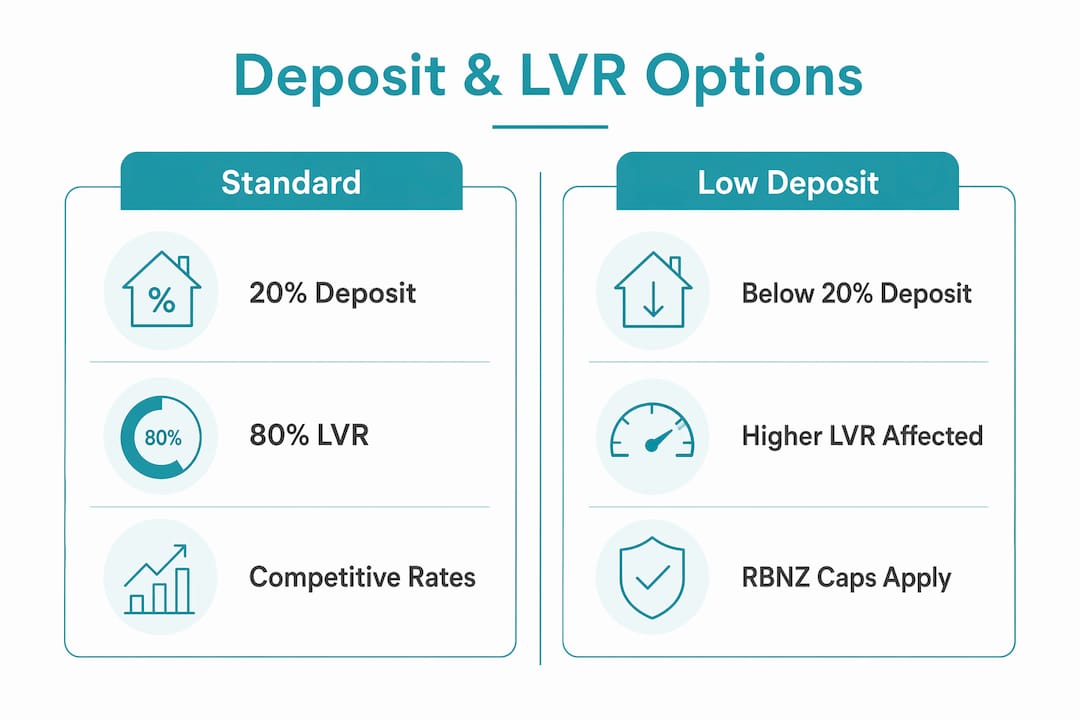
The 20% standard
Most New Zealand lenders use a 20% deposit (80% LVR) as the benchmark for their most competitive rates and fastest approvals. At this level, you avoid low equity premiums and access the full range of lender products. The amount required scales with purchase price, with larger properties requiring proportionally larger deposits.
Low-deposit options
RBNZ LVR caps limit the share of new lending that banks can write above 80% LVR, which means low-deposit slots are genuinely constrained. When lenders do approve a sub-20% deposit loan, they typically add a low equity premium (LEP) or rate loading to the interest rate. That loading can add meaningfully to your total interest cost over the life of the loan. For a full picture of which lenders currently offer low deposit options, Mortgagemanagers maintains a practical guide to current routes.
Kāinga Ora First Home Loan
The Kāinga Ora First Home Loan is a government-backed scheme that allows eligible first-home buyers to purchase with a 5% deposit. Income caps apply: $95,000 gross per year for a single applicant and $150,000 combined for two or more borrowers. Participating lenders administer the scheme, so your broker can confirm which lenders are currently accepting applications and whether you meet the criteria.
Deposit reality check: Industry commentary consistently shows that lenders prioritise 20% deposit borrowers for the best rates and quickest approvals. Low-LVR lending capacity is limited, and a rate loading on a high-LVR loan can cost you significantly more over a 25-year term than waiting an extra year to save a larger deposit.
Pro Tip: KiwiSaver funds, gifted money from family, and equity from a property sale are all acceptable deposit sources — but each needs specific documentation. Use the Mortgagemanagers deposit requirements guide to confirm what evidence each source requires before your appointment.
How do lenders assess your debts and living expenses?
Every liability you carry reduces the amount a lender will let you borrow. Understanding how lenders calculate this helps you prepare, and in some cases, take steps to improve your position before applying.
-
List every liability you hold. Personal loans, car finance, student loans, credit cards (including cards with a zero balance — lenders assess the credit limit, not the current balance), buy-now-pay-later accounts, and any joint debts all count. A credit card with a $10,000 limit is treated as a $10,000 commitment regardless of what you owe on it.
-
Gather the most recent statements for each. Lenders want at least three months of statements showing the current balance and scheduled repayment. Download these from your online banking and have them ready as PDFs.
-
Understand how living expenses are assessed. Lenders pull three to six months of bank transaction history and use it to estimate your actual monthly spending on food, transport, subscriptions, childcare, and discretionary items. If your statements show high or erratic spending, a detailed household budget prepared by you or your accountant can provide helpful context.
-
Run a simple serviceability check. Add up all your monthly debt repayments and estimate your living costs. Lenders subtract these from your net income to determine what’s left for a mortgage payment. If the remaining figure is tight, reducing a credit card limit or paying off a small personal loan before applying can materially increase your borrowing capacity.
-
Disclose everything. Undisclosed debts are one of the most common reasons applications are declined or delayed. Lenders run credit checks and will find liabilities you haven’t mentioned — and an omission looks far worse than the debt itself.
What property documents does a lender need?
Once you’ve found a property, the paperwork shifts from personal finance to the asset itself. Lenders need enough information about the property to assess its value and confirm it’s acceptable security.
- Sale and purchase agreement: The signed agreement is the trigger for a full application. Lenders check the purchase price, the settlement date, any conditions (finance, building report, LIM), and the deposit amount already paid. Make sure your finance condition gives you enough time — typically 10–15 working days — to complete the lender’s assessment.
- Deposit receipt: Confirmation from the real estate agent or vendor’s solicitor that your initial deposit has been paid.
- Certificate of title or LIM: The certificate of title confirms ownership and any encumbrances. A Land Information Memorandum from the local council covers zoning, consents, and any known issues with the property.
- Council rates notice: Confirms the property address and current rates, which lenders use as part of their records.
- Building report: Not always required by lenders, but strongly recommended for your own protection. If a report flags structural issues, the lender’s valuer may note them too.
For new builds and construction loans, lenders also need a fixed-price building contract, the builder’s details and licence number, a construction schedule, and evidence of staged draw-down milestones. These applications follow a different process and typically take longer to assess.
Credit checks, consent, and handling adverse history
Your credit file is one of the first things a lender reviews, and understanding what’s on it before you apply puts you in a much stronger position.
- Consent comes first. Lenders need your written authority to pull a credit report. Sign and return the consent form early — it’s a simple step that removes a common delay.
- What lenders see: Your credit report shows defaults, missed or late payments, repayment history, any bankruptcies or insolvency events, and the number of credit enquiries made in recent years. Multiple enquiries in a short period can signal financial stress, which is one reason to avoid applying to several lenders simultaneously.
- If you have adverse history: Prepare a short written explanation covering what happened, when it was resolved, and what has changed since. Evidence of rehabilitation — a repaid default, a clear period of on-time payments — carries real weight. Lenders are not looking for perfection; they’re looking for a credible story and a pattern of recovery.
- Order your own report first. You can request a free credit report from Centrix, Equifax, or Illion before you apply. Check for errors — incorrect defaults or outdated information do appear, and correcting them before a lender sees the file avoids unnecessary complications.
Pro Tip: Understanding how credit history affects lending decisions is worth doing before you apply. A single corrected error on your credit file can shift a lender’s assessment from a decline to a conditional approval.
What are the steps to get a house loan, and how long does it take?
Knowing what happens at each stage means you won’t be caught off guard, and you’ll know exactly what to prepare next.
-
Pre-approval (1–3 business days). Submit your document pack — ID, income evidence, bank statements, deposit proof, and debt disclosures. The lender runs a credit check and issues a conditional pre-approval confirming how much they’ll lend. Pre-approval is not a guarantee, but it tells you your budget and shows vendors you’re a serious buyer.
-
Full application and property valuation (5–15 business days). Once you have a signed sale and purchase agreement, you lodge the full application with the property details attached. The lender orders an independent valuation of the property. Access issues, complex properties, or rural locations can extend the valuation timeline.
-
Conditional approval. The lender issues approval subject to conditions — typically satisfactory valuation, confirmation of insurance, and any outstanding document requests. Work through these conditions promptly; each outstanding item adds days.
-
Final (unconditional) approval. Once all conditions are met, the lender issues final approval. Your solicitor can then confirm the finance condition on your sale and purchase agreement is satisfied.
-
Settlement (typically 20–40 days after signing). Your solicitor and the vendor’s solicitor coordinate the transfer of funds and title. The lender releases the loan funds on settlement day.
The most common delays: incomplete documents at the pre-approval stage, self-employed income verification taking longer than expected, valuation access problems, and conditional clauses in the sale and purchase agreement that extend the timeline. Lodge a complete pack from the start and approve credit checks early to keep things moving.
How a mortgage adviser from Mortgagemanagers can help you
Assembling a home loan application is manageable, but the details matter more than most borrowers expect. A mortgage adviser’s value is sharpest at the points where a small misstep causes a large delay.
Mortgagemanagers advisers review your document pack before it goes to a lender, flagging gaps or weak evidence that would trigger a request for more information. They know which lenders are currently accepting low-deposit applications, which ones treat self-employed income most favourably, and where a rate loading can be negotiated. That lender-matching step alone can save you weeks of back-and-forth with a bank whose policy doesn’t fit your profile.
The service covers document checklist review, lender selection, full application lodgement, and ongoing liaison through valuation to settlement. For first-home buyers using Kāinga Ora, Mortgagemanagers can confirm your eligibility, identify participating lenders, and structure your application to meet the scheme’s requirements. The role of a mortgage adviser in New Zealand goes well beyond paperwork — it’s about placing the right application with the right lender at the right time.
Pro Tip: Bring your last three months of bank statements and your most recent payslip or tax return to your first adviser meeting. That’s enough for Mortgagemanagers to give you a realistic picture of your borrowing capacity and identify any gaps before you start house hunting.
Key takeaways
Gathering the right documents before you apply is the single most effective way to speed up your home loan approval and avoid last-minute surprises.
| Point | Details |
|---|---|
| Core document pack | ID, payslips or tax returns, three months of bank statements, deposit evidence, and debt statements are non-negotiable for every application. |
| Deposit target | Aim for 20% to access the best rates and avoid low equity premiums; Kāinga Ora’s First Home Loan allows 5% for eligible buyers with income under $95,000 (single) or $150,000 (combined). |
| Self-employed evidence | Two years of tax returns, Notices of Assessment, and accountant-prepared financials are the standard; some lenders may consider 12 months only with strong cashflow and a detailed accountant letter, but two years is the normal minimum. |
| Credit file preparation | Order your own credit report before applying, correct any errors, and prepare a written explanation for any adverse events on your file. |
| Mortgagemanagers | Mortgagemanagers reviews your document pack, matches you to the right lender, and manages the application from lodgement through to settlement. |
The mistakes that cost borrowers the most time
Most application delays come down to the same handful of avoidable errors, and they’re worth knowing before you sit down with a lender or broker.
Incomplete payslips are the most common. Borrowers often provide one or two payslips when lenders want two to three, or they submit payslips that don’t show year-to-date earnings. Pair every payslip with a bank statement showing the corresponding salary credit and you remove the most frequent follow-up request.
Undisclosed debts are the most damaging. A credit card you forgot to mention, a buy-now-pay-later account you consider minor, or a joint loan from a previous relationship — lenders find all of these on the credit report, and an omission raises questions about your overall disclosure. List everything, even if you think it’s irrelevant.
Gifted deposits without documentation create real problems. A large deposit from a family member is perfectly acceptable, but it needs a statutory declaration or gift letter confirming the funds are a gift and not a loan. An unexplained large transfer into your account shortly before application looks like undisclosed debt until it’s explained in writing.
Last-minute large deposits from unclear sources trigger anti-money-laundering checks that can halt an application for days. Keep your deposit funds in one account, let them sit for at least three months, and avoid moving large sums around in the weeks before you apply.
Quick wins you can do in 48–72 hours to strengthen your application:
- Order a free credit report and check for errors
- Download three months of bank statements from every account
- Request a KiwiSaver balance letter from your provider
- Ask your employer for a signed letter confirming your role, salary, and start date
- Reduce or cancel unused credit card limits to improve your serviceability ratio
- Get any gifted funds documented with a signed gift letter
Practical steps to boost home loan approval are available on the Mortgagemanagers site if you want a fuller checklist to work through before your appointment.
Ready to get your application moving with Mortgagemanagers?
Pulling together a home loan application is a lot less stressful when you have someone who knows exactly what each lender wants. Mortgagemanagers is a locally owned mortgage advisory business based in Hobsonville, serving first-home buyers, self-employed borrowers, and existing homeowners across Auckland and remotely throughout New Zealand.

The service is commission-based, meaning there’s no upfront fee for advice. Mortgagemanagers reviews your documents, identifies the lender whose policy best fits your situation, lodges your application, and stays with you through valuation and settlement. Whether you’re working with a 5% Kāinga Ora deposit or a full 20%, the team can structure your application to give it the best possible chance of approval. To get started, talk to an Auckland mortgage broker or visit the Mortgagemanagers adviser page to book an initial review and find out exactly where you stand.
This article provides general information only and does not constitute financial advice. Lending criteria, eligibility rules, and scheme details change regularly — confirm current requirements with your lender, Kāinga Ora, or a licensed financial adviser before making decisions based on your own circumstances.
Useful New Zealand sources
- Kāinga Ora First Home Loan — Official scheme details, income caps, and participating lenders for the 5% deposit option
- BNZ home loan application guide — Standard bank checklist of documents and appointment preparation tips
- ASB home loan application checklist — Practical list of income, ID, deposit, and debt documents required by a major NZ lender
- Mortgagemanagers deposit requirements guide — NZ-specific guidance on deposit percentages, LVR expectations, and acceptable deposit sources
- Mortgagemanagers low deposit lender examples — Current routes and lender options for borrowers with less than 20% deposit
- Mortgagemanagers contact page — Book an initial review with a local adviser in Auckland or remotely across New Zealand