
Many Auckland homebuyers believe revolving credit mortgages are too complicated or risky for first home buyers. This misconception keeps people from exploring a flexible loan option that could save thousands in interest payments. Understanding how revolving credit mortgages work empowers you to make confident decisions about your home loan. This guide breaks down the mechanics, benefits, and considerations specific to Auckland’s property market, helping you determine if this loan type suits your financial goals and lifestyle.
Table of Contents
- What Is A Revolving Credit Mortgage?
- How Does A Revolving Credit Mortgage Work In Practice?
- Comparing Revolving Credit Mortgages With Traditional Home Loans
- Is A Revolving Credit Mortgage Right For You In Auckland?
- How Mortgage Managers Can Help With Your Revolving Credit Mortgage
- Frequently Asked Questions
Key takeaways
| Point | Details |
|---|---|
| Flexible borrowing | Revolving credit mortgages combine your home loan with everyday banking for adaptable repayments |
| Interest savings | Using accessible funds to reduce your loan balance daily cuts interest costs over time |
| Requires discipline | Success depends on careful financial management and avoiding overspending temptations |
| Professional advice | Auckland mortgage advisers help assess suitability based on your income and property goals |
What is a revolving credit mortgage?
A revolving credit mortgage combines your home loan with a transaction account, allowing flexible access to funds. Unlike traditional fixed repayment loans where you make set monthly payments, this product lets you borrow and repay money up to an approved credit limit as your financial situation changes. Think of it as a giant overdraft secured against your property.
The key difference lies in how interest gets calculated. Banks work out your interest charges daily based on your net balance, which is the loan amount minus any funds sitting in the account. This daily calculation creates opportunities to reduce interest costs that fixed loans simply cannot match.
Common features include:
- Transaction account functionality with EFTPOS and online banking access
- Flexible repayment amounts without penalties for paying extra
- Ability to redraw funds you have paid off, up to your credit limit
- Interest calculated on the actual daily balance rather than fixed amounts
- No requirement for regular minimum repayments beyond interest charges
Traditional fixed repayment loans lock you into scheduled payments regardless of your cash flow situation. You might have $10,000 in savings earning minimal interest while paying higher interest on your mortgage. Revolving credit eliminates this inefficiency by merging both accounts. Your salary, savings, and other deposits immediately reduce the loan balance, cutting the interest you pay each day.
This structure works brilliantly for disciplined borrowers who understand cash flow management. However, it demands more active involvement than set and forget fixed loans. You need to monitor your balance, track spending, and resist the temptation to treat available credit as free money. The flexibility that makes revolving credit powerful also creates risk for people who struggle with budgeting.
For Auckland homebuyers navigating high property prices, understanding what is a revolving credit mortgage opens doors to smarter debt management strategies.
How does a revolving credit mortgage work in practice?
Let’s walk through a realistic scenario to show how daily interest calculation creates savings. Imagine you have a $400,000 revolving credit mortgage at 7.5% annual interest. On day one, you owe the full $400,000, so your daily interest charge is roughly $82.

Your $6,000 monthly salary gets deposited directly into the revolving credit account. Instantly, your loan balance drops to $394,000, reducing your daily interest to about $81. Over the month, you spend $5,500 on living expenses, groceries, and bills. Your balance climbs back to $399,500, but you have still saved interest for the days your salary sat in the account.
Here’s how the mechanics work:
- Deposit income directly into the revolving credit account to reduce principal immediately
- Pay all regular expenses from the same account using your debit card or online transfers
- Monitor your balance to ensure spending does not exceed income consistently
- Make lump sum payments whenever possible to accelerate debt reduction
- Review statements monthly to track interest savings and balance trends
| Transaction | Balance | Daily interest at 7.5% |
|---|---|---|
| Starting balance | $400,000 | $82.19 |
| Salary deposited | $394,000 | $80.96 |
| Expenses paid | $399,500 | $82.05 |
| Bonus payment | $389,500 | $80.00 |
The real power emerges when you receive irregular income like bonuses, tax refunds, or work reimbursements. A $10,000 bonus sitting in the account for even two weeks saves substantial interest compared to parking it in a low interest savings account. Using available credit to reduce your loan balance daily can cut thousands off interest payments over a mortgage term.
Pro Tip: Set up automatic transfers for fixed expenses like insurance or subscriptions to maintain predictable cash flow patterns within your revolving credit account.
The flexibility extends beyond daily transactions. Need $15,000 for urgent home repairs? You can access those funds immediately without applying for a separate loan, provided you stay within your credit limit. Received a $20,000 inheritance? Pay it straight onto the mortgage and watch your interest charges plummet.
This operational model suits people with stable income streams and disciplined spending habits. If your income fluctuates wildly or you tend to spend whatever money appears available, the accessible credit can become a trap rather than a tool. Success requires treating the account as a mortgage first and a transaction account second.
For deeper insights into maximising these benefits, explore how revolving credit explained strategies work for Auckland homeowners.
Comparing revolving credit mortgages with traditional home loans
Choosing between revolving credit and traditional fixed loans requires understanding the fundamental trade offs. Each product serves different financial personalities and circumstances.
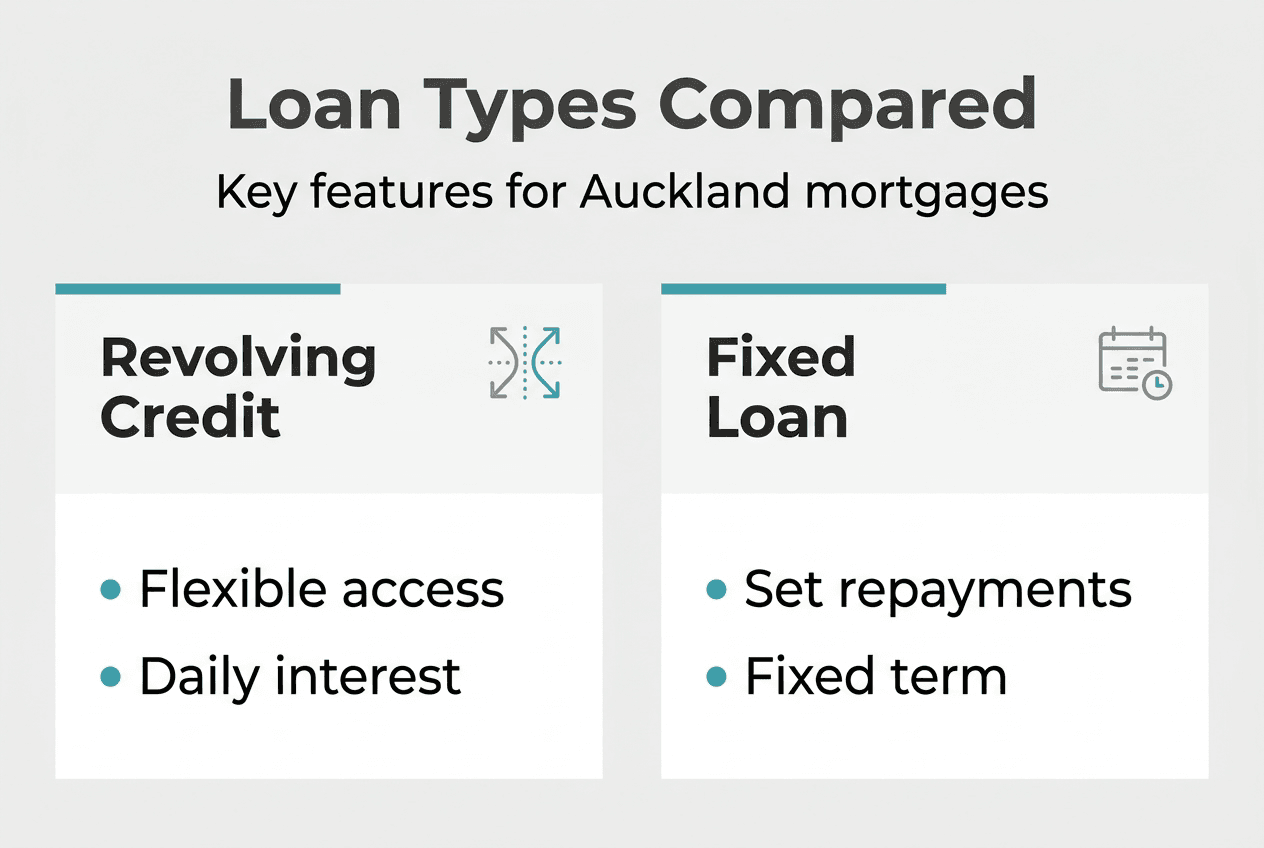
| Feature | Revolving credit | Traditional fixed loan |
|---|---|---|
| Repayment flexibility | Pay any amount, anytime | Fixed monthly payments |
| Interest calculation | Daily on net balance | Fixed rate on full amount |
| Access to paid funds | Immediate redraw available | Requires formal application |
| Interest rate | Usually variable, slightly higher | Fixed or variable options |
| Discipline required | High, easy to overspend | Low, automatic structure |
Revolving credit mortgages offer more flexibility but require discipline; fixed loans give stability but less access to funds. This fundamental difference shapes which product suits your situation.
Revolving credit advantages:
- Reduce interest through daily balance optimisation
- Access equity without refinancing applications
- No penalties for extra repayments or irregular payment amounts
- Combine banking and mortgage management in one account
- Adapt repayments to income fluctuations easily
Revolving credit disadvantages:
- Temptation to overspend reduces principal paydown
- Variable rates create uncertainty in rising rate environments
- Requires active monitoring and financial discipline
- Can lead to perpetual debt if not managed properly
- Higher cognitive load compared to automated fixed payments
Traditional loan advantages:
- Predictable repayments simplify budgeting
- Fixed rates protect against interest rate increases
- Forced savings through structured repayment schedules
- Less temptation to access equity for non essential spending
- Lower mental effort for people who prefer automation
Traditional loan disadvantages:
- Break fees for early repayment or refinancing
- Slower principal reduction due to interest calculation methods
- Separate application needed to access equity
- Less flexibility during financial hardship or opportunity
- Potential for wasted offset opportunities
Pro Tip: Many Auckland homeowners use a split strategy, keeping 70% in a fixed loan for stability and 30% in revolving credit for flexibility and interest optimisation.
Your income stability matters enormously. Salaried employees with predictable pay cycles can leverage revolving credit effectively. Self employed individuals or commission based workers might struggle with the variable cash flow demands. Spending habits prove equally critical. If you naturally live below your means and track expenses, revolving credit amplifies your financial efficiency. If you tend to spend whatever sits in your account, the accessible credit becomes dangerous.
Auckland’s property market volatility adds another consideration. When property values rise, revolving credit lets you access equity quickly for renovations or investment opportunities. During downturns, the variable rates typical of revolving credit can increase your costs unexpectedly.
For personalised comparison insights, mortgage experts discuss revolving credit mortgages with Auckland homebuyers regularly.
Is a revolving credit mortgage right for you in Auckland?
Assessing suitability requires honest evaluation of your financial behaviour and goals. This loan type rewards certain characteristics while punishing others.
Start by examining your income stability. Do you receive regular, predictable payments? Revolving credit works beautifully for people with consistent cash flow who can confidently predict their account balance weeks ahead. Irregular income creates stress and potential overspending as you try to manage fluctuating balances.
Considering your financial goals and cash flow is critical before choosing a revolving credit mortgage. Your property plans matter too. Planning to renovate within two years? Revolving credit provides easy access to equity as your property value increases. Expecting to sell and upgrade soon? The flexibility supports your transition without refinancing penalties.
Key assessment questions:
- Can you resist spending money simply because it appears available?
- Do you actively track your spending and maintain budgets?
- Does your income arrive regularly and predictably?
- Are you comfortable with variable interest rates?
- Do you have financial goals beyond just paying off your mortgage?
- Will you review your account balance and statements regularly?
Auckland’s property market presents unique considerations. High property values mean even small interest rate differences create significant dollar impacts over a 25 year mortgage term. The potential savings from optimal revolving credit management can reach tens of thousands of dollars. However, the same high values mean accessible equity can tempt you into lifestyle inflation or poor investment decisions.
Pro Tip: Test your discipline by treating your current transaction account like a revolving credit mortgage for three months, depositing income and paying all expenses from one account while tracking the daily balance.
Professional mortgage advice becomes invaluable here. An experienced adviser can model different scenarios based on your actual income, expenses, and financial goals. They spot risks you might miss and identify opportunities you had not considered. For Auckland homebuyers, local market knowledge helps advisers tailor recommendations to regional property trends and lending conditions.
The wrong choice costs money and creates stress. Choosing revolving credit when you lack discipline leads to growing debt and financial anxiety. Selecting a fixed loan when you could benefit from flexibility means leaving thousands in potential savings on the table. Getting expert input from the role of mortgage adviser in Auckland professionals helps you make the right call.
How Mortgage Managers can help with your revolving credit mortgage
Navigating revolving credit mortgage options in Auckland’s competitive property market requires local expertise and personalised guidance. Mortgage Managers specialises in helping first home buyers and existing homeowners evaluate whether revolving credit suits their financial situation and goals.

Our Auckland based advisers understand the unique challenges of the local property market. We analyse your income patterns, spending habits, and long term objectives to recommend the most suitable loan structure. Whether you need a full revolving credit mortgage, a split loan strategy, or a traditional fixed loan, we negotiate competitive terms with multiple lenders on your behalf.
We simplify complex loan comparisons and explain how different products affect your monthly cash flow and total interest costs. Mortgage advisers personal shoppers home loan services mean you get tailored solutions rather than one size fits all products. Our team stays current with lending criteria changes and rate movements, ensuring you receive relevant, timely advice.
Ready to explore if revolving credit fits your Auckland home buying journey? Talk to Auckland mortgage brokers that can help you make informed decisions. Contact us for a free consultation where we assess your situation and outline your best options. Discover more about the role of mortgage adviser expert guide services we provide to Auckland homebuyers.
Frequently asked questions
What is the difference between a revolving credit mortgage and a line of credit?
A revolving credit mortgage is a home loan secured against your property that functions like an everyday transaction account with flexible borrowing up to your limit. A line of credit is typically an unsecured loan facility separate from your mortgage, often with higher interest rates because it lacks property collateral. Revolving credit mortgages usually offer lower rates due to the security of your home backing the loan.
Can I convert my existing home loan to a revolving credit mortgage?
Yes, converting your current mortgage to revolving credit is possible through refinancing, subject to lender approval and your financial circumstances. Your equity position, income stability, and credit history all influence whether lenders will approve the switch. Consulting a mortgage adviser helps you explore refinancing your non bank mortgage options and understand the costs versus benefits of converting.
What are the risks of a revolving credit mortgage?
The main risk is overspending temptation since credit remains constantly accessible, potentially leading to growing debt rather than principal reduction. Variable interest rates can increase unexpectedly, raising your costs and monthly interest charges. Success requires disciplined financial management, regular account monitoring, and treating the facility as a mortgage rather than free spending money. Without discipline, you might never pay off your home loan.
How much can I save with a revolving credit mortgage compared to a fixed loan?
Savings depend on your income level, spending discipline, and how effectively you use deposits to reduce your daily balance. A household depositing $8,000 monthly salary and maintaining good cash flow discipline might save $15,000 to $30,000 in interest over a 25 year mortgage term compared to equivalent fixed loans. However, poor management can result in higher costs than fixed loans, making your behaviour the critical factor in realising savings.
Do all banks in New Zealand offer revolving credit mortgages?
Most major New Zealand banks offer revolving credit mortgage products, though terms, rates, and features vary significantly between lenders. Some banks limit revolving credit to a portion of your total loan or require minimum equity levels before approval. Working with mortgage advisers gives you access to multiple lender options and helps identify which institutions offer the most competitive revolving credit terms for your specific situation and property location.