
TL;DR:
- Getting a home loan in New Zealand involves meeting lender criteria, saving a deposit, and completing a structured application process.
- First-home buyers can access loans with as little as 5% deposit through the Kāinga Ora scheme, provided they meet income and regional caps.
Getting a home loan in New Zealand means securing a mortgage by meeting lender criteria, saving a sufficient deposit, and completing the application process with the right documents and approvals. How do you get a loan for a house when the rules feel complex? You follow a structured process, understand your deposit options, and prepare your finances before you ever speak to a bank. This guide covers everything from the Kāinga Ora First Home Loan to the Reserve Bank of New Zealand’s loan-to-value ratio restrictions, giving you a clear path from where you are now to the keys in your hand.
What deposit do I need and what low-deposit options exist?
The standard minimum deposit for an owner-occupier mortgage in New Zealand is 20% of the purchase price. That means a $700,000 home requires $140,000 upfront. That figure stops many buyers cold, but the full picture is more encouraging.
The Reserve Bank of New Zealand’s loan-to-value ratio rules allow banks to lend up to 25% of new loans to borrowers with less than a 20% deposit. That allocation has expanded in 2026, which means more low-deposit applications are getting through than in previous years. The catch is that banks still apply strict affordability tests to every one of those applications.
The most accessible low-deposit pathway for first-home buyers is the Kāinga Ora First Home Loan. Eligible buyers can purchase with just a 5% deposit, subject to income caps of $95,000 for a single applicant and $150,000 for joint applicants. You also need at least three months of continuous employment with your current employer. Crucially, the Kāinga Ora guarantee means you pay standard bank interest rates despite your high loan-to-value ratio, which saves you thousands compared to a standard low-deposit premium.
Other pathways include guarantor mortgages, where a family member uses equity in their own property to support your application, and gifted deposits, where a parent or relative contributes funds toward your deposit. New builds often attract more flexible lending rules as well, making them worth considering if you are open to purchasing off the plans.
| Deposit option | Minimum deposit | Key eligibility | Key risk |
|---|---|---|---|
| Standard bank mortgage | 20% | Meets bank serviceability | Higher deposit required |
| High-LVR bank lending | 10–19% | Bank discretion, strong income | Limited availability |
| Kāinga Ora First Home Loan | 5% | Income and price caps apply | Regional price caps strictly enforced |
| Guarantor mortgage | 5–10% | Guarantor has sufficient equity | Guarantor’s property at risk |
| Gifted deposit | Varies | Gift letter required | Lender scrutiny of source of funds |
Pro Tip: Always verify the Kāinga Ora regional price caps before you start house hunting. Exceeding the cap by even a small amount disqualifies you entirely, regardless of your income or deposit strength. Check your KiwiSaver balance too, as it can count toward your deposit.
What documents do I need for a home loan application?
Preparation is the foundation of a successful home loan application. Banks do not just assess your income. They assess your financial character, and that assessment starts with your paperwork.
The documents you will typically need include:
- Proof of identity: Passport or New Zealand driver’s licence
- Proof of income: Three months of payslips, or two years of financial statements if self-employed
- Bank statements: Three to six months of transaction history across all accounts
- KiwiSaver statements: Current balance and scheme details
- Existing debt information: Credit card limits, personal loans, hire purchase agreements, and Buy Now Pay Later balances
- Proof of deposit: Savings history, gift letters, or KiwiSaver withdrawal confirmation
Banks audit three to six months of bank statements to identify discretionary spending patterns. A subscription to every streaming service, regular takeaway spending, and BNPL repayments all factor into their risk assessment. This is not about judging your lifestyle. It is about calculating how much you can genuinely afford to repay each month.
The preparation phase typically takes three to six months for buyers who are not yet ready. Use that time to reduce unnecessary debt, build consistent savings, and stabilise your employment. A clean three-month spending period before you apply makes a measurable difference to how lenders view your application.
Pro Tip: Avoid applying for any new credit, including credit cards or car loans, in the three months before your home loan application. New credit inquiries and increased limits reduce your borrowing capacity and raise red flags for lenders. Keep your spending consistent and predictable.
For a complete document checklist, the mortgage application checklist from Mortgagemanagers walks you through every item you need to gather before you apply.
What are the steps in the home loan application process?
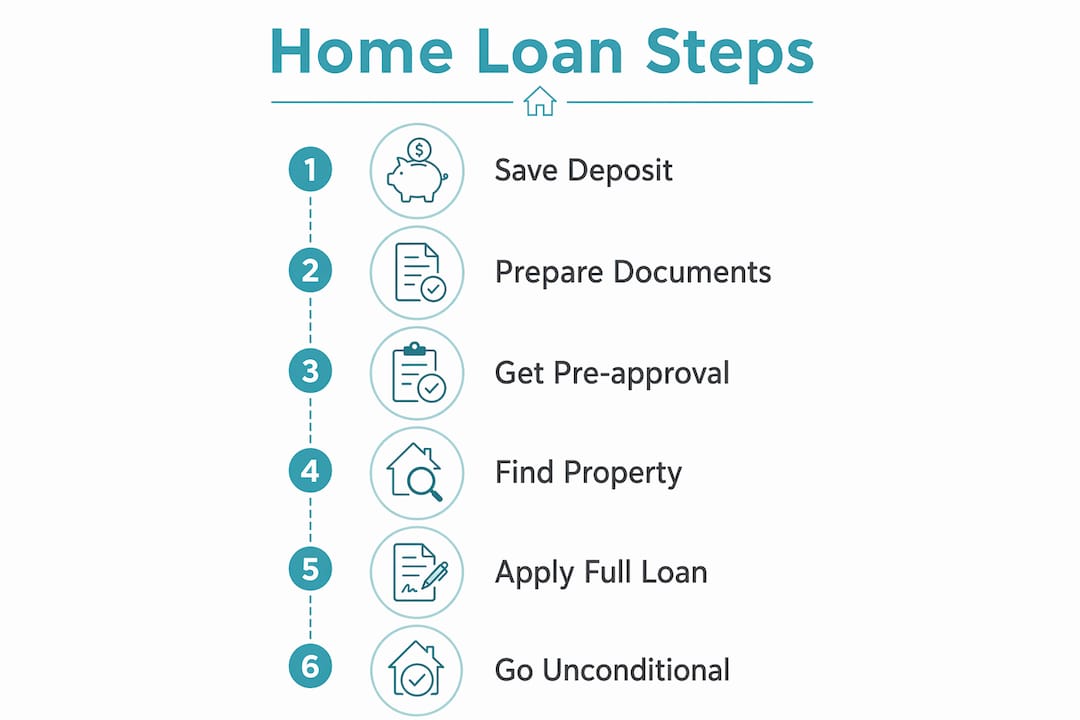
The home loan approval process follows five clear stages. Understanding each one helps you move through it with confidence rather than anxiety.
- Preparation. Sort your finances, gather your documents, and get a realistic picture of your borrowing capacity. Use this phase to reduce debt and build savings history.
- Pre-approval. Submit your application to a lender for conditional approval. Pre-approval typically takes three to seven business days once your documentation is ready. Pre-approval is valid for 60–90 days, giving you a clear budget for house hunting.
- Conditional offer. Once you find a property, you make an offer subject to conditions. Standard conditions include finance approval, a building inspection, a LIM report, and a registered valuation. You typically have 5–15 working days to satisfy these conditions.
- Formal application and valuation. Your lender orders a registered valuation of the property and completes a full credit assessment. Full approval after a conditional offer typically takes 5–10 business days.
- Unconditional approval and settlement. Once all conditions are met and the lender confirms approval, you go unconditional. Settlement then occurs within one to eight weeks, depending on the agreed date in your sale and purchase agreement.
| Stage | Typical duration | What the lender assesses |
|---|---|---|
| Pre-approval | 3–7 business days | Income, expenses, credit history |
| Conditional offer period | 5–15 working days | Finance, building inspection, LIM |
| Formal application and valuation | 5–10 business days | Property value, full credit check |
| Settlement | 1–8 weeks | Legal and financial completion |
The most critical moment in this process is going unconditional. Once you waive your conditions, you are legally committed to the purchase. If your finance falls through after that point, you risk losing your deposit. Never go unconditional until your lender has confirmed approval in writing.
For a detailed breakdown of each stage, the mortgage process guide from Mortgagemanagers covers every step from preparation to settlement.
What common mistakes should I avoid when applying for a home loan?
Most home loan applications that fail do so for predictable reasons. Knowing them in advance puts you well ahead of the average applicant.
- Underestimating the spending audit. Banks scrutinise discretionary spending and BNPL usage in detail. A pattern of high lifestyle spending can reduce your approved loan amount even if your income is strong.
- Missing Kāinga Ora price caps. The First Home Loan scheme enforces regional price caps strictly. Buyers who exceed the cap by even a small margin are disqualified, regardless of their deposit or income.
- Submitting incomplete documentation. A rushed or incomplete application delays the process and signals disorganisation to the lender. Gather every document before you submit.
- Overestimating your borrowing capacity. Banks apply stress tests at interest rates above the current market rate. Your approved amount may be lower than online calculators suggest. Build your budget around the lender’s figure, not your own estimate.
- Ignoring sale and purchase agreement conditions. Conditions that are too short or poorly worded leave you exposed. Always include finance, building inspection, LIM, and valuation clauses, and give yourself enough time to satisfy each one.
The 2026 market conditions are genuinely favourable for first-home buyers, with lower interest rates and expanded high-LVR lending. That does not mean the process is easy. Banks remain stringent on financial stability and serviceability, and a well-prepared application still separates successful buyers from those who miss out.
Working with a mortgage adviser gives you access to lender criteria knowledge that most buyers simply do not have. Advisers know which lenders are more flexible on certain income types, which ones scrutinise BNPL more heavily, and how to present your application in the strongest possible light. You can also explore home loan options across different lender types to understand what criteria vary between institutions.

Key takeaways
Getting a home loan in New Zealand requires a clear deposit strategy, thorough documentation, and a structured approach to each stage of the approval process.
| Point | Details |
|---|---|
| Standard deposit is 20% | Banks can lend to low-deposit borrowers, but only within RBNZ’s high-LVR allocation. |
| Kāinga Ora opens the door | Eligible first-home buyers can purchase with 5% deposit at standard interest rates. |
| Documents make or break applications | Three to six months of bank statements, payslips, and KiwiSaver details are non-negotiable. |
| Five stages from start to settlement | Pre-approval, conditional offer, formal application, valuation, and unconditional approval each have set timelines. |
| Going unconditional is the point of no return | Never waive conditions until your lender confirms approval in writing. |
What I have learned from watching buyers get this wrong
The most common mistake I see is buyers treating pre-approval as the finish line. They get conditional approval, find a property they love, and rush through the conditions phase because they are excited. Then the valuation comes in low, or the building inspection reveals a problem, and they are suddenly in a very difficult position.
The buyers who succeed are the ones who treat every stage with the same discipline they brought to saving their deposit. They read their sale and purchase agreement carefully. They give themselves enough time in the conditions period. They do not go unconditional until every piece of the puzzle is confirmed.
I also see a lot of first-home buyers underestimate how much their spending habits matter. A bank does not just see your salary. It sees your Uber Eats orders, your Afterpay repayments, and your gym memberships. Three months of clean, consistent spending before you apply genuinely changes the outcome for many buyers.
The 2026 market is the most accessible it has been for first-home buyers in several years. Lower rates and expanded high-LVR lending mean more people can qualify. But the buyers who get the best results are the ones who prepare properly, use the right tools, and get advice from someone who knows the lender landscape inside out. That preparation is not just paperwork. It is the difference between an approved application and a declined one.
— Stuart
How Mortgagemanagers can help you secure the right home loan
Applying for a home loan is one of the biggest financial decisions you will make. Getting it right the first time matters.

Mortgagemanagers is a locally owned mortgage advisory business based in Hobsonville, Auckland, with the expertise to help buyers across West Auckland, the North Shore, and remotely throughout New Zealand. As specialist mortgage advisers, the team compares products across multiple lenders, handles complex and low-deposit applications, and presents your file in the way that gives you the best chance of approval. Whether you are a first-home buyer exploring the Kāinga Ora First Home Loan or a buyer with a non-standard income situation, Mortgagemanagers knows the lender criteria that make the difference between a yes and a no. Reach out for a consultation and get clarity on your options before you apply.
FAQ
What is the minimum deposit to get a home loan in New Zealand?
The standard minimum deposit is 20% of the purchase price. Eligible first-home buyers can access the Kāinga Ora First Home Loan with a 5% deposit, subject to income and regional price caps.
How long does the home loan approval process take?
Pre-approval typically takes 3–7 business days. Full approval after a conditional offer takes 5–10 business days, with settlement occurring one to eight weeks after going unconditional.
What do I need for a mortgage application in New Zealand?
You need proof of identity, three months of payslips or two years of financial statements if self-employed, three to six months of bank statements, KiwiSaver details, and information on all existing debts.
Can I get a home loan with bad credit in New Zealand?
Some lenders will consider applications with impaired credit, particularly if the issues are minor or historic. A mortgage adviser can identify which lenders are most likely to approve your specific situation.
How much can I borrow for a house in New Zealand?
Your borrowing capacity depends on your income, existing debts, deposit size, and the lender’s stress test rate. Banks calculate how much you could repay if interest rates rose significantly above current levels, so your approved amount may be lower than online calculators suggest.