
TL;DR:
- Refinancing a home loan involves replacing your current mortgage with a new one on different terms, which may include changing lenders or loan features.
- It is typically worthwhile if your expected ongoing savings exceed the upfront costs within a reasonable timeframe, usually around 18 months.
Refinancing a home loan means replacing your existing mortgage with a new one, either with your current lender or a different one, on different terms. The quick rule: if your likely ongoing savings exceed the upfront switching costs within a reasonable period, it’s worth investigating further. That’s the threshold most NZ advisers use as a starting point, and it’s the lens this guide applies throughout.
Table of Contents
- What does refinancing a home loan actually mean?
- Why do homeowners refinance?
- What are the costs and risks of refinancing?
- How does refinancing a home loan work in New Zealand?
- Does refinancing actually save you money?
- How do you shop around for a refinance in New Zealand?
- What should you check before you sign up to refinance?
- Key takeaways
- Is refinancing always the right move?
- Get a free refinance review with Mortgagemanagers
- Useful NZ sources for further reading
What does refinancing a home loan actually mean?
Refinancing is not simply adjusting your interest rate. Legally, it means discharging your existing mortgage and registering a new one. That new loan can sit with the same bank or move to a completely different lender, and it can carry a different rate, term, repayment structure, or loan features.
There’s an important distinction to understand here:
- Refixing means choosing a new fixed term with your existing lender when your current term expires. No legal work, no valuation, usually no hard cost. It’s the simplest path.
- Refinancing (switching) means a new loan agreement, new mortgage registration with LINZ, and typically a solicitor to handle the discharge and registration.
What can change with a new loan:
-
Interest rate (fixed or floating)
-
Loan term (shorter or longer)
-
Repayment type (interest-only to principal and interest, or vice versa)
-
Loan features (offset account, redraw facility, split structure)
-
Loan amount (if you’re topping up to access equity)
The parties involved in a full switch are you, your current lender, the new lender, a solicitor or conveyancer, and sometimes a registered valuer. The FMA also sets the regulatory framework under which any mortgage adviser helping you must operate.
Why do homeowners refinance?
People refinance for a handful of clear reasons, and each one maps to a different financial outcome.
Lower interest rate. This is the most common driver. Even a modest rate reduction on a large loan produces meaningful monthly savings. On a $500,000 balance, dropping from 6.50% to 6.00% saves roughly $250 per month, depending on the remaining term.
Changing loan structure. Some borrowers switch from interest-only to principal and interest repayments to start reducing their balance. Others add an offset account to reduce the interest they’re charged daily, or split their loan between fixed and floating portions for flexibility.
Accessing equity (top-up). If your property has increased in value, refinancing can unlock that equity for renovations, an investment property deposit, or consolidating higher-interest debt. This is sometimes called a home loan top-up rather than a full refinance, though the process overlaps.
Cashback incentives. Many NZ lenders offer cashback deals to attract switching borrowers. These can cover most or all of your switching costs, which changes the break-even calculation significantly. Treat them carefully though: a cashback paired with a less competitive ongoing rate can cost you more over time.
Better product features or service. Flexible repayment options, a genuinely useful app, or a lender that handles non-standard situations well are all legitimate reasons to move, even when the rate difference is small. For homeowners moving from a non-bank lender to a bank, there are specific product checks worth running before signing.
For a deeper look at the full range of refinancing benefits for NZ homeowners, Mortgagemanagers has a practical guide worth reading alongside this one.
What are the costs and risks of refinancing?
The savings from a lower rate can look compelling on paper. The costs are what most people underestimate.
Hard upfront costs for a straightforward NZ refinance typically sit between NZ$1,500 and NZ$3,000, covering:
- Application or establishment fee (new lender)
- Registered valuation fee
- Solicitor/conveyancing fees for mortgage discharge and registration
Break fees are the biggest wildcard. If you’re mid-way through a fixed-rate term, your lender will charge an early repayment fee calculated on the rate differential, your remaining balance, and the time left on the fix. On a large loan with significant time remaining, break fees can run into thousands of dollars and can easily wipe out a year or more of rate savings.
Indirect risks are worth naming too:
- Extending your loan term to lower repayments means paying more total interest over the life of the loan, even at a lower rate.
- A credit check from a new lender leaves a hard inquiry on your credit file. Multiple applications in a short period can affect your borrowing capacity.
- You may lose existing lender benefits (loyalty discounts, bundled products) that aren’t replicated elsewhere.
Pro Tip: Always calculate the break-even period before you proceed. Divide your total switching costs by your monthly savings to find how many months it takes to recover those costs. If that number exceeds your likely time in the property, or your next fixed term, refinancing probably doesn’t stack up.
How does refinancing a home loan work in New Zealand?
A straightforward refinance in NZ follows a clear sequence. End-to-end, expect three to six weeks for a simple case; more if a valuation is complex or additional documentation is needed.
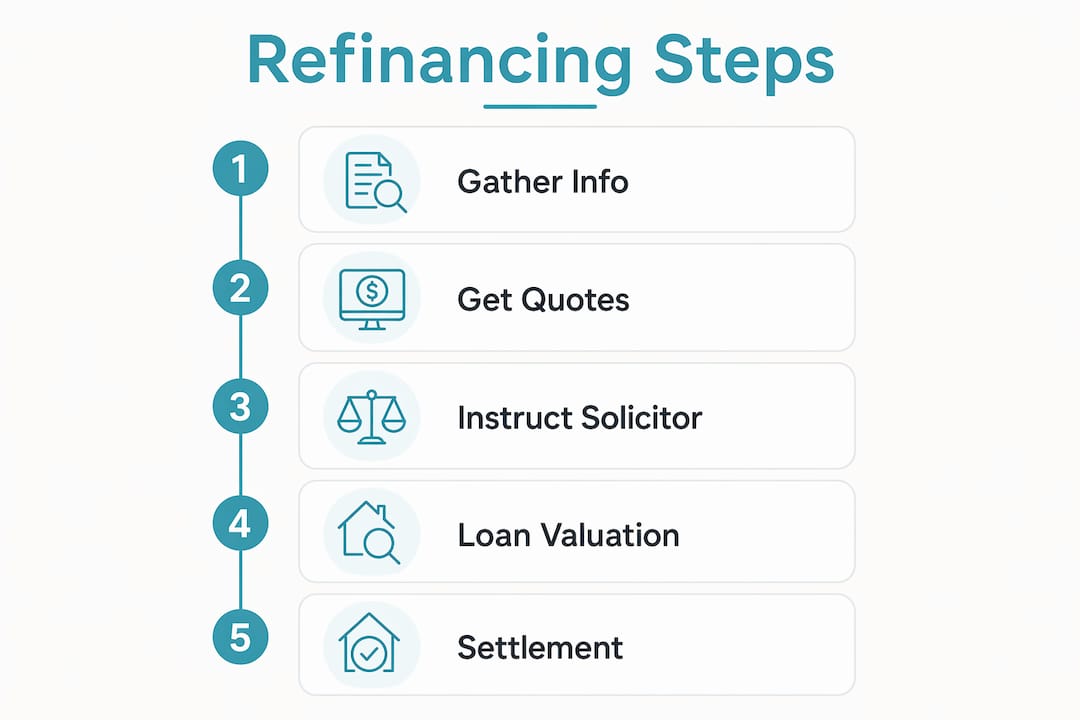
Step 1: Gather your current loan details
Pull together your current loan balance, interest rate, fixed term expiry date, and any break fee estimate from your lender. Recent payslips, bank statements (usually three months), and photo ID will be needed for any new application.
Step 2: Get quotes and conditional approvals
Contact lenders directly or work with a mortgage adviser to obtain written quotes. Ask for the comparison rate, total switching costs, and any cashback on offer. Conditional approval gives you a firm basis for comparison.

Step 3: Instruct a solicitor
Once you’ve chosen a new lender, your solicitor handles the discharge of the existing mortgage and the registration of the new one with LINZ. This is where most of the legal cost sits.
Step 4: Valuation (if required)
The new lender may require a registered valuation, particularly if your loan-to-value ratio is close to their lending limits or the property type is non-standard.
Step 5: Settlement
The new lender pays out the old loan directly. Your repayments to the new lender begin from the agreed date. Confirm the final payout figure with your existing lender close to settlement to avoid any shortfall.
| Stage | Who’s responsible | Typical timeframe |
|---|---|---|
| Quotes and conditional approval | You / adviser | 1–2 weeks |
| Valuation (if needed) | Registered valuer | 3–6 days |
| Legal discharge and registration | Solicitor / LINZ | 1–2 weeks |
| Settlement and first repayment | New lender | 1–3 days after legal completion |

Pro Tip: Start shopping 4–6 weeks before your fixed term expires. This gives you time to compare properly, avoids break fees, and prevents being rolled onto a higher floating rate by default.
Does refinancing actually save you money?
The break-even calculation is the most useful tool in this decision. Here’s how it works:
Break-even months = Total switching costs ÷ Monthly savings
If switching costs are moderate and you save a reasonable amount per month, your break-even point may be within a timescale that justifies refinancing if you plan to stay in the property long enough.
Worked example:
| Item | Current loan | New loan |
|---|---|---|
| Loan balance | $500,000 | $500,000 |
| Interest rate | discussed difference | discussed difference |
| Monthly repayment | example values | example values |
At a break-even timescale within a year, this refinance might be sensible for borrowers with stable housing plans.
NZ advisers commonly use a rule-of-thumb threshold of a moderate rate reduction as a starting point for whether refinancing is worth investigating. That’s a guide, not a guarantee. A smaller rate drop on a large balance can still produce a short break-even. A larger drop on a small remaining balance may not.
Cashback offers from new lenders can shift the maths considerably. If a lender’s cashback covers or exceeds your switching costs, your net cost effectively reduces, enhancing potential savings. Factor cashbacks into the calculation, but treat one-off incentives cautiously if the ongoing rate is less competitive.
Pro Tip: Non-monetary factors matter too. If you’re planning to sell within two years, or your income situation is about to change, the numbers alone don’t tell the full story. Factor in your plans before committing.
How do you shop around for a refinance in New Zealand?
Banks don’t always offer their best rate unprompted. The FMA’s guidance is clear: ask your current lender for a retention offer, then independently compare the market. That second step is where most of the value is found.
Where to look:
- Lender websites for published rates and cashback offers
- A mortgage adviser (broker) for packaged quotes, negotiation, and access to non-bank lenders
- Comparison tools for a quick market overview
Questions to ask every lender:
- What is the total cost to switch, including all fees?
- Is there a break fee on my current loan, and how is it calculated?
- What cashback is available, and are there conditions attached?
- What is the comparison rate (rate plus fees)?
- What product features are included (offset, redraw, split)?
When a mortgage adviser adds real value:
A broker is particularly useful when your situation is non-standard (self-employed, low deposit, non-bank lender history), when you want to compare a wide range of lenders without making multiple individual applications, or when you’re unsure how to weigh up cashback against ongoing rate differences. Advisers also know which lenders are currently competitive and which are not, without you having to ring around. For a broader picture of how mortgage brokers help, Mortgagemanagers covers this in detail.
Understanding the difference between mortgage renewal and refinancing is also worth a few minutes if you’re unsure which path applies to your situation.
What should you check before you sign up to refinance?
Run through this checklist before you commit:
- Break fee estimate: Request a written estimate from your current lender. Don’t assume it’s zero.
- Total switching costs: Add up application, valuation, and legal fees. Compare against monthly savings.
- Break-even calculation: Divide total costs by monthly savings. Is the result within your planning horizon?
- Loan term changes: If the new loan resets your term, calculate total interest over the life of the loan, not just the monthly repayment.
- Repayment type: Confirm whether you’re switching from interest-only to principal and interest, and what that means for your monthly budget.
- Valuation and legal fees: Clarify whether these are covered by the new lender, included in a cashback, or billed to you separately.
- Approval conditions: Check any conditions on the new lender’s approval (e.g., property valuation, income verification) and confirm the expected settlement timeline.
Pro Tip: Ask your new lender for a settlement statement before signing. It should show the exact payout figure, all fees, and the net amount you’ll receive or owe. Surprises at settlement are avoidable.
Key takeaways
Refinancing a home loan is worth investigating when your switching costs break even within roughly 18 months and your housing plans support the commitment.
| Point | Details |
|---|---|
| What refinancing means | Replacing your existing mortgage with a new loan, legally discharging the old one and registering a new mortgage with LINZ. |
| Break-even rule | Divide total switching costs by monthly savings; if the result is under 18 months, refinancing generally makes sense. |
| Typical NZ switching costs | Hard costs for a straightforward switch usually sit between NZ$1,500 and NZ$3,000; cashback offers can offset these. |
| When to start shopping | Begin comparing 4–6 weeks before your fixed term expires to avoid break fees and default rollover to a floating rate. |
| Mortgagemanagers | Offers a free initial refinance review, comparing rates and costs across lenders to help you decide whether switching makes sense for your situation. |
Is refinancing always the right move?
Here’s what I see regularly: homeowners who come in excited about a rate they’ve spotted online, only to discover their break fee makes the switch unviable for another 12 months. The rate is real. The saving is real. But the timing is wrong, and locking in now would cost more than waiting.
The flip side is equally common: borrowers who’ve been sitting on a rate that expired two years ago, rolled onto floating by default, and never got around to reviewing it. That inertia is expensive.
My honest observation is that most people either move too early (mid-fix, ignoring break fees) or too late (well past the optimal window). The sweet spot is the four to six weeks before a fixed term ends. That’s when you have the most leverage, no break fee exposure, and time to compare properly rather than scramble.
When Mortgagemanagers recommends refinancing, it’s usually because the rate differential is meaningful, the break-even is short, and the client’s plans support a multi-year commitment to the new loan. When we advise staying put, it’s typically because break fees would absorb more than a year of savings, or the loan balance is small enough that the absolute dollar gain doesn’t justify the effort and cost.
One thing clients often miss: product features matter as much as rate for some borrowers. An offset account on a $600,000 loan with $50,000 sitting in savings can reduce interest charges significantly, sometimes more than a 0.25% rate cut would. Rate is the headline; structure is often the real story.
Get a free refinance review with Mortgagemanagers
Knowing whether refinancing makes sense for your specific loan takes more than a rate comparison. It requires running the actual numbers: your break fee, your switching costs, your monthly saving, and your break-even period against your plans.

Mortgagemanagers offers a free initial refinance review with a local NZ mortgage adviser. In that conversation, you’ll get a clear picture of what switching would cost, what you’d save, and whether the timing works in your favour. There’s no obligation, and the adviser is paid by the lender only if a loan settles, so the advice is genuinely in your interest.
Ready to find out where you stand? Talk to a Mortgagemanagers adviser and get a personalised refinance check today.
This article provides general information only and is not financial advice. Your situation is unique, so confirm current rates, fees, and eligibility with a qualified mortgage adviser or your lender before making any decision.
Useful NZ sources for further reading
- Sorted — How to refinance your mortgage: NZ’s independent financial guidance site. Covers the mechanics of refinancing, what to compare, and how to weigh up switching costs. A reliable starting point for unbiased information.
- FMA — Getting mortgage advice: The Financial Markets Authority’s consumer guidance on using a mortgage adviser, what to expect, and your rights. Useful if you want to understand the regulatory framework before engaging a broker.
- BNZ — Refinancing your mortgage: BNZ’s own guide to the refinancing process, including what they look for in an application. Good for understanding one major bank’s perspective and process.
- RatePal — How to refinance your mortgage in NZ: A practical NZ-specific guide covering timelines, break fees, and rule-of-thumb thresholds. Useful for a quick market overview.
- Mortgagemanagers — Why refinance a mortgage: NZ homeowner’s complete guide: A deeper dive into the reasons NZ homeowners refinance, with local examples and adviser perspective.
- Mortgagemanagers — Steps to refinance your mortgage: A step-by-step walkthrough of the NZ refinancing process, useful if you want more detail on what to expect at each stage.
- Mortgagemanagers — Different home loans in New Zealand: Background on NZ loan types and features, helpful for comparing product options when refinancing.