
Getting a home loan with bad credit in New Zealand is harder than it used to be, but it is far from impossible. The realistic routes in 2025 are non-bank specialist lending, guarantor or near-relative loans, and higher-deposit secured applications. Your single best next step is to speak with a specialist mortgage adviser before you apply anywhere, because the wrong application at the wrong lender can make your credit file worse.
Here is what to do right now:
- Pull your credit report from one of New Zealand’s three credit reporting agencies (Centrix, Equifax, or Illion) and check for errors.
- Gather three months of bank statements and proof of income (payslips or accountant-prepared financials if you are self-employed).
- Write a brief, factual explanation for any defaults or missed payments on your file.
- Contact a specialist broker such as Mortgagemanagers before lodging any formal application.
All New Zealand lenders, including non-bank lenders, must comply with responsible-lending obligations under the Credit Contracts and Consumer Finance Act (CCCFA), overseen by the Financial Markets Authority (FMA). That means every lender must verify you can afford repayments without substantial hardship, regardless of which route you take.
Pro Tip: Do not apply to multiple lenders at once. Each credit inquiry lowers your score. Let a specialist broker run a single, well-targeted application instead.
Table of Contents
- What bad credit mortgage solutions are available in New Zealand?
- What do lenders actually check when you apply with bad credit?
- How does a mortgage broker speed up approval for bad credit cases?
- Step-by-step: what to do right now to improve your approval chances
- What costs and timelines should you expect in 2026?
- Key takeaways
- Why most bad-credit borrowers get this wrong
- Mortgagemanagers can help you move forward today
- Useful New Zealand sources and further reading
What bad credit mortgage solutions are available in New Zealand?
There is no single answer here because the right route depends on your specific credit event, your deposit, and your income situation. The five main options are:
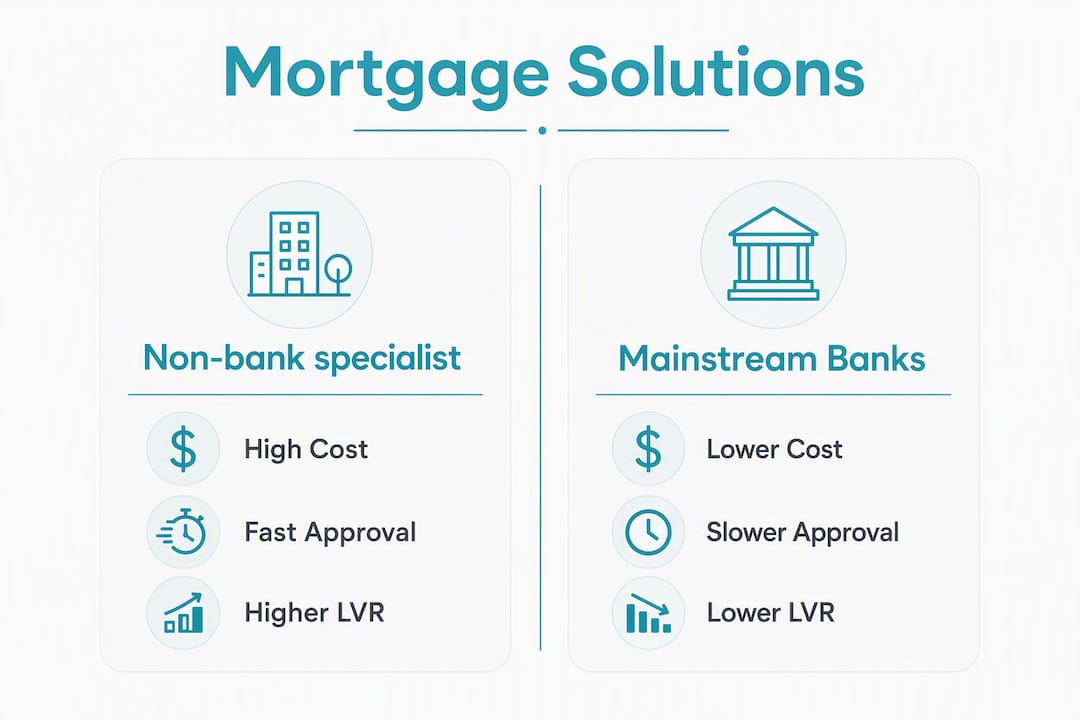
- Non-bank specialist lending. Lenders outside the main trading banks assess applications more flexibly, accepting alt-doc income evidence and single risk factors such as an aged default. They are the most common entry point for bad credit home loans in New Zealand.
- Guarantor or near-relative loans. A family member offers their property as additional security, which can offset a weak credit profile or a small deposit. This route often allows access to near-bank rates.
- Higher-deposit or lower-LVR applications. Putting in 20–30% or more shifts the risk calculus for lenders significantly. Even a mainstream bank may reconsider a borderline application when the deposit is strong.
- Bridging or short-term finance. Useful when you need to purchase before a credit event ages off your file or before a refinance is possible. These are short-term by design and carry higher costs.
- Credit repair and reapply. If your situation is not urgent, spending 12–24 months repairing your credit history before applying can open mainstream bank options at standard rates.
| Route | Cost profile | Speed to approval | Typical LVR | Best for |
|---|---|---|---|---|
| Non-bank specialist | Higher rate, establishment fee | 1–4 weeks | Higher LVR possible | Aged defaults, self-employed, thin file |
| Guarantor/near-relative | Near-bank rate | 2–5 weeks | — | Small deposit, minor credit issues |
| Higher-deposit secured | Standard to near-standard | 2–4 weeks | 20–30% | Strong income, one credit event |
| Bridging/short-term | Highest cost | Days to 2 weeks | Varies | Urgent purchase, clear exit plan |
| Credit repair + reapply | Standard rate (after repair) | 12–24 months | Standard | Non-urgent, improving profile |
Pro Tip: If you have one isolated credit event but a solid deposit and stable income, a higher-deposit application to a non-bank lender is usually the fastest realistic route. Non-bank lenders rarely approve when multiple risk factors stack, so address what you can before applying.
What do lenders actually check when you apply with bad credit?
Every lender in New Zealand, bank or non-bank, must conduct a responsible-lending assessment under the CCCFA. That assessment goes well beyond your credit score.
Lenders look at six core areas:
- Credit history. Defaults, insolvency, missed payments, and the age of those events. A default from four years ago carries far less weight than one from six months ago, partly because most negative items stay on your file for four to five years.
- Repayment behaviour. Recent, consistent on-time payments on any credit product signal a turning point. Even a phone contract or utility bill paid on time counts.
- Deposit and LVR. The lower your loan-to-value ratio, the less risk the lender carries. Major NZ banks generally expect credit scores of 500–600+ for mortgage approval; borrowers below that threshold typically move to non-bank lenders.
- Income stability. PAYE borrowers provide payslips and three months of bank statements. Self-employed applicants need accountant-prepared financials, usually two years of tax returns and management accounts.
- Debt-to-income ratio. Total debt obligations relative to gross income. High consumer debt alongside a mortgage application is a red flag for any lender.
- Property security. The type, location, and condition of the property being purchased affects how much a lender will advance.
Non-bank lenders use a more judgemental approach, meaning a real person reviews your full file rather than relying solely on automated scoring. This is why alt-doc and flexible credit assessment options exist for borrowers who cannot meet standard bank documentation requirements.
Document checklist

| Document | PAYE applicant | Self-employed applicant |
|---|---|---|
| Photo ID | Required | Required |
| Credit report | Required | Required |
| Bank statements (3 months) | Required | Required |
| Payslips (3 months) | Required | Not applicable |
| Tax returns (2 years) | Not applicable | Required |
| Accountant-prepared financials | Not applicable | Required |
| Written explanation for defaults | If applicable | If applicable |
| Accountant letter confirming income | Not applicable | Recommended |
Having your credit score clearly understood before you walk into any lender conversation puts you in a much stronger position.
How does a mortgage broker speed up approval for bad credit cases?
A specialist broker does four things a direct application cannot. First, they know which lenders will consider your specific credit event, so they target the right lender from the start rather than letting you burn credit inquiries on rejections. Second, they package your application, which means presenting your income, assets, and explanations in the format each lender prefers. Third, they negotiate fees and terms, including establishment fees and rate margins, that a borrower approaching a lender directly rarely has leverage to move. Fourth, they build your exit plan, mapping a realistic 12–36 month path to refinancing from a non-bank rate back to a mainstream bank once your repayment record and equity improve.

Brokers who specialise in complex mortgages also understand that non-bank lenders will often accept one significant risk factor, provided the rest of the application is solid. They frame your application to highlight the strengths and contextualise the weakness, which is a skill that takes lender-relationship experience to do well.
Mortgagemanagers publishes practical bad-credit application resources including document templates and guidance on assembling alt-doc packs, so you can start preparing before your first call.
Pro Tip: Before your first broker appointment, write a one-page summary of your credit events: what happened, when, why, and what you have done since. Lenders respond well to clear, factual explanations. A broker can help you refine the wording.
Step-by-step: what to do right now to improve your approval chances
Follow this sequence. Each step builds on the last, and skipping one usually costs time later.
- Get your credit report. Request it from Centrix, Equifax, and Illion. Check all three because lenders may use different agencies.
- Fix any errors. Dispute inaccurate defaults or incorrect balances in writing. Errors are more common than most people expect.
- Assess the age of negative items. Defaults older than four years are close to dropping off your file. Waiting a few months can change your lender options significantly.
- Gather your bank statements. Three months minimum. Make sure they show consistent, responsible spending with no unexplained large withdrawals.
- Secure your deposit. The more you can put in, the more lender options open up. Even moving from 10% to 20% can shift you from a non-bank rate to a near-bank rate.
- Prepare written explanations. A brief, factual letter for each default or missed payment. Avoid emotional language; focus on circumstances and resolution.
- If self-employed, brief your accountant. Ask for a letter confirming your income and business stability. Accountant-prepared financials carry more weight than bank statements alone.
- Contact a specialist broker. Do this before lodging any application. Mortgagemanagers’ bad-credit checklist walks you through exactly what to bring to that first appointment.
For credit repair strategies with realistic timelines, the guide on rebuilding credit for mortgage success is worth reading before you start.
Typical timelines by route:
- Non-bank specialist: pre-approval in 1–4 weeks, settlement in 4–8 weeks from application.
- Guarantor/near-relative: 2–5 weeks to pre-approval, depending on guarantor documentation.
- Higher-deposit secured: 2–4 weeks, similar to a standard application.
- Credit repair and reapply: 12–24 months before a mainstream bank application is realistic.
What costs and timelines should you expect in 2026?
Bad-credit lending costs more than standard lending. The rate premium and fees reflect the additional risk the lender carries, and understanding them upfront helps you plan the exit.
Non-bank lenders in New Zealand currently publish floating rates notably higher than mainstream bank rates for impaired-credit applicants, depending on the severity of the credit event and the LVR. This rate premium reflects the cost of accessing the market now rather than waiting.
Pro Tip: Map your exit before you sign. If you take a non-bank loan at a higher rate today, calculate what your repayment record and equity position will look like in 18–24 months. That is when you approach a mainstream bank to refinance. The non-bank loan is a stepping stone, not a destination.
| Route | Indicative rate range | Typical establishment fee | Approval timeline |
|---|---|---|---|
| Non-bank specialist | 1%–4% above mainstream bank rates (floating typically 5.64%–9.85% p.a.) | — | 1–4 weeks |
| Guarantor/near-relative | Near-bank rate | Standard bank fees | 2–5 weeks |
| Higher-deposit secured | Near-standard rate | Standard bank fees | 2–4 weeks |
| Bridging/short-term | Higher than non-bank | — | Days to 2 weeks |
Non-bank lenders can also offer higher LVRs and are not bound by the same debt-to-income caps that constrain mainstream banks, which makes them a practical short-term route for borrowers with deposit shortfalls or aged credit events. For a broader view of how home loan interest rates compare across lender types, that page is a useful reference.
Key takeaways
Getting a mortgage with bad credit in New Zealand is achievable in 2025 when you target the right lender type, prepare the right documents, and work through a specialist broker.
| Point | Details |
|---|---|
| Non-bank lending is the primary route | Specialist non-bank lenders accept impaired credit where mainstream banks decline, at a rate premium of typically 1%–4%. |
| Your credit score determines your lender pool | Banks generally require scores of 500–600+; below that, non-bank or guarantor routes apply. |
| Documents make or break the application | Three months of bank statements, a credit report, ID, and written explanations for defaults are the minimum required. |
| Plan a 12–36 month exit to refinance | Non-bank lending is a bridge; demonstrated repayment behaviour and improved equity open the door to mainstream bank rates. |
| Mortgagemanagers is the recommended first contact | As a specialist NZ broker, Mortgagemanagers matches bad-credit borrowers to the right lender and packages applications for the best outcome. |
This article is general information only and does not constitute financial advice. Confirm your specific situation with a qualified mortgage adviser and check current CCCFA obligations with the Financial Markets Authority.
Why most bad-credit borrowers get this wrong
Bad credit does not disqualify you from homeownership. What disqualifies most people is the approach: applying directly to a bank that will decline them, triggering a credit inquiry, then applying to another, and another, each one leaving a mark on the file. By the time they reach a non-bank lender, the file looks worse than it did at the start.
The more useful insight is this: non-bank lending in New Zealand is not a last resort. It is a structured, regulated part of the mortgage market, and a non-bank loan recorded on your credit file does not stigmatise future bank lending. What banks look at when you refinance is your repayment behaviour on that non-bank loan, your current equity, and your income stability. A clean 18-month repayment record on a non-bank mortgage is often more persuasive than a spotless credit history with no mortgage experience at all.
The borrowers who get the best outcomes are the ones who treat the non-bank loan as a deliberate, time-limited strategy with a clear refinance target, not as a consolation prize. That mindset shift, from “I had to take this” to “I chose this as step one,” changes how you manage the loan and how you present yourself when you refinance.
Mortgagemanagers can help you move forward today
Bad credit does not have to mean a dead end. Mortgagemanagers is a locally owned, specialist mortgage advisory practice based in Hobsonville, Auckland, with access to lenders across New Zealand, including the non-bank and specialist lenders that mainstream banks cannot offer you. Where a bank sees a declined application, a specialist adviser sees a packaging problem, and that is exactly what Mortgagemanagers solves.

When you book a consultation, bring your credit report, three months of bank statements, proof of income, and a brief note on any defaults. Mortgagemanagers will assess your position, identify the most realistic lender options, and build an application that presents your case in the strongest possible light. The bad-credit home loan checklist on the Mortgagemanagers website tells you exactly what to prepare before that first call.
Ready to take the next step? Talk to the team at Mortgagemanagers today and find out which route fits your situation.
Useful New Zealand sources and further reading
- Consumer Protection NZ: Credit checks, scores and history — how credit scores work, how to fix errors, and how to build a positive history.
- Financial Markets Authority (FMA) — oversight of responsible-lending obligations under the CCCFA.
- Mortgagemanagers: Bad credit home loans explained — detailed explainer on bad-credit loan mechanics and lender requirements.
- Mortgagemanagers: Mortgage approval tips for bad credit — practical tips and quick wins to improve approval odds.
- Mortgagemanagers: Why credit history matters for NZ first home buyers — contextual guidance for first-home buyers with thin or impaired credit.