
Today we are talking about apartment lending NZ.
Yes, you can get a mortgage on most New Zealand apartments — but apartment lending works differently from house lending, with the single factor that most often changes the outcome is the apartment’s internal floor area combined with its title type. Banks treat many apartments as higher-risk security, which means deposit requirements, LVR limits, and lender appetite all shift depending on what you’re buying.
Here’s what that looks like in practice:
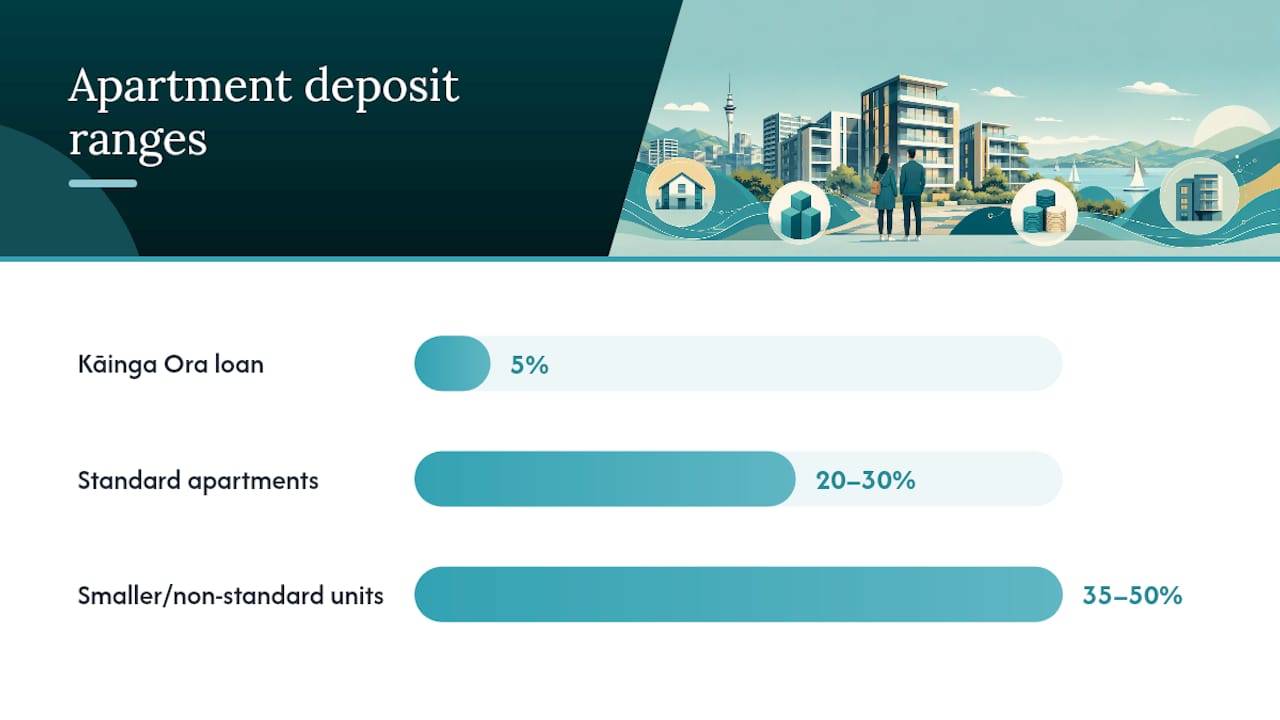
- Standard apartments (unit title, 40–50sqm or more of internal floor area, residential use, sound body corporate) typically require a 20–30% deposit and are treated similarly to houses by most lenders.
- Smaller or non-standard units — studios under 40sqm, leasehold titles, serviced apartments, or buildings with deferred maintenance — commonly require a 35–50% deposit, and some lenders will decline them outright.
- The Reserve Bank’s LVR speed limits cap high-LVR owner-occupier lending at 25% of a bank’s new lending above 80% LVR, and investor high-LVR lending at 10% above 70% LVR — these are bank-level constraints, not borrower entitlements.
- The Kāinga Ora First Home Loan can allow eligible first-home buyers to purchase with as little as a 5% deposit, and Kāinga Ora loans are exempt from RBNZ LVR restrictions.
- KiwiSaver first-home withdrawals can contribute to your deposit, subject to IRD eligibility rules.
Pro Tip: Before you make an offer on any apartment, ask the selling agent for the Pre-Contract Disclosure Statement (PCDS) and request the last three years of body corporate minutes. Check the lender’s minimum internal floor area requirement before you fall in love with a unit that won’t qualify.
Key takeaways
Apartment lending in New Zealand is available for most buyers, but floor area, title type, and body corporate health determine whether your specific unit qualifies and at what deposit level.
| Point | Details |
|---|---|
| Floor area is the first filter | Most major banks require 40–50sqm of internal floor area; units below this threshold face higher deposits or declines. |
| Deposit bands vary by apartment type | Standard apartments typically need 20–30% deposit; smaller or non-standard units commonly require 35–50%. |
| RBNZ LVR limits and Kāinga Ora | RBNZ caps owner-occupier high-LVR lending at 25% of new loans above 80% LVR. Kāinga Ora First Home Loans are exempt and allow a 5% deposit for eligible buyers. |
| Body corporate levies reduce borrowing capacity | Lenders deduct annual levies from assessed income — a $6,500 annual levy can reduce borrowing capacity by tens of thousands of dollars. |
| Mortgagemanagers | Mortgagemanagers pre-checks lender appetite for specific apartments and sources Kāinga Ora, KiwiSaver, and specialist non-bank options before you commit. |
Table of Contents
- How apartment lending in NZ actually works: what lenders assess
- Deposits, LVRs and government help for apartment buyers
- Which apartments lenders call ‘standard’ versus ‘non-standard’
- How to prepare a strong apartment loan application
- When a mortgage broker makes the real difference for apartment buyers
- Sources
How apartment lending in NZ actually works: what lenders assess
Lenders assess apartments more tightly than houses because they’re perceived as weaker security. A house on freehold land holds its value across a wide range of market conditions; an apartment in a large building shares risk with every other owner in that complex, and its resaleability depends on factors entirely outside your control.
The practical checks a lender runs on an apartment application go well beyond income and credit score. Understanding how lenders assess risk for apartments specifically can save you from a late-stage surprise.
Title type is the first filter. Unit title is the standard and most lender-friendly structure. Leasehold titles — where you own the building but not the land — introduce ground rent, lease renewal risk, and a finite term that shrinks the property’s value as the lease runs down. Company-share arrangements, where you own shares in a company rather than a registered title, are treated as non-standard by most major banks.
Internal floor area is the second major filter. Most major banks apply a minimum, commonly in the 40–50sqm range, measured as internal floor area only — balconies, car parks, and storage don’t count. Banks may also apply their own measurement standard, which can differ from the vendor’s floor plan. A unit that looks like 48sqm on the marketing brochure might come in at 43sqm under the lender’s definition.
Building condition and weathertightness matter enormously, particularly for buildings constructed between the mid-1980s and mid-2000s. Leaky-building risk is a live concern for many Auckland apartment complexes, and lenders know it. A building with an outstanding weathertightness claim or significant deferred maintenance will often trigger a decline regardless of the individual unit’s condition.
Body corporate financial health is assessed through the PCDS, the long-term maintenance plan, and recent minutes. Lenders look for large special levies (one-off charges to fund repairs), outstanding body corporate debt, and any signs that the building’s maintenance fund is undercapitalised.
Body corporate levies are treated as an ongoing financial commitment, not a discretionary expense. Lenders deduct the annual levy from your assessed income before calculating how much you can borrow — a $6,500 annual levy can reduce your borrowing capacity by the equivalent of tens of thousands of dollars. A unit that looks affordable at its asking price can become genuinely unaffordable once the levy impact is factored in. See how levies affect your numbers with a worked calculator example.
Building insurance is another checkpoint. Lenders require the building to be insured, and body corporate insurance must be current and adequate. Some older or complex buildings face insurance challenges that can stall or block lending.
Major banks are most likely to apply strict minimum floor-area rules and to decline non-standard titles outright. Specialist non-bank lenders may consider smaller units or unusual titles, but expect higher interest rates and lower LVRs in return. A pre-approval for a house does not guarantee the same lender will fund an apartment — banks run a separate property assessment once you identify a specific unit.
Pro Tip: Always confirm lender appetite for the specific apartment before going unconditional. An approval in principle based on your income and deposit tells you nothing about whether the lender will accept the property itself.
Deposits, LVRs and government help for apartment buyers
The deposit you’ll need for an apartment in New Zealand depends on three overlapping factors: the RBNZ’s LVR speed limits, the lender’s internal credit policy for that apartment type, and whether you qualify for government assistance.
How RBNZ LVR rules affect apartment lending
The Reserve Bank’s LVR restrictions set limits on how much high-LVR lending banks can do across their whole book. These are speed limits for banks, not guarantees for borrowers. A bank that has already used up its high-LVR quota for the month may decline a perfectly creditworthy application simply because of portfolio constraints.
For apartments specifically, many lenders apply their own internal LVR limits that are stricter than the RBNZ floor. Understanding LVR and how it interacts with apartment policy is one of the most practical things you can do before you start searching.
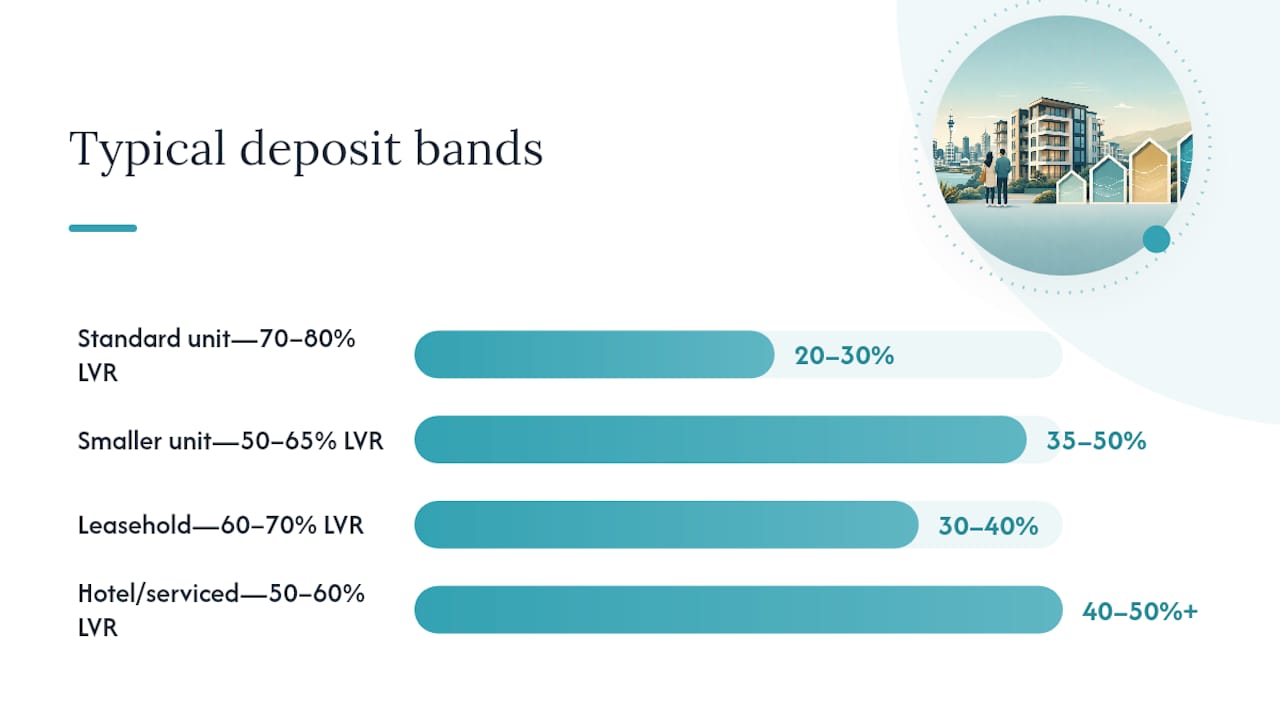
Typical deposit bands for NZ apartments
| Apartment category | Typical deposit required | Typical max LVR | Common exemptions |
|---|---|---|---|
| Standard unit title, 40sqm+ internal, sound body corporate | 20–30% | 70–80% | Kāinga Ora First Home Loan (5% deposit); new builds may be exempt from LVR limits |
| Smaller unit (under 40sqm) or non-standard title | 35–50% | 50–65% | Specialist non-bank lenders may accept lower LVR at higher rates |
| Leasehold with long remaining term | 30–40% | 60–70% | Case by case; depends on lease term and ground rent |
| Serviced/hotel-style or company-share | 40–50%+ | 50–60% | Very limited lender appetite; non-bank only in many cases |
Ranges are indicative and reflect typical lender practice. Always confirm current policy with your lender or adviser.
Kāinga Ora First Home Loan
The Kāinga Ora First Home Loan is one of the most useful tools available to first-home buyers purchasing an apartment. Critically, Kāinga Ora loans are exempt from RBNZ LVR speed limits, so the bank’s high-LVR quota doesn’t affect your application. Income and house-price caps apply, and the apartment must meet the lender’s property criteria, so it’s not a universal solution for every unit. The government’s first-home buyer guidance sets out eligibility in full, including the Kāinga Whenua Loan and other pathways.
KiwiSaver first-home withdrawals
If you’ve been contributing to KiwiSaver for at least three years, you may be able to withdraw most of your balance to put toward a first-home deposit. The mechanics and eligibility conditions are set out in IRD’s KiwiSaver guidance — check with your scheme provider for the specific process, as some cases require Kāinga Ora confirmation before the withdrawal is released. For a deeper look at first-home buyer schemes and how to stack these options, the Mortgagemanagers guide covers the eligibility steps in detail.
Which apartments lenders call ‘standard’ versus ‘non-standard’
Lenders group apartments into standard and non-standard categories, and this grouping drives almost every LVR and deposit decision. Knowing which side of the line your target apartment sits on before you make an offer can save weeks of wasted effort.
Standard apartments: what lenders want to see
A standard apartment typically has all of the following:
- Unit title (freehold or cross-lease unit title, not leasehold or company-share)
- Internal floor area of 40–50sqm or more (measured to the lender’s definition, excluding balconies and car parks)
- Residential use only (no commercial management agreement, no short-term rental restrictions that affect resaleability)
- Sound body corporate with adequate maintenance reserves, no large outstanding special levies, and current building insurance
- No significant deferred maintenance or weathertightness claims
Standard apartments are generally treated similarly to houses by major banks. Deposit requirements for standard apartments align closely with what you’d expect for a comparable house purchase.
Non-standard apartments: the types that trigger stricter rules
Non-standard apartments come in several forms, each with its own lender response:
- Leasehold with a short remaining term — ground rent adds to ongoing costs and the finite lease term erodes the property’s value over time. Lenders typically require larger deposits and may decline if the remaining term is under 50–60 years.
- Serviced or hotel-style apartments — units within a hotel complex or managed serviced-apartment building are treated as commercial or semi-commercial security. Most major banks will not lend on these at all; specialist non-bank lenders may, at significantly higher rates and lower LVRs.
- Company-share arrangements — owning shares in a company rather than a registered title is a non-standard structure that most banks decline. The legal complexity and limited resale market make these very difficult to finance.
- Dual-key units or studios without a separate bedroom — some lenders treat these as non-residential or as having limited resaleability, triggering lower LVR limits or outright declines.
- Buildings with significant deferred maintenance or special levies — even a perfectly standard unit title in a well-sized apartment can be declined if the building itself has a large outstanding special levy, a pending weathertightness claim, or a long-term maintenance plan that shows major underfunding.
Questions to ask before you make an offer
When you’re assessing a specific apartment, ask the vendor or agent for:
- The PCDS (Pre-Contract Disclosure Statement) — this is a legal requirement for body corporate properties and discloses levies, insurance, and known issues
- The last three years of body corporate minutes — look for mentions of special levies, maintenance disputes, or insurance difficulties
- The long-term maintenance plan — check whether the maintenance fund is adequately capitalised
- The lease term and ground rent schedule (if leasehold)
- The lender’s floor-area definition and whether the unit meets it
How to prepare a strong apartment loan application
Start by confirming the lender will accept the apartment itself — minimum floor area and title type — before you make an offer. This single step prevents the most common and most painful outcome in apartment lending: going unconditional on a purchase only to find the bank won’t fund it.
Step-by-step preparation checklist
- Confirm lendability first. Contact your lender or a mortgage adviser with the apartment’s address, floor area, title type, and body corporate details. Get written confirmation that the property meets the lender’s criteria before you proceed.
- Collect your income and identity documents. Payslips (last three months), bank statements (last three months), tax returns if self-employed, and two forms of photo ID.
- Obtain the body corporate documents. Request the PCDS, the last three years of minutes, the long-term maintenance plan, and the current insurance certificate from the vendor.
- Confirm special levies and unit entitlement. Check whether any special levies have been raised or are anticipated, and confirm the unit’s levy contribution relative to the building total.
- Check the lease term if leasehold. Get the full lease document and confirm the remaining term, ground rent, and renewal conditions.
- Prepare your deposit evidence. Bank statements showing savings history, KiwiSaver balance statements, and any gift letters if part of the deposit is gifted.
- Confirm Kāinga Ora and KiwiSaver eligibility. If you’re a first-home buyer, check your eligibility for the First Home Loan and KiwiSaver withdrawal before you finalise your deposit structure.
Costs to allow for
Beyond the deposit itself, apartment purchases carry costs that house buyers sometimes underestimate:
- Legal fees — allow $1,500–$2,500 for a standard apartment purchase; more if the title is complex
- Valuation — lenders typically require an independent registered valuation for apartments; budget $800–$1,200
- Lender fees — application or establishment fees vary by lender and product
- Body corporate levies — your first year’s levies will be due at or shortly after settlement
- Special levies — if a special levy has been raised but not yet paid, this may be your liability post-settlement; confirm with your solicitor
- Building remediation — if the building has known weathertightness issues, factor in potential remediation costs
A worked example from MoneyBalance’s apartment lending calculator shows how a lower LVR on a smaller apartment can require tens of thousands of dollars more deposit than a house at the same price — the combination of a higher deposit percentage and ongoing levies makes the true cost of entry higher than the purchase price alone suggests.
Timeline and where hold-ups occur
A typical apartment purchase from conditional approval to settlement takes four to six weeks, but hold-ups are common. Valuations on apartments in complex buildings can take longer than for houses, particularly if the valuer needs body corporate documents. Body corporate issues discovered in the minutes — a pending special levy, an insurance dispute, or a weathertightness claim — can stall the process while your solicitor seeks clarification. Vendor remedial works, if required as a condition of sale, add further time.
Red flags that commonly cause declines:
- Lease terms under 50 years remaining
- Large or recently raised special levies (particularly for weathertightness remediation)
- Pending or unresolved leaky-building claims
- Commercial management agreements that restrict the owner’s ability to sell or occupy freely
- Body corporate insurance that has lapsed or been declined by insurers
When a mortgage broker makes the real difference for apartment buyers
Use a broker when an apartment has any non-standard feature, when your deposit is tight, or when you need to compare policies across multiple lenders quickly. Apartment lending policy varies significantly from one lender to the next, and it changes without public announcement — a bank that declined a 42sqm unit last year may have quietly revised its minimum, or vice versa.
Mortgage Managers works as your personal shopper across the lending market. Before you make an offer, a Mortgagemanagers adviser can pre-check lender floor-area thresholds and current lending appetite for the specific building, identify whether a specialist non-bank lender is needed (and which ones are actively lending on that property type), guide you through the Kāinga Ora First Home Loan application and KiwiSaver withdrawal process, and review the PCDS and body corporate minutes for red flags before you’re committed.
The value of a broker is sharpest when the apartment sits in a grey zone — 42sqm, a leasehold with 65 years remaining, or a building that had a weathertightness issue resolved five years ago. These are exactly the cases where one lender declines and another approves, and where knowing which lender to approach first saves weeks of time and avoids unnecessary credit enquiries on your file.
What to bring to your first meeting with a Mortgagemanagers adviser:
- The PCDS and three years of body corporate minutes (if you have them)
- The apartment’s floor plan with internal floor area clearly marked
- Proof of deposit (savings statements, KiwiSaver balance)
- Your last three months of payslips and bank statements
- Any pre-approval or correspondence from a lender you’ve already approached
Pro Tip: Bring the PCDS and body corporate minutes to your first broker meeting even if you haven’t made an offer yet. A good adviser can give you a rapid read on lendability in that first conversation, which tells you whether to proceed or walk away before you spend money on a valuation.
E-E-A-T signals for this guide: Stuart is a mortgage adviser at Mortgagemanagers, based in Hobsonville, Auckland, and advising clients across New Zealand. Mortgagemanagers is a locally owned and operated financial services business specialising in mortgage advice for first-home buyers, investors, and borrowers with non-standard lending needs.
What apartment buyers most often don’t see coming
My single best tip for anyone buying an apartment in New Zealand is this: find out the annual body corporate levy before you calculate your borrowing capacity, not after.
The levy surprise catches more buyers than any other single issue. You’ve done your sums, you know what you can borrow, and then you discover the apartment carries a $9,000 annual levy. That levy gets deducted from your assessed income before the bank calculates your maximum loan. The borrowing capacity you thought you had shrinks, sometimes by enough to make the purchase unworkable at the price you were planning to pay.
The floor-area fail is the second most common late-stage shock. A buyer goes unconditional, the bank orders a valuation, and the valuer measures the internal floor area at 38sqm — below the lender’s 40sqm minimum. The loan is declined. The buyer loses their deposit and legal fees.
Both of these outcomes are entirely preventable. Request the PCDS before you make an offer. Call a broker before you go unconditional. These two steps cost you nothing and can save you everything.
Mortgagemanagers can check your apartment’s lendability before you commit
Apartment lending in New Zealand is genuinely possible for most buyers — but the gap between “possible” and “approved” often comes down to one or two property-specific details that a lender will only flag after you’ve already committed. That’s the gap Mortgagemanagers closes for you.

Mortgagemanagers will check lender appetite for your specific apartment, identify whether a Kāinga Ora First Home Loan or KiwiSaver pathway applies to your situation, and source specialist non-bank options if the major banks won’t lend on the property. You get a clear picture of what’s possible before you sign anything.
Before your first conversation with a Mortgagemanagers adviser, pull together the PCDS, three years of body corporate minutes, your proof of deposit, KiwiSaver statements, and your ID. The more you bring, the faster the adviser can give you a real answer.
Low-deposit apartment lending options are available for buyers who qualify — and the best way to find out if you do is to talk to an Auckland mortgage broker who knows the current lender landscape.
Sources
These are the official pages and practical tools referenced throughout this guide. Each one is worth bookmarking if you’re actively researching apartment lending in New Zealand.
- Loan-to-value ratio restrictions – Reserve Bank of New Zealand – Te Pūtea Matua
- First Home Loan :: Kāinga Ora – Homes and Communities
- Financial help for first-home buyers (New Zealand Government)
- Apartment Mortgage NZ — LVR Rules, Minimum Size and Lender Appetite | MoneyBalance
- Apartment Lending Calculator NZ | Floor Area, Deposit and Levy Cost
- KiwiSaver – IRD
This article provides general information about apartment lending in New Zealand and is not a substitute for personalised financial advice. Lending criteria, LVR limits, and government programme eligibility change regularly — confirm current rules with your lender, a registered financial adviser, or the relevant government agency before making any financial decision.