
Securing your first home in Auckland can feel out of reach when saving for a large deposit and managing credit scores stand in your way. For many young professionals, high property prices and strict lending rules make home ownership seem impossible. Government-backed first home buyer schemes offer real solutions by combining deposit help, low-deposit loans, and flexible options tailored for Auckland buyers. Discover how these affordable pathways to ownership can work together to get you on the property ladder sooner.
Table of Contents
- What Are First Home Buyer Schemes?
- Major Types of Schemes in New Zealand
- Eligibility, Deposit Rules, and Key Requirements
- Navigating the Application Process in Auckland
- Risks, Costs and Common Mistakes to Avoid
- Support, Alternatives and Navigating Next Steps
Key Takeaways
| Point | Details |
|---|---|
| Understanding First Home Buyer Schemes | These government-backed schemes are designed to assist first-time buyers by reducing deposit barriers and providing access to lower deposit loans. |
| Utilising Multiple Schemes | Buyers should consider combining different schemes strategically to enhance their borrowing power and improve their chances of ownership. |
| Eligibility Requirements | Each scheme has specific eligibility criteria; understanding these early can help avoid wasted efforts and streamline the application process. |
| Importance of Professional Guidance | Engaging a mortgage adviser and building a support team can simplify the complex home buying process and ensure you navigate it effectively. |
What Are First Home Buyer Schemes?
First home buyer schemes are government-backed financial support programmes designed to make home ownership achievable for people who would otherwise struggle to break into the property market. In Auckland and across New Zealand, these schemes recognise a fundamental barrier that prevents many young professionals from buying: the deposit. Whether you’re earning a solid income or have managed to save some funds, getting together a 20% deposit on an Auckland property often feels impossible. These schemes exist specifically to bridge that gap, and they’re more sophisticated than simply handing out cash. Instead, they combine deposit assistance, loan products with lower requirements, and strategic access to retirement savings—all working together to create a pathway to ownership that actually suits your situation.
The core idea behind these programmes is straightforward: help first-time buyers access home ownership without the crushing burden of massive upfront cash requirements. Instead of needing to save a 20% deposit, KiwiSaver first-home withdrawals allow you to access most of your retirement savings after just three years of contributions, dramatically accelerating your buying timeline. The First Home Loan goes even further by enabling you to purchase with as little as a 5% deposit, removing the conventional deposit barrier entirely. For Māori buyers specifically, the Kāinga Whenua Loan supports purchasing or building on Māori land with tailored terms. These aren’t one-size-fits-all solutions either—they’re designed to work for different buyer circumstances, whether you’re a couple pooling resources, a solo buyer with limited savings, or someone with cultural connections to Māori land ownership.
What makes these schemes particularly valuable for Auckland buyers is the recognition that the capital city presents unique affordability challenges. Your income might be competitive, but Auckland property prices outpace most of New Zealand’s regions significantly. A scheme like the First Home Loan programme removes the deposit obstacle without forcing you into decades of struggling—you can actually purchase a property today rather than waiting another five to ten years to save a traditional deposit. The Progressive Home Ownership Scheme works differently still, allowing you to own a percentage of the property initially and increase your stake over time, which suits buyers who want to build equity progressively rather than commit to full ownership immediately. These varieties matter because they acknowledge that Auckland’s first-home buyers aren’t all the same, and rigid solutions don’t work for diverse circumstances.
The practical reality is that most buyers benefit from stacking these schemes strategically. You might withdraw KiwiSaver funds to boost your deposit, then use a First Home Loan for the remaining amount, potentially with support from family or other sources. Understanding how KiwiSaver withdrawals and HomeStart Grants work together with loan products is crucial because the combination often determines whether ownership is truly achievable or remains out of reach. These schemes exist in a specific legislative framework, and they have eligibility criteria you need to meet, but they’re genuinely designed to help people like you—not wealthy investors or second-home buyers, but people working toward their first property.
Pro tip: Contact a mortgage adviser early to map which schemes you actually qualify for and how combining them creates your strongest buying position. Eligibility calculations can be complex, and one scheme might dramatically change your borrowing capacity when layered with others.
Major Types of Schemes in New Zealand
New Zealand’s first home buyer support system isn’t a single programme. Instead, it’s a toolkit of distinct schemes, each designed to solve different problems first-time buyers face. Understanding which schemes exist and how they work separately is the first step toward figuring out which combination might work for your situation in Auckland. The major schemes fall into three broad categories: deposit-reduction products, loan products with relaxed requirements, and culturally-tailored options for Māori buyers. Knowing the difference between these categories helps you see why one scheme alone might not be enough, and why combining multiple schemes often creates the strongest buying position.

The First Home Loan is arguably the most recognisable scheme for Auckland buyers. This is Kāinga Ora’s flagship first-home product, which allows you to purchase a property with just a 5% deposit instead of the traditional 15% to 20%. This single change transforms your buying power dramatically. Instead of needing to save $100,000 to $150,000 on a $500,000 property, you need only $25,000. The catch is that you’ll pay mortgage insurance on the loan, and you need to meet specific eligibility criteria including income limits and property price caps (currently $625,000 in Auckland for new builds, lower for existing properties). The KiwiSaver First-Home Withdrawal operates entirely differently. Rather than offering a special loan product, it simply allows you to access the savings you’ve already accumulated in KiwiSaver after three years of contributing. You can withdraw both your own contributions and the employer contributions (though not the government contributions in most cases), and use those funds toward your purchase. This scheme works brilliantly if you’ve been disciplined about KiwiSaver contributions, but it offers nothing if you’ve only recently started saving or contributed minimal amounts.
For Māori buyers, the Kāinga Whenua Loan addresses specific barriers in Māori land ownership. This scheme supports purchasing or building on multiply-owned Māori land, which is notoriously difficult to finance through conventional channels due to complex ownership structures and title issues. The loan operates with similar low-deposit principles to the First Home Loan, but it’s specifically engineered for Māori land transactions. There’s also the Tenant Home Ownership Grant for people currently renting through Kāinga Ora, which provides financial assistance to help those tenants purchase their current home or another property. Beyond these flagship products, the Progressive Home Ownership Scheme allows you to own a percentage of the property initially, with the ability to increase your ownership stake over time. This scheme suits buyers who want to enter the market sooner but aren’t ready to commit to full ownership immediately, or who want to build equity progressively rather than all at once. Each scheme operates under different eligibility rules, asset limits, and income thresholds, which is why comparing schemes and understanding how they layer together matters so much.
The crucial thing to recognise is that these schemes often work together rather than as standalone solutions. You might combine a KiwiSaver withdrawal with a First Home Loan, or use the Progressive Home Ownership Scheme as a stepping stone toward full ownership later. Auckland’s competitive property market means that using multiple schemes strategically often determines whether you can actually purchase or remain locked out. The schemes also have specific geographic and property-type restrictions. Some apply only to new builds in certain areas, others work anywhere in Auckland, and some have maximum property prices that exclude expensive suburbs. Understanding these specifics requires detailed analysis of your personal situation, which is exactly why working with a mortgage adviser early in your planning matters so much. They can map your eligibility across all available schemes and show you precisely which combination creates your strongest position.
Here’s a quick reference Comparing Key First Home Buyer Schemes in New Zealand:
| Scheme Name | Minimum Deposit Required | Unique Feature | Who Benefits Most |
|---|---|---|---|
| First Home Loan | 5% | Low deposit, mortgage insurance applies | Buyers with limited savings |
| KiwiSaver First-Home Withdrawal | Based on savings | Access KiwiSaver after 3 years | Regular contributors to KiwiSaver |
| Progressive Home Ownership | No standard deposit | Gradually increase ownership share | Buyers preferring staged entry |
| Kāinga Whenua Loan | 5% | For Māori land purchases and builds | Māori applicants only |
| Tenant Home Ownership Grant | Varies | Helps Kāinga Ora tenants buy their home | Eligible tenants |
| Shared Equity Scheme | Varies | Joint ownership with non-family entity | Buyers needing smaller mortgages |
This table highlights the key differences and target users for each scheme.
Pro tip: Don’t assume you qualify for only one scheme. Most first-time buyers are eligible for multiple products simultaneously, and combining them often increases your borrowing capacity by $50,000 to $150,000 or more.
Eligibility, Deposit Rules, and Key Requirements
Every first home buyer scheme in New Zealand has eligibility rules, and these rules exist for a reason. They’re not there to make things harder. Instead, they ensure that government support reaches people genuinely buying their first home and genuinely committed to living in it, not investors looking for a loophole. Understanding these rules early means you won’t waste time chasing a scheme you don’t qualify for, and you’ll know exactly what you need to fix if you fall slightly short. The requirements vary between schemes, but certain core principles run through all of them. You need to be a New Zealand citizen or permanent resident, at least 18 years old, and genuinely purchasing your first home. Most schemes also require that you plan to live in the property for a minimum of three years, which rules out quick flips or investment plays. Income limits exist on most schemes too, which might sound restrictive but actually reflects the reality that government support targets people who truly need it rather than high-income earners who can access conventional financing.
The deposit rules are where first home buyer schemes truly differentiate themselves from conventional mortgages. With standard bank lending, you’d typically need 15% to 20% down, sometimes higher depending on your credit history and the lender’s appetite. The First Home Loan slashes this to just 5%, which transforms your buying power overnight. On a $600,000 Auckland property, you’d need $30,000 instead of $90,000 to $120,000. That’s the difference between scraping together a deposit in five years versus purchasing today. However, this lower deposit requirement comes with mortgage insurance, which protects the lender if you default. You’ll pay for this insurance as part of your loan, typically adding between 1% and 3% to your total borrowing cost. The KiwiSaver First-Home Withdrawal doesn’t reduce your deposit requirement directly. Instead, it provides the funds to meet whatever deposit requirement your lender sets. If you’ve accumulated $80,000 in KiwiSaver over five years and you’re buying a $500,000 property, you could use that $80,000 as your deposit without needing to save additional funds. The Progressive Home Ownership Scheme works entirely differently again. Rather than requiring a traditional deposit, you own a percentage of the property initially, gradually buying out the government or provider’s share over time. This means you could own 25% of a $600,000 property with just $150,000, which is much more achievable than saving a conventional deposit.
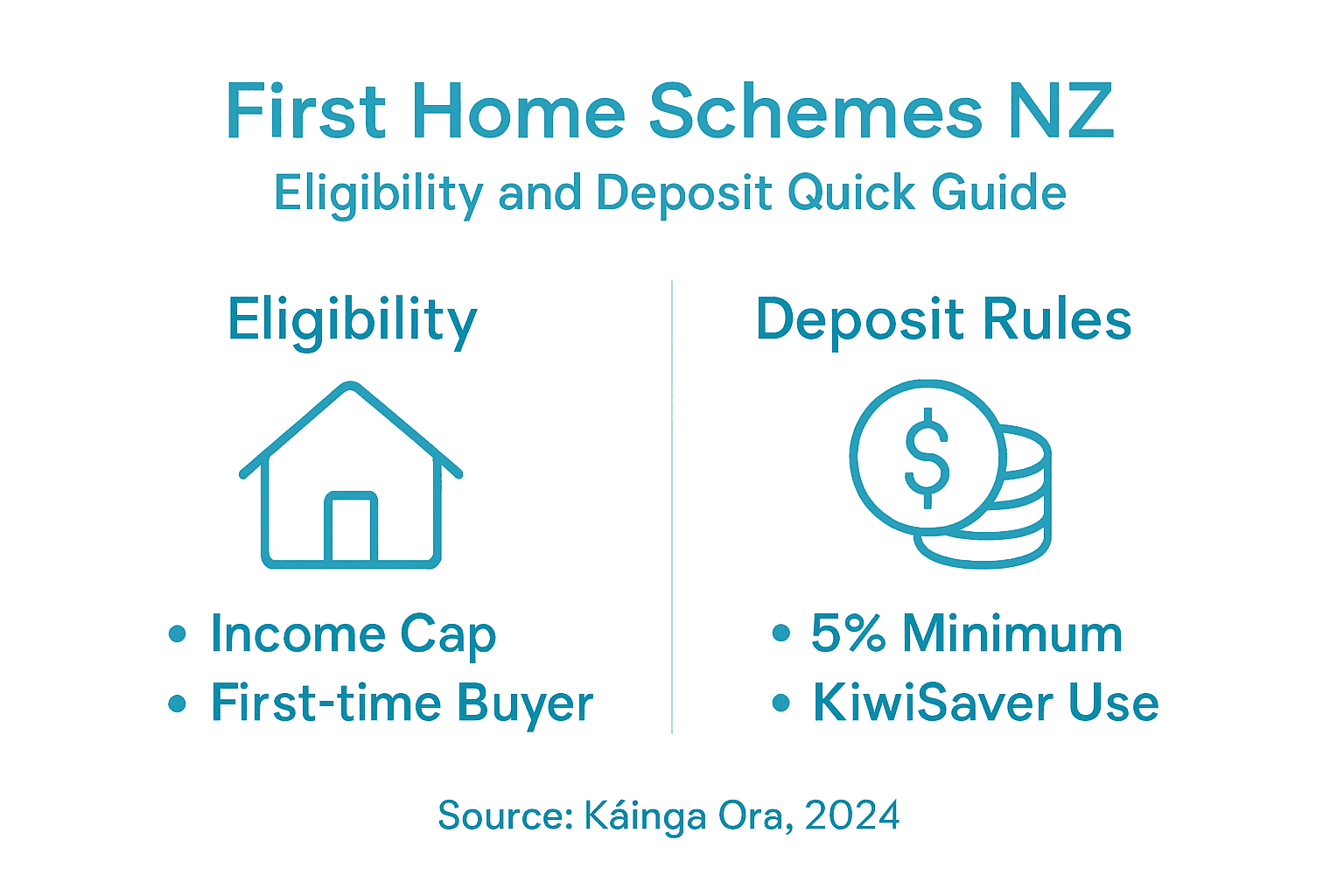
Looking at specific eligibility thresholds, income limits set boundaries that vary by scheme and family size. For instance, single applicants face different income caps than couples or families. You’ll also need pre-approved finance from a certified lender before you can access most schemes, which means the lender has already assessed your creditworthiness and approved you for a certain amount. This is actually beneficial because it proves to sellers that you’re a serious buyer with financing already sorted. Property price caps apply too, which means some schemes won’t work if you’re looking at properties above certain thresholds. In Auckland, these caps can be restrictive in expensive suburbs but workable in more affordable areas. Asset limits also apply on some schemes, which means if you own significant assets (investment properties, shares worth over a certain amount, or cash reserves beyond a threshold), you might not qualify. The logic here is that the schemes target people genuinely struggling with affordability, not people sitting on significant assets. Having a poor credit history won’t automatically disqualify you from most schemes, but it will make lending more difficult. Some lenders are stricter than others about credit scores, which is another reason working with a mortgage adviser who knows which lenders are most flexible becomes valuable.
One critical rule across almost all schemes is the “first home buyer” definition. You must never have owned residential property in New Zealand before, with limited exceptions for specific circumstances. Divorce situations sometimes allow exceptions, and some schemes have provisions for people who owned property decades ago. However, if you own investment property or you’ve previously owned a residential home anywhere in New Zealand, you’ll likely be excluded from most first home schemes. This rule can feel frustrating if you’ve made poor property decisions in the past, but it reflects the schemes’ purpose. They’re designed to help people entering the market for the first time, not people returning after owning property previously. Understanding exactly where you stand on these requirements means having an honest conversation with a mortgage adviser who can assess your situation against each scheme’s specific criteria.
Pro tip: Request a pre-approval letter early from multiple lenders even before you start house hunting, because pre-approval status significantly strengthens your offer with sellers and is a requirement for most first home buyer schemes anyway.
Navigating the Application Process in Auckland
The application process for first home buyer schemes in Auckland feels daunting until you break it into manageable steps. Most people get overwhelmed imagining the entire journey at once, but the reality is that each stage builds logically on the previous one. You start by understanding your financial position, move through pre-approval, then find a property, and finally settle. What makes Auckland different from other regions is the competitive market speed. Properties move quickly, sometimes receiving multiple offers within days of listing. This means you need to be prepared and pre-approved before you even start seriously house hunting. Waiting until you’ve found the perfect property to apply for pre-approval puts you at a significant disadvantage because sellers know you’re not ready to move quickly. The application process isn’t complicated, but timing matters enormously, and having your documentation organised from the start saves weeks of back and forth with lenders.
Your first real step is assessing your financial situation honestly. Gather your most recent payslips, tax returns, bank statements covering the last three months, and any documentation about existing debts or liabilities. Calculate what deposit you can realistically accumulate, then explore which schemes you might qualify for. This is where a First Home Decision Tool becomes invaluable. It walks you through eligibility questions for different schemes and shows you exactly what you qualify for before you commit to anything. Once you understand your eligibility, approach a mortgage adviser or certified lender for pre-approval. Pre-approval is the critical gateway because it confirms your borrowing capacity and proves to sellers you’re serious. During pre-approval, the lender reviews your income, employment history, credit history, and existing commitments. They’ll ask about the deposit you’re putting down and confirm whether you’re using KiwiSaver withdrawals, First Home Loans, or other schemes. This is also where having organised documentation like payslips and tax returns matters. Missing documents delay pre-approval unnecessarily. The pre-approval letter itself doesn’t commit you to anything. It simply confirms that the lender will lend you a certain amount, subject to property valuation and final approval.
Once pre-approved, you can start house hunting in Auckland with confidence. When you find a property you want to make an offer on, include your pre-approval letter with the offer. This demonstrates you’re not a casual browser but someone ready to purchase. If your offer is accepted, the real application process begins. You’ll submit a full mortgage application with all supporting documents. The lender orders a valuation to ensure the property is worth what you’re paying. They’ll conduct a final credit check and employment verification. Throughout this period, lenders are also verifying that you meet all the specific requirements of any government schemes you’re using. If you’re using a First Home Loan, Kāinga Ora will verify your eligibility. If you’re using KiwiSaver withdrawals, KiwiSaver administrators need to process that withdrawal separately. These processes run in parallel but on different timelines, which is why understanding the full mortgage approval timeline helps manage expectations. From full application to final approval typically takes two to four weeks in Auckland, though it can stretch longer if documents are missing or if title issues need investigation. During this period, you’ll also need to engage a lawyer to review the sale and purchase agreement, conduct property due diligence, and prepare for settlement.
Building a support team transforms the process from stressful to manageable. You need a mortgage adviser who understands Auckland’s market and first home buyer schemes intimately. They guide you through pre-approval and application, flag potential issues early, and liaise with lenders on your behalf. A lawyer handles the legal side, protecting your interests in the sale and purchase agreement and managing settlement. A real estate agent (if you’re buying through an agent) handles property search and negotiation. Kāinga Ora’s resources and advisers are available throughout, especially if you’re using their loan products. Don’t hesitate to use these support systems. They exist precisely because the first home buying process is complex, and trying to navigate it entirely alone wastes time and increases the risk of costly mistakes. Auckland’s competitive market means speed matters, which means having experienced professionals coordinating the process gives you a genuine edge. When you’re comparing offers on the same property, the buyer with pre-approval already sorted and a mortgage adviser handling logistics moves faster and looks more credible to sellers.
Pro tip: Start building your support team (mortgage adviser, lawyer, real estate agent) before you start searching for properties, not after you’ve found one and are in a rush.
Risks, Costs and Common Mistakes to Avoid
First home buyer schemes exist to help you, but they’re not magic. They reduce barriers, but they don’t eliminate the financial reality that purchasing a property involves significant money and serious commitment. Many first-time buyers get so focused on accessing the schemes that they overlook the genuine costs and risks involved. The most dangerous mistake isn’t misunderstanding the schemes themselves—it’s underestimating what home ownership actually costs. You see the mortgage payment and think that’s the whole picture. It isn’t. Between legal fees, building inspections, LIM reports, council searches, moving expenses, and immediate repairs or maintenance, the hidden costs can easily reach $15,000 to $30,000 on top of your deposit and deposit bonds. Factor in lender mortgage insurance if you’re using a low-deposit First Home Loan, which typically adds 1 to 3 percent to your total loan amount. This cost gets capitalised into your mortgage, meaning you’re paying interest on the insurance itself over 25 or 30 years. First-time buyers often focus entirely on getting pre-approval and finding a property, then get shocked when they discover the full picture of what they’re actually paying.
Another critical mistake is stretching your budget too thin. The pre-approval amount your lender gives you isn’t a recommendation—it’s a ceiling. Just because you’re approved to borrow $480,000 doesn’t mean you should spend all of it. If you’re already maximising your borrowing, you have zero buffer for life events like job loss, serious illness, or emergency home repairs. In Auckland’s competitive market, there’s enormous pressure to offer at the top of your budget just to be competitive. Resist this pressure. Your genuine financial safety depends on maintaining a cushion. Consider that your mortgage isn’t your only housing cost either. You’ll pay rates, council fees, building insurance, contents insurance, maintenance and repairs, and potentially body corporate fees if you’re in a unit. All of these are ongoing costs that need to fit comfortably within your budget. Rushing through property inspections and due diligence is another costly mistake. You find a property you love, you’re excited, and you want to move fast. Suddenly you skip the full inspection or don’t dig into the LIM report properly. Then six months later you discover the property has a leaky building issue, foundation problems, or structural concerns. These issues can cost tens of thousands of dollars to fix and can be catastrophic financially. The inspection fee seems small—it’s not. It’s one of your best insurance policies against making a $500,000 mistake.
Misunderstanding scheme eligibility rules creates another class of problems. You might incorrectly assume you qualify for a particular scheme, structure your finances around it, then discover during application that you don’t meet the criteria. Or you qualify for a scheme but don’t understand its specific terms, like the First Home Loan’s requirement to live in the property for three years, or the KiwiSaver withdrawal’s limitations around government contributions. Not getting pre-approved before you start house hunting is deceptively risky. You fall in love with a property, make an offer, your offer is accepted, then you apply for pre-approval and discover you don’t actually qualify or you’re approved for less than you offered. Now you’re trying to renegotiate or withdraw from a binding agreement. Property due diligence mistakes are expensive too. Different property types—freehold, leasehold, unit titles—have vastly different implications for ownership, maintenance responsibility, and resale value. Some buyers purchase thinking they understand the tenure structure, only to discover later that body corporate levies are astronomical or that leasehold agreements restrict their ability to make changes. Building a weak support team or going it entirely alone compounds all these risks. Your lawyer should review the sale and purchase agreement thoroughly. Your mortgage adviser should explain every cost and scheme term. Your building inspector should conduct a genuine inspection, not a cursory walkthrough.
Financial overcommitment is perhaps the most insidious risk because it develops gradually. You’re approved for a mortgage, you find a property, you make an offer, everything progresses smoothly. Then suddenly you’re locked into a 25-year commitment that consumes far more of your income than you anticipated. If your financial situation changes—redundancy, reduced hours, unexpected illness—you’re trapped with obligations you can’t meet. This risk is especially acute in Auckland’s expensive market, where first-time buyers are often stretching hard just to get into the market. The schemes help, but they don’t change the fundamental economic reality that Auckland property is expensive. Be honest about what you can genuinely afford, not just what lenders will approve. Don’t assume property will automatically appreciate enough to bail you out of a stretched budget. Some buyers also make the mistake of not understanding the implications of using KiwiSaver withdrawals. Yes, you access your savings, but you’re reducing your retirement nest egg. If you withdraw $80,000 at age 30 to buy your first home, that $80,000 doesn’t have 35 years to compound and grow for retirement. This trade-off might be the right decision for you, but make it consciously, not by accident.
Below is a summary of Common Risks and Costs First-Time Buyers Should Consider:
| Category | Example Cost/Challenge | Impact on Buyer |
|---|---|---|
| Upfront Fees | Legal, inspection, valuation: $15k+ | Immediate cash needed |
| Ongoing Expenses | Rates, insurance, body corp fees | Affects monthly budget |
| Mortgage Insurance | Adds 1–3% to loan amount | Raises total repayment cost |
| Maintenance & Repairs | Unexpected home repairs | Can cause financial strain |
| KiwiSaver Withdrawal | Reduces retirement savings | Less funds at retirement |
| Overcommitting | Borrowing maximum allowed | Little or no safety buffer |
Consider these factors to make informed decisions and avoid common pitfalls.
Pro tip: Before you start house hunting, create a realistic budget that includes every cost—mortgage, rates, insurance, maintenance, body corporate if applicable—and ensure it doesn’t exceed 30 percent of your gross household income, leaving yourself genuine financial safety margin.
Support, Alternatives and Navigating Next Steps
You don’t have to figure out first home buyer schemes alone. The Auckland property market is complex, government support programmes have specific rules, and the financial commitment is enormous. This is precisely why support systems exist, and why using them is genuinely smart rather than unnecessary. Your mortgage adviser becomes your financial GPS through the entire process. They understand which schemes you qualify for, how combining them optimises your borrowing capacity, and which lenders are most flexible with your specific situation. They know Auckland’s market intimately, understand local pricing patterns, and can flag opportunities or risks that first-time buyers miss. Beyond that, they handle communication between you and lenders, manage documentation, explain costs in language that makes sense, and advocate for your interests when things get complicated. Yes, you could navigate this alone. But a good mortgage adviser saves you time, money, and stress. Your lawyer protects you legally. They review the sale and purchase agreement, identify potential issues, conduct due diligence on your behalf, and manage settlement. Don’t skip this step. Property law has enormous complexities, and a $500 legal consultation that identifies a problem is worth infinitely more than discovering issues later. Community support services, financial advisers, and home ownership education initiatives exist throughout Auckland. Kāinga Ora provides resources specifically designed for first-time buyers. Citizens Advice Bureau offers free financial guidance. Some community organisations provide workshops on budgeting, saving, and home ownership responsibilities. These resources aren’t luxuries. They’re tools that increase your chances of making informed decisions and achieving sustainable home ownership.
If the standard schemes don’t quite work for your situation, alternatives might. The Kāinga Whenua Loan specifically supports Māori buyers purchasing or building on Māori land. If this applies to you, it opens pathways that conventional lending often struggles with because Māori land has unique title structures and ownership complexity. The Progressive Home Ownership Scheme allows you to own a percentage of the property initially, then gradually increase your ownership stake over time. This pathway works beautifully if you want to enter the market sooner but aren’t ready to commit to full ownership immediately, or if your income is growing and you expect to afford higher payments in future years. The Tenant Home Ownership Grant targets Kāinga Ora tenants who want to purchase their current home or another property. If you’re currently renting through Kāinga Ora, this scheme might be your most accessible pathway. Shared equity schemes allow you to own a portion of the property with a government or community organisation holding the remaining share. This reduces your deposit requirement and your mortgage amount simultaneously. Family lending is another alternative many Auckland buyers explore. Your parents, grandparents, or other family members might lend you funds for your deposit. This requires careful structuring to ensure it doesn’t complicate your mortgage application, but it’s a genuine option that works for many families. Whatever alternative pathway you’re considering, get professional advice before committing. What feels straightforward often has hidden implications.
Navigating next steps starts with honest self-assessment. You’ve learned about schemes, understood costs and risks, and ideally you’ve already started conversations with a mortgage adviser. Now comes preparation. Build your financial checklist systematically. Gather documentation meticulously. Organise your finances so your application is clean and straightforward. Clean up your credit history if needed. Pay down high-interest debt if possible. Increase your deposit if you can. Every step you take before formally applying strengthens your position. Start saving aggressively if you haven’t already. Even small contributions to a deposit accelerate your timeline. Consider using KiwiSaver strategically for the deposit, but understand the retirement implications. Think about your medium-term future. Where do you want to be in five years, ten years? Is Auckland where you want to stay? What type of property actually suits your life, not just what you can technically afford? Property is a massive commitment. It’s worth thinking through carefully rather than chasing the first opportunity that presents itself.
Building relationships with professionals before you need them urgently transforms your ability to move quickly when you find the right property. Contact mortgage advisers, have consultations, build rapport. Get pre-approval sorted. Identify lawyers you trust. Know how real estate agents operate in your area. When an opportunity appears, you’ll be ready to move decisively while others are still figuring out where to start. Educate yourself continuously. Read about property, finance, the Auckland market, ownership responsibilities. Attend first-home buyer workshops if available. Join online communities where first-time buyers share experiences and advice. Knowledge compounds. Each piece of information you gather reduces uncertainty and improves decision-making quality. Remember that purchasing your first home is a beginning, not an ending. You’ll still have responsibilities after settlement. Maintenance, rates, insurance, building issues—these continue long after you’ve bought the property. Choose something sustainable for your life and budget, not something that stretches you to breaking point. Ownership is rewarding, but only if it’s actually sustainable. The schemes exist to help you access the market, but they don’t change the fact that home ownership is a serious financial commitment. Approach it thoughtfully.
Pro tip: Contact at least three mortgage advisers and get their perspective on your situation independently before deciding who to work with, because adviser quality varies significantly and you want someone who genuinely understands your circumstances.
Take Control of Your First Home Journey in Auckland Today
Navigating the complex first home buyer schemes and understanding how to combine options like the First Home Loan and KiwiSaver withdrawals can be overwhelming. The real challenge lies in turning eligibility into action while managing affordability and competing in Auckland’s fast-moving market. If you are looking to unlock ownership without exhausting your savings or missing critical opportunities, expert guidance tailored to your situation is essential.

At Mortgage Managers, we specialise in helping Auckland buyers confidently access schemes designed to reduce deposits and increase borrowing capacity. Our local mortgage advisers based in Hobsonville understand the unique hurdles first home buyers face here. From pre-approval and scheme eligibility assessments to strategic layering of loan products to maximise your purchasing power, we partner with you every step of the way. Do not wait while others secure the homes you seek. Visit Mortgage Managers now and start your personalised journey toward owning your first home in Auckland. Learn more about how we can support your success with first home buyer schemes and expert mortgage advice at Mortgage Managers.
Frequently Asked Questions
What are first home buyer schemes?
First home buyer schemes are government-backed financial support programmes aimed at assisting individuals who are striving to purchase their first home. These schemes provide strategies such as deposit assistance, lower loan requirements, and access to retirement savings to help facilitate home ownership.
How much deposit do I need for a First Home Loan?
With the First Home Loan, you can purchase a property with just a 5% deposit. This significantly reduces the amount you need to save compared to traditional loans, which often require deposits of 15% to 20%.
Can I use my KiwiSaver funds for a home purchase?
Yes, you can access your KiwiSaver funds for a home purchase if you have been contributing for at least three years. You can withdraw both your own contributions and the employer contributions, significantly boosting your deposit for the home.
Are there specific eligibility requirements for first home buyer schemes?
Yes, eligibility requirements vary for each scheme but generally require you to be a New Zealand citizen or permanent resident, at least 18 years old, and genuinely purchasing your first home. Some schemes also have income limits and property price caps that you must meet.