
TL;DR:
- Understanding loan structures helps Kiwi buyers choose options suited to their financial goals.
- Eligibility rules like LVR and DTI limit the borrowing options available to borrowers.
- Comparing flexibility, interest costs, and life plans is essential for selecting the optimal mortgage.
Choosing a home loan in New Zealand can feel like standing at a crossroads with no signpost. You’ve found a property you love, but suddenly you’re faced with terms like revolving credit, table loans, and debt-to-income ratios, and it’s hard to know where to start. Getting this decision wrong can cost you tens of thousands of dollars over the life of your loan. Getting it right, however, can give you genuine financial freedom. This guide walks you through the main loan structures available to Kiwi buyers, the eligibility rules that shape your options, and a practical framework for making a confident, well-informed choice.
Table of Contents
- Understand the main home loan structures in New Zealand
- Check your eligibility: The rules that affect your loan options
- Compare loan structures: How features affect your cost and flexibility
- Choose and review: Steps to pick the best loan structure for you
- Our take: Why most buyers focus too much on rates, not structure
- Get expert help with your loan structure decision
- Frequently asked questions
Key Takeaways
| Point | Details |
|---|---|
| Know your options | Familiarise yourself with the main NZ loan structures and how they differ in repayment, flexibility, and cost. |
| Check eligibility rules | Understand LVR, DTI, and deposit requirements as they determine what home loan structures you can access. |
| Compare real costs | Look beyond rates—compare true cost, repayment flexibility, and your ability to make extra payments. |
| Review regularly | Revisit your loan structure whenever your circumstances or market rates change so it stays optimal. |
| Get expert support | Qualified advisers help you avoid mistakes and match your home loan structure to your goals. |
Understand the main home loan structures in New Zealand
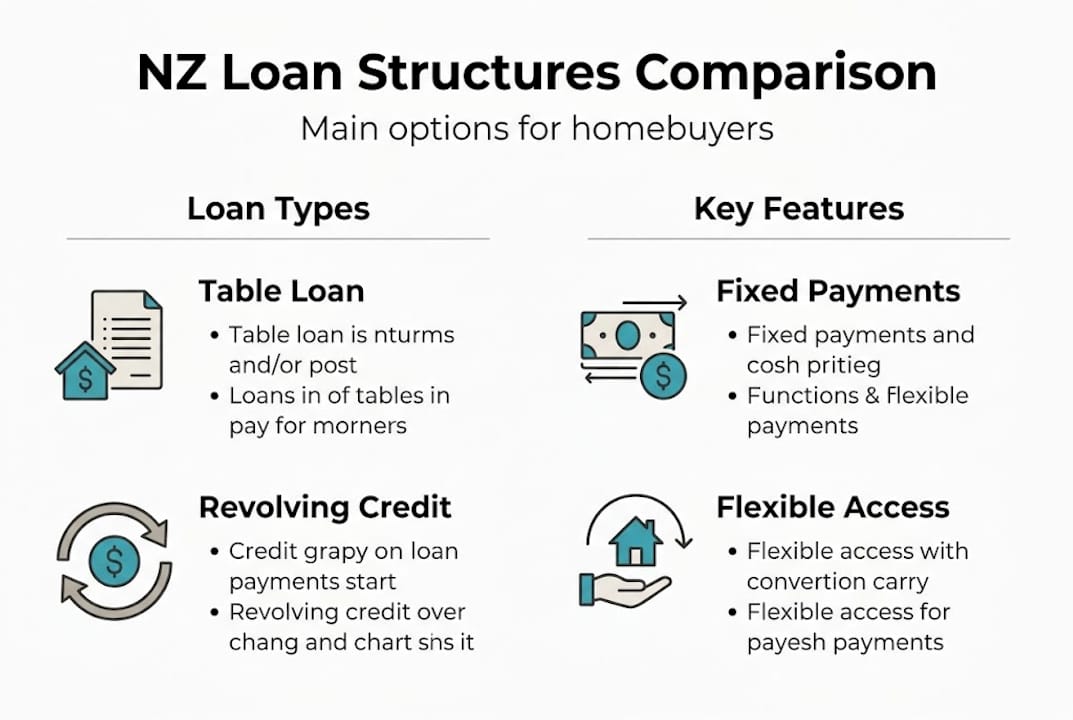
Before you speak to a lender, it pays to understand what’s actually on the menu. NZ mortgage types include table loans, revolving credit, offset loans, reducing loans, and interest-only arrangements, each with its own rhythm of repayment and level of flexibility.
Here’s a quick comparison to orient you:
| Loan structure | How it works | Best suited to | Flexibility |
|---|---|---|---|
| Table loan | Fixed regular payments; interest-heavy early on | Most owner-occupiers | Moderate |
| Reducing loan | Decreasing payments as principal falls | Those wanting faster equity | Low |
| Revolving credit | Linked to a transactional account; balance fluctuates | Disciplined savers | High |
| Offset loan | Savings offset the loan balance, reducing interest | Those with strong savings | High |
| Interest-only | Pay only interest for a set period | Investors, short-term buyers | Low to moderate |
The table loan is the most common structure in New Zealand. Your regular payment stays the same throughout the term, but in the early years, most of that payment goes toward interest rather than reducing your actual debt. It’s predictable and suits buyers who value consistency.

Revolving credit mortgages work more like a large overdraft. Your salary goes in, your bills go out, and the remaining balance reduces your interest daily. It rewards financial discipline and can save significant interest over time.
Interest-only loans are worth understanding even if they’re not for everyone. You pay only the interest charged each month, meaning your principal balance doesn’t reduce. This keeps repayments low in the short term but costs more over the full loan life.
Key pros and cons at a glance:
- Table loan: Predictable payments, easy to budget, but slow to build equity early on
- Revolving credit: Great interest savings if managed well, but risky without discipline
- Offset: Reduces interest without losing access to savings, but not all banks offer it
- Interest-only: Lower short-term payments, but no equity growth during the interest-only period
- Reducing loan: Builds equity faster, but higher initial payments can strain cash flow
Many buyers also use a split loan, dividing their mortgage across two or more structures. For example, you might fix part of your loan for rate certainty while keeping a portion floating for flexibility. The Kāinga Ora First Home Loan is one scheme that can work alongside these structures for eligible first-home buyers.
Check your eligibility: The rules that affect your loan options
Once you know the main structures, it’s vital to understand which options you can actually access based on your personal situation. The Reserve Bank of New Zealand sets rules that directly shape what lenders can offer you.
RBNZ LVR restrictions and DTI limits apply to different borrower types and loan structures. Here’s how the key rules break down in 2026:
| Rule | Owner-occupier | Investor | New build |
|---|---|---|---|
| LVR (min. deposit) | 20% | 35% | 10% (some schemes) |
| DTI limit | 6x income | 7x income | Varies |
| Interest-only access | Restricted | More accessible | Case by case |
LVR stands for loan-to-value ratio, which is simply the size of your loan compared to the value of the property. A higher LVR means a smaller deposit and more risk for the lender. High-LVR loans may incur a low equity margin (LEM), which is an additional interest charge that can add noticeably to your repayments.
DTI, or debt-to-income ratio, measures your total debt against your gross annual income. If your combined debts exceed the allowed multiple, lenders may decline your application or reduce what they’ll lend.
Common edge cases to be aware of:
- First-home buyers may access lower deposit thresholds through government-backed schemes
- New builds often attract more favourable LVR treatment from banks
- Interest-only loans for owner-occupiers are tightly restricted and usually time-limited
- Some lenders hold exemption capacity for high-LVR lending, but spots fill quickly
Understanding how LVR and DTI work before you apply can save you from a disappointing surprise at the bank.
Pro Tip: If your deposit is under 20%, check whether you qualify for the Kāinga Ora First Home Loan or a new build exemption. These low deposit options can open doors that standard lending rules would otherwise close.
Compare loan structures: How features affect your cost and flexibility
Eligibility checked, now it’s time to look at what each option means for your wallet and your plans. The numbers tell a compelling story.
Here’s a stepwise approach to comparing your options:
- Calculate your baseline repayment using the standard table loan as your reference point
- Compare the interest cost over the first five years versus the full loan term
- Assess flexibility by asking whether the structure allows extra repayments without penalty
- Model a rate change scenario to see how your repayments shift if rates rise or fall
- Factor in your life plans including possible income changes, family growth, or property upgrades
To make this real, consider a $500,000 loan over 30 years at 6.5% interest. Your monthly table loan repayment would sit around $3,160. In the first year alone, roughly $32,000 of your total repayments goes to interest, with only about $6,000 actually reducing your principal. That’s a striking ratio, and it’s worth sitting with.
Stat callout: On a standard table loan, most early payments go toward interest rather than reducing your principal balance, meaning equity builds slowly in the first several years.
Fixed loans lock in your rate for a set term, typically one to five years. Floating loans move with the market. A split loan gives you both, and split loan strategies are increasingly popular because they balance certainty with room to move.
When calculating repayments, always model what happens if you make even modest extra payments. Paying an additional $100 per fortnight on a $500,000 loan can cut years off your term and save well over $30,000 in interest. Exploring loan repayment strategies early gives you a genuine edge.
Pro Tip: Flexibility often matters more than the lowest advertised rate. A loan that allows extra repayments and lump sum payments without break fees can save you far more than a marginally cheaper fixed rate that locks you in rigidly.
Also consider expert mortgage tips when weighing up your choices, as the right structure depends heavily on your personal cash flow, not just the interest rate headline.
Choose and review: Steps to pick the best loan structure for you
Having compared what’s possible, the final step is picking your structure and preparing to revisit it over time. This is where a clear framework becomes your best ally.
Five steps to choosing your loan structure:
- Map your financial situation including income stability, savings, and existing debts
- Define your priorities by deciding whether certainty, flexibility, or speed of repayment matters most
- Model at least two structures side by side using realistic numbers and your actual loan amount
- Consider a split approach to capture the benefits of both fixed certainty and floating flexibility, as split loan advice consistently shows this suits many Kiwi buyers
- Get qualified advice from a licensed mortgage adviser who knows the current lender landscape
Splitting your loan and prioritising flexibility is usually wise because the optimal structure often blends certainty with room for extra payments. Life rarely stays the same for 30 years.
Review your structure regularly. Set a reminder to reassess:
- After one to two years, especially when a fixed term expires
- Following any major life change such as a new job, growing family, or income shift
- When interest rates move significantly in either direction
Common mistakes to avoid:
- Chasing the lowest rate without checking break fee conditions
- Choosing interest-only to ease cash flow without a clear exit plan
- Ignoring the value of extra repayment flexibility over the long term
- Failing to review your structure as your circumstances evolve
- Not seeking independent advice before committing to a structure
The right structure today may not be the right one in three years. Building in a review habit protects you and keeps your mortgage working for you, not the other way around.
Our take: Why most buyers focus too much on rates, not structure
After years of helping Kiwi buyers navigate the mortgage market, we’ve noticed a consistent pattern. Most people walk in asking, “What’s your best rate?” Very few ask, “Which structure suits my life?”
Rates matter, of course. But the structure of your loan determines how much real flexibility you have, how quickly you build equity, and whether you can adapt when life throws a curveball. We’ve seen buyers locked into fixed-only loans who couldn’t make a lump sum payment after an inheritance, losing thousands in potential savings. We’ve also seen disciplined buyers use revolving credit to shave years off their mortgage, simply because the structure matched their habits.
The uncomfortable truth is that no online calculator can replicate a conversation that accounts for your actual income pattern, your family plans, and your risk comfort. Exploring clever repayment strategies with an adviser who genuinely knows your situation is worth far more than finding the lowest rate on a comparison website. Structure first, rate second. That’s the mindset shift that makes the real difference.
Get expert help with your loan structure decision
If this guide has helped you see the landscape more clearly, the next step is getting advice that’s tailored specifically to you.

At Mortgage Managers, we act as your personal shoppers for a home loan, comparing structures and lenders on your behalf so you don’t have to navigate it alone. Based in Hobsonville and servicing buyers across Auckland and throughout New Zealand, our team understands the local market and the nuances that make each buyer’s situation unique. Whether you’re buying your first home or refinancing an existing loan, our mortgage adviser team is ready to help you make a confident decision. Apply for your mortgage today and let’s find the structure that works for your life.
Frequently asked questions
What is the difference between fixed and floating loans in New Zealand?
Fixed loans offer certainty with a locked rate for a set term, while floating loans move with market rates and allow flexible extra repayments without break fees. Your choice depends on whether budget predictability or repayment freedom matters more to you.
Who can qualify for an interest-only home loan in NZ in 2026?
Interest-only loans are mainly accessible to property investors with strong equity, while owner-occupiers face strict approval criteria and are generally limited to short, time-bound periods.
How much deposit do I need for a home loan in New Zealand?
Most owner-occupiers need a 20% deposit under RBNZ LVR rules, but first-home schemes can allow eligible buyers to enter with as little as 5 to 10%.
Can I mix loan structures for my NZ mortgage?
Yes, splitting your loan across fixed and floating portions is a popular strategy that balances rate certainty with the flexibility to make extra repayments.
What happens if my LVR is above 80%?
High-LVR loans typically attract a low equity margin charge, increasing your interest rate, and banks have limited capacity to approve them, making approval less certain.